
 100% FREE ACCESS
11th Standard CBSE Syllabus & Materials
11th Standard CBSE
CBSE 11th Economics PART-A - Presentation of Data - New Sample Question Papers Study Material - QB365 Set A
NEW11th Standard CBSE
CBSE 11th Economics PART-A - Organisation of Data - New Sample Question Papers Study Material - QB365 Set A
NEW11th Standard CBSE
CBSE 11th Economics PART-A - Collection of Data - New Sample Question Papers Study Material - QB365 Set A
NEW11th Standard CBSE
CBSE 11th Economics PART-A - Introduction to Economics and Statistics - New Sample Question Papers Study Material - QB365 Set A
NEW11th Standard CBSE
CBSE 11th Business Studies International Trade Sample Question Papers Study Material - QB365 Set A
NEW11th Standard CBSE
CBSE 11th Business Studies Evolution and Fundamentals of Business Sample Question Papers Study Material - QB365 Set A

Published on: 14/09/2019
Chemical Bonding and Molecular Structure
Download CBSE Class 11th Standard CBSE Chemistry question papers, sample papers, important questions, and previous year solved papers in PDF format. Get free study materials, NCERT solutions, and exam preparation resources for Class 11th Standard CBSE Chemistry
Questions + Answers key
Take MCQ Chemistry Test
1.
Explain the diamagnetic behaviour of F2 molecule on the basis of molecular orbital theory
2.
Define bond order. How is it related to the stability of a molecule
3.
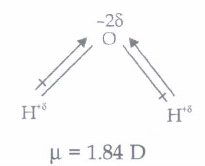
What do you mean by Dipole moment? Draw the dipole diagram of H2O.
4.
Why B2 is paramagnetic in nature while C2 is not?
5.
Write the type of hybridization involved in CH4 C2H4 and C2H2.
6.
How is bond order related to the stability of a molecule?
7.
Considering x-axis as the internuclear axis which out of the following will not form a sigma bond and why?
(a) 1s and 1s
(b) 1s and 2px ;
(c) 2py and 2py
(d) 1s and 2s.
8.
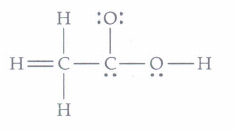
The skeletal structure of CH3COOH as shown below is correct, but some of the bonds are shown incorrectly. Write the correct Lewis structure for acetic acid
9.
Explain the formation of a chemical bond.
10.
Why does formic acid exist as dimer? What is its one consequence?
11.
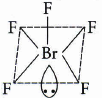
Explain the shape of BrF5
12.
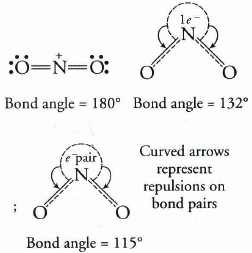
Arrange the following in order of decreasing bond angle, giving reason NO2, \(NO_{ 2 }^{ + }\) and \(NO_{ 2 }^{ - }\)
13.
Arrange the following bonds in order of increasing ionic character giving reason. N-H, F-H, C-H and O-H
14.
Arrange the bonds in order of increasing ionic character in the molecules: LiF, K2O , N2, SO2 and ClF3 .
1.
The orbital electronic configuration of fluorine (Z = 9)
\(={ 1s }^{ 2 }{ 2s }^{ 2 }{ 2p }_{ x }^{ 2 }{ 2p }_{ y }^{ 2 }{ 2p }_{ z }^{ 1 }\)
M.O.E.C. of fluorine =[σ2s]2 [σ*2s]2 [σ2pz]2 [\(\pi\)2px]2 [\(\pi\)2py]2 [\(\pi\)*2px]2 [\(\pi\)*2py]2
Due to presence of all filled orbitals, F2 is diamagnetic
2.
Bond order is defined as half of the difference between the number of.electrons present in bonding and antibonding molecular orbitals.
Bond order (B.O.)\(\frac { 1 }{ 2 } \)[Nb - Na]
If the bond order is positive (Nb > Na), the molecule or ion will be stable. If it is negative (Nb < Na) the molecule or ion will be unstable.
3.
The product of magnitude of charges (+ve, or -ve) and distance between them is called dipole moment. It is usually denoted by \(\mu \) .
\(\mu =Q\times d\)
Its 51 unit is Debye.
4.
The molecular orbital electronic configuration of both B2 and C2 are
B2: [σ1s]2 [σ*1s]2 [σ2s]2 [σ*2s]2 [\(\pi\)2px]1[\(\pi\)*2py]1
C2: [σ1s]2 [σ*1s]2 [σ2s]2 [σ*2s]2 [\(\pi\)2px]2[\(\pi\)*2py]2
Since B2 has two unpaired electrons, B2 is paramagnetic. C2 has no unpaired electron. Thus, C2 is diamagnetic.
5.
CH4 = sp3
CH = sp2
C2H2 = sp
6.
Higher the bond order, greater is the stability.
7.
2py and 2py orbitals will not a form a sigma bond. Taking x-axis as the internuclear axis, 2py and 2py orbitals will undergo lateral overlapping, thereby forming a pi (π) bond.
8.
A Lewis Structure is a very simplified representation of the valence shell electrons in a molecule. It is used to show how the electrons are arranged around individual atoms in a molecule.
Electrons are shown as "dots" or for bonding electrons as a line between the two atoms. The goal is to obtain the "best" electron configuration, i.e., the octet rule and formal charges need to be satisfied.
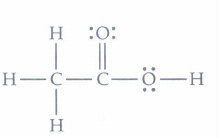
Hence, given Lewis structure is not the correct
9.
According to Kossel and Lewis, atoms combine together in order to complete their respective octets so as to acquire the stable inert gas configuration. This can occur in two ways; by transfer of one or more electrons from one atom to other or by sharing of electrons between two or more atoms.
10.
Formic acid exists as dimer because of hydrogen bonding
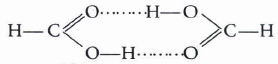
Because of hydrogen bonding, it pretends larger size as well as molecular mass.
11.
The central atom Br has seven electrons in the valence shell. Five of these will form bonds with five fluorine atoms and the remaining two electrons are present as one lone pair. Hence, total pairs of electrons are six (5 bond pairs and 1 lone pair).
To minimize repulsion between lone pairs and bond pairs, the shape becomes square pyramidal.
12.
\(NO_{ 2 }^{ + }\)>NO2 >\(NO_{ 2 }^{ - }\) This is because \(NO_{ 2 }^{ + }\) has no lone pair of electrons (i.e. has only bond pairs on two sides) and hence it is linear.
NO2 has one unshared electron while \(NO_{ 2 }^{ - }\) has one unshared electron pair.
There are greater repulsion on N-O bonds in case of \(NO_{ 2 }^{ - }\) than in case of NO2
13.
Greater is the electronegativity difference between the two bonded atoms, greater is the ionic character.
| N-H | F-H | C-H and | O-H | |
| Electronegativity difference |
(3.0-2.1) =0.9 |
(4.0-2.1) = 1.9 |
(2.5-2.1) = 0.4 |
(3.5-2.1) = 1.4 |
Therefore, increasing order of ionic character of the given bonds is as follows.
C-H.
14.
Ionic character \(\propto \) lattice energy
\(\propto \frac { 1 }{ size \ of \ ion } \propto charge \ on \ ion,\)
A non-polar molecule like N2 has almost negligible ionic character.
\(\therefore \)The order of ionic character is
\( ({ N }_{ 2 }<{ SO }_{ 2 }<{ CIF }_{ 3 }<{ K }_{ 2 }O\)

11th Standard CBSE Syllabus & Materials
11th Standard CBSE
CBSE 11th Business Studies Forms of Business Organisation Sample Question Papers Study Material - QB365 Set A
NEW11th Standard CBSE
CBSE 11th Business Studies Business, Trade and Commerce Sample Question Papers Study Material - QB365 Set A
NEW11th Standard CBSE
CBSE 11th Physics Waves Sample Question Papers Study Material - QB365 Set A
NEW11th Standard CBSE
CBSE 11th Physics Kinetic Theory Sample Question Papers Study Material - QB365 Set A



CBSE 11th Standard CBSE Subjects
CBSE Standards









