
 100% FREE ACCESS
11th Standard CBSE Syllabus & Materials
11th Standard CBSE
CBSE 11th Economics PART-A - Presentation of Data - New Sample Question Papers Study Material - QB365 Set A
NEW11th Standard CBSE
CBSE 11th Economics PART-A - Organisation of Data - New Sample Question Papers Study Material - QB365 Set A
NEW11th Standard CBSE
CBSE 11th Economics PART-A - Collection of Data - New Sample Question Papers Study Material - QB365 Set A
NEW11th Standard CBSE
CBSE 11th Economics PART-A - Introduction to Economics and Statistics - New Sample Question Papers Study Material - QB365 Set A
NEW11th Standard CBSE
CBSE 11th Business Studies International Trade Sample Question Papers Study Material - QB365 Set A
NEW11th Standard CBSE
CBSE 11th Business Studies Evolution and Fundamentals of Business Sample Question Papers Study Material - QB365 Set A

Published on: 30/12/2018
+1 First Revision Test
Download CBSE Class 11th Standard CBSE Chemistry question papers, sample papers, important questions, and previous year solved papers in PDF format. Get free study materials, NCERT solutions, and exam preparation resources for Class 11th Standard CBSE Chemistry
Questions + Answers key
Take MCQ Chemistry Test
1.
Why is boron used in nuclear reactions?
2.
(i) What do you mean by diffusion?
(ii) Ammonia and hydrochloric acid gases are prepared at the two extreme corners in the laboratory. Which gas will reach first to a person in the centre of the laboratory?
(iii) Write down the value points
3.
What is the condition for spontaneity in terms of free energy change?
4.
Write van der Waals equation for n moles of a gas.
5.
Out of benzene, m–dinitrobenzene and toluene which will undergo nitration most easily and why?
6.
Why is nitric acid added to sodium extract before adding silver nitrate for testing halogens?
7.
Will CCI4 give white precipitate of AgCl on heating it with silver nitrate? Give reason for your answer.
8.
Explain the correct context in which the following terms are used hydron.
9.
When sulphur in the form of S8 is heated at 900 K, the initial pressure of 1 atm falls by 29% at equilibrium. This is because of conversion of S8 to S2. Calculate the equilibrium constant for the reaction.
10.
For the reaction \({ N }_{ 2 }(g)+3{ H }_{ 2 }(g)\rightleftharpoons 2NH_{ 3 }(g),\) the partial pressure of N2 and H2 are 0.80 and 0.40 atmosphere respectively at equilibrium. The total pressure of the system is 2.80 atmosphere. What is Kp for the above reaction?
11.
The compound YBa2Cu3O7, Which shows superconductivity, has copper in x oxidation state. Assume that the rare earth element yttrium is in its usual +3 oxidation state. Predict the value of x.
12.
Why does formic acid exist as dimer? What is its one consequence?
13.
What type of hybridisation is involved in SF6?
14.
Calculate the mass and charge of one mole of electrons.
15.
Explain why uncertainty principle is significant only for the motion of sub-atomic particle but is negligible for the macroscopic objects?
16.
A flask P contains 0.5 mole of oxygen gas. Another flask Q contains 0.4 mole of ozone gas. Which of the two flasks contain greater number of oxygen atoms?
17.
Dr.Sharma , cardiologist suggested his patienta to take more potassium ions for healthy heart. potassium ions are the most abundant cations within cell fluids, where they activate many enzymes, participate in the oxidation of glucose to pro duse ATP While sodiun ions are responsible for the transmission for nerve signals. It intake of potassium , harmful for our body?
18.
The variation of the vapour pressure of different liquids with temperature is shown in the figure below.
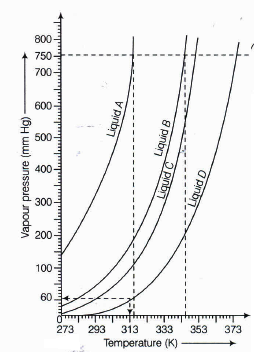
At high altitude, atmospheric pressure is low (say 60 mm Hg). At what temperature will liquid D boil?
19.
A solution contains 25% water, 25% ethanol, and 50% acetic acid by mass.Calculate the mole fraction of each component.
20.
Predict the products of electrolysis in each of the following
A dilute solution of H2SO4 with platinum electrodes
21.
(a) What do you understand by Homolytic fission?
(b) What are carbanions? Give an example.
22.
Which colour is imparted to flame by sodium ?
23.
The first ionisation constant on H2S is \(9.1\times { 10 }^{ -8 }\) .Calculate the concentration of HS- ion in its 0.1 M solution. How will this concentration be affected if the solution is 0.1 M in HCl also? If the second dissociation constant of H2S is \(1.2\times { 10 }^{ -13 }\), calculate the concentration of S2- under both conditions.
24.
For the reaction
2A(g)+B(g)→2D(g)Δ Uθ=−10.5 kJ and Δ Sθ=–44.1 JK−1.
Calculate Δ Gθ for the reaction, and predict whether the reaction may occur spontaneously.
25.
According to de-Broglie, matter should exhibit dual behaviour, that is both particle and wave like properties.However, a cricket ball of mass 100g does not move like a wave when it is thrown by a bowler at a speed of 100km/h.Calculate the wavelength of the ball and explain why it does not show wave nature?
26.
Lithium oxide is used to remove water from air according to the reaction \({ Li }_{ 2 }O(s)+{ H }_{ 2 }O(g)\longrightarrow 2LiOH(s)\). If 72 Kg of water is to be removed and 35 kg of Li2O is available, then (i) which reactant is limiting?
(b) how many kg of excess reactant is left?
27.
What is inert pair effect?
28.
Why does hard water not form lather with soap?
1.
Because Boron can absorb neutrons.
2.
(i) Intermixing of particles 9ases or liquids spontaneously is called diffusion. Liquids diffuse at a slower rate as compared to gases.
(ii) Ammonia gas will reach first to a person in the centre of the laboratory because it is lighter than hydrochloric acid.
(iii) The phenomenon of diffusion of gases is very useful in daily life. As a result of diffusion, the poisonous effect of the gases gets slowly diluted
3.
If △G is negative, process is spontaneous.
If △G is positive, the process is non-spontaneous.
If △G = 0, the process is in equilibrium.
4.
\(\left[ P+\frac { { an }^{ 2 } }{ { V }^{ 2 } } \right] \)(V - nb) = nRT
Where 'a' and 'b' are van der waals constants.
5.
Nitration of benzene is an electrophilic substitution reaction. Presence of electron releasing group such as - CH3 activates the benzene nucleus towards electrophilic substitution while presence of electron withdrawing group such as -NO2 deactivates the benzene nucleus towards electrophilic substitution.
Therefore, the ease of nitration decrease in the order
Toluene > benzene > m-dinitrobenzene
Thus, toluene will undergo nitration most easily.
6.
sodium extract is boiled with nitric acid to decompose NaCN and Na2S if present.
\(\mathrm{NaCN}+\mathrm{HNO}_{3} \longrightarrow \mathrm{NaNO}_{3}+\mathrm{HCN} \uparrow\)
\(\mathrm{Na}_{2} \mathrm{~S}+2 \mathrm{HNO}_{3} \longrightarrow 2 \mathrm{NaNO}_{3}+\mathrm{H}_{2} \mathrm{~S} \uparrow\)
If cyanide and sulphide are not removed, they will react with AgNO3 and hence, will interfere with the silver nitrate test for halogens
\(\mathrm{NaCN}+\mathrm{AgNO}_{3} \longrightarrow \underset{\text { White ppt }}{\mathrm{AgCN}}+\mathrm{NaNO}_{3}\)
\(\mathrm{Na}_{2} \mathrm{~S}+2 \mathrm{AgNO}_{3} \longrightarrow \underset{\text { Black } \mathrm{ppt}}{\mathrm{Ag}_{2} \mathrm{~S}}+2 \mathrm{NaNO}_{3}\)
7.
CCI4 will not give a white ppt of AgCI with AgNO3 solution because CCI4 is a covalent compound. It does not ionise to give CI- ions required for the formation of AgCI precipate.
8.
Hydron H+when used in relation to the isotopic mixture, is called hydron.
9.
According to the given Reaction,
S8 (g)⇌4S2 (g)
At start 1 0
At eqbm 1−0.29 4×0.29
=0.71 atm=1.16 atm
Kp\(=\frac{[pS_2]^4}{[pS_8]}\)
putting the values,
Kp\(=\frac{(1.16)^4}{(0.71)}\)=2.55
10.
\({ N }_{ 2 }(g)+3{ H }_{ 2 }(g)\rightleftharpoons 2NH_{ 3 }(g),\)
Given, at equilibrium, \({ P }N_{ 2 }=0.80\) atmosphere
\(P{ H }_{ 2 }=0.40\) atmosphere
\({ P }_{ { N }_{ 2 } }+{ P }_{ { H }_{ 2 } }+{ P }_{ { NH }_{ 3 } }=2.80\) atmosphere
\(\therefore { P }_{ { NH }_{ 3 } }=2.80-(0.80+0.40)=1.60\) atmosphere
From, Kp \(=\frac { { P }\overset { 2 }{ N{ H }_{ 3 } } }{ { P }_{ { N }_{ 2 } }\times P\overset { 3 }{ H_{ 2 } } } =\frac { (1.60)^{ 2 } }{ 0.80\times (0.40)^{ 3 } } =50.0\)
11.
1×(+3)+2×(+2)+3x+7×(−2)=0
or 3+4+3x−14=0
3x=7; x=7/3
12.
Formic acid exists as dimer because of hydrogen bonding
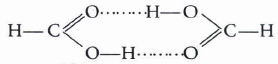
Because of hydrogen bonding, it pretends larger size as well as molecular mass.
13.
SF6 , S is the central atom with six valence electrons.
∴Number of hybrid orbitals=1/2[6+6−0+0]=6
Hence, the hybridisation involved in sp3d2.
14.
1 mole species = 6.022 x 10²³
Mass of 1 e- = 9.11 x 10⁻³¹kg
Charge on 1e- = 1.602 x 10.19C
\(\therefore \) Mass of 1 electron = 9.11 x 10⁻³¹kg
Mass of 1 mole of electrons
= 9.11 x 10-31 x 6.022 x 10-23
= 54.86 x 10-8 = 5.486 x 10⁻⁷ kg
Charge on 1 electron = 1.602 x 10⁻¹⁹
\(\therefore \) Charge on mole of electrons
= 1.602 x 10-19 x 6.022 x 1023 = 9.647 x 10⁴C
15.
The energy of photon is sufficient to disturb a sub-automic particle so that there is uncertainty in the measurement of position and momentum of the sub-atomic particle. However the energy is insufficient to disturb a macroscopic object.
16.
1 molecular of oxygen ( O2 ) = 2 atoms of oxygen
1 molecular of oxygen ( O3 ) = 3 atoms of oxygen
In flask P, 1 mole of oxygen gas = 6.022 \(\times\) 1023 molecules
\(\therefore\) 0.5 mole of oxygen gas = 6.022 \(\times\)1023\(\times\)0.5 molecules
= 6.022\(\times\)1023\(\times\)0.5\(\times\)2 atoms
= 6.022 \(\times\) 1023 atoms
In flask Q, 1 mole of ozone gas = 6.022\(\times\)1023 molecules
0.4 mole of ozone gas = 6.022\(\times\)1023\(\times\) 0.4 molecules
= 6.022 \(\times\)1023\(\times\)0.4\(\times\)3 atoms
= 7.23\(\times\)1023 atoms
\(\therefore\) Flask Q has greater number of oxygen atoms as compared to the flask P.
17.
No . it is useful our body
18.
Temperature corresponding to 60 mm \(\simeq \) 313 K.
19.
Let the total mass of solution = 100 g
Mass of water = 25g, Mass of ethanol = 25 g
Mass of acetic acid = 50 g
Moles of water 25/18 = 1388 \((\because \ molar \ mass \ of \ { H }_{ 2 }O=18)\)
Moles of ethanol = 25/46 = 0.543
\((\because \ molar \ mass \ of \ C_{ 2 }{ H }_{ 5 }OH=46)\)
Moles of acetic acid = 50/60 = 0.833
\((\because \ molar \ mass \ of \ CH_{ 3 }COOH=60)\)
Total number of moles = 1.388 + 0.543 + 0.833 = 2.764
Mole fraction of water = 1.388/2.764 = 0.196
Mole fraction of acetic acid = 0.833/2.764 = 0.302.
20.
In aqueous solution, H2SO4 ionises to give H+(aq) and \({ SO }_{ 4 }^{ 2- }\)t(aq) ions.
H2SO4(aq) \(\rightarrow\) 7 2H+(aq) + \({ SO }_{ 4 }^{ 2- }\)(aq)
Thus, when electricity is passed, H+ (aq) ions move towards cathode while \({ SO }_{ 4 }^{ 2- }\) (aq) ions move towards anode. In other words, at cathode either H+(aq) ions or H2O molecules are reduced. Their electrode potentials are:
2H+(aq) + 2e- \(\rightarrow\) H2(g); Eo = 0.0 V
HzO(aq) + 2e- \(\rightarrow\) H2(g) + 20H-(aq); EO = -0.83 V
Since the electron potential (i.e., reduction potential) of H+(aq) ions is higher than that of H2O, therefore, at the cathode, it is W(aq) ions (rather than H2O molecules) which are reduced to evolve H2 gas.
Similarly at the anode, either \({ SO }_{ 4 }^{ 2- }\) (aq) ions or H2O molecules are oxidised. Since the oxidation potential of \({ SO }_{ 4 }^{ 2- }\) is expected to be much lower (since it involved cleavage of many bonds as compared to those in H2O than that of H2O molecules, therefore, at the anode, it is H2O molecules (rather than sot ions) which are oxidised to evolve O2 gas. From the above discussion, it follows that during electrolysis of an aqueous solution of H2SO4 only the electrolysis of H2O occurs liberating H2 at the cathode and O2 at the anode.
21.
Homolytic fission is breaking of a bond in such a manner that each atom takes one electron each to form free radicals.
\(A-B\longrightarrow A.+B\)
(b) Organic ions which contain a negatively charged carbon atom are called carbanions. e.g., \(\overset { \ominus }{ { CH }_{ 3 } } \) is carbanion.
22.
Smaller the size, higher is the hydration enthalpy and size of alkali metal ions increases on moving down the group.
Sodium imparts a golden yellow colour to the flame.
23.
For second dissociation constant,
\({ HS }^{ - }+{ H }_{ 2 }O\rightleftharpoons { H }_{ 3 }{ O }^{ + }+{ S }^{ 2- } \ (in \ absence \ of \ HCl)\)
\( \left[ { HS }^{ - } \right] \left[ { H }_{ 3 }{ O }^{ + } \right] =9.54\times { 10 }^{ -5 }M\)
\( Now,\ { K }_{ { a }_{ 2 } }=\frac { \left[ { { H }_{ 3 }{ O }^{ + } } \right] \left[ { S }^{ 2- } \right] }{ \left[ { HS }^{ - } \right] } \)
\(\left[ { H }_{ 3 }{ O }^{ + } \right] =\left[ { S }^{ 2- } \right] =\sqrt { { K }_{ { a }_{ 2 } }.C }\)
\( =\sqrt { 1.2\times { 10 }^{ -13 }\times 9.54\times { 10 }^{ -5 } } \)
\( =3.38\times { 10 }^{ -9 }M\)
24.
For the given reaction,
2A(g)+B(g)→2D(g)
Δng=2−(3)=–1 mole
Substituting the value of ΔUθ the expression of Δ H:
Δ Hθ=Δ Uθ+ ΔngRT
=(−10.5kJ)+(−1)(8.314×10⁻³kJ K−1mol−1)(298 K)
=−10.5 kJ−2.48 kJ
ΔHθ=−12.98 kJ
Substituting the value of ΔHθ and ΔSθ in the expression of ΔGθ:
ΔGθ=ΔHθ=TΔSθ
=−12.98 kJ−(298K)(−44.1JK−1)
=−12.98 kJ+13.14 kJΔ Gθ= +0.16kJ
Since Δ Gθ for the reaction is positive, the reaction will not occur spontaneously.
25.
Given, m = 100g = 0.1kg
v = 100km/h = \(\frac { 100\times 1000 }{ 60\times 60 } =\frac { 1000 }{ 36 } { ms }^{ -1 }\)
From de-Broglie equation, wavelength,
\(\lambda =\frac { h }{ mv } =\frac { 6.626\times { 10 }^{ -34 }{ kgm }^{ 2 }{ s }^{ -1 } }{ 0.1kg\times \frac { 100 }{ 36 } { ms }^{ -1 } } =238.5\times { 10 }^{ -36 }m\)
As the wavelength is very small so wave nature cannot be detected.
26.
(i) Li2O
(ii) 43.36 Kg
27.
()
In the elements of 4th, 5th and 6th period of the p-block the electrons present in the intervening d and f-orbitals do not shield the s-electrons of the valence shell effectively. As a result, ns-2-electrons remain more tightly held by the nucles and hence, do not participate in bonding, this is called inert pair effect.
28.
()
Hard water contains salts of calcium and magnesium ions. Hard water does not give lather with soap and forms scum/precipitate with soap. Soap containing sodium stearate(C17 H35 COONA)reacts with hard water to precipitate out as Ca/Mg stearate.
2C17 H35 COONA(aq) + M2+ (aq) \(\rightarrow \)
(C17 H35Coo)2M\(\downarrow \) + 2Na+ (aq) (Where, M is Ca/Mg)
It is therfore, unsuitable for laundry.

11th Standard CBSE Syllabus & Materials
11th Standard CBSE
CBSE 11th Business Studies Forms of Business Organisation Sample Question Papers Study Material - QB365 Set A
NEW11th Standard CBSE
CBSE 11th Business Studies Business, Trade and Commerce Sample Question Papers Study Material - QB365 Set A
NEW11th Standard CBSE
CBSE 11th Physics Waves Sample Question Papers Study Material - QB365 Set A
NEW11th Standard CBSE
CBSE 11th Physics Kinetic Theory Sample Question Papers Study Material - QB365 Set A



CBSE 11th Standard CBSE Subjects
CBSE Standards









