
 100% FREE ACCESS
11th Standard CBSE Syllabus & Materials
11th Standard CBSE
CBSE 11th Economics PART-A - Presentation of Data - New Sample Question Papers Study Material - QB365 Set A
NEW11th Standard CBSE
CBSE 11th Economics PART-A - Organisation of Data - New Sample Question Papers Study Material - QB365 Set A
NEW11th Standard CBSE
CBSE 11th Economics PART-A - Collection of Data - New Sample Question Papers Study Material - QB365 Set A
NEW11th Standard CBSE
CBSE 11th Economics PART-A - Introduction to Economics and Statistics - New Sample Question Papers Study Material - QB365 Set A
NEW11th Standard CBSE
CBSE 11th Business Studies International Trade Sample Question Papers Study Material - QB365 Set A
NEW11th Standard CBSE
CBSE 11th Business Studies Evolution and Fundamentals of Business Sample Question Papers Study Material - QB365 Set A

Published on: 01/12/2018
Class 11 Chemistry Chapter 13 - Hydrocarbons solved by Expert Teachers as per NCERT (CBSE) Book guidelines. All Chapter 14 - Environmental Chemistry Exercise Questions with Solutions to help you to revise complete Syllabus and Score More marks.
Get 100 percent accurate NCERT Solutions for Class 11 Chemistry Chapter 13 - Hydrocarbons solved by expert Chemistry teachers. We provide solutions for questions given in Class 11 Chemistry text-book as per CBSE Board guidelines from the latest NCERT book for Class 11 Chemistry.
Unit 13, NCERT Grade 11 Chemistry, Chapter 13, Hydrocarbons holds a weightage of 18 marks in the final examination in combination with Unit 12 and Unit 14. In this chapter, students can well understand the importance of hydrocarbons in their daily life. In this unit, students will learn more about hydrocarbons.
Through in depth learning of NCERT Grade 11 Chemistry, Chapter 13, Hydrocarbons; students will master the concepts of Classification, Alkanes, Nomenclature and Isomerism, Preparation, Properties, Conformations, Alkenes, Structure of Double Bond, Nomenclature, Isomerism, Preparation, Properties, Alkynes, Nomenclature and Isomerism, Structure of Triple Bond, Preparation, Properties, Aromatic Hydrocarbon, Nomenclature and Isomerism, Structure of Benzene, Aromaticity, Preparation of Benzene, Properties, Directive influence of a functional group in monosubstituted benzene and Carcinogenicity and Toxicity.
Download CBSE Class 11th Standard CBSE Chemistry question papers, sample papers, important questions, and previous year solved papers in PDF format. Get free study materials, NCERT solutions, and exam preparation resources for Class 11th Standard CBSE Chemistry
Questions + Answers key
Take MCQ Chemistry Test
1.
Define resonance energy. What is resonance energy of benzene?
2.
Why is Wurtz reaction not preferred for preparation of alkanes containing odd number of carbon atoms? Illustrate your answer by taking one example.
3.
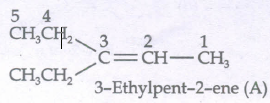
An alkene ‘A’ on ozonolysis gives a mixture of ethanal and pentan-3-one. Write structure and IUPAC name of ‘A’.
4.
In the presence of peroxide, addition of HBr to propene takes place according to anti-Markownikoff's rule but peroxide effect is not seen in the case of HCl and HI. Explain.
5.
Write the structure of the alkene which on reductive ozonolysis gives butanone and ethanol.
6.
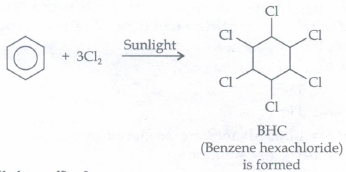
What happens when benzene is treated with excess of Cl2 in presence of sunlight? Give chemical reaction.
7.
What effect does branching of an alkane chain has on its boiling point?
8.
Draw the cis and trans structures of hex-2-ene. Which isomer will have higher b.p. and why?
9.
n-propylmagnesium bromide on hydrolysis gives propane. Is there any other Grignard reagent which also gives propane? If so, give its name, structure and equation for the reaction.
10.
Why do hydrocarbon molecules with an odd number of carbon atoms have lower melting points than those with an even number of carbon atoms?
11.
On converting benzene to toluene, state whether there will be a rise or fall in the melting point.
12.
Why does benzene undergo electrophilic substitution reactions easily and nucleophilic substitutions with difficulty?
13.
Which of the following compounds will show cis-trans isomerism?
(CH3)2C=CH-C2H5
14.
(a) What type of isomerism is shown by methoxymethane and ethanol?
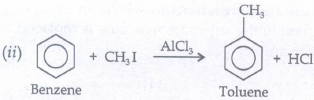
(b) How will you bring out the following conversions.
(i) Acetylene to ethane
(ii) Benzene to Toluene
(iii) Ethanol to ethene?
15.
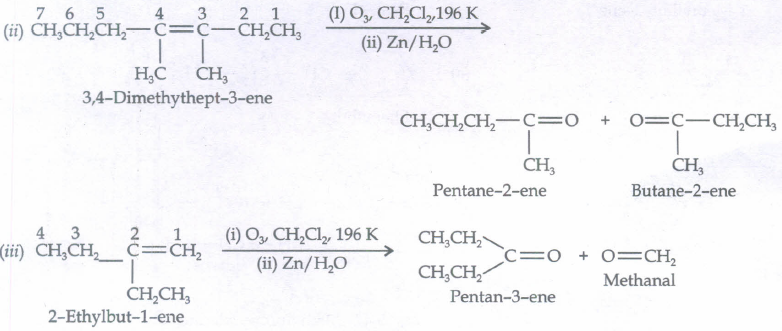
Write IUPAC names of the products obtained by the ozonolysis of the following compounds :
(i) Pent-2-ene
(ii) 3,4-Dimethylhept-3-ene
(iii) 2-Ethylbut-1-ene
(iv) 1-Phenylbut-1-ene
16.
Which of the following is less reactive than benzene towards electrophilic substitution reactions?
Nitrobenzene
Aniline
Bromobenzene
Chlorobenzene
17.
An aqueous solution of compound A gives ethane on electrolysis, the compound A is ______.
Ethyl acetate
Sodium acetate
Sodium propionate
Sodium ethoxide
18.
Benzene reacts with acetyl chloride in the presence of AlCl3 to give ______.
acetophenone
toluene
benzophenone
ethyl benzene
19.
The peroxide effect in anti-Markovnikov addition involves ______.
The heterolytic fission of the double bond
The homolytic fission of the double bond
a free radical mechanism
an ionic mechanism
20.
Which of the following is correct regarding the stability of carbocation?
3°>2°>1°
1°<2°<3°
2°>1°>3°
2°>3°>1°
1.
Resonance energy is the difference in energy between actual structure of compound and most stable resonating structure. The resonance energy of benzene is 150.325 J mol-1.
2.
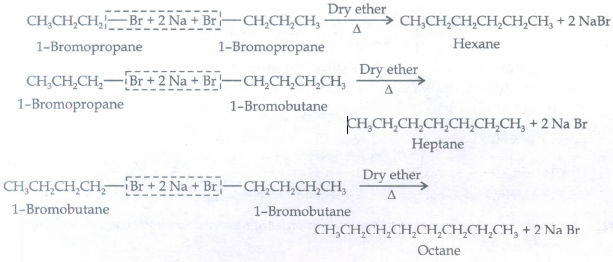
For preparation of alkanes containing odd number of carbon atoms, a mixture of two alkyl halides has to be used. Since two alkyl halides can react in three different ways, therefore, a mixture of three alkanes instead of the desired alkane would be formed. For example, the Wurtz reaction between 1-bromopropane and 1-bromobutane gives a mixture of three alkanes i.e., hexane, heptane and octane as shown below:
3.
Step 1. Write the structure of the products side by side with their oxygen atoms pointing towards each other.
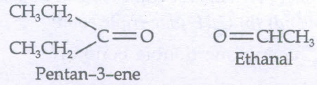
Step 2. Remove the oxygen atoms and join the two ends by a double bond, the structure of the alkene 'A' is
4.
Peroxide effect is not observed in addition of HCl and HI. This is due to fact that the H__Cl bond being stronger (430.5 kJ mol-1) than H__Br bond (363.7 kJ mol-1) is not cleaved by the free radical whreas the H___I bond is weaker (296.8 kJ mol-1) and iodine free radicals combine to form iodine molecules instead of adding to the double bond.
5.
CH3CH2C(CH3) = CHCH3
6.
7.
Boiling points of alkanes
1. The boiling points of alkanes rise as the number of carbons increases.
2. Since nonane has a longer carbon chain than octane, it will have a higher boiling point.
Effect of branching on the boiling point of alkane
1. As an alkane chain branch, the surface area of the molecule decreases.
2. The intermolecular force reduces as a result of this.
3. At a lower temperature, the forces can be readily overcome.
4. Therefore, as the branching increases, the boiling point of an alkane chain decreases.
8.
The structures of cis- and trans-isomer of hex-2-ene are:
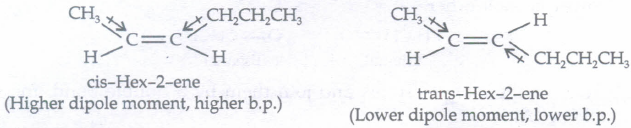
The boiling point of a molecule depends upon dipole-dipole interactions. Since cis-isomer has higher dipole moment, therefore, it has higher boiling point.
9.
Iso - propylmagnesium bromide (CH3)2CHMgBr,
(CH3)2CHMgBr+H2O⟶CH3CH2CH3+Mg(OH)Br
10.
Molecules with odd number of carbon atoms have lower melting points because they do not fit into crystal lattice easily whereas, hydrocarbons with even number of carbon atoms can fit into crystal lattice easily.
11.
On converting benzene to toluene, there is a fall in the melting point although toluene has the higher molecular mass. This is because the planar molecules of benzene can pack more closely in the crystal lattice and the cohesive forces are strong, whereas the methyl group in toluene prevents such close packing.
12.
Benzene is a planar molecule having delocalized electrons above and below the plane of ring. Hence, it is electron-rich. As a result, it is highly attractive to electron deficient species i.e., electrophiles.
Therefore, it undergoes electrophilic substitution reactions very easily.

Nucleophiles are electron-rich. Hence, they are repelled by benzene. Hence, benzene undergoes nucleophilic substitutions with difficulty.
13.
For exhibiting cis-trans (or geometrical isomerism, a molecule must fulfil the following condition.
It must have atlest one double bond.
14.
(a) Functional isomerism.
(b) (i) \(CH\equiv CH+{ 2H }_{ 2 }\overset { Ni }{ \underset { 573\ K }{ \longrightarrow } } \ { CH }_{ 3 }-{ CH }_{ 3 }\)
Acetylene Ethane
(iii) CH3CH2OH \(\overset { Conc.{ H }_{ 2 }{ SO }_{ 4 } }{ \underset { heat }{ \longrightarrow } } \) CH2 = CH2 + H2O
15.
(i) \(\overset { 5 }{ C } { H }_{ 3 }-\overset { 4 }{ C } H_{ 2 }-\overset { 3 }{ C } H=\overset { 2 }{ C } H\overset { 1 }{ C } { H }_{ 3 }\overset { (i){ O }_{ 3 }/{ CH }_{ 2 }{ CI }_{ 2 },196\quad K }{ \underset { (ii)\quad Zn/{ H }_{ 2 }O }{ \longrightarrow } } { CH }_{ 3 }-{ CH }_{ 2 }-CH=O+O=CH-{ CH }_{ 3 }\)
Pent-2-ene Propanal Ethanal
(iv) \({ \overset { 4 }{ C } }H_{ 3 }\overset { 3 }{ C } { H }_{ 2 }-\overset { 2 }{ C } H=\overset { 1 }{ C } { H }_{ 2 }-{ C }_{ 6 }{ CH }_{ 5 }\overset { (i){ O }_{ 3 },{ CH }_{ 2 }{ C1 }_{ 2 },196\quad K }{ \underset { (ii)Zn/{ H }_{ 2 }O }{ \longrightarrow } } { CH }_{ 3 }{ CH }_{ 2 }CH=0+0=CH-{ C }_{ 6 }{ H }_{ 5 }\)
1-Phenylbut-1-ene Propanal Benzaldehyde
16.
(a)
Nitrobenzene
17.
(b)
Sodium acetate
18.
(a)
acetophenone
19.
(c)
a free radical mechanism
20.
(a)
3°>2°>1°

11th Standard CBSE Syllabus & Materials
11th Standard CBSE
CBSE 11th Business Studies Forms of Business Organisation Sample Question Papers Study Material - QB365 Set A
NEW11th Standard CBSE
CBSE 11th Business Studies Business, Trade and Commerce Sample Question Papers Study Material - QB365 Set A
NEW11th Standard CBSE
CBSE 11th Physics Waves Sample Question Papers Study Material - QB365 Set A
NEW11th Standard CBSE
CBSE 11th Physics Kinetic Theory Sample Question Papers Study Material - QB365 Set A



CBSE 11th Standard CBSE Subjects
CBSE Standards









