
 100% FREE ACCESS
11th Standard CBSE Syllabus & Materials
11th Standard CBSE
CBSE 11th Economics PART-A - Presentation of Data - New Sample Question Papers Study Material - QB365 Set A
NEW11th Standard CBSE
CBSE 11th Economics PART-A - Organisation of Data - New Sample Question Papers Study Material - QB365 Set A
NEW11th Standard CBSE
CBSE 11th Economics PART-A - Collection of Data - New Sample Question Papers Study Material - QB365 Set A
NEW11th Standard CBSE
CBSE 11th Economics PART-A - Introduction to Economics and Statistics - New Sample Question Papers Study Material - QB365 Set A
NEW11th Standard CBSE
CBSE 11th Business Studies International Trade Sample Question Papers Study Material - QB365 Set A
NEW11th Standard CBSE
CBSE 11th Business Studies Evolution and Fundamentals of Business Sample Question Papers Study Material - QB365 Set A

Published on: 30/07/2019
State of Matter
Download CBSE Class 11th Standard CBSE Chemistry question papers, sample papers, important questions, and previous year solved papers in PDF format. Get free study materials, NCERT solutions, and exam preparation resources for Class 11th Standard CBSE Chemistry
Questions + Answers key
Take MCQ Chemistry Test
1.
Name two intermolecular force that exists between HF molecules in a liquid state.
2.
What is the value of gas constant in SI units?
3.
State and explain Dalton's law of partial pressures. Can we apply Dalton's law of partial pressures to a mixture of carbon monoxide and oxygen?
4.
State and explain Boyle's law. Represent the law graphically.
5.
Isotherms of carbon dioxide at various temperatures are represented in the figure. Answer the following questions based on the figure.
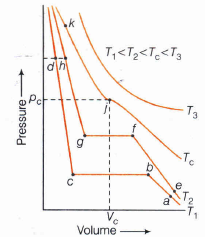
What portion of the isotherm at T1 represent liquid and gaseous CO2 at equilibrium?
6.
Rohan takes an open pan to cook vegetables and pulses at a hill station while Sohan cooks pulses and vegetables in a pressure cooker at the same place.The gas cylinder of Rohan lasts for only 15 days whereas Sohan uses one gas cylinder per month.
Why does Sohan need only one gas cylinder per month and not two like Rohan?
7.
At what temperature centigrade will the volume of a gas at \({ 0 }^{ \circ }\) C double itself, pressure remaining constant?
8.
State Dalton's law of partial pressure.
9.
Name four properties of gases.
10.
Define an ideal gas.
11.
180 g of steam is contained in a vessel of 25 L capacity under a pressure of 50 bar. Calculate the temperature of the steam. Given that for water vapour, a = 5.46 bar L2mol-2 and b = 0.031 L mol-1.
12.
A 2 L vessel contains oxygen at a pressure of 380 mm Hg at 27oC.1.40 g of N2 gas is introduced in the vessel.Will the pressure of gaseous mixture increase or decrease and to what extent?
13.
A 34.0 dm3 cylinder contains 212 g of oxygen gas at 21°C. What mass of oxygen must be released to reduce the pressure in the cylinder to 1.24 bar.
14.
At 25°C and 760 mm of Hg pressure a gas occupies 600 mL volume. What will be its pressure at a height where temperature is 10°C and volume of the gas is 640 mL?
15.
Give reasons for the following. Tyres of automobiles are inflated to the lesser pressure in summer than in winter.
16.
A large flask fitted with a stop-cock is evacuated and weighted; it mass is found to be 134.567g. It is then filled to a pressure of 735 mm at 31oC with a gas of unknown molecular mass and then reweighted; it mass is 137.456 g. The flask is then filled with water and weighed again; its mass is now 1067.9 g. Assuming that the gas is ideal, calculate the molar mass of the gas.
17.
On liter flask containing vapours of methyl alcohol( molar mass = 32) at a pressure of 1 atm and 25oC was evacuated till the final pressure was 10-3 mm. How many molecules of methyl alcohol were left in the flask?
18.
Which of the following gases will have the lowest rate of diffusion?
H2
N2
F2
O2
19.
The compressibility factor, z for an ideal gas is
zero
less than one
greater than one
equal to one
20.
The cleansing action of soaps and detergents is due to
internal friction
high hydrogen bonding
viscosity
surface tensions
21.
Viscosity of a liquid is a measure of
repulsive forces between the liquid molecules
frictional resistance
intermolecular forces between the molecules
none of the above
22.
For one mole of a gas, the ideal gas equation is
PV =\(\frac{1}{2}\)RT
PV=RT
PV =\(\frac{3}{2}\)RT
PV =\(\frac{5}{2}\)RT
1.
()
HF molecules are polar covalent molecules.In a liquid state, there are dipole-dipole interactions and H-bonding.
2.
()
8.314 JK-1 mol = -1
3.
Dalton's law of partial pressure: When two or more non-reacting gases are enclosed in a vessel, the total pressure of the gaseous mixture is equal to the sum of the partial pressures that each gas will exert when enclosed separately in the same vessel at constant temperature.
P = P1 + P2 + P3
Where, P is the total pressure of the three gases A, B, and C enclosed in a container. P1 ,P2 and P3 are the partial pressures of the three gases when enclosed separately
in the same vessel at a given temperature one by one.
No, the law cannot be applied. Carbon monoxide and oxygen readily combine to form carbon dioxide. The law can be applied only to the non-reacting gases.
4.
It states that, the pressure of a fixed mass of a gas is inversely proportional to its volume if temperature is kept constant.
P\(\alpha\)\(\frac{1}{V}\)
PV = constant (n and T are constant)
P1V1 = P2V2.
Graphical representation:
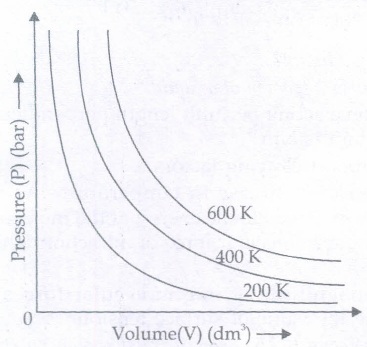
Fig. Graph of pressure, P vs. Volume,
V of a gas at different temperatures.
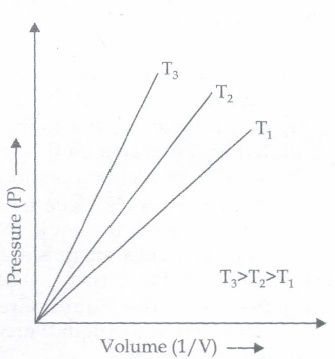
Fig. Graph of pressure of a gas, P VS. 1N
5.
Between 'b' and 'c' is the portion of isotherm at which liquid CO2 is in equilibrium with gaseous CO2.
6.
Sohan needs less fuel as pressure cooker helps in cooking at faster rate.
7.
Let the volume of the gas at \(0^{ \circ }C=V \ mL\)
Thus, we have \({ V }_{ 1 }=V \ mL,{ V }_{ 2 }=2V \ mL\)
\({ T }_{ 1 }=0+273=273K\)
\({ T }_{ 2 }=to \ be \ calculated\)
By Charles law \(\frac { { V }_{ 1 } }{ { T }_{ 1 } } =\frac { { V }_{ 2 } }{ { T }_{ 2 } } \)
Substituting the corresponding value, we have
\(\frac { V }{ 273 } =\frac { 2V }{ { T }_{ 2 } } \Rightarrow { T }_{ 2 }=\frac { 2V\times 273 }{ V } \)
\( =546K\)
\( { T }_{ 2 }=564-273={ 273 }^{ \circ }C\)
8.
Daltons' Law states that, total pressure exerted by the mixture of non-reactive gases is equal to the sum of the partial pressures of individual gases.
9.
(i) Gases, have no definite shape and no definite volume.
(ii) There is no force of attraction existing between the molecules of gases.
(iii) Gases are highly compressible.
(iv) Gases can mix evenly and can spread in whole space.
10.
A gas that follows Boyle's law, Charles' law and Avogadro law strictly, is called an ideal gas.
11.
T = 1513.33K
12.
P2 = 1.1157 atm and the pressure will increase.
13.
Step I. Calculation of no. of moles of O2 left in cylinder.
P = 1.24 bar, V = 34 dm3
T = (21 + 273) = 294 K, R = 0.083 dm3 bar K-1 mol-1
According to ideal gas equation,
PV = nRT
n = \(\frac { PV }{ RT } \)
n = \(\frac { \left( 1.24bar \right) \times \left( { 34 \ dm }^{ 3 } \right) }{ \left( { 0.083 \ dm }^{ 3 }{ bar \ K }^{ -1 }{ mol }^{ -1 } \right) \times \left( 294 \ K \right) } \)
= 1.727 mol
Step II. Calculation of mass of oxygen released.
Mass of O2 left in the cylinder = n x M = (1.727 mol) x (32g mol -1) = 55.26 g
Mass of O2 initially present = 212 g
Mass of O2 released = (212 - 55.26) = 156.74 g
14.
P1 = 760 mm Hg, V1 = 600 mL
T1 = 25 + 273 = 298 K
V2 = 640 mL and T2=10 + 273 = 283 K
According to combined gas law,
\(\frac { { P }_{ 1 }V_{ 1 } }{ { T }_{ 1 } } =\frac { { P }_{ 2 }V_{ 2 } }{ { T }_{ 2 } } \)
\(\Rightarrow \) P2 = \(\frac { { p }_{ 1 }{ V }_{ 1 }{ T }_{ 2 } }{ { T }_{ 1 }{ V }_{ 2 } } \)
\(\Rightarrow \) P2 = \(\frac { (760 \ mm \ Hg)\times (600 \ mL)\times (283K) }{ (640mL)\times (298K) } \)
= 676.6 mm Hg
15.
In summer, due to higher temperature, the average Kinetic energy of the air molecules inside the tyre increases,i.e. molecules start moving faster. Hence, the pressure on the walls of the tube increases. If pressure inside is not kept low at the time of inflation, at a higher temperature, the pressure may become so high that the tyre may burst.
16.
80.25 mol-1
17.
Number of molecules = \(3.51+1{ 0 }^{ 16 }\)
18.
(c)
F2
19.
(d)
equal to one
20.
(d)
surface tensions
21.
(b)
frictional resistance
22.
(b)
PV=RT

11th Standard CBSE Syllabus & Materials
11th Standard CBSE
CBSE 11th Business Studies Forms of Business Organisation Sample Question Papers Study Material - QB365 Set A
NEW11th Standard CBSE
CBSE 11th Business Studies Business, Trade and Commerce Sample Question Papers Study Material - QB365 Set A
NEW11th Standard CBSE
CBSE 11th Physics Waves Sample Question Papers Study Material - QB365 Set A
NEW11th Standard CBSE
CBSE 11th Physics Kinetic Theory Sample Question Papers Study Material - QB365 Set A



CBSE 11th Standard CBSE Subjects
CBSE Standards









