
 100% FREE ACCESS
11th Standard CBSE Syllabus & Materials
11th Standard CBSE
CBSE 11th Economics PART-A - Presentation of Data - New Sample Question Papers Study Material - QB365 Set A
NEW11th Standard CBSE
CBSE 11th Economics PART-A - Organisation of Data - New Sample Question Papers Study Material - QB365 Set A
NEW11th Standard CBSE
CBSE 11th Economics PART-A - Collection of Data - New Sample Question Papers Study Material - QB365 Set A
NEW11th Standard CBSE
CBSE 11th Economics PART-A - Introduction to Economics and Statistics - New Sample Question Papers Study Material - QB365 Set A
NEW11th Standard CBSE
CBSE 11th Business Studies International Trade Sample Question Papers Study Material - QB365 Set A
NEW11th Standard CBSE
CBSE 11th Business Studies Evolution and Fundamentals of Business Sample Question Papers Study Material - QB365 Set A

Published on: 23/09/2019
Consumer Equilibrium
Download CBSE Class 11th Standard CBSE undefined question papers, sample papers, important questions, and previous year solved papers in PDF format. Get free study materials, NCERT solutions, and exam preparation resources for Class 11th Standard CBSE undefined
Questions + Answers key
Take MCQ Biology Test
1.
Define market rate of exchange.
2.
"Law of diminishing marginal utility will operate even if consumption takes place in intervals." Defend or refute.
3.
Explain why an Indifference curve has a negative slope (i.e. IC slope downwards to the right).
4.
State and explain the condition of consumer's equilibrium in case of two commodities through utility approach.
5.
Differentiate between Cardinal and Ordinal Utility.
6.
How many units of a commodity should a consumer buy to get its maximum utility? Explain with the help of a numerical example
7.
State condition of consumer equilibrium in case of a single commodity.
8.
Show diagrammatically the conditions for consumer's equilibrium, in Hicksian analysis of demand
9.
Using indifference curve approach, explain the conditions of consumer's equilibrium.
10.
Explain consumer's equilibrium in case of a single commodity with the help of a utility schedule.
1.
The rate at which market requires to sacrifice one commodity to gain an additional unit of another commodity is called market rate of exchange.
MREx1,x2=\(\frac{change\ in\ quantity\ of\ good\ sacrificed(\triangle X_2)}{change\ in\ quantity\ of\ good\ gained(\triangle X_1)}\)
Or MREX1, X2=\(\frac{Price\ of Good\ gained[P_1]}{price\ of\ good\ sacrificed[P_2]}\)
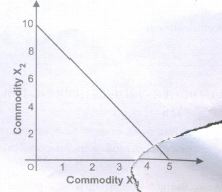
This can be explained with the help of the following diagram. Let consumer's Money Income is 10 and Price of commodity 1 is 2 and price of commodity 2 is 1. i.e., M = 10, P1= 2 and P2 = 1.
MRE is constant throughout because P1 and P2 on the basis of which it is calculated are constant throughout.
2.
The given statement is refuted. Law of diminishing marginal utility will operate only when consumption is a continuous process. For example, if one sandwich is consumed in the morning and another in the afternoon, the second sandwich may provide equal or higher satisfaction as compared to the first one.
3.
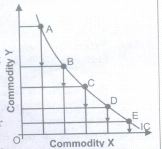
Every IC is based on the assumption that various combinations of two commodities gives equal satisfaction to a consumer. In order to remain at the same level of satisfaction, the U consumer will have to reduce Commodity X the consumption of one commodity if wants to increase the consumption of and another commodity.
4.
According to the two commodity consumer equilibrium a consumer gets maximum satisfaction, when
\(\frac { M{ U }_{ x } }{ { P }_{ x } } =\frac { M{ U }_{ y } }{ { P }_{ y } } \)
Conditions of Consumer's Equilibrium In case of Two Commodities
Necessary Condition
Marginal utility of last rupee spent on each commodity is same. Suppose there are two commodities, X and Y respectively. So, for commodity X, the condition is, marginal utility in terms of Money= Price of X
\(\frac { Marginal\ utility\ of\ a\ product\ in\ utils[M{ U }_{ X }] }{ Marginal\ utility\ of\ one\ rupee[M{ U }_{ M }] } = Price\ of\ X\)
\(\frac { M{ U }_{ x } }{ { P }_{ x } } =M{ U }_{ m }\) -----(1)
Similarly,forcommodityY,the condition is,
\(\frac { M{ U }_{ y } }{ { P }_{ y } } =M{ U }_{ m }\) -----(2)
Putting equation (2)in (1),we get
\(\frac { M{ U }_{ x } }{ { P }_{ x } } =\frac { M{ U }_{ y } }{ { P }_{ y } } \)
If \(\frac { M{ U }_{ x } }{ P_{ y } } >\frac { M{ U }_{ y } }{ { P }_{ y } } \)
It means, marginal utility from the last rupee spent on commodity X is more than marginal utility from the last rupee spent on commodity Y. So, to attain the equilibrium, consumer must increase the MU quantity of X, which decrease the \(\frac { M{ U }_{ x } }{ P_{ x } } \)and decrease the quantity of Y which will increase the \(\frac { M{ U }_{ y } }{ { P }_{ y } } \)Increase in quantity of X and decrease in quantity of Y will continue till.\(\frac { M{ U }_{ x } }{ { P }_{ x } } =\frac { M{ U }_{ y } }{ { P }_{ y } } .\)
If, \(\frac { M{ U }_{ x } }{ P_{ x } } <\frac { M{ U }_{ y } }{ { P }_{ y } } \)
It means, marginal utility from the last rupee spent on commodity X is less than marginal utility from the last rupee spent on commodity Y. So, to attain the equilibrium the consumer must decrease the quantity of X, will increase the \(\frac { M{ U }_{ x } }{ P_{ x } } \) and decrease the quantity of Y, which will decrease the \(\frac { M{ U }_{ y } }{ { P }_{ y } } .\) Decrease in quantity of X and increase in quantity of Y continues till \(\frac { M{ U }_{ x } }{ { P }_{ x } } =\frac { M{ U }_{ y } }{ { P }_{ y } } \)
Sufficient Condition: Expenditure on commodity X + Expenditure on commodity Y = Money Income. In other words, law of Diminishing Marginal utility should be applicable.
5.
| Cardinal Utility Approach | Basis | Indifference Curve (Ordinal Utility) Approach |
|---|---|---|
| It states that the satisfaction the consumer derives by consuming goods and services can be measured with number. | Meaning | It states that the satisfaction the consumer derives from the consumption of goods and services by using a ranking system in which a ranking is provided to the satisfaction that is derived from consumption |
| Diminishing Marginal Utility (DMU): As the consumer has more units of a commodity, the marginal utility of the commodity falls. | Diminising Marginal Utility/Substitution | Diminishing MRS: As the consumer has more units of good X, the consumer is willing to give up less and less units of good Y, so as to maintain same level of satisfaction |
| DMU is shown by MU curve which is falling throughout | Representation | MRS is the slope of indifference curve. Indifference curve is convex to the origin showing diminishing MRS |
| Consumer's Equilibrium MU=Px ... for single commodity \(\frac { { MU }_{ x } }{ { P }_{ x } } =\frac { M{ U }_{ y } }{ { P }_{ y } } \) for two commodities. subject Px .X+Py .Y=M |
Equilibrium Condition | Consumer's Equilibrium [slope of indifference curve=[slope of budget line] MRS=\(\frac { { P }_{ x } }{ { P }_{ y } } \) and convexity of indifference curve. |
6.
(a) When purchasing a unit of a commodity a consumer compares its price with the expected utility from it. Utility obtained is the benefit, and the price payable is the cost. The consumer compares benefit and the cost. He will buy the unit of a commodity only if the benefit is greater than or at least equal to the cost.
(b) equilibrium Conditions for Single Commo ·ty Consumer Equilibrium Necessary Condition Marginal utility in terms of Money = Price
\(\frac { Marginal\ utility\ of\ a\ product\ in\ utils[M{ U }_{ X }] }{ \ utility\ of\ one\ rupee[M{ U }_{ M }] } \)
In particular, the condition (A) says that the marginal utility of a Product in terms of Money be equal to its price. Sometimes, this is loosely stated as marginal utility is equal to price, i.e.,
| Consumption(Un-its) | Marginal Utility(MU)(Uti-Ls) | M.U.(Rs) | Price | Marginal Gain(MU-Price) | Total Gain |
|---|---|---|---|---|---|
| 1 | 5 | 5 | 3 | 2 | 2 |
| 2 | 4 | 4 | 3 | 1 | 3 |
| 3 | 3 | 3 | 3 | 0 | 3 |
| 4 | 2 | 2 | 3 | -1 | 2 |
(b) Suppose, the price of commodity X in the market is Rs.3 per unit. It means he has to pay Rs.3 per unit for all the units he buys. Suppose, the utility obtained from the first unit is 5 utils (=Rs. 5). The consumer will buy this unit because the utility of this unit is greater than the price and this process continues till Marginal utility = Price as shown in the above schedule at quantity 3.
(c) Consumer will not buy the fourth unit MU = Price.
If MU> PRICE
(a) Means benefit is greater than cost and whenever benefit is greater than cost, consumer keeps on consuming additional unit of a commodity till MU = Price.
(b) It is so because according to the law of diminishing marginal utility, MUfalls as more is purchased till it becomes equal to price.
If MU< PRICE
(a) Means benefit is less than cost and whenever benefit is less than cost, the consumer keeps on decreasing additional unit of a commodity till MU = Price.
(b) It is so because according to the law of diminishing marginal utility, MU rises as less units are consumed till it becomes equal to price.
Sufficient Condition
Total gain falls as more is purchased after equilibrium. It means that consumer continues to purchase so long as total gain is increasing or at least constant.
(a) It can be explained with the help of the following schedule:
because utility of this unit is 2 utils (= Rs.2) which is less than the price. It is not worth buying the fourth unit. The consumer will restrict his purchase to only 3 units
7.
(a) When purchasing a unit of a commodity a consumer compares its price with the expected utility from it. Utility obtained is the benefit, and the price payable is the cost. The consumer compares benefit and the cost. He will buy the unit of a commodity only if the benefit is greater than or at least equal to the cost.
(b) equilibrium Conditions for Single Commo ·ty Consumer Equilibrium Necessary Condition Marginal utility in terms of Money = Price
\(\frac { Marginal\ utility\ of\ a\ product\ in\ utils[M{ U }_{ X }] }{ \ utility\ of\ one\ rupee[M{ U }_{ M }] } \)
In particular, the condition (A) says that the marginal utility of a Product in terms of Money be equal to its price. Sometimes, this is loosely stated as marginal utility is equal to price, i.e.,
| Consumption(Un-its) | Marginal Utility(MU)(Uti-Ls) | M.U.(Rs) | Price | Marginal Gain(MU-Price) | Total Gain |
|---|---|---|---|---|---|
| 1 | 5 | 5 | 3 | 2 | 2 |
| 2 | 4 | 4 | 3 | 1 | 3 |
| 3 | 3 | 3 | 3 | 0 | 3 |
| 4 | 2 | 2 | 3 | -1 | 2 |
(b) Suppose, the price of commodity X in the market is Rs.3 per unit. It means he has to pay Rs.3 per unit for all the units he buys. Suppose, the utility obtained from the first unit is 5 utils (=Rs. 5). The consumer will buy this unit because the utility of this unit is greater than the price and this process continues till Marginal utility = Price as shown in the above schedule at quantity 3.
(c) Consumer will not buy the fourth unit MU = Price.
If MU> PRICE
(a) Means benefit is greater than cost and whenever benefit is greater than cost, consumer keeps on consuming additional unit of a commodity till MU = Price.
(b) It is so because according to the law of diminishing marginal utility, MUfalls as more is purchased till it becomes equal to price.
If MU< PRICE
(a) Means benefit is less than cost and whenever benefit is less than cost, the consumer keeps on decreasing additional unit of a commodity till MU = Price.
(b) It is so because according to the law of diminishing marginal utility, MU rises as less units are consumed till it becomes equal to price.
Sufficient Condition
Total gain falls as more is purchased after equilibrium. It means that consumer continues to purchase so long as total gain is increasing or at least constant.
(a) It can be explained with the help of the following schedule:
because utility of this unit is 2 utils (= Rs.2) which is less than the price. It is not worth buying the fourth unit. The consumer will restrict his purchase to only 3 units
8.
(i) To define consumer equilibrium, we use Indifference Curve map and the budget line.
Two Conditions Cor Consumer Equilibrium
(a) Necessary Condition
Marginal Rate of Substitution Market Rate of Exchange \(\left[ \frac { { P }_{ x } }{ { P }_{ y } } \right] \)
Or MRS x,y =\(\frac { { P }_{ x } }{ { P }_{ y } } \)
(Market Rate of Exchange) MRE
Or MRS x,y =MRE\(\left[ \frac { { P }_{ x } }{ { P }_{ y } } \right] \)
If MRS x,y>MRE\(\left[ \frac { { P }_{ x } }{ { P }_{ y } } \right] \)
(a) It means that to obtain one more unit of X, the consumer is willing to sacrifice more unit of Y as compared to what is required in the market.
(b) In other words, consumers willingness to pay for commodity X is higher than what market values for commodity X.
(c) This induces the consumer to buy more of X and less of Y, which result in fall in MRS till it become equal to price.
(ii) If MRS x,y< MRE\(\left[ \frac { { P }_{ x } }{ { P }_{ y } } \right] \)
(a) It means that to obtain one more unit of X, the consumer is willing to sacrifice less unit of Y as compared to what is required in the market.
(b) In other words, consumer's willingness to pay for commodity X is lower than what market values for commodity X.
(c) This induces the consumer to buy less of X and more of Y, which result in rise in MRS till it become equal to price.
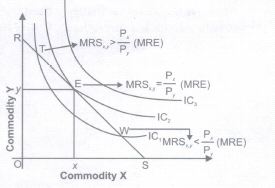
(b) Sufficient Condition MRS Diminishing (Convex) at X, Y a point of equilibrium i.e., when MRS x,y=MRE \(\left[ \frac { { P }_{ x } }{ { P }_{ y } } \right] \)
(ii) The consumer will reach equilibrium when the budget line is tangential to the higher possible Indifference Curve, i.e., where necessary and sufficient conditions satisfy. In the above diagram, the consumer will reach equilibrium at point E where budget line RS is tangential to the highest possible IC2.
(iii) The consumer cannot move to Indifference Curve, i.e., IC3 as this is beyond his money income.
(iv) Even on IC2, all the other points except E are beyond his means.
(v) Hence, at point E, the consumer is in equilibrium where his satisfaction maximizes, given his income and prices of goods X and Y. In equilibrium at E, the slope of Budget line = the slope of Indifference, Therefore, MRS xy is eq to the ratio of the prices of two goods \(\left[ \frac { { P }_{ x } }{ { P }_{ y } } \right] \)
9.
(i) To define consumer equilibrium, we use Indifference Curve map and the budget line.
Two Conditions Cor Consumer Equilibrium
(a) Necessary Condition
Marginal Rate of Substitution Market Rate of Exchange \(\left[ \frac { { P }_{ x } }{ { P }_{ y } } \right] \)
Or MRS x,y =\(\frac { { P }_{ x } }{ { P }_{ y } } \)
(Market Rate of Exchange) MRE
Or MRS x,y =MRE\(\left[ \frac { { P }_{ x } }{ { P }_{ y } } \right] \)
If MRS x,y>MRE\(\left[ \frac { { P }_{ x } }{ { P }_{ y } } \right] \)
(a) It means that to obtain one more unit of X, the consumer is willing to sacrifice more unit of Y as compared to what is required in the market.
(b) In other words, consumers willingness to pay for commodity X is higher than what market values for commodity X.
(c) This induces the consumer to buy more of X and less of Y, which result in fall in MRS till it become equal to price.
(ii) If MRS x,y< MRE\(\left[ \frac { { P }_{ x } }{ { P }_{ y } } \right] \)
(a) It means that to obtain one more unit of X, the consumer is willing to sacrifice less unit of Y as compared to what is required in the market.
(b) In other words, consumer's willingness to pay for commodity X is lower than what market values for commodity X.
(c) This induces the consumer to buy less of X and more of Y, which result in rise in MRS till it become equal to price.
(b) Sufficient Condition MRS Diminishing (Convex) at X, Y a point of equilibrium i.e., when MRS x,y=MRE \(\left[ \frac { { P }_{ x } }{ { P }_{ y } } \right] \)
(ii) The consumer will reach equilibrium when the budget line is tangential to the higher possible Indifference Curve, i.e., where necessary and sufficient conditions satisfy. In the above diagram, the consumer will reach equilibrium at point E where budget line RS is tangential to the highest possible IC2.
(iii) The consumer cannot move to Indifference Curve, i.e., IC3 as this is beyond his money income.
(iv) Even on IC2, all the other points except E are beyond his means.
(v) Hence, at point E, the consumer is in equilibrium where his satisfaction maximizes, given his income and prices of goods X and Y. In equilibrium at E, the slope of Budget line = the slope of Indifference, Therefore, MRS xy is eq to the ratio of the prices of two goods \(\left[ \frac { { P }_{ x } }{ { P }_{ y } } \right] \)
10.
(a) When purchasing a unit of a commodity a consumer compares its price with the expected utility from it. Utility obtained is the benefit, and the price payable is the cost. The consumer compares benefit and the cost. He will buy the unit of a commodity only if the benefit is greater than or at least equal to the cost.
(b) Equilibrium Conditions for Single Commodity Consumer Equilibrium
Necessary Condition
Marginal utility in terms of Money = Price ...(A)
\(\frac { Marginal\ utility\ of\ a\ product\ in\ utils[M{ U }_{ X }] }{ Marginal\ utility\ of\ one\ rupee[M{ U }_{ M }] } =Price\) ...(B)
In particular, the condition (A) says that the marginal utility of a Product in terms of Money be equal to its price. Sometimes, this is loosely stated as marginal utility is equal to price, i.e.,
| Consumption(Un-its) | Marginal Utility(MU)(Uti-Ls) | M.U.(Rs) \(\left[ {{{MU}_{x}}\over{{MU}_{m(1)}}} \right]\) |
Price | Marginal Gain(MU-Price) | Total Gain |
|---|---|---|---|---|---|
| 1 | 5 | 5 | 3 | 2 | 2 |
| 2 | 4 | 4 | 3 | 1 | 3 |
| 3 | 3 | 3 | 3 | 0 | 3 |
| 4 | 2 | 2 | 3 | -1 | 2 |
(b) Suppose, the price of commodity X in the market is Rs.3 per unit. It means he has to pay Rs.3 per unit for all the units he buys. Suppose, the utility obtained from the first unit is 5 utils (=Rs. 5). The consumer will buy this unit because the utility of this unit is greater than the price and this process continues till Marginal utility = Price as shown in the above schedule at quantity 3.
(c) Consumer will not buy the fourth unit MU= Price.
If MU> PRICE
(a) Means benefit is greater than cost and whenever benefit is greater than cost, consumer keeps on consuming additional unit of a commodity till MU = Price.
(b) It is so because according to the law of diminishing marginal utility, MU falls as more is purchased till it becomes equal to price.
If MU< PRICE
(a) Means benefit is less than cost and whenever benefit is less than cost, the consumer keeps on decreasing additional unit of a commodity till MU = Price.
(b) It is so because according to the law of diminishing marginal utility, MU rises as less units are consumed till it becomes equal to price.
Sufficient Condition
Total gain falls as more is purchased after equilibrium. It means that consumer continues to purchase so long as total gain is increasing or at least constant.
(a) It can be explained with the help of the following schedule:
because utility of this unit is 2 utils (= Rs.2) which is less than the price. It is not worth buying the fourth unit. The consumer will restrict his purchase to only 3 units.

11th Standard CBSE Syllabus & Materials
11th Standard CBSE
CBSE 11th Business Studies Forms of Business Organisation Sample Question Papers Study Material - QB365 Set A
NEW11th Standard CBSE
CBSE 11th Business Studies Business, Trade and Commerce Sample Question Papers Study Material - QB365 Set A
NEW11th Standard CBSE
CBSE 11th Physics Waves Sample Question Papers Study Material - QB365 Set A
NEW11th Standard CBSE
CBSE 11th Physics Kinetic Theory Sample Question Papers Study Material - QB365 Set A



CBSE 11th Standard CBSE Subjects
CBSE Standards










