
 100% FREE ACCESS
11th Standard CBSE Syllabus & Materials
11th Standard CBSE
CBSE 11th Economics PART-A - Presentation of Data - New Sample Question Papers Study Material - QB365 Set A
NEW11th Standard CBSE
CBSE 11th Economics PART-A - Organisation of Data - New Sample Question Papers Study Material - QB365 Set A
NEW11th Standard CBSE
CBSE 11th Economics PART-A - Collection of Data - New Sample Question Papers Study Material - QB365 Set A
NEW11th Standard CBSE
CBSE 11th Economics PART-A - Introduction to Economics and Statistics - New Sample Question Papers Study Material - QB365 Set A
NEW11th Standard CBSE
CBSE 11th Business Studies International Trade Sample Question Papers Study Material - QB365 Set A
NEW11th Standard CBSE
CBSE 11th Business Studies Evolution and Fundamentals of Business Sample Question Papers Study Material - QB365 Set A

Published on: 24/09/2019
Elasticity of Demand
Download CBSE Class 11th Standard CBSE undefined question papers, sample papers, important questions, and previous year solved papers in PDF format. Get free study materials, NCERT solutions, and exam preparation resources for Class 11th Standard CBSE undefined
Questions + Answers key
Take MCQ Biology Test
1.
"Elasticity of demand at a common point will be more on a flatter curve than on a steeper curve".Prove
2.
Differentiate between Law of Demand and Price Elasticity of Demand.
3.
When price of a good falls from Rs 5 to Rs 3 per unit, its demand rises by 40%.Calculate its price elasticity of demand
4.
Calculate the price elasticity of demand for a commodity when its price increases by 25% and quantity demanded falls from 150 units to 120 units.
5.
A consumer buys 20 units of a good at Rs10 per unit. The price elasticity of demand of this good is (-) 1. Calculate quantity demanded by the consumer when price falls to Rs 8 per unit.
6.
A consumer buys 80 units of a good at a price of Rs 5 per unit. Suppose, the price elasticity of demand is (-) 2. At what price will he buy 64 units?
7.
A consumer spends Rs 80 on a commodity when price is Rs 1 per unit. If the price increases by Rs 1, what would be his expenditure. PED = -0.4?
8.
A consumer demands 40 kg of a commodity when its price is Rs1 per kg. If the price increases by Rs 0.10, what would be the quantity demanded? PED = -1.
9.
A consumer buys 14 units of a good at a price of Rs 8 per unit. At price Rs 7 per unit he spends Rs 98 on the good. Calculate price elasticity of demand by the percentage method. Comment upon the shape of demand curve based on this information.
10.
When price of a good is Rs 7 per unit, a consumer buys 12 units. When price falls to Rs 6 per unit he spends Rs 72 on the good. Calculate price elasticity of demand by using the percentage method. Comment on the likely shape of demand curve based on this measure of elasticity.
11.
A consumer spends Rs 80 on a commodity when price is Rs 1 per unit. If the price increases by Rs 1, his expenditure becomes Rs 96. Comment on PED.
12.
Differentiate between perfectly elastic and perfectly inelastic demand
13.
Suppose the price elasticity of demand for a good is -0.2. If there is a 5% increase in the price of the good, by what percentage will the demand for the good go down?
14.
Consider the demand curve D(P) = 10 - 3p. What is the elasticity at price 5/3?
15.
Explain price elasticity of demand.
1.
In the given diagram, at point R the flatter demand curve D1D1 is more elastic than the steeper curve DD. This is because at point R, price and quantity are the same for both the curves. Now, for a given change in price, i.e., \(\triangle\)P, the corresponding \(\triangle\)q for the flatter curve D1D1 is QQ2 while for the steeper curve, it is QQ1, QQ2 is more than QQ1.
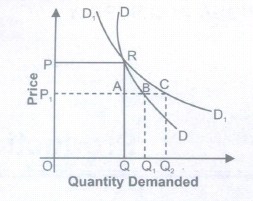

Therefore, QQ2 divided by PP1 on the flatter curve D1D1 will be more than QQ1 divided by PP1 on the steeper curve DD, i.e.,\({QQ_2\over PP_1}>{QQ_1\over PP_1}.\)
Hence, elasticity of demand will be more on a flatter curve D1D1, than on a steeper curve DD.
2.
| Law of Demand | Basis | Price Elasticity of Demand |
|---|---|---|
| Law of demand states, other things being equal, the inverse relation between price of a commodity and its quantity demanded. | Meaning | Price Elasticity of demand is the degree of responsiveness of quantity demanded due to change in price of the commodity. |
| It is qualitative statement, i.e., it reflects the direction of change in quantity demanded | Statement | It is quantitative statement, i.e., it tells us the magnitude of the change in quantity demanded as a result of change in price |
 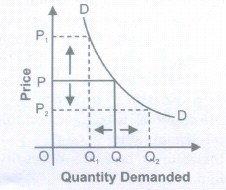 |
Shape of Demand Curve |  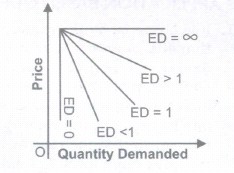 |
3.
| Original Price (P)=Rs 5 | % Change in Quantity = 40% |
| New Price (PI) = Rs 3 | Elasticity of Demand (ED) =? |
| Change in Price (\(\triangle\)P)=-Rs2 |
Percentage change in Price=\({\triangle P\over P}\times 100={-2\over5}\times100=-40\%\)
\(Price\ Elasticity\ of\ Demand\ (ED)={\%Change\ in\ quantity\ demanded \over \%Change\ in\ price}={40\% \over-40\%}\)
Price Elasticity of Demand (ED) = (-) 1
ED = (-)1; Demand is unitary elastic.
4.
| Original Quantity (Q)=150 units | % Change in Price = 25% |
| New Quantity (Q1) = 120 units | Elasticity of Demand (ED) =? |
| Change in Quantity(\(\triangle\)Q)= -30 units |
Percentage change in demand=\({\triangle Q\over Q}\times 100={-30\over150}\times100=-20\%\)
Price Elasticity of Demand\ (ED)\(={\%Change\ in\ quantity\ demanded \over \%Change\ in\ price}={-20\% \over 25\%}\)
Price Elasticity of Demand (ED)= (-) 0.8
ED = (-)0.8; Demand is less elastic because ED < 1.
5.
| PED = [-]1 | |
| Initial Price (P)= 10 | Initial Quantity (Q)= 20 |
| New Price (P1) = 8 | New Quantity (Q1)=? |
| \(\triangle P=[-]2\) | \(\triangle Q=?\) |
PED=\({\triangle Q\over \triangle P}\times {P\over Q}\) or\(1={\triangle Q\over (-)2}\times {10\over 20}\)
\(\triangle Q=4\)
As, Price is falling, than demand must rise by \(\triangle\)Q. So, New Quantity = Initial Quantity +\(\triangle\)Q = 20 + 4 = 24.
6.
| Original Quantity (Q)= 80 units | Original Price (P)=Rs 5 |
| New Quantity (QI)=64units | New Price (PI) =? |
| Change in Quantity(\(\triangle\) Q)=-16 units | Change in Price(\(\triangle\) P) =? |
| Elasticity of Demand (ED)= -2 | |
Price Elasticity of demand (ED)=\({\triangle Q\over \triangle P}\times {P\over Q}\)
\(-2={-16\over \triangle P}\times {5\over 80}=\triangle P=Rs\ 0.5\)
As the quantity demanded is decreasing, price will increase. It means that New Price = Original Price (P) + Change in Price (P) = 5 + 0.5 = Rs 5.5 New Price = Rs 5.5.
7.
| Initial Price (P)= 1 | Initial Expenditure = 80 | Initial Quantity (Q)=\({Exp.\over Price}=80\) |
| New Price (P1)= 2 | New Expenditure =? | NewQuantity (Q1) =? |
| \(\triangle P=1\) | \(\triangle Q=?\) |
\(PED={\triangle Q\over \triangle P}\times {P\over Q}or -0.4={\triangle Q\over 1}\times {1\over80}\)
-32 = \(\triangle\)Q
As New Price is increasing from 1 to 2, quantity demanded must decrease by \(\triangle\)Q. New Quantity = Initial Quantity + \(\triangle\)Q = 80 + (-32) = 48
At Price = 2, Quantity demanded = 48.
The Expenditure at this Price = P x Q = 2 x 48 = 96
8.
| Elasticity of demand = -1 | |
| Original Quantity (Q)= 40 | Original Price (P)= 1 |
| New Quantity (Q1) =? | New Price (P1) = 1.1 |
| Change in Quantity (\(\triangle\)Q) =? | Change in Price (\(\triangle\)P)= 0.1 |
\(PED={\triangle Q\over \triangle P}\times {P\over Q} or [-]1={\triangle Q\over 0.1}\times {1\over40}\)
\(\triangle Q=-4\)
As, price is increasing, then quantity demanded must decrease by 4.
So, New Quantity = Initial quantity + \(\triangle\)Q = 40 + (-4) = 36
9.
| Initial Price (P)= 8 | Initial Expenditure = 112 | Initial Quantity (Q)= 14 |
| NewPrice (P1)=7 | NewExpenditure = 98 | NewQuantity (Q1)= \({Exp.\over Quantity}={98\over7}=14\) |
| \(\triangle P=(-)1\) | \(\triangle Q=0\) |
\(PED={\triangle Q\over \triangle P}\times {P\over Q}={0\over(-)1}\times{8\over14}=0\)
ED is perfectly inelastic as quantity demanded does not change at all in response to change in price. Thus, its demand curve will be vertical/parallel to y-axis.
10.
| Initial Price (P) = 7 | Initial Expenditure = 84 | Initial Quantity (Q)= 12 |
| New Price (P1) = 6 | New Expenditure = 72 | NewQuantity (Q1)=\({Exp.\over Price}={72\over6}12\) |
| \(\triangle P=(-)1\) | \(\triangle Q=0\) |
\(PED={\triangle Q\over \triangle P}\times {P\over Q}={0\over(-)}1\times {7\over 12}=0\)
ED is perfectly inelastic as quantity demanded does not change at all in response to change in price. Thus, its demand curve will be vertical/parallel to y-axis.
11.
| Initial Price (P) = 1 | Initial Expenditure = 80 | Initial DD (Q)\({80\over1}\)=80 |
| New Price (P1) = 2 | New Expenditure = 96 | NewDD (Q1)=\({96\over2}\) =48 |
| \(\triangle P=1\) | \(\triangle Q=-32\) |
\(PED={\triangle Q\over \triangle P}\times{P\over Q}={[-]32\over1}\times {1\over 80}=[-]{4\over10}=[-]0.4\)
Negative Sign of ED indicates the inverse relationship between price and quantity demanded.
PED = 0.4 [Less than unitary elastic demand or inelastic demand]
12.
| Perfectly elastic | Basis | Perfectly inelastic | ||||||||||||
|---|---|---|---|---|---|---|---|---|---|---|---|---|---|---|
| If quantity demand changes and price remains constant, then ED =\(\infty\) and the result is known as perfectly elastic demand | Meaning | If price changes, and quantity demand remains constant, then ED = 0 and the result is known as perfectly Inelastic Demand | ||||||||||||
|
Schedule |
|
||||||||||||
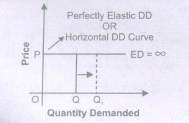 |
Diagram | 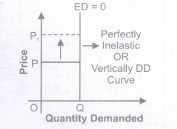 |
Numerical Problems on Price Elasticity of Demand to Calculate PED
13.
| %Change in Demand =? | % Change in Price = 5% |
| Elasticity of Demand (ED) = (-) 0.2 | |
Price Elasticity of Demand (ED) = \({\% \ change \ in \ quntity \ Demand \over \% \ Change \ in \ price}\)
\((-)0.2={\% \ change \ in \ quntity \ Demand \over \% 5}\)
Percentage fall in demand = 1%
Demand for the piece of goods will fall by 1%.
14.
Given Q = 10 - 3P.
When P = \({5\over3},Q=10-3\times{5\over3}=5\)
Differentiating Q with respect to P,
we get,
We know,\({\triangle Q\over \triangle P}=-3\)
\(ED={\triangle Q\over \triangle P}\times {P\over Q}=-3\times{5/3\over 5}\)
\(=-3\times{5\over3}\times{1\over5}=[-]1\)
Negative Sign of ED indicates that inverse relationship between price and quantity demanded.
PED = 1 [Unitary elastic demand].
15.
The degree of responsiveness of quantity demanded to changes in price of commodity is known as price elasticity of demand.

11th Standard CBSE Syllabus & Materials
11th Standard CBSE
CBSE 11th Business Studies Forms of Business Organisation Sample Question Papers Study Material - QB365 Set A
NEW11th Standard CBSE
CBSE 11th Business Studies Business, Trade and Commerce Sample Question Papers Study Material - QB365 Set A
NEW11th Standard CBSE
CBSE 11th Physics Waves Sample Question Papers Study Material - QB365 Set A
NEW11th Standard CBSE
CBSE 11th Physics Kinetic Theory Sample Question Papers Study Material - QB365 Set A



CBSE 11th Standard CBSE Subjects
CBSE Standards










