
 100% FREE ACCESS
11th Standard CBSE Syllabus & Materials
11th Standard CBSE
CBSE 11th Economics PART-A - Presentation of Data - New Sample Question Papers Study Material - QB365 Set A
NEW11th Standard CBSE
CBSE 11th Economics PART-A - Organisation of Data - New Sample Question Papers Study Material - QB365 Set A
NEW11th Standard CBSE
CBSE 11th Economics PART-A - Collection of Data - New Sample Question Papers Study Material - QB365 Set A
NEW11th Standard CBSE
CBSE 11th Economics PART-A - Introduction to Economics and Statistics - New Sample Question Papers Study Material - QB365 Set A
NEW11th Standard CBSE
CBSE 11th Business Studies International Trade Sample Question Papers Study Material - QB365 Set A
NEW11th Standard CBSE
CBSE 11th Business Studies Evolution and Fundamentals of Business Sample Question Papers Study Material - QB365 Set A

Published on: 23/09/2019
Introduction to Economics
Download CBSE Class 11th Standard CBSE undefined question papers, sample papers, important questions, and previous year solved papers in PDF format. Get free study materials, NCERT solutions, and exam preparation resources for Class 11th Standard CBSE undefined
Questions + Answers key
Take MCQ Biology Test
1.
Discuss the central problems of an economy
2.
Explain three factors that lead to an economic problem
3.
State any two causes of economic problem.
4.
Using a diagram explain what will happen to the PPC of Bihar if the river Kosi causes widespread floods?
5.
Production in an economy is below to its potentiality due to unemployment. Government starts employment generation schemes. Explain its effects by using production possibility curve.
6.
Explain the meaning of opportunity cost with the help of production possibility schedule.
7.
"An economy always produces on but not inside PPC. Defend or refute
8.
Distinguish between microeconomics and macroeconomics.
1.
The three central problems of an economyare:
(i) What to produce?
(a) What to produce refers to a problem in which decision regarding which goods and services should be produced is to be taken.
(b) Since its resources are limited, every economy has to decide what commodities are to be produced and in what quantities.
(c) The guiding principle for an economy here is to allocate resources in such a way that gives maximum aggregate utility to the society.
(ii) How to produce?
(a) How to produce refers to a problem in which decision regarding which technique of production should be used is made.
(b) Goods and services can be produced in two ways: by using labour intensive techniques, and by using capital-intensive techniques
(c) The guiding principle for an economy in such a case has to decide about the techniques of production on the basis of cost of production. Those techniques of production should be used which lead to the least possible cost per unit of commodity or service.
(iii) For whom to produce?
(a) For whom to produce refers to a problem in which decision regarding which category of people are going to consume a good, i.e., economically poor or rich.
(b) As we know, goods and services are produced for those who can purchase them or have the capacity to buy them.
(c) Capacity to buy depends upon how income is distributed among the factors of production. The higher the income, the higher will be the capacity to buy and vice versa. So, this is a problem of distribution.
(d) The guiding principle is that the economy must see here that important and urgent wants of its citizens are being satisfied for the maximum possible extent or not.
2.
Economic problem arises because of scarcity of resources in relation to demand for them.
(i) Wants are unlimited:
(a) This is a basic fact of human life. Human wants are unlimited.
(b) They are not only unlimited but also grow and multiply very fast.
(ii) Resources are limited:
(a) The resources to produce goods and services to satisfy human wants are available in limited quantities. Land, labour, capital and entrepreneurship are the basic scarce resources.
(b) These resources are available in limited quantities in every economy, big or small, developed or underdeveloped, rich or poor. Some economies may have more of one or two resources but not all the resources.
(c) For example, Indian economy has relatively more labour but less capital and land. The U.S. economy has relatively more land but less labour. No economy in the world is comfortable in all the resources.
(iii) Resources have alternative uses:
(a) Generally a resource has many alternative uses.
(b) A worker can be employed in a factory, in a school, in a government office, self employed and so on.
(c) Like this, nearly all resources have alternative uses. But the problem is that which resource should be put to which use.
3.
Economic problem arises because of scarcity of resources in relation to demand for them.
(i) Wants are unlimited:
(a) This is a basic fact of human life. Human wants are unlimited.
(b) They are not only unlimited but also grow and multiply very fast.
(ii) Resources are limited:
(a) The resources to produce goods and services to satisfy human wants are available in limited quantities. Land, labour, capital and entrepreneurship are the basic scarce resources.
(b) These resources are available in limited quantities in every economy, big or small, developed or underdeveloped, rich or poor. Some economies may have more of one or two resources but not all the resources.
(c) For example, Indian economy has relatively more labour but less capital and land. The U.S. economy has relatively more land but less labour. No economy in the world is comfortable in all the resources.
(iii) Resources have alternative uses:
(a) Generally a resource has many alternative uses.
(b) A worker can be employed in a factory, in a school, in a government office, self employed and so on.
(c) Like this, nearly all resources have alternative uses. But the problem is that which resource should be put to which use.
4.
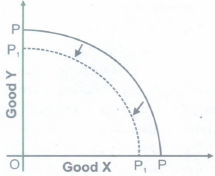
If the river Kosi causes widespread floods in Bihar, it will lead to destruction of resources in Bihar. This will shift the PPC leftward. Initially PPC is PP. With floods, the PPC will shift to P1P1
Value: Analytic
5.
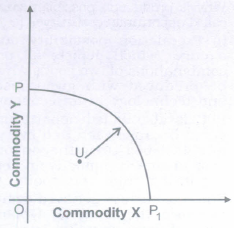
Production possibility curve is a curve which depicts all the possible combinations of goods which can be produced with given resources and technology in an economy i.e., producing goods at its full potentiality. Production below the potentiality means that total production in the economy is somewhere below the production possibility curve PPI, for example, point U in the diagram. We know production below the production possibility curve highlights unemployment. When government starts employment generation schemes, the economy moves towards the full employment, thereby removes unemployment. So, economy comes back to its potential level.
Value: Analytic
6.
Opportunity cost of any commodity is the amount of other good which has been given up in order to produce that commodity. Alternatively, opportunity cost of a given activity is the value of the next best activity.
Production Possibility Schedule
| Production Possibilities | Production of Commodity X | Production of Commodity Y |
|---|---|---|
| A | 0 | 15 |
| B | 1 | 14 |
| C | 2 | 12 |
| D | 3 | 9 |
| E | 4 | 5 |
| F | 5 | 0 |
Initially at combination B, in order to produce one unit of X, the economy has to sacrifice one unit of Y. So, at combination B, opportunity cost is 1 unit. At combination C, for producing additional unit of commodity X, the economy has to sacrifice 2 units of commodity Y. So, at combination C, opportunity cost is 2 units. Similarly, at combination D, for producing additional unit of commodity X, the economy has to sacrifice 3 units of commodity Y. So, at combination C, opportunity cost is 3 units and so on.
7.
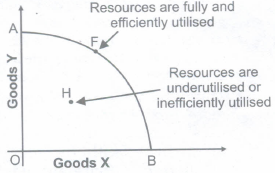
The given statement is refuted. An economy operates on PPC, only when resources are fully and efficiently utilised. It means, if there is unemployment or inefficient use of resources, the economy may operate inside PPC. So, the economy may operate at point 'H' (Figure), in addition to the points on the curve AB on PPC.
8.
| Microeconomics | Basis | Macroeconomics |
|---|---|---|
| Microeconomics studies the behaviour of individual economic units of an economy, like households, firms, individual consumers and producers etc. | Degree of Aggregation | Macroeconomics is that part of economic theory which studies the economy as a whole, such as national income, aggregate employment, general price level, aggregate consumption, aggregate investment, etc |
| The objective of macroeconomics is to study the principles, problems, policies concerning the optimum utilisation of resources. | Objective | Its objective is to study the problems, policies and principles relating to the full employment of resources. |
| In this, laws are based on the assumption of other things being constant (ceteris paribus). It means that we show effect of only one change by keeping other factor constant. This method of study is called partial equilibrium analysis. | Method of study |
In this, laws are formulated so that mutual interdependence between different economic variables such as total savings total employment could be studied easily. This method of study is called general equilibrium analysis. |
| Its main instruments are demand and supply. | Instrument | Its main instruments are aggregate demand and aggregate supply |
| It is also called 'Price Theory' | Alternative Name | It is also called the 'Income Theory' or 'Employment Theory'. |

11th Standard CBSE Syllabus & Materials
11th Standard CBSE
CBSE 11th Business Studies Forms of Business Organisation Sample Question Papers Study Material - QB365 Set A
NEW11th Standard CBSE
CBSE 11th Business Studies Business, Trade and Commerce Sample Question Papers Study Material - QB365 Set A
NEW11th Standard CBSE
CBSE 11th Physics Waves Sample Question Papers Study Material - QB365 Set A
NEW11th Standard CBSE
CBSE 11th Physics Kinetic Theory Sample Question Papers Study Material - QB365 Set A



CBSE 11th Standard CBSE Subjects
CBSE Standards










