
 100% FREE ACCESS
11th Standard CBSE Syllabus & Materials
11th Standard CBSE
CBSE 11th Economics PART-A - Presentation of Data - New Sample Question Papers Study Material - QB365 Set A
NEW11th Standard CBSE
CBSE 11th Economics PART-A - Organisation of Data - New Sample Question Papers Study Material - QB365 Set A
NEW11th Standard CBSE
CBSE 11th Economics PART-A - Collection of Data - New Sample Question Papers Study Material - QB365 Set A
NEW11th Standard CBSE
CBSE 11th Economics PART-A - Introduction to Economics and Statistics - New Sample Question Papers Study Material - QB365 Set A
NEW11th Standard CBSE
CBSE 11th Business Studies International Trade Sample Question Papers Study Material - QB365 Set A
NEW11th Standard CBSE
CBSE 11th Business Studies Evolution and Fundamentals of Business Sample Question Papers Study Material - QB365 Set A

Published on: 25/10/2019
Measures of Central Tendency - Median and Mode
Download CBSE Class 11th Standard CBSE undefined question papers, sample papers, important questions, and previous year solved papers in PDF format. Get free study materials, NCERT solutions, and exam preparation resources for Class 11th Standard CBSE undefined
Questions + Answers key
Take MCQ Biology Test
1.
What are quartiles? How are quartiles, deciles and percentiles different from each other?
2.
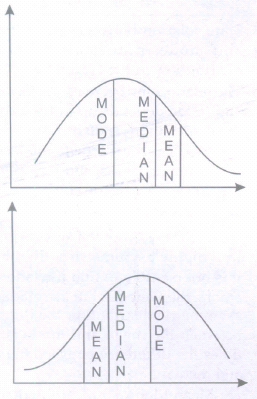
State relation between mean, median and mode in normal and skewed distribution with an example.
3.
Define Mode. Discuss its merits and demerits.
4.
From the data given below, find Mean, Median and Mode.
| Marks | 0-10 | 10-20 | 20-30 | 30-40 | 40-50 | 50-60 |
| No of students | 8 | 12 | 20 | 10 | 6 | 4 |
5.
From the data given below, find Q1 and Q3.
| Mid Values | 10 | 20 | 30 | 40 | 50 | 60 |
| Frequency | 3 | 5 | 8 | 6 | 5 | 3 |
6.
Calculate Q1 and Q3 from the following data set.
| Marks in Economics | 0-10 | 10-20 | 20-30 | 30-40 | 40-50 | 50-60 | 60-70 | 70-80 |
| No. of students | 5 | 15 | 18 | 12 | 20 | 15 | 7 | 3 |
7.
Find the Lower and Upper Quartile in the set of numbers given below:
62, 68, 53, 57, 20, 30, 32, 45, 72, 77, 81
8.
The hourly wages of 7 workers are 19, 21, 32, 45, 60, 65, 70. Find the median wages.
9.
Find the median in the set of numbers given below:
62, 68, 53, 57, 20, 30, 32, 45, 72, 77, 81
1.
Quartile is that value which divides the total distribution into four equal parts. So there are three quartiles, i.e. Q1, Q2 and Q3. Q1, Q2 and Q3 are termed as first quartile, second quartile and third quartile or lower quartile, middle quartile and upper quartile respectively. Quartiles, deciles and percentiles all are positional measures with following difference.
Quartiles divide the series into four equal parts, deciles divide the series into 10 equal parts, and percentiles divide the series into 100 equal parts. Method of their estimation is also similar.
2.
The relationship between mean, median and mode depends upon the nature of the distribution. A distribution may be symmetrical or asymmetrical.
In asymmetrical distribution the mean, median and mode are equal
i.e. Mean(AM) = Median(M)
= Mode(Mo)
In a highly asymmetrical distribution it is not possible to find a relationship among the averages. But in a moderately asymmetric distribution the difference between the mean and mode is three times the difference between the mean and median.
i.e. Mean-Mode = 3(Mean-Median)
In other words, In a normal Distribution,
Mean = Median = Mode
But in a moderately skewed distribution,
Mode = 3Median - 2Mean
This formula can also be used to find mode in case of bimodal series. If this formula is used to find mode, such a mode is called empirical mode. Karl Pearson expressed this relationship as:
Mode = mean - 3 [mean - median]
Mode = 3 median - 2 mean and Median = mode + ()
Knowing any two values, the third can be computed.
Example: Given median = 20.6, mode = 26 Find mean.
Mode = 3 median - 2 mean
\(\therefore\) Mean = () [3 median - mode)
\(\therefore\) Mean = () [3(20.6) - (26)]
\(\therefore\) Mean = () [35.8]
\(\therefore\) Mean = 17.9
3.
Mode is the most frequent item in the series.
Merits:
(a) It is easy to calculate and simple to understand.
(b) It is not affected by the extreme values.
(c) The value of mode can be can be determined graphically.
(d) Its value can be determined in case of open-end class interval.
(e) The mode is the most representative of the distribution.
Demerits:
(a) It is not suitable for further mathematical treatments.
(b) The value of mode cannot always be determined.
(c) The value of mode is not based on each and every items of the series.
(d) The mode is strictly defined.
(e) It is difficult to calculate when one of the observations is zero or the sum of the observations is zero.
4.
Calculation of Arithmetic mean by direct method
| Marks | Frequency (f) | Mid Value (M) | Frequency* Midvalue (FM) |
|---|---|---|---|
| 0.10 | 8 | 5 | 40 |
| 10-20 | 12 | 15 | 180 |
| 20-30 | 20 | 25 | 500 |
| 30-40 | 10 | 35 | 350 |
| 40-50 | 6 | 45 | 270 |
| 50-60 | 4 | 55 | 220 |
| Total | ΣF=60 | ΣFM=1560 |
\(\bar x=\frac{\sum_{i=1}^nf_im_i}{\sum_{i=1}^nf_i}=\frac{1560}{60}=26\)
Calculation of Median
| Marks | Frequency (f) | Cumulative Frequency |
|---|---|---|
| 0-10 | 8 | 8 |
| 10-20 | 12 | 20 |
| 20-30 | 20 | 40 |
| 30-40 | 10 | 50 |
| 40-50 | 6 | 56 |
| 50-60 | 4 | 60 |
\(Median=size\ of\frac{N}{2}\ Item\)
Median = size of \(\frac{60}{20}\) observation 30th observation lies in 20-30
We can find median by using the formula equal to
\(Median=l_1+\frac{(\frac{N}{2}-C)}{f}(i)\)
Where l1 = 20; f = 20;\(\frac{N}{2}=30\);C = 20; i = 10
\(Median=20+\frac{(30-20)}{20}(10)=25\)
Mode = 3Median - 2Mean
Mode = 3 (25) - 2 (26)
Mode = 23
5.
| Mid Value | Frequency | Classes | Cumulative Frequency (less than type) |
| 10 | 3 | 5-15 | 3 |
| 20 | 5 | 15-25 | 8 |
| 30 | 8 | 25-35 | 16 |
| 40 | 6 | 35-45 | 22 |
| 50 | 5 | 45-55 | 27 |
| 60 | 3 | 55-65 | 30 |
\(Q_1=\frac{n}{4}th\ observation\frac{30}{4}=7.5th\ observation\)
Q1 class is 15-25
\(Q_1=l_1+\frac{(\frac{N}{4}-C)}{f}(i)\)
Where l1 = 15; f = 5;\(\frac{N}{4}=7.5\); C=3;i=10
\(Q_1=10+\frac{(7.5-3)}{5}(10)=24\)
\(Q_3=\frac{3(n)}{4}\ observation\frac{3(30)}{4}=22.5\ observation\)
Q3 class is 45-55
Then Quartile of a continuous series can be calculated by the below interpolation formula.
\(Q_3=l_1+\frac{(\frac{3N}{4}-C)}{f}(i)\)
Where l1 = 45, f= 5;\(\frac{3N}{4}=22.5\);C = 22, i = 10
\(Q_3=45+\frac{(22.5-20)}{5}(10)=50\)
6.
| Mark in Economics | No. of students | Cf |
| 0.10 | 5 | 5 |
| 10-20 | 15 | 20 |
| 20-30 | 18 | 38 |
| 30-40 | 12 | 50 |
| 40-50 | 20 | 70 |
| 50-60 | 15 | 85 |
| 60-70 | 7 | 92 |
| 70-80 | 3 | 95 |
| 95 |
\(Q_1=\frac{n}{4}\ observation\frac{95}{4}\ observation\)
Q1 class is 20-30
\(Q_1-l_1\frac{(\frac{N}{4}-C)}{f}(i)\)
Where l1=20;f=18;\(\frac{N}{2}=23.75\);C=20;i=10
\(Q_1=\frac{(23.75-20)}{18}=22.08\)
\(Q_3\frac{3(n)}{4}\ observation\frac{3(95)}{4}=71.25 \ observation\)
Q3 class is 50-60
Then Quartile of a continuous series can be calculated by the below interpolation formula.
\(Q_3l_1\frac{(3\frac{N}{4}-C)}{f}(i)\)
Where l1=50;f=15;\(\frac{3N}{2}=71.25\);C=20;i=10
\(Q_1=\frac{(71.25-70)}{15}=50.83\)
7.
| Serial Number | Value |
| 1 | 20 |
| 2 | 30 |
| 3 | 32 |
| 4 | 45 |
| 5 | 53 |
| 6 | 57 |
| 7 | 62 |
| 8 | 68 |
| 9 | 72 |
| 10 | 77 |
| 11 | 81 |
\(Q_1=\frac{n+1}{4}\ observation\frac{11+1}{4}\ observation=32\)
\(Q_3=\frac{3(n+1)}{4}th\ observation\frac{3(11+1)}{4}=9th\ observation=72\)
8.
| Serial Number | Value |
| 1 | 19 |
| 2 | 21 |
| 3 | 32 |
| 4 | 45 |
| 5 | 60 |
| 6 | 65 |
| 7 | 70 |
\(Median=\frac{n+1}{2}th\ observation\frac{6+1}{2}\ observation=\frac{3rd\ item+4\ item}{2}=\frac{140+145}{2}=142.5\)
9.
From the definition of median, we should be able to tell that the first step is to rearrange the given set of numbers in order of increasing magnitude, i.e. from the lowest to the highest
| Serial Number | Value |
| 1 | 20 |
| 2 | 30 |
| 3 | 32 |
| 4 | 45 |
| 5 | 53 |
| 6 | 57 |
| 7 | 62 |
| 8 | 68 |
| 9 | 72 |
| 10 | 77 |
| 11 | 81 |
\(Median=\frac{n+1}{2}th\ observation \frac{11+1}{2}\) observation=57.

11th Standard CBSE Syllabus & Materials
11th Standard CBSE
CBSE 11th Business Studies Forms of Business Organisation Sample Question Papers Study Material - QB365 Set A
NEW11th Standard CBSE
CBSE 11th Business Studies Business, Trade and Commerce Sample Question Papers Study Material - QB365 Set A
NEW11th Standard CBSE
CBSE 11th Physics Waves Sample Question Papers Study Material - QB365 Set A
NEW11th Standard CBSE
CBSE 11th Physics Kinetic Theory Sample Question Papers Study Material - QB365 Set A



CBSE 11th Standard CBSE Subjects
CBSE Standards










