100% FREE ACCESS
11th Standard CBSE Syllabus & Materials
11th Standard CBSE
CBSE 11th Economics PART-A - Presentation of Data - New Sample Question Papers Study Material - QB365 Set A
NEW11th Standard CBSE
CBSE 11th Economics PART-A - Organisation of Data - New Sample Question Papers Study Material - QB365 Set A
NEW11th Standard CBSE
CBSE 11th Economics PART-A - Collection of Data - New Sample Question Papers Study Material - QB365 Set A
NEW11th Standard CBSE
CBSE 11th Economics PART-A - Introduction to Economics and Statistics - New Sample Question Papers Study Material - QB365 Set A
NEW11th Standard CBSE
CBSE 11th Business Studies International Trade Sample Question Papers Study Material - QB365 Set A
NEW11th Standard CBSE
CBSE 11th Business Studies Evolution and Fundamentals of Business Sample Question Papers Study Material - QB365 Set A

Published on: 03/10/2019
Supply
Download CBSE Class 11th Standard CBSE undefined question papers, sample papers, important questions, and previous year solved papers in PDF format. Get free study materials, NCERT solutions, and exam preparation resources for Class 11th Standard CBSE undefined
Questions + Answers key
Take MCQ Biology Test
1.
State factors for leftward shift of supply curve.
2.
State factors that can cause a rightward shift of supply curve.
3.
Distinguish between stock and supply.
4.
Price of commodity A is Rs.10 per unit and total revenue at this price is Rs.1,600. When its price rises by 20 percent, total revenue increases by Rs.800. Calculate its price elasticity of supply
5.
The price of a commodity rises from Rs.5 per unit to Rs.6 per unit. Consequently, its supply increases by 20%. Comment on PES.
6.
When price of a commodity falls by 50%, the quantity supplied decreases by 100%. Find out its price elasticity of supply
7.
The price elasticity of supply of a commodity is 2.5. At a price of Rs.5 per unit, its quantity supplied is 300 units. calculate its quantity supplied at a price of Rs.4 per unit.
8.
PES of a commodity is 5. A producer sells 500 units of a good at a price of Rs. 5 per unit. How much wil be willing to sell at the price of Rs.6 per unit?
9.
Differentiate between increase in supply ·and expansion in supply [increase in quantity supplied].
10.
Explain effect of technological changes on supply of a product.
11.
Explain effect of 'change in prices' of other products on supply of a given product.
12.
Explain how changes in prices of inputs influence the supply of a product.
13.
Explain the concept of law of supply.
14.
A firm earns a revenue of Rs.50 when the market price of a good is Rs.10. The market price increases to Rs.15 and the firm now earns a revenue of Rs.150. What is the price elasticity of the firm's supply curve?
15.
At the market price of Rs.10, a firm supplies 4 units of output. The market price increases to Rs.30. The price elasticity of the firm's supply is 1.25. What quantity will the firm supply at the new price?
16.
What is the supply curve of a firm in the short run?
17.
What does the price elasticity of supply mean? How do we measure it?
18.
How does an increase in price of an input affect the supply curve of a firm?
19.
How does technological progress affect the supply curve of a firm?
20.
Consider a market with two firms. In the following table, columns labelled as SS1 and SS2 give the supply schedules of firm 1 and firm 2 respectively. Compute the market supply schedule.
| Price (Rs) | SS1(Kg) | SS2 (Kg) |
|---|---|---|
| 0 | 0 | 0 |
| 1 | 0 | 0 |
| 2 | 0 | 0 |
| 3 | 1 | 0 |
| 4 | 2 | 0.5 |
| 5 | 3 | 1 |
| 6 | 4 | 1.5 |
| 7 | 5 | 2 |
| 8 | 6 | 2.5 |
1.
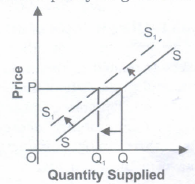
A decrease in supply means that producers now supply less at a given price level. The conditions are:
(a) Rise in the prices of remuneration of factors of production.
(b) Rise in the prices of other goods.
(c) When the technology becomes outdated.
(d) Change in the objective of producer (decrease supply at the same price).
(e) Taxation policy of government rises.
2.
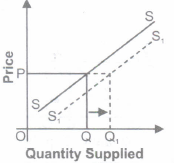
An increase in supply means that producers now supply more at a given price level. The conditions or causes are:
(a) Fall in the prices of other goods
(b) Fall in the prices of remuneration of factors of production.
(c) Improvement in Technology.
(d) Change in objective of producer (increase the supply at the same rate).
(e) Taxation policy of government falls.
3.
| Stock | Basis | Supply |
|---|---|---|
| Stock refers to total quantity of a particular commodity that is available with the firm at a particular point of time. | Meaning | Supply refers to the quantity of a commodity that a firm is willing and able to offer for sale, at each possible price during a given period of time. |
| It is static in nature. | Nature | It is Dynamic in nature |
| Stock can never be less than supply. | Greater/ Smaller | Supply can be equal or smaller than stock. |
4.
We have,
| Initial Price (P) = Rs.10 | Initial Revenue = 1600 | Initial Quantity (Q) = \(\frac { TR }{ P } =\frac { 1600 }{ 10 } =160\) |
| New Price (P1)= Rs.12 | New Revenue = 2400 | New Quantity (Q1) =\(\frac { TR }{ P } =\frac { 2400 }{ 12 } =200\) |
| [As price increases by 20%. So, 20% of initial price [10] = 2. So, New price = Initial price + \(\triangle \)P= 10 + 2 = 12 | \(\triangle \)P = 2 | \(\triangle \)Q = 40 |
\(PES=\frac { \triangle Q }{ \triangle P } \times \frac { P }{ Q } =\frac { 40 }{ 2 } \times \frac { 10 }{ 160 } =\frac { 400 }{ 320 } \)
PES = 1.25 [More than unitary elastic supply or elastics supply]
5.
We have,
| Initial Price (P)=Rs.5 | Percentage change in quantity supplied=20% |
| New Price (P1) = Rs.6 | \(\triangle \)P=1 |
Percentage change in price = \(\frac { \triangle P }{ P } \times 100=\frac { 1 }{ 5 } \times 100\)=20%
PES=\(\frac { Percentage\ change\ in\ quantity\ supplied }{ Percentage\ change\ in\ price } =\frac { 20\%}{ 20 \%} =1\)
PES = 1 [Unitary Elastic supply]
6.
| % Change in Quantity = 100% | % Change in Price (P)= 50% |
| Elasticity of Supply (ES) =? | |
\(ES=\frac { percentage\ change\ in\ quantity\ supplied }{ Percentage\ change\ in\ price } ={{100\%}\over{50\%}}=2\)
ES = 2 (Supply is highly elastic as ES > 1)
ES is always positive due to direct relationship between price and quantity supplied.
7.
| Original Quantity(Q)=300 units | Original Price(P)=Rs.5 |
| New Quantity (Q1)=? | New Price(P1)=Rs.4 |
| Change in quantity(\(\triangle \)Q)=? | Change in price(\(\triangle \)P)=Rs.1 |
| Elasticity of supply(ES)=2.5 | |
Price Elasticity of Supply (ES)= \(\frac { \triangle Q }{ \triangle P } \times \frac { P }{ Q } \)
\(2.5=\frac { \triangle Q }{ 1 } \times \frac { 5 }{ 300 } \),i.e.,\(\triangle \)Q=150
As price decreases, than quantity supplied will also decrease. It means, New Quantity = Original Quantity (Q) - Change in Quantity (\(\triangle \)Q] = 300 - 150 = 150 units New Quantity = 150 units
8.
| ES=5 | |
| Initial price(P)=Rs.5 | Initial Quantity(Q)=500 |
| New Price(P1)=Rs.6 | New Quantity(Q1)=? |
| \(\triangle \)P=1 | \(\triangle \)Q=? |
PES=\(\frac { \triangle Q }{ \triangle P } \times \frac { P }{ Q } \)
\(5=\frac { \triangle Q }{ 1 } \times \frac { 5 }{ 500 } \)
\(\triangle Q=\frac { 2500 }{ 5 } =500\)
As price increases, quantity supplied must also increses as per law of supply
New Quantity=Initial Quantity+\(\triangle \)Q=500+500=1000
9.
| Increase in Supply | Basis | Expansion in Supply | ||||||||
|---|---|---|---|---|---|---|---|---|---|---|
| An increase in supply means that producers now supply more at a given orice level | Meaning | It states that rise in quantity supplied due to the rise in price of the commodity | ||||||||
| (i) Fall in the price of remuneration of factors of production (ii) Fall in the prices of other goods (iii) Improvement in technology. (iv) Change in objective of producer (increase the supply at the same rate). (v) Taxation policy of government falls. |
Cause | It is caused by rise in price of the commodity. | ||||||||
|
Schedule |
|
||||||||
|
|
Diagram | 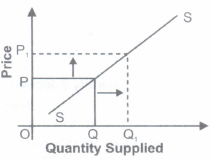 |
10.
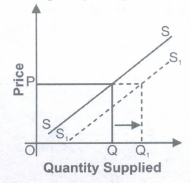
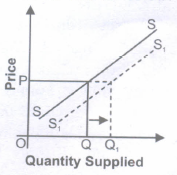
Case 1- Technological Progress: When there is technological progress in the firm, then cost of production will decrease, which leads to increase in the profit margin of the firm and thereby shifts the supply curve shifts rightward as shown below:
Case ll- Outdated Technology
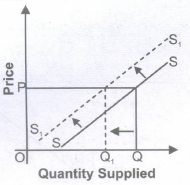
Supply of those goods which are being produced with old and inferior technology causing increase in cost of production will decrease the total output and shift the supply curve to the left.
11.
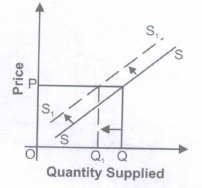
Case1- Rise in Price of other Goods: As we mow price of other goods are inversely related to the supply of given commodity. So, when there is rise in price of other product, the supply curve of given commodity decreases and shifting the supply curve to the left as shown in the given figure.
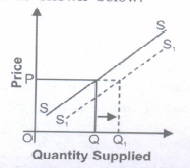
Case ll- Fall in price of Other goods: As, against it, if there is fall in price of other product, the supply curve of a given commodity increase and shifting the supply curve to the right as shown below:
12.
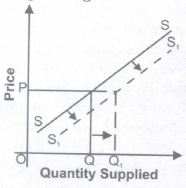
Case 1- When price of input rises: Due to rise in price of input the cost of production of a firm increases, which will thereby decrease the supply curve to the left as shown in the given figure.
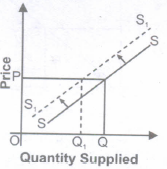
Case ll- When price of input falls: Due to fall in price of input, the cost of production of a firm decreases which will thereby increase the supply curve to the right as shown in the given figure.
13.
It is based on certain assumptions. If these assumptions fulfil in the economy, Law of supply states that positive relationship exists between price of the commodity and quantity supplied of that commodity.
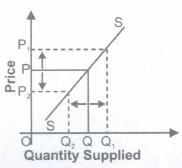
"Other things being constant (ceteris paribus), based on the price of the commodity" is called Law of Supply. It means due to rise in price of a commodity its quantity supplied also rises and vice-versa.
The assumptions are as under:
(a) Price of other commodity remains constant.
(b) Technology of production should not change.
(c) Cost of production remains constant.
(d) Goal of the firm remains constant.
(e) Taxation policy of the government should not change.
| Price(Rs.) | Supply(Units) |
|---|---|
| 1 | 5 |
| 2 | 10 |
| 3 | 15 |
| 4 | 20 |
14.
| Price(Rs) | Total Receipts(Rs) | Quantity in units (Total Receipts+price) |
|---|---|---|
| 10 | 50 | 5 |
| 15 | 150 | 10 |
| Original Quantity (Q)= 5 units | OriginalPrice(P)=Rs.10 |
| NewQuantity (Q1)=10 units | NewPrice (P1)=Rs.15 |
| Change in Quantity (\(\triangle Q\))=5 units | Change in Price(\(\triangle P\))=Rs.5 |
| Elasticity of supply (ES)=? | |
Price Elasticity
of Supply (ES)=\(\frac { \triangle Q }{ \triangle P } \times \frac { P }{ Q } =\frac { 5 }{ 5 } \times \frac { 10 }{ 5 } =2\)
ES=2 (supply is highly elastic as ES>1)
ES is always positive due to direct relationship between price and quantity supplied.
15.
| Original Quantity(Q)=4 units | Original Price(P)=Rs.10 |
| New Quantity(Q1)=? | Rise in price(\(\triangle \)P)=Rs.20 |
| Change in Quantity(\(\triangle \)Q)=? | New Price (P1)=Rs.30 |
| Elasticity of supply (ES)=1.25 | |
Price Elasticity of Supply (ES)=\(\frac { \triangle Q }{ \triangle P } \times \frac { P }{ Q } \)
\(1.25={{\triangle Q}\over{20}}\times{10\over4}\)
As price increases, then quantity supplied also increases. It means, New Quantity = Original Quantity (Q)+ Change in Quantity
(\(\triangle \)Q) = 4 + 10
= 14 units
New Quantity = 14 units.
16.
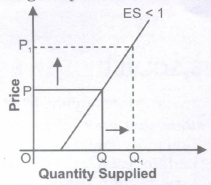
(i) In the short period, supply is relatively less elastic as firm can change the supply by changing the variable factors only, as fixed factors remain fixed during short period.
(ii) The supply curve during short period is inelastic, i.e., percentage change in quantity supplied is less than percentage change in price as shown below:
17.
(i) The degree of responsiveness of quantity supplied to the changes in price of the commodity is known as price elasticity of supply.
(ii) Percentage Method: To measure price elasticity of supply, we use percentage method. According to this method, elasticity is measured as the ratio of percentage change in the quantity supplied to percentage change in the price. Price elasticity of supply (ES)
\(=\frac { Percentage\ change\ in\ quantity\ supplied }{ Percentage\ change\ in\ price } \)
Where,
Percentage change in quantity supplied
\(=\frac { change\ in\ quantity\ supplied(\triangle Q) }{ Initial\ Quantity\ Supplied(Q) } \)X100
Change in Quantity \((\triangle Q)\)
=New Quantity(Q1)-Initial Quantity(Q)
Percentage change in price
\(=\frac { change\ in\ Price(\triangle P) }{ Initial\ Price(P) } \times 100\)
Change in price \((\triangle P)\)=New price (P1)-Initial Price (P)
Proportionate Method:
The percentage method can also be converted into the proportionate method. Putting the values of 1, 2, 3 and 4 in the formula of percentage method, we get,
\(ES=\frac { \frac { \triangle Q }{ Q } \times 100 }{ \frac { \triangle P }{ P } \times 100 } =\frac { \frac { \triangle Q }{ Q } }{ \frac { \triangle P }{ P } } \)
Elasticity of Supply (Proportionate Method)=\(\frac { \triangle Q }{ \triangle P } \times \frac { P }{ Q } \)
Where, Q = Initial Quantity Supplied
\(\triangle \)Q = Change in Quantity Supplied
P = Initial Price
\(\triangle \)P = Change in Price
18.
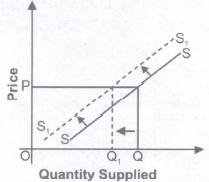
(i) This also influences the supply since price of inputs (rent, wages, interest, profit) constitutes the cost of production of a commodity.
(ii) An increase in the price of an input may lead to rise in cost of production, which will thereby decrease the production of a commodity shifting the supply curve to the left as shown.
19.
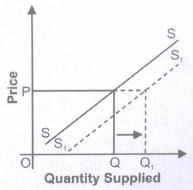
When there is technological progress in the firm, then cost of production will decrease, which leads to increase in the profit margin of the firm and thereby shifts the supply curve rightward as shown.
20.
| Price (Rs) | SS1(Kg) | SS2 (Kg) | Market supply (SS1+SS2) |
|---|---|---|---|
| 0 | 0 | 0 | 0 |
| 1 | 0 | 0 | 0 |
| 2 | 0 | 0 | 0 |
| 3 | 1 | 0 | 1 |
| 4 | 2 | 0.5 | 2.5 |
| 5 | 3 | 1 | 4 |
| 6 | 4 | 1.5 | 5.5 |
| 7 | 5 | 2 | 7 |
| 8 | 6 | 2.5 | 8.5 |

11th Standard CBSE Syllabus & Materials
11th Standard CBSE
CBSE 11th Business Studies Forms of Business Organisation Sample Question Papers Study Material - QB365 Set A
NEW11th Standard CBSE
CBSE 11th Business Studies Business, Trade and Commerce Sample Question Papers Study Material - QB365 Set A
NEW11th Standard CBSE
CBSE 11th Physics Waves Sample Question Papers Study Material - QB365 Set A
NEW11th Standard CBSE
CBSE 11th Physics Kinetic Theory Sample Question Papers Study Material - QB365 Set A



CBSE 11th Standard CBSE Subjects
CBSE Standards