
 100% FREE ACCESS
11th Standard CBSE Syllabus & Materials
11th Standard CBSE
CBSE 11th Economics PART-A - Presentation of Data - New Sample Question Papers Study Material - QB365 Set A
NEW11th Standard CBSE
CBSE 11th Economics PART-A - Organisation of Data - New Sample Question Papers Study Material - QB365 Set A
NEW11th Standard CBSE
CBSE 11th Economics PART-A - Collection of Data - New Sample Question Papers Study Material - QB365 Set A
NEW11th Standard CBSE
CBSE 11th Economics PART-A - Introduction to Economics and Statistics - New Sample Question Papers Study Material - QB365 Set A
NEW11th Standard CBSE
CBSE 11th Business Studies International Trade Sample Question Papers Study Material - QB365 Set A
NEW11th Standard CBSE
CBSE 11th Business Studies Evolution and Fundamentals of Business Sample Question Papers Study Material - QB365 Set A

Published on: 24/07/2019
Introduction to Economics
Download CBSE Class 11th Standard CBSE undefined question papers, sample papers, important questions, and previous year solved papers in PDF format. Get free study materials, NCERT solutions, and exam preparation resources for Class 11th Standard CBSE undefined
Questions + Answers key
Take MCQ Biology Test
1.
Discuss the central problems of an economy
2.
Which type of science is economics?
3.
State two features of resources that give rise to an economic problem?
4.
What is economics?
5.
What is meant by economy?
6.
Which one of the following alternatives illustrate a decrease in unemployment using the PPF?
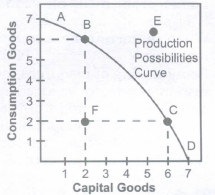
A movement down along the PPF.
A rightward shift of the PPF.
A movement from a point on the PPF to a point inside the PPF.
A movement from a point inside the PPF to a point on the PPF.
7.
Which of the following clearly represents a movement toward greater productive efficiency?
A movement from point A to point B
A movement from point C to point D.
A movement from point F to point C
A movement from point E to point B.
8.
An economy achieves "productive efficiency" when:
Resources are employed in their most highly valued uses.
The best resources are employed.
The total number of produced goods is the greatest.
Goods and services are produced at least cost and no resources are wasted
9.
The central problem in economics is that of
Comparing the success of command versus market economies
Guaranteeing that production occurs in the most efficient manner.
Guaranteeing a minimum level of income for every citizen.
Allocating scarce resources in such a manner that society's unlimited needs or wants are satisfied in the best possible manner.
10.
The law of scarcity
Does not apply to rich, developed countries
Applies only to the less developed countries.
Implies that consumers' wants will be satisfied in a socialistic system.
Implies that consumers' wants will never be completely satisfied
11.
Explain three factors that lead to an economic problem
12.
State any three assumptions on which a production possibilities curve is based.
13.
Define Production Possibility Curve and state its properties.
14.
State the central problems of an economy.
15.
Why do all economies have similar central problems?
16.
Why does an economic problem arise?
17.
A job guarantee scheme will lead to a rightward shift of PPF.
18.
Because of destruction caused by war, a country's PPF will shift to the left.
19.
Economic problem arises due to plenty of resources.
20.
In the context of an economy when we talk about 'scarcity', we refer to short supply of land.
21.
An economy always manages to meet all the needs of the people living in the country.
1.
The three central problems of an economyare:
(i) What to produce?
(a) What to produce refers to a problem in which decision regarding which goods and services should be produced is to be taken.
(b) Since its resources are limited, every economy has to decide what commodities are to be produced and in what quantities.
(c) The guiding principle for an economy here is to allocate resources in such a way that gives maximum aggregate utility to the society.
(ii) How to produce?
(a) How to produce refers to a problem in which decision regarding which technique of production should be used is made.
(b) Goods and services can be produced in two ways: by using labour intensive techniques, and by using capital-intensive techniques
(c) The guiding principle for an economy in such a case has to decide about the techniques of production on the basis of cost of production. Those techniques of production should be used which lead to the least possible cost per unit of commodity or service.
(iii) For whom to produce?
(a) For whom to produce refers to a problem in which decision regarding which category of people are going to consume a good, i.e., economically poor or rich.
(b) As we know, goods and services are produced for those who can purchase them or have the capacity to buy them.
(c) Capacity to buy depends upon how income is distributed among the factors of production. The higher the income, the higher will be the capacity to buy and vice versa. So, this is a problem of distribution.
(d) The guiding principle is that the economy must see here that important and urgent wants of its citizens are being satisfied for the maximum possible extent or not.
2.
()
Economics is a social science.
3.
()
The two features of resources that giverise to an economic problem are:
(i) Resources are limited.
(ii) They have alternative uses.
4.
()
Economics is about studying economic problems arising due to limited means (having alternative uses) in relation to unlimited wants.
5.
()
Economy is a system which provides people with the means to work and earn living.
6.
(d)
A movement from a point inside the PPF to a point on the PPF.
7.
(c)
A movement from point F to point C
8.
(d)
Goods and services are produced at least cost and no resources are wasted
9.
(d)
Allocating scarce resources in such a manner that society's unlimited needs or wants are satisfied in the best possible manner.
10.
(d)
Implies that consumers' wants will never be completely satisfied
11.
Economic problem arises because of scarcity of resources in relation to demand for them.
(i) Wants are unlimited:
(a) This is a basic fact of human life. Human wants are unlimited.
(b) They are not only unlimited but also grow and multiply very fast.
(ii) Resources are limited:
(a) The resources to produce goods and services to satisfy human wants are available in limited quantities. Land, labour, capital and entrepreneurship are the basic scarce resources.
(b) These resources are available in limited quantities in every economy, big or small, developed or underdeveloped, rich or poor. Some economies may have more of one or two resources but not all the resources.
(c) For example, Indian economy has relatively more labour but less capital and land. The U.S. economy has relatively more land but less labour. No economy in the world is comfortable in all the resources.
(iii) Resources have alternative uses:
(a) Generally a resource has many alternative uses.
(b) A worker can be employed in a factory, in a school, in a government office, self employed and so on.
(c) Like this, nearly all resources have alternative uses. But the problem is that which resource should be put to which use.
12.
The concept of PP curve is based on the following assumptions:
(i) First, the amount of resources in the economy is fixed.
(ii) Second, the technology is given and unchanged.
(iii) Third, the resources are efficient and fully employed.
13.
Production possibility curve is a curve which depicts all possible combinations of two goods which can be produced with given resources and technology in an economy.
Properties of Production Possibility Curve
(i) PPC is downward sloping: The downward slope of PPC means if the country wants to produce more of one good, it has to produce less quantity of the other goods.
(ii) PPC is concave to the point of origin:
Concave shape of PPC implies that the slope of PPC increases. Slope of PPC is defined as the quantity of goods Y given up in exchange for additional unit of goods X.
[Slope of Production Possibility Curve]
\(=\frac { \triangle Y }{ \triangle X } =\frac { Amount\ of\ Goods\ Y\ lost }{ Amount\ of\ Good\ X\ gained } \)
[Slope of PPC] = MRT = [Marginal Opportunity Cost]
14.
The central problems of an economy are:
(i) What to produce and in what quantity?
(ii) How to produce?
(iii) For whom to produce?
15.
All economies whether developed or developing, have similar central problem because one or more of their resources (land, labour, capital and entrepreneurship) are limited and these resources can be put to alternative uses. The wants of the economies are unlimited. Therefore all economies have to face the basic economic problem of choice (what to produce, how to produce and for whom to produce).
16.
Economic problem arises because of scarcity of resources in relation to demand for them.
(i) Wants are unlimited:
(a) This is a basic fact of human life. Human wants are unlimited.
(b) They are not only unlimited but also grow and multiply very fast.
(ii) Resources are limited:
(a) The resources to produce goods and services to satisfy human wants are available in limited quantities. Land, labour, capital and entrepreneurship are the basic scarce resources.
(b) These resources are available in limited quantities in every economy, big or small, developed or underdeveloped, rich or poor. Some economies may have more of one or two resources but not all the resources.
(c) For example, Indian economy has relatively more labour but less capital and land. The U.S. economy has relatively more land but less labour. No economy in the world is comfortable in all the resources.
(iii) Resources have alternative uses:
(a) Generally a resource has many alternative uses.
(b) A worker can be employed in a factory, in a school, in a government office, self employed and so on.
(c) Like this, nearly all resources have alternative uses. But the problem is that which resource should be put to which use.
17.
(b)
18.
(a)
19.
(b)
20.
(b)
21.
(b)

11th Standard CBSE Syllabus & Materials
11th Standard CBSE
CBSE 11th Business Studies Forms of Business Organisation Sample Question Papers Study Material - QB365 Set A
NEW11th Standard CBSE
CBSE 11th Business Studies Business, Trade and Commerce Sample Question Papers Study Material - QB365 Set A
NEW11th Standard CBSE
CBSE 11th Physics Waves Sample Question Papers Study Material - QB365 Set A
NEW11th Standard CBSE
CBSE 11th Physics Kinetic Theory Sample Question Papers Study Material - QB365 Set A



CBSE 11th Standard CBSE Subjects
CBSE Standards










