
 100% FREE ACCESS
11th Standard CBSE Syllabus & Materials
11th Standard CBSE
CBSE 11th Economics PART-A - Presentation of Data - New Sample Question Papers Study Material - QB365 Set A
NEW11th Standard CBSE
CBSE 11th Economics PART-A - Organisation of Data - New Sample Question Papers Study Material - QB365 Set A
NEW11th Standard CBSE
CBSE 11th Economics PART-A - Collection of Data - New Sample Question Papers Study Material - QB365 Set A
NEW11th Standard CBSE
CBSE 11th Economics PART-A - Introduction to Economics and Statistics - New Sample Question Papers Study Material - QB365 Set A
NEW11th Standard CBSE
CBSE 11th Business Studies International Trade Sample Question Papers Study Material - QB365 Set A
NEW11th Standard CBSE
CBSE 11th Business Studies Evolution and Fundamentals of Business Sample Question Papers Study Material - QB365 Set A

Published on: 25/07/2019
Consumer Equilibrium
Download CBSE Class 11th Standard CBSE undefined question papers, sample papers, important questions, and previous year solved papers in PDF format. Get free study materials, NCERT solutions, and exam preparation resources for Class 11th Standard CBSE undefined
Questions + Answers key
Take MCQ Biology Test
1.
How much is total utility at zero level of consumption?
2.
Define total utility
3.
Define utility.
4.
Explain why budget line is downward sloping?
5.
What is Budget Line?
6.
Explain the law of diminishing marginal utility schedule.
7.
"Total Utility remains the same, whether Marginal Utility is positive or negative". Defend or refute.
8.
How many chocolates will a consumer have, if they are available free of cost?
9.
Explain with diagram, the relationship between TU and MU.
10.
Suppose a consumer wants to consume two goods which are available only in integer units. The two goods are equally priced at Rs.10 and the consumer's income is Rs.40.
(i) Write down all the bundles that are available to the consumer.
(ii) Among the bundles that are available to the consumer's. Identify those which cost her exactly 40.
11.
The consumer is in equilibrium when the following condition is satisfied
\(\frac { M{ U }_{ x } }{ M{ U }_{ y } } >\frac { { P }_{ x } }{ { P }_{ y } } \)
\(\frac { M{ U }_{ x } }{ M{ U }_{ y } } >\frac { { P }_{ x } }{ { P }_{ y } } \)
\(\frac { M{ U }_{ x } }{ M{ U }_{ y } } =\frac { { P }_{ x } }{ { P }_{ y } } \)
None of these
12.
The second glass of lemonade gives lesser satisfaction to a thirsty boy. This is a clear case of
Law of demand
Law of diminishing returns.
Law of diminishing
Law of supply
13.
An indifference curve slopes down towards right since more of one commodity and less of another result in______________.
Same satisfaction.
Greater satisfaction.
Maximum satisfaction
Decreasing expenditure
14.
The consumer is in equilibrium at a point where the budget line___________.
Is above an indifference curve
Is below an indifference curve
Is tangent to an indifference curve
Cuts an indifference curve
15.
Total utility is maximum when
Marginal utility is zero
Marginal utility is at its highest point
Marginal utility is equal to average utility
Average utility is maximum
16.
If TU remains the same; MU may be negative or positive
17.
If there are two commodities, consumer is in equilibrium if \(\frac { M{ U }_{ x } }{ income } =\frac { M{ U }_{ y } }{ income } \)
18.
In case of single commodity, consumer will be in equilibrium when M.U. = Income
19.
Marginal utility of the first unit is equal to Total Utility
20.
A consumer is in equilibrium if he earns the maximum profit.
21.
State and explain the conditions of consumer's equilibrium in indifference curve analysis.
22.
What are the conditions of consumer's equilibrium under the indifference curve approach? What changes will take place if the conditions are not fulfilled to reach equilibrium
23.
Why is the consumer in equilibrium when he buys only that combination of the two goods that is shown at the point of tangency of the budget line with an indifference curve? Explain
24.
Using indifference curve approach, explain the conditions of consumer's equilibrium.
25.
A consumer consumes only two goods. Explain the conditions of the consumer's equilibrium with the help of Utility Analysis.
1.
()
Zero
2.
()
Total utility is the sum of all the utilities derived from consumption of all the units of a particular commodity.
3.
()
Utility is the power or capacity of a commodity to satisfy human wants
4.
()
Budget line is downward sloping because if a consumer wants to buy more of one commodity, he has to buy less of other goods, given money income.
5.
()
Budget line is a graphical representation which shows all the possible combinations of the two goods that a consumer can buy with the given income and prices of commodities. It is also called consumption possibility line.
6.
The law states that marginal utility derived from the consumption of a commodity declines as more units of that commodity are consumed
| Quantity of X | Total Utility | Marginal Utility |
|---|---|---|
| 1 | 50 | 50 |
| 2 | 90 | 40 |
| 3 | 120 | 30 |
| 4 | 140 | 20 |
| 5 | 150 | 10 |
It can be seen from the above schedule that total utility increases at a diminishing rate, which leads to fall in marginal utility.
7.
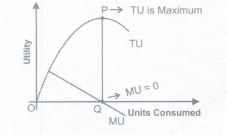
The given statement is refuted. When Marginal Utility is positive till point Q as shown in figure then total Utility increases at a diminishing rate and when Marginal Utility is negative after point Q, total Utility decreases.
8.
In case of free chocolates, consumer will carry on the consumption till his total utility is maximum. It means till the additional chocolates gives positive satisfaction, consumer will keep on having chocolates. Let us understand this with the help of the figure Consumer will stop the consumption at the point of satiety (Point 'Q'), i.e., where marginal utility is equal to zero.
9.
(i) When MU decreases, TU increases at a diminishing rate. (As shown in figure till consumption level OQ).
(ii) When MU is zero, TU is maximum at P.
(iii) When MU is negative, TU starts diminishing.
10.
Let Px = Py = Rs.10
Money Income = 40
(i) Bundles available to consumer are: (0,0), (0,1), (0,2), (0,3), (0,4), (1,0), (1,1), (1,2), (1,3), (2,0), (2,1), (2,2), (3,0), (3,1) and (4, 0).
(ii) (0,4), (1,3), (2,2), (3,1) and (4,0) cost exactly Rs.40. All the other bundles cost less than Rs.40.
11.
(c)
\(\frac { M{ U }_{ x } }{ M{ U }_{ y } } =\frac { { P }_{ x } }{ { P }_{ y } } \)
12.
(c)
Law of diminishing
13.
(a)
Same satisfaction.
14.
(c)
Is tangent to an indifference curve
15.
(a)
Marginal utility is zero
16.
(b)
17.
(b)
18.
(b)
19.
(a)
20.
(b)
21.
(i) To define consumer equilibrium, we use Indifference Curve map and the budget line.
Two Conditions Cor Consumer Equilibrium
(a) Necessary Condition
Marginal Rate of Substitution Market Rate of Exchange \(\left[ \frac { { P }_{ x } }{ { P }_{ y } } \right] \)
Or MRS x,y =\(\frac { { P }_{ x } }{ { P }_{ y } } \)
(Market Rate of Exchange) MRE
Or MRS x,y =MRE\(\left[ \frac { { P }_{ x } }{ { P }_{ y } } \right] \)
If MRS x,y>MRE\(\left[ \frac { { P }_{ x } }{ { P }_{ y } } \right] \)
(a) It means that to obtain one more unit of X, the consumer is willing to sacrifice more unit of Y as compared to what is required in the market.
(b) In other words, consumers willingness to pay for commodity X is higher than what market values for commodity X.
(c) This induces the consumer to buy more of X and less of Y, which result in fall in MRS till it become equal to price.
(ii) If MRS x,y< MRE\(\left[ \frac { { P }_{ x } }{ { P }_{ y } } \right] \)
(a) It means that to obtain one more unit of X, the consumer is willing to sacrifice less unit of Y as compared to what is required in the market.
(b) In other words, consumer's willingness to pay for commodity X is lower than what market values for commodity X.
(c) This induces the consumer to buy less of X and more of Y, which result in rise in MRS till it become equal to price.
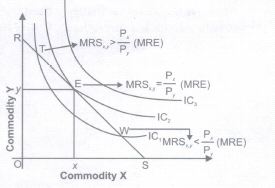
(b) Sufficient Condition MRS Diminishing (Convex) at X, Y a point of equilibrium i.e., when MRS x,y=MRE \(\left[ \frac { { P }_{ x } }{ { P }_{ y } } \right] \)
(ii) The consumer will reach equilibrium when the budget line is tangential to the higher possible Indifference Curve, i.e., where necessary and sufficient conditions satisfy. In the above diagram, the consumer will reach equilibrium at point E where budget line RS is tangential to the highest possible IC2.
(iii) The consumer cannot move to Indifference Curve, i.e., IC3 as this is beyond his money income.
(iv) Even on IC2, all the other points except E are beyond his means.
(v) Hence, at point E, the consumer is in equilibrium where his satisfaction maximizes, given his income and prices of goods X and Y. In equilibrium at E, the slope of Budget line = the slope of Indifference, Therefore, MRS xy is eq to the ratio of the prices of two goods \(\left[ \frac { { P }_{ x } }{ { P }_{ y } } \right] \)
22.
(i) To define consumer equilibrium, we use Indifference Curve map and the budget line.
Two Conditions Cor Consumer Equilibrium
(a) Necessary Condition
Marginal Rate of Substitution Market Rate of Exchange \(\left[ \frac { { P }_{ x } }{ { P }_{ y } } \right] \)
Or MRS x,y =\(\frac { { P }_{ x } }{ { P }_{ y } } \)
(Market Rate of Exchange) MRE
Or MRS x,y =MRE\(\left[ \frac { { P }_{ x } }{ { P }_{ y } } \right] \)
If MRS x,y>MRE\(\left[ \frac { { P }_{ x } }{ { P }_{ y } } \right] \)
(a) It means that to obtain one more unit of X, the consumer is willing to sacrifice more unit of Y as compared to what is required in the market.
(b) In other words, consumers willingness to pay for commodity X is higher than what market values for commodity X.
(c) This induces the consumer to buy more of X and less of Y, which result in fall in MRS till it become equal to price.
(ii) If MRS x,y< MRE\(\left[ \frac { { P }_{ x } }{ { P }_{ y } } \right] \)
(a) It means that to obtain one more unit of X, the consumer is willing to sacrifice less unit of Y as compared to what is required in the market.
(b) In other words, consumer's willingness to pay for commodity X is lower than what market values for commodity X.
(c) This induces the consumer to buy less of X and more of Y, which result in rise in MRS till it become equal to price.
(b) Sufficient Condition MRS Diminishing (Convex) at X, Y a point of equilibrium i.e., when MRS x,y=MRE \(\left[ \frac { { P }_{ x } }{ { P }_{ y } } \right] \)
(ii) The consumer will reach equilibrium when the budget line is tangential to the higher possible Indifference Curve, i.e., where necessary and sufficient conditions satisfy. In the above diagram, the consumer will reach equilibrium at point E where budget line RS is tangential to the highest possible IC2.
(iii) The consumer cannot move to Indifference Curve, i.e., IC3 as this is beyond his money income.
(iv) Even on IC2, all the other points except E are beyond his means.
(v) Hence, at point E, the consumer is in equilibrium where his satisfaction maximizes, given his income and prices of goods X and Y. In equilibrium at E, the slope of Budget line = the slope of Indifference, Therefore, MRS xy is eq to the ratio of the prices of two goods \(\left[ \frac { { P }_{ x } }{ { P }_{ y } } \right] \)
23.
(i) To define consumer equilibrium, we use Indifference Curve map and the budget line.
Two Conditions Cor Consumer Equilibrium
(a) Necessary Condition
Marginal Rate of Substitution Market Rate of Exchange \(\left[ \frac { { P }_{ x } }{ { P }_{ y } } \right] \)
Or MRS x,y =\(\frac { { P }_{ x } }{ { P }_{ y } } \)
(Market Rate of Exchange) MRE
Or MRS x,y =MRE\(\left[ \frac { { P }_{ x } }{ { P }_{ y } } \right] \)
If MRS x,y>MRE\(\left[ \frac { { P }_{ x } }{ { P }_{ y } } \right] \)
(a) It means that to obtain one more unit of X, the consumer is willing to sacrifice more unit of Y as compared to what is required in the market.
(b) In other words, consumers willingness to pay for commodity X is higher than what market values for commodity X.
(c) This induces the consumer to buy more of X and less of Y, which result in fall in MRS till it become equal to price.
(ii) If MRS x,y< MRE\(\left[ \frac { { P }_{ x } }{ { P }_{ y } } \right] \)
(a) It means that to obtain one more unit of X, the consumer is willing to sacrifice less unit of Y as compared to what is required in the market.
(b) In other words, consumer's willingness to pay for commodity X is lower than what market values for commodity X.
(c) This induces the consumer to buy less of X and more of Y, which result in rise in MRS till it become equal to price.
(b) Sufficient Condition MRS Diminishing (Convex) at X, Y a point of equilibrium i.e., when MRS x,y=MRE \(\left[ \frac { { P }_{ x } }{ { P }_{ y } } \right] \)
(ii) The consumer will reach equilibrium when the budget line is tangential to the higher possible Indifference Curve, i.e., where necessary and sufficient conditions satisfy. In the above diagram, the consumer will reach equilibrium at point E where budget line RS is tangential to the highest possible IC2.
(iii) The consumer cannot move to Indifference Curve, i.e., IC3 as this is beyond his money income.
(iv) Even on IC2, all the other points except E are beyond his means.
(v) Hence, at point E, the consumer is in equilibrium where his satisfaction maximizes, given his income and prices of goods X and Y. In equilibrium at E, the slope of Budget line = the slope of Indifference, Therefore, MRS xy is eq to the ratio of the prices of two goods \(\left[ \frac { { P }_{ x } }{ { P }_{ y } } \right] \)
24.
(i) To define consumer equilibrium, we use Indifference Curve map and the budget line.
Two Conditions Cor Consumer Equilibrium
(a) Necessary Condition
Marginal Rate of Substitution Market Rate of Exchange \(\left[ \frac { { P }_{ x } }{ { P }_{ y } } \right] \)
Or MRS x,y =\(\frac { { P }_{ x } }{ { P }_{ y } } \)
(Market Rate of Exchange) MRE
Or MRS x,y =MRE\(\left[ \frac { { P }_{ x } }{ { P }_{ y } } \right] \)
If MRS x,y>MRE\(\left[ \frac { { P }_{ x } }{ { P }_{ y } } \right] \)
(a) It means that to obtain one more unit of X, the consumer is willing to sacrifice more unit of Y as compared to what is required in the market.
(b) In other words, consumers willingness to pay for commodity X is higher than what market values for commodity X.
(c) This induces the consumer to buy more of X and less of Y, which result in fall in MRS till it become equal to price.
(ii) If MRS x,y< MRE\(\left[ \frac { { P }_{ x } }{ { P }_{ y } } \right] \)
(a) It means that to obtain one more unit of X, the consumer is willing to sacrifice less unit of Y as compared to what is required in the market.
(b) In other words, consumer's willingness to pay for commodity X is lower than what market values for commodity X.
(c) This induces the consumer to buy less of X and more of Y, which result in rise in MRS till it become equal to price.
(b) Sufficient Condition MRS Diminishing (Convex) at X, Y a point of equilibrium i.e., when MRS x,y=MRE \(\left[ \frac { { P }_{ x } }{ { P }_{ y } } \right] \)
(ii) The consumer will reach equilibrium when the budget line is tangential to the higher possible Indifference Curve, i.e., where necessary and sufficient conditions satisfy. In the above diagram, the consumer will reach equilibrium at point E where budget line RS is tangential to the highest possible IC2.
(iii) The consumer cannot move to Indifference Curve, i.e., IC3 as this is beyond his money income.
(iv) Even on IC2, all the other points except E are beyond his means.
(v) Hence, at point E, the consumer is in equilibrium where his satisfaction maximizes, given his income and prices of goods X and Y. In equilibrium at E, the slope of Budget line = the slope of Indifference, Therefore, MRS xy is eq to the ratio of the prices of two goods \(\left[ \frac { { P }_{ x } }{ { P }_{ y } } \right] \)
25.
According to the two commodity consumer equilibrium a consumer gets maximum satisfaction, when
\(\frac { M{ U }_{ x } }{ { P }_{ x } } =\frac { M{ U }_{ y } }{ { P }_{ y } } \)
Conditions of Consumer's Equilibrium In case of Two Commodities
Necessary Condition
Marginal utility of last rupee spent on each commodity is same. Suppose there are two commodities, X and Y respectively. So, for commodity X, the condition is, marginal utility in terms of Money= Price of X
\(\frac { Marginal\ utility\ of\ a\ product\ in\ utils[M{ U }_{ X }] }{ Marginal\ utility\ of\ one\ rupee[M{ U }_{ M }] } = Price\ of\ X\)
\(\frac { M{ U }_{ x } }{ { P }_{ x } } =M{ U }_{ m }\) -----(1)
Similarly,forcommodityY,the condition is,
\(\frac { M{ U }_{ y } }{ { P }_{ y } } =M{ U }_{ m }\) -----(2)
Putting equation (2)in (1),we get
\(\frac { M{ U }_{ x } }{ { P }_{ x } } =\frac { M{ U }_{ y } }{ { P }_{ y } } \)
If \(\frac { M{ U }_{ x } }{ P_{ y } } >\frac { M{ U }_{ y } }{ { P }_{ y } } \)
It means, marginal utility from the last rupee spent on commodity X is more than marginal utility from the last rupee spent on commodity Y. So, to attain the equilibrium, consumer must increase the MU quantity of X, which decrease the \(\frac { M{ U }_{ x } }{ P_{ x } } \)and decrease the quantity of Y which will increase the \(\frac { M{ U }_{ y } }{ { P }_{ y } } \)Increase in quantity of X and decrease in quantity of Y will continue till.\(\frac { M{ U }_{ x } }{ { P }_{ x } } =\frac { M{ U }_{ y } }{ { P }_{ y } } .\)
If, \(\frac { M{ U }_{ x } }{ P_{ x } } <\frac { M{ U }_{ y } }{ { P }_{ y } } \)
It means, marginal utility from the last rupee spent on commodity X is less than marginal utility from the last rupee spent on commodity Y. So, to attain the equilibrium the consumer must decrease the quantity of X, will increase the \(\frac { M{ U }_{ x } }{ P_{ x } } \) and decrease the quantity of Y, which will decrease the \(\frac { M{ U }_{ y } }{ { P }_{ y } } .\) Decrease in quantity of X and increase in quantity of Y continues till \(\frac { M{ U }_{ x } }{ { P }_{ x } } =\frac { M{ U }_{ y } }{ { P }_{ y } } \)
Sufficient Condition: Expenditure on commodity X + Expenditure on commodity Y = Money Income. In other words, law of Diminishing Marginal utility should be applicable.

11th Standard CBSE Syllabus & Materials
11th Standard CBSE
CBSE 11th Business Studies Forms of Business Organisation Sample Question Papers Study Material - QB365 Set A
NEW11th Standard CBSE
CBSE 11th Business Studies Business, Trade and Commerce Sample Question Papers Study Material - QB365 Set A
NEW11th Standard CBSE
CBSE 11th Physics Waves Sample Question Papers Study Material - QB365 Set A
NEW11th Standard CBSE
CBSE 11th Physics Kinetic Theory Sample Question Papers Study Material - QB365 Set A



CBSE 11th Standard CBSE Subjects
CBSE Standards










