
 100% FREE ACCESS
11th Standard CBSE Syllabus & Materials
11th Standard CBSE
CBSE 11th Economics PART-A - Presentation of Data - New Sample Question Papers Study Material - QB365 Set A
NEW11th Standard CBSE
CBSE 11th Economics PART-A - Organisation of Data - New Sample Question Papers Study Material - QB365 Set A
NEW11th Standard CBSE
CBSE 11th Economics PART-A - Collection of Data - New Sample Question Papers Study Material - QB365 Set A
NEW11th Standard CBSE
CBSE 11th Economics PART-A - Introduction to Economics and Statistics - New Sample Question Papers Study Material - QB365 Set A
NEW11th Standard CBSE
CBSE 11th Business Studies International Trade Sample Question Papers Study Material - QB365 Set A
NEW11th Standard CBSE
CBSE 11th Business Studies Evolution and Fundamentals of Business Sample Question Papers Study Material - QB365 Set A

Published on: 28/07/2019
Elasticity of Demand
Download CBSE Class 11th Standard CBSE undefined question papers, sample papers, important questions, and previous year solved papers in PDF format. Get free study materials, NCERT solutions, and exam preparation resources for Class 11th Standard CBSE undefined
Questions + Answers key
Take MCQ Biology Test
1.
"Elasticity of demand at a common point will be more on a flatter curve than on a steeper curve".Prove
2.
Which one of the following commodities have inelastic demand? Salt, a particular brand of lipstick, medicine and school uniform.
3.
A 5 percent fall in the price of a good, raises its demand from 300 units to 318 units. Calculate its price elasticity of demand.
4.
The demand for a good rises by 20 percent as a result· of fall in its price. Its price elasticity of demand is (-)0.8. Calculate the percentage fall in price.
5.
A consumer buys 18 units of a good at a price of Rs 9 per unit. The price elasticity of demand for the good is (-)1. How many units the consumer will buy at a price of Rs 10 per unit? Calculate.
6.
The market demand for a good at Rs 5 per unit is 50 units. Due to increase in price, the market demand falls to 30 units. Find out the new price if the price elasticity of demand is (-)2.
7.
A consumer spends Rs 100 on a good priced at Rs 4 per unit. When its price falls by 25 percent, the consumer spends Rs 75 on the good. Calculate price elasticity of demand by percentage method.
8.
The demand for a goods falls to 500 units in response to rise in price by Rs 10. If the original demand was 600 units at the price of Rs 30, calculate price elasticity of demand.
9.
Suppose the price elasticity of demand for a good is -0.2. If there is a 5% increase in the price of the good, by what percentage will the demand for the good go down?
10.
If demand is elastic, how will an increase in price affect the total revenue? Explain.
11.
How will a rich household's demand for low-quality rice respond to an increase in income of the household?
12.
If ED < 1, in which portion the point would be located on a straight line demand curve?
13.
Suppose, there was 4% decrease in the price of a good and as a result, the expenditure on the goods increased by 2%. What can you say about the elasticity of demand?
14.
The price elasticity of demand is defined as the responsiveness of:
price to a change in quantity demanded.
quantity demanded to a change in price
price to a change in income.
quantity demanded to a change in income
15.
Identify the factor which generally keeps the price elasticity of demand for a good low
Variety of uses for that good
Its low price
Close substitutes for that good
High proportion of the consumer's income spent on it
16.
In case of a straight line demand curve meeting the two axes, the price elasticity of demand at the midpoint of the line would be:
0
1
1.5
2
17.
If percentage change in demand is greater than percentage change in price, it will be less elastic.
18.
On a demand curve where it touches X-axis elasticity of demand is Infinity?
19.
Price elasticity of demand explains qualitative relationship between price and demand.
1.
In the given diagram, at point R the flatter demand curve D1D1 is more elastic than the steeper curve DD. This is because at point R, price and quantity are the same for both the curves. Now, for a given change in price, i.e., \(\triangle\)P, the corresponding \(\triangle\)q for the flatter curve D1D1 is QQ2 while for the steeper curve, it is QQ1, QQ2 is more than QQ1.
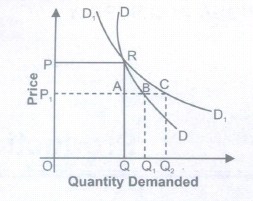

Therefore, QQ2 divided by PP1 on the flatter curve D1D1 will be more than QQ1 divided by PP1 on the steeper curve DD, i.e.,\({QQ_2\over PP_1}>{QQ_1\over PP_1}.\)
Hence, elasticity of demand will be more on a flatter curve D1D1, than on a steeper curve DD.
2.
Salt, medicine and school uniform have inelastic demand as they do not have many substitutes. On the other hand, a particular brand of lipstick has an elastic demand since they have many substitutes.
3.
| Original Quantity (Q)= 300 units | % Change in Price = -5% |
| Change in Quantity (\(\triangle\)Q) = 18 units | Elasticity of Demand (ED) =? |
| NewQuantity (Ql) = 318 units |
Percentage change in demand=\({\triangle Q\over Q}\times 100={18\over318}\times100=6\%\)
Price Elasticity of Demand (ED)\(={\%Change\ in\ quantity\ demanded \over \%Change\ in\ price}={6\% \over -5\%}\)
Price Elasticity of Demand (ED) = (-) 1.2
ED = (-) 1.2; Demand is more elastic because ED > 1.
4.
| %Change in Demand = 20% | % Change in Price =? |
| Elasticity of Demand (ED)= -0.8 | |
\((-)0.8={20\%\over \% Change\ in\ Price}\)Percentage Fall in Price = 25%
Price for the goods will fall by 25%
5.
| Original Quantity (Q)= 18 units | Original Price (P)= Rs 9 |
| New Quantity (Q1) = ? | New Price (P1) = 10 |
| Change in Quantity (\(\triangle\)Q) =? | Change in Price (\(\triangle\)P) = 1 |
| Elasticity of Demand (ED)= (-)1 | |
\(PED={\triangle Q\over \triangle P}\times{P\over Q}\)
\(-1={\triangle Q\over 1}\times {9\over 18}\)
\(-2=\triangle Q\)
As New Price is increasing from 9 to 10, quantity demanded must decrease by\(\triangle\)Q. New Quantity = Initial Quantity + \(\triangle\)Q = 18 + (-2) = 16 At Price= 10, Quantity demanded = 16.
6.
| Original Quantity (Q)= 50 units | Original Price (P)= Rs 5 |
| New Quantity (Q1)= 30 units | New Price (P1) =? |
| Change in Quantity (\(\triangle\)Q)= -20 units | Change in Price (\(\triangle\)P)= \(\triangle\)P |
| Elasticity of Demand (ED)= (-)2 | |
Price Elasticity of demand (ED)= \({\triangle Q\over \triangle P}\times {P\over Q}\)
\(-2={-20\over \triangle P}\times{5\over 50}=\triangle P=Rs1\)
As the quantity demanded is decreasing, price will increase. It means, New Price = Original Price (P) + Change in Price (\(\triangle\)P) = 5 + 1 = Rs 6 New Price = Rs 6
7.
| Initial Price (P)= 4 | Initial Expenditure = 100 | Initial Quantity (Q)=\({100\over4}=25\) |
| New Price (P1) =\(3[4-4\times {25\over 100}]\) | New Expenditure = 75 | New Quantity (Q2)=\({Exp.\over Price}={75\over3}=25\) |
| \(\triangle P=(-)1\) | \(\triangle Q=0\) |
\(PED={\triangle Q\over \triangle P}\times{P\over Q}={0\over (-)1}\times {4\over25}=0\)
ED is perfectly inelastic as quantity demanded does not change at all in response to change in price. Thus, its demand curve will be vertical/parallel to y-axis.
8.
| New Quantity (Q1)= 500 units | Rise in Price (\(\triangle\)P)= Rs 10 |
| Original Quantity (Q) =600 units | Original Price (P) = Rs 30 |
| Change in Quantity(\(\triangle\)Q)=-100 units | New Price (P1)= -Rs 40 |
| Elasticity of Demand (ED) = ? | |
Price Elasticity of demand (ED)=\({\triangle Q \over \triangle P}\times {P\over Q}={-100\over10}\times {30\over600}=(-)0.5\)
ED = (-) 0.5 (Demand is inelastic as ED < 1)
Negative sign indicates the inverse relationship between price and quantity demanded.
9.
| %Change in Demand =? | % Change in Price = 5% |
| Elasticity of Demand (ED) = (-) 0.2 | |
Price Elasticity of Demand (ED) = \({\% \ change \ in \ quntity \ Demand \over \% \ Change \ in \ price}\)
\((-)0.2={\% \ change \ in \ quntity \ Demand \over \% 5}\)
Percentage fall in demand = 1%
Demand for the piece of goods will fall by 1%.
10.
()
If demand is elastic, an increase in price reduces the total revenue. Inelastic demand, the quantity demanded falls by a greater percentage than the price rises; As the result of, total revenue declines.
11.
()
It will decrease
12.
()
In the lower half.
13.
()
As total expenditure has increased with the decrease in price, the demand is said to be highly elastic.
14.
(b)
quantity demanded to a change in price
15.
(b)
Its low price
16.
(b)
1
17.
(b)
18.
(b)
19.
(b)

11th Standard CBSE Syllabus & Materials
11th Standard CBSE
CBSE 11th Business Studies Forms of Business Organisation Sample Question Papers Study Material - QB365 Set A
NEW11th Standard CBSE
CBSE 11th Business Studies Business, Trade and Commerce Sample Question Papers Study Material - QB365 Set A
NEW11th Standard CBSE
CBSE 11th Physics Waves Sample Question Papers Study Material - QB365 Set A
NEW11th Standard CBSE
CBSE 11th Physics Kinetic Theory Sample Question Papers Study Material - QB365 Set A



CBSE 11th Standard CBSE Subjects
CBSE Standards










