
 100% FREE ACCESS
11th Standard CBSE Syllabus & Materials
11th Standard CBSE
CBSE 11th Economics PART-A - Presentation of Data - New Sample Question Papers Study Material - QB365 Set A
NEW11th Standard CBSE
CBSE 11th Economics PART-A - Organisation of Data - New Sample Question Papers Study Material - QB365 Set A
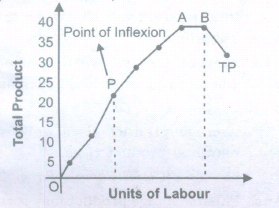
NEW11th Standard CBSE
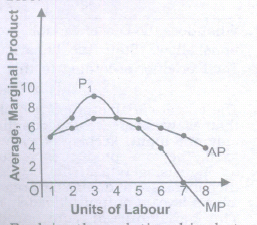
CBSE 11th Economics PART-A - Collection of Data - New Sample Question Papers Study Material - QB365 Set A
NEW11th Standard CBSE
CBSE 11th Economics PART-A - Introduction to Economics and Statistics - New Sample Question Papers Study Material - QB365 Set A
NEW11th Standard CBSE
CBSE 11th Business Studies International Trade Sample Question Papers Study Material - QB365 Set A
NEW11th Standard CBSE
CBSE 11th Business Studies Evolution and Fundamentals of Business Sample Question Papers Study Material - QB365 Set A

Published on: 30/07/2019
Production
Download CBSE Class 11th Standard CBSE undefined question papers, sample papers, important questions, and previous year solved papers in PDF format. Get free study materials, NCERT solutions, and exam preparation resources for Class 11th Standard CBSE undefined
Questions + Answers key
Take MCQ Biology Test
1.
Define the law of variable proportions.
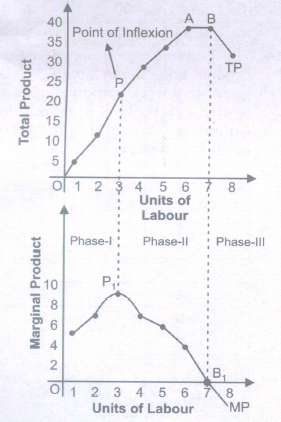
2.
Assume the marginal product for a particular good is constant. Describe the shape of the total product function that would accompany it.
3.
Explain how is it possible for marginal product to fall while average product is rising?
4.
What is the law of variable proportions?
5.
What is the law of diminishing marginal product?
6.
What does the Law of variable proportions show? State the behaviour of Total product according to this Law.
7.
Explain the relationship between Marginal product and Average Product.
8.
Differentiate between Short Period and Long Period.
9.
The following table gives the average product schedule of labour. Find the total product and marginal product schedules. It is given that the total product is zero at zero level of labour employment.
| L | APL |
| 1 | 2 |
| 2 | 3 |
| 3 | 4 |
| 4 | 4.25 |
| 5 | 4 |
| 6 | 3.5 |
10.
Explain the concepts of run and the long run.
11.
The law of variable proportions is drawn under all of the assumptions men tioned below except the assumption that:
The technology is changing.
There must be some inputs whose quantity is kept fixed.
We consider only physical inputs and not economically profitability in monetary terms.
The technology is given and stable.
12.
The average product of labour is maximized when marginal product of labour:
Equals the average product of labour.
Equals zero.
Is maximized
None of these.
13.
Which one of the following statements is the best definition of production function?
The relationship between market price and quantity supplied.
The relationship between the firm's total revenue and the cost of production.
The relationship between the quantities of inputs needed to produce a given level of output.
The relationship between the quantity of inputs and the firm's marginal cost of production.
14.
To economists, the main difference between short run and long run is that:
In short run all inputs are fixed, while in long run all inputs are variable.
In short run the firm varies all of its inputs to find the least cost combination of inputs.
In short run, at least one of the firm's input level is fixed.
In long run, the firm is making a constrained decision about how to use existing plant and equipment efficiently.
15.
The marginal product of a variable input is best described as:
Total product divided by the number of units of variable input.
The additional output resulting from one unit increase in the variable input.
The additional output resulting from one unit increase in both the variable and fixed inputs.
The ratio of the amount of the variable input that is being used to the amount of the fixed input that is being used.
16.
Average product rises only where marginal product rises.
17.
Under diminishing returns to a factor, total product continues to increase till marginal product reaches zero.
18.
Average product will increase only when marginal product increases.
19.
Total product will increase only when marginal product increases.
20.
When the quantity of a variable input is increased from 3 units to 4 units, the total output increases from 70 units to 85 units. The marginal product of the variable input is 15 units.
21.
State the different phases of changes in Total Product and Marginal Product in the Law of Variable Proportions. Also show the same in a single diagram
22.
State the behaviour of marginal product in the law of variable proportions. Explain the causes of this behaviour.
1.
()
The law of variable proportion states that as we increase the quantity of only one input, keeping other inputs fixed, the total product increases at an increasing rate in the beginning, then increases at decreasing rate and after a level the output ultimately falls.
2.
()
The total product function would be upward sloping and increases at a constant rate.
3.
()
Average product can rise even if marginal product is falling as long as the marginal product is higher than the average product.
4.
()
The law of variable proportion states that as we increase the quantity of only one input, keeping other inputs fixed, the total product increases at an increasing rate in the beginning, then increases at decreasing rate and after a level the output ultimately falls.
5.
()
The Law of diminishing marginal product states that when we applied more and more units of variable factor to a given quantity of fixed factor, total product increases at a diminishing rate and marginal product falls.
6.
The law of variable proportion shows that as we increase the quantity of only one input, keeping other inputs fixed, the total product increases at an increasing rate in the beginning, then increases at diminishing rate and after a level of output ultimately falls. The behaviour of Total product according to this law is as under:
(I) TP increases continuously from points O to A.
(iI) It increases at an increasing rate (convex shape) from O to P and at a diminishing rate (concave shape) from P to A.
(iii) TP is maximum at A and remains so upto point B.
(iv) After Point B, Total Product falls.
7.
(i) Average Product increases as long as Marginal Product (MP)> Average Product (AP). Alternatively, when MP > AP, AP rises.
(ii) Average Product is maximum and constant when AverageProduct (AP) = Marginal Product (MP). Alternatively, when AP = MP, AP is maximum.
(iii) average product falls when Marginal Product < Average product.
(iv) Marginal Product can be zero and negative but Average product is never zero.
8.
| Short Period | Basis | Long Period |
| A short period refers to the period of time in which a firm cannot change some of its factors like a firm can change all factors of due to insufficiency of time but can change any variable factor like labour, raw material, etc | Meaning | A long period, on the other hand, is a time period during which a firm can change all factors of production including machines, building, organization etc |
| Output can only be increased by changing the quantity of variable factors. | Output | Output can be increased by making changes in the quantity of both fixed as well as the variable factor inputs. |
| Factors of production here can be grouped in two categories: Fixed Factors, Variable Factors. | Classification | In the long period, the distinction between the fixed and the variable factors disappear. |
| Demand here plays a dominant role in the determination of price of a commodity. | Effects | In the long period, supply can be adjusted to any change in demand. So, demand and supply play equal role in price determination. |
9.
| L | APL | TPL = APL X L |
MPL = \(\frac { { \Delta P }_{ L } }{ \Delta L } \) |
| 1 | 2 | 2 | 2 |
| 2 | 3 | 6 | 4 |
| 3 | 4 | 12 | 6 |
| 4 | 4.25 | 17 | 5 |
| 5 | 4 | 20 | 3 |
| 6 | 3.5 | 21 | 1 |
10.
(i) Short run:
(a) A short run refers to the period of time in which a firm cannot change some of its factors like plant, machinery, building, etc. due to insufficiency of time but can change any variable factor like labour, raw material, etc.
(b) Thus, in short run, there will be some factors of production that are fixed at predetermined levels, e.g., a farmer may have fixed amount of land.
(ii) Long run:
(a) A long run is a time period during which a firm can change all its factors of production including machines, building, organization, etc.
(b) In other words, it is a period of time during which supplies can adjust itself to change in demand.
Note: (i) Mind, here the terms long run and short run are functional and do not refer to a calendar month or a year.
(ii) This distinction depends merely upon how quickly factor inputs can be change by producers in an industry.
11.
(a)
The technology is changing.
12.
(a)
Equals the average product of labour.
13.
(c)
The relationship between the quantities of inputs needed to produce a given level of output.
14.
(c)
In short run, at least one of the firm's input level is fixed.
15.
(b)
The additional output resulting from one unit increase in the variable input.
16.
(b)
17.
(a)
18.
(b)
19.
(b)
20.
(a)
21.
According to the Law of Variable Proportion when only one input is increased while all other inputs are kept constant, Marginal Product and Total Product behave in the following manner:
(i) When Marginal product rises (till Point PI), Total product increases at an increasing rate (convex shape) (till point P).
(ii) When Marginal product falls and remains positive (Till point B1), total product increases at a diminishing rate (concave shape) (till point A).
(iii) When Marginal Product is zero (at point B1), Total Product is at its maximum and constant (At point B).
(iv) When Marginal product becomes negative (after point B1), total product falls (after point B).
22.
The behaviour of Marginal product in the law of variable proportion is as under:
(i) When Marginal product rises (till Point P1), Total product increases at an increasing rate (convex shape) (till point P).
(ii) When Marginal product falls and remains positive (till point B1), total product increases at a diminishing rate (concave shape) (till point A).
(iii) When Marginal Product is zero (at point B1), Total Product is at its maximum and constant (At point B).
(iv) When Marginal product becomes negative (after point B1), total product falls (after point B).
Causes or Reasons of this Behaviour is as Under:
(i) Phase I
(a) Proper utilization of the fixed factor
1. In the initial stage of production the units of variable input (i.e., labour) is so less that fixed inputs cannot be effectively utilized.
2. Proper utilization of the fixed factor can be attained when more and more units of variable factor (labour units) are applied to the fixed factor (land), the fixed factor will be used intensively and output will increase rapidly.
(b) Specialization and division of labour
1. Initially, there was only one labour working on all the 5 acres of land ploughing, watering, etc.
2. As the number of labour units increases, each worker specialized in a particular activity leads to
specialization of the variable units and this resulted in increased output.
(ii) Phase II
(a) The non-optimal combination of variable factor with the fixed factor
1. When a given quantity of a fixed factor is combined with more and more units of variable factor, the additional units of variable factor will have smaller and smaller quantity of fixed factor to work with them.
2. As many workers share the same fixed factor, the share of each would obviously fall. Therefore, the cooperation of the fixed factor is not available to the same extent. Thus, an increase in the variable factor would add less and less to total output.
(b) Imperfect Substitutes
1. Diminishing return to factor occurs because variable factor and fixed factor are imperfect substitutes to each other.
2. Technically speaking, there is a limit to which variable factor can be applied to fixed factor and that limit depends upon the efficiency of fixed factor. So, variable factor and fixed factor are imperfect substitutes to each other.
(iii) Phase III
(a) Efficiency of Variable Factor Fall
1. In this stage the amount of variable factor becomes excessive relative to the fixed factor. This happens when too many LABOUR are engaged in cultivating on a given piece of land.
2. Instead of helping each other in production they cause overcrowding and chaos and thus hamper each other's work. In such a case, the contribution of additional labour to production is bound to be negative.
3. Thus, the marginal returns become negative and the total returns start diminishing.
(b) Efficiency of Fixed Factor Fall
1. Too much of a variable factors may also lead to the inefficiency of the fixed factor as well. • In case of capital, which is a fixed factor, too much of labour may cause lot of wear and tear of machinery, frequent breakdowns and excessive cost of maintenance. This is bound to affect total production adversely.
2. In such a situation it is advisable to reduce the units of the variable factor than to increase it with a view for getting maximum production.

11th Standard CBSE Syllabus & Materials
11th Standard CBSE
CBSE 11th Business Studies Forms of Business Organisation Sample Question Papers Study Material - QB365 Set A
NEW11th Standard CBSE
CBSE 11th Business Studies Business, Trade and Commerce Sample Question Papers Study Material - QB365 Set A
NEW11th Standard CBSE
CBSE 11th Physics Waves Sample Question Papers Study Material - QB365 Set A
NEW11th Standard CBSE
CBSE 11th Physics Kinetic Theory Sample Question Papers Study Material - QB365 Set A



CBSE 11th Standard CBSE Subjects
CBSE Standards










