
 100% FREE ACCESS
11th Standard CBSE Syllabus & Materials
11th Standard CBSE
CBSE 11th Economics PART-A - Presentation of Data - New Sample Question Papers Study Material - QB365 Set A
NEW11th Standard CBSE
CBSE 11th Economics PART-A - Organisation of Data - New Sample Question Papers Study Material - QB365 Set A
NEW11th Standard CBSE
CBSE 11th Economics PART-A - Collection of Data - New Sample Question Papers Study Material - QB365 Set A
NEW11th Standard CBSE
CBSE 11th Economics PART-A - Introduction to Economics and Statistics - New Sample Question Papers Study Material - QB365 Set A
NEW11th Standard CBSE
CBSE 11th Business Studies International Trade Sample Question Papers Study Material - QB365 Set A
NEW11th Standard CBSE
CBSE 11th Business Studies Evolution and Fundamentals of Business Sample Question Papers Study Material - QB365 Set A

Published on: 31/07/2019
Cost
Download CBSE Class 11th Standard CBSE undefined question papers, sample papers, important questions, and previous year solved papers in PDF format. Get free study materials, NCERT solutions, and exam preparation resources for Class 11th Standard CBSE undefined
Questions + Answers key
Take MCQ Biology Test
1.
Give two examples of variable costs.
2.
Give two examples of fixed cost
3.
Give the meaning of cost.
4.
What do the short run marginal cost, average variable cost and short run average cost curves look like?
5.
Can there be some fixed cost in the long run? If not, why?
6.
Explain the behaviour of aver age fixed cost using numerical example.
7.
What is meant by variable (prime) cost of a firm? Give examples.
8.
Define total fixed cost (Supplement/ Indirect/ overhead cost).
9.
Why does SMC curve cut AVC curve at the minimum point of AVC curve?
10.
What are total fixed cost, total variable cost and total cost of a firm? How are they related?
11.
Why does difference between ATC and AVC decrease with increase in level of output? Explain.
12.
The following table gives the total cost schedule of a firm. It Is also given that the average fixed cost at 4 units of output is Rs. 5. Find the TVC, TFC. AVC, AFC, SAC and SMC schedules of the firm for the corresponding values of output.
| Q | TC |
|---|---|
| 1 | 50 |
| 2 | 65 |
| 3 | 75 |
| 4 | 95 |
| 5 | 130 |
| 6 | 185 |
13.
A firm's average fixed cost is Rs. 20 at 6 units of output. What will it be at 4 units of output?
Rs. 60
Rs. 30
Rs. 40
Rs. 20
14.
Which one of the following elements is not a determinant of the firm's cost function?
The production function.
The price of labour.
Taxes.
The price of the firm's output.
15.
Marginal cost is defined as:
The change in total cost due to a one unit change in output.
Total cost divided by output.
The change in output due to a one unit change in an input.
Total product divided by the quantity of input.
16.
Which one of the following statements is an example of "explicit cost"?
The wages a proprietor could have made by working as an employee of a large firm.
The income that could have been earned in alternative uses by the resources owned by the firm.
The payment of wages by the firm.
The normal profit earned by a firm.
17.
Which one of the following cost curves is never 'U' shaped?
Average cost curve.
Marginal cost curve.
Average variable cost curve.
Average fixed cost curve.
18.
With the increase in level of output, average fixed cost goes on falling till it reaches zero.
19.
Total Cost rises only when marginal cost rises.
20.
The difference between total cost and total variable cost falls with the increase in output.
21.
Average variable cost can fall even when marginal cost is rising.
22.
When marginal cost rises, average cost will also rise.
1.
()
(l) Raw materials.
(II) Labour engaged on production
2.
()
(l) Rent of the building.
(II) Salary of permanent employees
3.
()
Cost of producing a good, in economics, is the sum total of explicit cost, implicit cost and certain minimum profit (normal profit).
4.
()
The Short run marginal cost, average variable cost and short run average cost curves are U-shaped because of Law of variable proportion.
5.
()
No, there are no fixed costs in the long run as all the factors become variable. Fixed cost exists only in short run.
6.
(i) The per unit cost incurred on fixed factors of production is known as average fixed cost.
AFC = \(\frac{TFC}{Output}\)
(ii)
| Units of commodity | TFC | AFC |
|---|---|---|
| 0 | 60 | - |
| 1 | 60 | 60 |
| 2 | 60 | 30 |
| 3 | 60 | 20 |
| 4 | 60 | 15 |
| 5 | 60 | 12 |
AFC falls as output increases because
AFC = \(\frac{TFC}{Output}\)and TFC remains constant.
So, as output increases, TFC remains constant, AFC falls.
7.
(i) The cost incurred on variable factors of production is known as TVC.
(ii) TVC is very much related with the production and fluctuates with the fluctuation in production.
(iii) In case of zero level of production, TVC would also be zero.
(iv) For example, Wages of casual labour, payment for raw material, etc.
8.
(i) Fixed costs are those costs of production which do not change with a change in output.
(ii) These are the costs incurred on fixed factors, like rent of land and building, interest, etc. These are unavoidable contractual costs.
(iii) Fixed costs are also called overhead costs or general costs because these are common for all the units produced. These costs are also called supplementary costs or indirect costs.
(iv) The shape of Total fixed Cost is horizontal (Parallel to X-Axis). They have to be incurred when the output is large or small or even zero.
9.
(i) It happens because when AVC falls, SMC is less than AVC.
(ii) When AVC starts rising, SMC is more than AVC.
(iii) So, it is only when AVC is constant and at its minimum point, that SMC is equal to AVC. Therefore, SMC curve cuts AVC curve at its minimum point.
10.
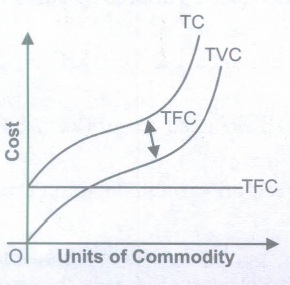
(i) TC is divided into two parts TFC and TVC such that TC = TFC + TVC.
(ii) TFC is the overhead cost and it remains constant or fixed whatever be the level of output. TFC curve is a horizontal line parallel to the x-axis.
(iii) TVC is cost due to increased use of variable factors like raw material, labour, etc. TVC is inverse S-shaped starting from the origin due to law of variable proportion.
(iv) TC is aggregate of TFC and TVC. TC curve is inverse S-shaped starting from the level of fixed cost. The reason behind it shape is the law of variable proportion.
11.
As, we know the difference between Average Total Cost and Average Variable Cost is average fixed cost (AFC = ATC- AVC) and AFC always decreases with the increase in output. It can be explained with the help of the following diagram and schedule
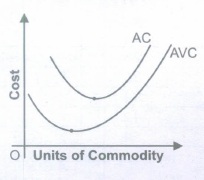
It can be seen from the above diagram that there is a huge gap between AC and AVC with the starting of production. The gap between them decreases with the increase in production.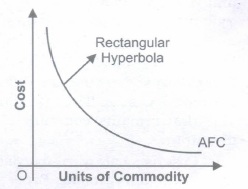
It is so because the gap between AC and AVC is AFC and AFC always decreases with the increase in production. The point to be remembered is that AVC can never touch AC curve because AFC cannot be Zero.
| Units of commodity | TFC | AFC |
|---|---|---|
| 0 | 60 | - |
| 1 | 60 | 60 |
| 2 | 60 | 30 |
| 3 | 60 | 20 |
| 4 | 60 | 15 |
| 5 | 60 | 12 |
12.
| Q | TC (given) |
TFC |
AFC= \(\frac{TFC}{Output}\) | TVC = TC-TFC | AVC= \(\frac{TVC}{Output}\) | SAC= \(\frac{TC}{Output}\) | SMC=\(\frac{\Delta{TC}}{\Delta{Output}}\) OR \(\frac{\Delta{TVC}}{\Delta{Output}}\) |
|---|---|---|---|---|---|---|---|
| 1 | 5 | 20 | 2 | 30 | 30 | 50 | 30 |
| 2 |
65 |
20 | 10 | 45 | 22.5 | 32.5 | 15 |
| 3 | 75 | 20 | 6.67 | 55 | 18.33 | 25 | 10 |
| 4 | 95 | 20 | 5(given) | 75 | 18.75 | 23.75 | 20 |
| 5 | 130 | 20 | 4 | 110 | 22 | 26 | 35 |
| 6 | 185 | 20 | 3.33 | 165 | 27.5 | 30.83 | 55 |
13.
(b)
Rs. 30
14.
(d)
The price of the firm's output.
15.
(a)
The change in total cost due to a one unit change in output.
16.
(c)
The payment of wages by the firm.
17.
(d)
Average fixed cost curve.
18.
(b)
19.
(b)
20.
(b)
21.
(a)
22.
(b)

11th Standard CBSE Syllabus & Materials
11th Standard CBSE
CBSE 11th Business Studies Forms of Business Organisation Sample Question Papers Study Material - QB365 Set A
NEW11th Standard CBSE
CBSE 11th Business Studies Business, Trade and Commerce Sample Question Papers Study Material - QB365 Set A
NEW11th Standard CBSE
CBSE 11th Physics Waves Sample Question Papers Study Material - QB365 Set A
NEW11th Standard CBSE
CBSE 11th Physics Kinetic Theory Sample Question Papers Study Material - QB365 Set A



CBSE 11th Standard CBSE Subjects
CBSE Standards










