
 100% FREE ACCESS
11th Standard CBSE Syllabus & Materials
11th Standard CBSE
CBSE 11th Economics PART-A - Presentation of Data - New Sample Question Papers Study Material - QB365 Set A
NEW11th Standard CBSE
CBSE 11th Economics PART-A - Organisation of Data - New Sample Question Papers Study Material - QB365 Set A
NEW11th Standard CBSE
CBSE 11th Economics PART-A - Collection of Data - New Sample Question Papers Study Material - QB365 Set A
NEW11th Standard CBSE
CBSE 11th Economics PART-A - Introduction to Economics and Statistics - New Sample Question Papers Study Material - QB365 Set A
NEW11th Standard CBSE
CBSE 11th Business Studies International Trade Sample Question Papers Study Material - QB365 Set A
NEW11th Standard CBSE
CBSE 11th Business Studies Evolution and Fundamentals of Business Sample Question Papers Study Material - QB365 Set A

Published on: 10/12/2018
From this post Get 100 percent accurate NCERT Solutions for Class 11 Biology Chapter 20 (Locomotion and Movement) solved by expert Biology teachers. We provide solutions for questions given in Class 11 Biology text-book as per CBSE Board guidelines from the latest NCERT book for Class 11 Biology.
NCERT Grade 11 Biology Chapter 20, Locomotion and Movement is from Unit 5, Human Physiology. Different forms of locomotion in unicellular organisms as well as in humans is discussed in this chapter. Types of Movement, Muscle, Skeletal System, Joints and Disorders of Muscular and Skeletal System are the major topics discussed in this chapter.
NCERT Grade 11 Biology, Chapter 20, Locomotion and Movement is a part of Unit 5, Human Physiology. Unit 5 is a combination of 7 chapters and holds a total weightage of 20% in the NEET examination and 18 marks in the final examination.
Download CBSE Class 11th Standard CBSE Biology question papers, sample papers, important questions, and previous year solved papers in PDF format. Get free study materials, NCERT solutions, and exam preparation resources for Class 11th Standard CBSE Biology
Questions + Answers key
Take MCQ Biology Test
1.
What is arthritis and what are the causes of arthritis?
2.
What is the role of pectoral girdle?
3.
What is the reason of pliable matrix of cartilage?
4.
What is aerobic muscle?
5.
Which bones help in hearing? Where are they found?
6.
Why is muscle fibre a syncitium? How are myofilaments arranged in it?
7.
What are the points of articulation for pelvic and pectoral girdles?
8.
Sarcolemma, sarcoplasm and sarcoplasmic reticulum refer to a particular type of cell in our body. Which is this cell and to what parts of that cell do these names refer to?
9.
What is Still's disease?
10.
Which energy is converted to mechanical energy during contraction?
11.
Give a brief explanation of the human skeletal system.
12.
What is osteoporosis? Why are women at a greater risk of suffering from osteoporosis? Suggest some precautionary means to avoid osteoporosis.
13.
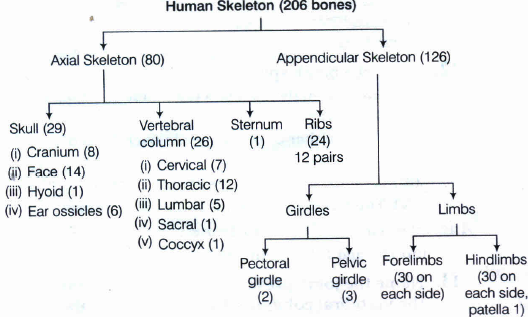
Give the name of the major parts of human skeleton.Also mention the number of bones in each part.
14.
Describe the important steps in muscle contraction.
15.
In old age, people often suffer from stiff and inflammed joints. What is this condition called? What are the possible reasons for these symptoms?
16.
Explain the structure of contractile protein in skeletal muscle.
17.
Differentiate between pectoral and pelvic girdle
18.
______________and______________ pairs of ribs are called floating ribs.
19.
Thin filament of myofibril contains 2 'F' actins and two other proteins namely_________________ and_________________
20.
All mammals (except a few) have_______________________ cervical vertebra.
21.
What is the name of the fusion of two halves of pelvic girdle?
Acetabulum
Pubis
Pubic symphysis
Sacrum
22.
Which of the following is not part of the axial skeleton?
Occipital condyle
Rib Cage
Acetabulum
Coccyx
23.
What is the reason of reddish colour of certain muscles?
High concentration of myoglobin
Lowconcentration of myoglobin
High metabolic activity
Low metabolic acitivity
24.
Which of the following organs have unstriated muscles?
Fingers
Heart
Lower Jaw
Small Intestine
25.
Which type of movement facilitates the passage of ova in fallopian tubules?
Amoeboid Movement
Ciliary Movement
Muscular Movement
Ovulation
1.
Arhtritis is inflammation of joints. This happens mostly in synovial joints. Because of ageing and wear and tear the synovial fluid dries up. This leads to corrosion of cartilage. At the end the movement of joints is not as smooth as it should be. This results in general discomfort while doing normal tasks and causes swelling and pain of the affected joint.
2.
Pectoral girdle provides fulcrum to forelimbs.
3.
In locomotion and movement, There is a sentence which is this - Cartilage has slightly pliable matrix due to chondroitin salts.
4.
Certain muscles have high concentration of myoglobin which gives it a red appearance. They also contain plenty of mitochondria which utilize large amounts of oxygen to produce ATP. Because of this they are also called aerobic muscles.
5.
Malleus, incus and stapes. These are found in internal ear.
6.
Muscle fibre is a syncitium as the sarcoplasm contains many nuclei. Myofilaments are parallelly arranged and are present in large number in muscle fibre.
7.
Pelvic girdles provide articulations to the bones of legs. These support and protect abdominal visceral organs and provide attachement to certain leg muscles.
Pectoral girdles provide an attachment point for numerous muscles that allows shoulder and elbow joints.
8.
The cell is muscle.
These names refer to the following parts
Sarcolemma -Plasma membrane
Sarcoplasm -Cytoplasm
Sarcoplasmic reticulum -Endoplasmic reticulum
9.
Still's disease is a kind of rheumatoid arthritis that occurs in younger people.
10.
During muscle contraction, chemical energy is converted to mechanical energy when ATP is hydrolysed during cross-bridge cycling. This mechanical energy is then distributed and stored in the tissue as the muscle deforms or is used to perform external work.
11.
Bones and cartilages constitute our skeletal system. The skeletal system is divisible into axial and appendicular. Skull, vertebral column, ribs and sternum constitute the axial skeleton. Limb bones and girdles form the appendicular skeleton. Three types of joints are formed between bones or between bone and cartilage - fibrous, cartilaginous and synovial. Synovial joints allow considerable movements and therefore, playa significant role in locomotion.
12.
Osteoporosis is the condition in which the bone mass is decreased. This leads to general weakening of bones. Even a minor slip can result in fractures if a person is suffering from osteoporosis.
Women are at greater risk of suffering from osteoporosis because of several reasons. During child bearing major part of calcium from their body is utilized in formation of the skeleton of the foetus. Additionally during lactation there is further depletion of the calcium reserve of the body because of milk formation. A calcium rich diet can help prevent the progression of osteoporosis. Milk and eggs are good source of calcium. During pregnancy oral calcium supplement is also given to prevent osteoporosis.
13.
14.
Summary of steps in skeletal muscle contraction
(i) Stimulation :
(a) Nerve impulse arrives at neuromuscular junction and release of acetylcholine takes place.
(b) Spreading of action potential through muscle fibre.
(c) The release of Ca2+ from sarcoplasmic reticulum to cytoplasm of muscle fibre.
(ii) Contraction :
(a) ATP joins to meromyosin head that hydrolyses into ADP and Pi releasing energy, which in turn raises the head to high energy state (the head joins active site on actin, forming cross-bridge).
(b) ADP and Pi are released. And head returns to low energy state.
(c) Actin filament is thus, pulled towards center of sarcomere. And a new ATP joins head, detaching it from actin filament.
(d) Above mentioned steps are thus, repeated many times during one contraction to draw the thin myofilaments further inward.
15.
This condition is called as arthritis.
The possible reasons can be
(i) inflammation of the synovial membrane,
(ii) progressive erosion of articular cartilage,
(iii) infection by a microorganism,
(iv) due to metabolic defect causing excess of uric acid and urate crystals.
16.
Structure of Contractile Proteins
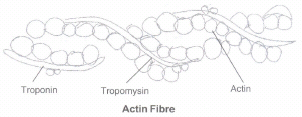
i) Each actin (thin) filament is made of two 'F' (filamentous) actins helically wound to each other. Each 'F' actin is a polymer of monomeric 'G' (Globular) actins.
ii) Two filaments of another protein, tropomyosin also run close to the 'F' actins throughout its length.
iii) A complex protein Troponin is distributed at regular intervals on the tropomyosin. In the resting state a subunit of troponin masks the active binding sites for myosin on the actin filaments.
Each myosin (thick) filament is also a polymerised protein. Many monomeric proteins called Meromyosins constitute one thick filament. Each meromyosin has two important parts, a globular head with a short arm and a tail, the former being called the heavy meromyosin (HMM) and the latter, the light meromyosin (LMM).
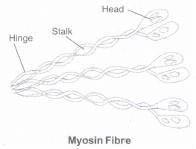
The HMI component, i.e.; the head and short arm projects outwards at regular distance and angle from each other from the surface of a polymerised myosin filament and is known as cross arm. The globular head is an active ATPase enzyme and has binding sites for ATP and active sites for actin.
17.
Pectoral and pelvic girdle help in the articulation of upper and lower limbs, respectively. Each girdle is made of two equal halves.
Each half of a pectoral girdle consists of clavicle and scapula. Scapula is a large triangular flat bone. There is glenoid cavity at the joint of scapula, clavicle and acromian process, which articulates with the head of humerus to form the shoulder joint.
Each half of pelvic girdle is formed by three bones, i.e., ilium, ischium and pubis. At the point of their fusion, there is a cavity called acetabulum to which the head of femur articulates.
18.
()
11th, 12th
19.
()
tropomyosin, troponin
20.
()
7
21.
(c)
Pubic symphysis
22.
(c)
Acetabulum
23.
(a)
High concentration of myoglobin
24.
(d)
Small Intestine
25.
(b)
Ciliary Movement

11th Standard CBSE Syllabus & Materials
11th Standard CBSE
CBSE 11th Business Studies Forms of Business Organisation Sample Question Papers Study Material - QB365 Set A
NEW11th Standard CBSE
CBSE 11th Business Studies Business, Trade and Commerce Sample Question Papers Study Material - QB365 Set A
NEW11th Standard CBSE
CBSE 11th Physics Waves Sample Question Papers Study Material - QB365 Set A
NEW11th Standard CBSE
CBSE 11th Physics Kinetic Theory Sample Question Papers Study Material - QB365 Set A



CBSE 11th Standard CBSE Subjects
CBSE Standards









