
 100% FREE ACCESS
11th Standard CBSE Syllabus & Materials
11th Standard CBSE
CBSE 11th Economics PART-A - Presentation of Data - New Sample Question Papers Study Material - QB365 Set A
NEW11th Standard CBSE
CBSE 11th Economics PART-A - Organisation of Data - New Sample Question Papers Study Material - QB365 Set A
NEW11th Standard CBSE
CBSE 11th Economics PART-A - Collection of Data - New Sample Question Papers Study Material - QB365 Set A
NEW11th Standard CBSE
CBSE 11th Economics PART-A - Introduction to Economics and Statistics - New Sample Question Papers Study Material - QB365 Set A
NEW11th Standard CBSE
CBSE 11th Business Studies International Trade Sample Question Papers Study Material - QB365 Set A
NEW11th Standard CBSE
CBSE 11th Business Studies Evolution and Fundamentals of Business Sample Question Papers Study Material - QB365 Set A

Published on: 11/10/2019
Conic Sections
Download CBSE Class 11th Standard CBSE Mathematics question papers, sample papers, important questions, and previous year solved papers in PDF format. Get free study materials, NCERT solutions, and exam preparation resources for Class 11th Standard CBSE Mathematics
Questions + Answers key
Take MCQ Mathematics Test
1.
The foci of a hyperbola coincide with the faci of the elipse \(\frac { { x }^{ 2 } }{ 25 } +\frac { y^{ 2 } }{ 9 } =1\) find the equation of the hyperbola if its eccentricity is 2.
2.
An arch is in the form of a parabola with its vertical. The arch is 10 m high and 5 m wide at the base. How wide it is 2 m from the vertex of the parabola?
3.
A man running a race leave no space course notes that the sum of the distances from the two flag posts from him is always 10m and the distance between the flag posts is 8 m. Find the equation of the posts traced by the man.
4.
Find the equation of the parabola whose vertex is at (2,1) and the directrix x = y = 1
5.
Find the equation of the circle passing through (0, 0) and making intercepts a and b on the coordinate axes.
6.
Find the equation of the circle with radius 5 whose centre lies on x-axis and passes through the point (2,3).
7.
Find the equation of the circle passing through the points (2,3) and (-1, 1) and whose centre is on the line x - 3y - 11 =0.
8.
Find the equation of the circle passing through the points (4, 1) and (6, 5) and whose centre is on the line 4x +y = 16.
9.
A rod of length 12cm moves with its ends always touching the coordinate axes. Determine the equation of the locus of a point P on the rod, which is 3 cm from the end in contact with the x-axis.
10.
Find the equation of the hyperbola satisfying the given conditions.
Foci (0, ± \(\sqrt10\) ),passing through (2, 3)
1.
The equation of the ellipse is
\(\frac { { x }^{ 2 } }{ 25 } +\frac { { y }^{ 2 } }{ 9 } =1\)
\(\therefore \ { a }^{ 2 }=25\ and \ { b }^{ 2 }=9\)
\(\text { Eccentricity of ellipse }=\sqrt { 1-\frac { { b }^{ 2 } }{ { a }^{ 2 } } } =\sqrt { 1-\frac { 9 }{ 25 } } =\frac { 4 }{ 5 } \)
\(\text { So the co-ordinates of foci are } (\pm 4,0)\)
\(\text { Let equation of required hyperbola is}\)
\(\frac { { x }^{ 2 } }{ { a' }^{ 2 } } -\frac { y^{ 2 } }{ { b }'^{ 2 } } =1\)
\(\text { Let e' be the eccentricity of required hyperbola then,}\)
\(a'e'=4\Rightarrow 2e'=4\Rightarrow e'=2\)
\(\therefore b'^{ 2 }={ a' }^{ 2 }({ e' }^{ 2 }-1)\Rightarrow b'^{ 2 }=4(4-1)=12\)
\(\text { Thus equation of required hyperbola is}\)
\(\frac { { x }^{ 2 } }{ 4 } -\frac { { y }^{ 2 } }{ 12 } =1\)
2.
Here, axis is vertical, so let arch of parabola is in the form
\({ x }^{ 2 }=4ay\) ..(i)
\(\text {Given, OB=10m}\)
\(\text {and AC}=5m\Rightarrow AB=\frac { 5 }{ 2 } m\)
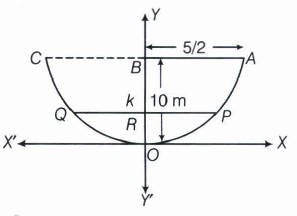
\(\text{Hence,coordinates of A}=\left( \frac { 5 }{ 2 } ,10 \right) \text{will satisfy Eq.(i)}\)
\( \left( \frac { 5 }{ 2 } \right) ^{ 2 }=4a\times 10\Rightarrow \frac { 25 }{ 4 } =40a\Rightarrow a=\frac { 5 }{ 32 } \)
From Eq.(i),
\( { x }^{ 2 }=4\times \frac { 5 }{ 32 } y\Rightarrow { x }^{ 2 }=\frac { 5 }{ 8 } y\)
Now,let OR=2 and
\( PQ=k\Rightarrow RP=\frac { k }{ 2 } \)
\(\therefore,P=\left( \frac { k }{ 2 } ,2 \right) \) will lie on parabola.
\(\therefore \left( \frac { k }{ 2 } \right) ^{ 2 }=\frac { 5 }{ 8 } \times 2\Rightarrow \frac { { k }^{ 2 } }{ 4 } =\frac { 5 }{ 4 } \Rightarrow k=\sqrt { 5 } =2.23m(approx.)\)
3.
Let F1 and F2 be two points where the flag parts are fixed on the ground. The origin O is the mid point of F1F2
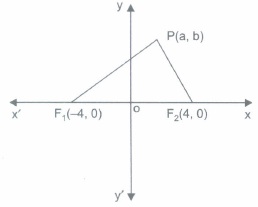
∴ OF1=OF2=\(\frac { 1 }{ 2 } \)F1F2=\(\frac { 1 }{ 2 } \) x 8 =4m
∴ Coordinates of F; are (-4, 0) and F2 are (4, 0)
Let P(α, β) be any point on the track.
∴ PF1+PF2 = 0
∴ \(\sqrt { (\alpha +4)^{ 2 }+(\beta -0)^{ 2 } } +\sqrt { (\alpha -4)^{ 2 }+(\beta -0)^{ 2 } } \)
=10
⇒ \(\sqrt { \alpha ^{ 2 }+16+8\alpha +{ \beta }^{ 2 } } \)
=10-\(\sqrt { { \alpha }^{ 2 }+16-8\alpha +{ \beta }^{ 2 } } \)
Squaring both sides, we have
\(\\ { \alpha }^{ 2 }+{ \beta }^{ 2 }+8\alpha +16=100+{ \alpha }^{ 2 }+{ \beta }^{ 2 }-8\alpha \)+16
=-20\(\sqrt { { \alpha }^{ 2 }+{ \beta }^{ 2 }-8d+16 } \)
⇒ 16\(\alpha \)-100=-20\(\sqrt { { \alpha }^{ 2 }+{ \beta }^{ 2 }-8d+16 } \)
Squaring both sides again, we have
(16\(\alpha \)-100)2=(-20\(\sqrt { { (\alpha }^{ 2 }+{ \beta }^{ 2 }-8d+16)^{ 2 } } \)
⇒ 256\(\alpha \)2+1000-3200\(\alpha \) = 400(\(\alpha \)2+\(\beta \)2+8\(\alpha \)+16)
⇒ 256\(\alpha \)2+10000-3200\(\alpha \)=400\(\alpha \)2+400\(\beta \)2-3200\(\alpha \)+6400
⇒ 144\(\alpha \)2+400\(\beta \)2=3600
⇒ \(\frac { 144\alpha ^{ 2 } }{ 3600 } +\frac { 400{ \beta }^{ 2 } }{ 3600 } \)=1 ⇒ \(\frac { { \alpha }^{ 2 } }{ 25 } +\frac { { \beta }^{ 2 } }{ 9 } \)=1
Thus required equation of locus of point P is
\(\frac { { x }^{ 2 } }{ 25 } +\frac { { y }^{ 2 } }{ 9 } \)=1
4.
Since the axes of the parabola is a line perpendicular to the directrix and passing through the vertex (2,1).
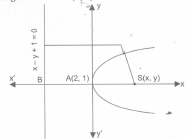
So the equation of lines is x+y+λ=0.
∴ 2+1+λ=0⇒λ=−3
∴ equation of directrix is x+y−3=0....(i)
equation of directrix is x−y+1=0....(ii)
Solving (i) and (ii),we have
x=1 and y=2
So the co−ordinate of B are(1,2)
Now A is mid point of BS
\( \therefore \frac { { x }_{ 1 }+1 }{ 2 } =2\quad and\frac { { y }_{ 1 }+2 }{ 2 } =1\)
\(\Rightarrow { x }_{ 1 }=3\quad and\quad { y }_{ 1 }=0\)
\(So\quad co-ordinates\quad of\quad focus\quad are\quad (3,0)\)
\(Now\quad PS=PM\Rightarrow { PS }^{ 2 }={ PM }^{ 2 }\)
\(\Rightarrow { \left( x-3 \right) }^{ 2 }+{ \left( y-0 \right) }^{ 2 }={ \left[ \frac { x-y+1 }{ \sqrt { { \left( 1 \right) }^{ 2 }+{ -1 }^{ 2 } } } \right] }^{ 2 }\)
\(\Rightarrow { x }^{ 2 }+9-6x+{ y }^{ 2 }\)
\(=\frac { { x }^{ 2 }+{ y }^{ 2 }+1-2xy+2x-2y }{ 2 }\)
\(\Rightarrow 2({ x }^{ 2 }+{ y }^{ 2 }-6x+9)={ x }^{ 2 }{ y }^{ 2 }+1-2xy+2x-2y\)
\(\Rightarrow { x }^{ 2 }+{ y }^{ 2 }-14x+2y+2xy+17=0.\)
5.
Let the equation of the required circle be (x – h)2 + (y – k)2 = r2.
Since the circle passes through (0, 0),
(0 – h)2 + (0 – k)2 = r2
⇒ h2 + k2 = r2
The equation of the circle now becomes (x – h)2 + (y – k)2 = h2 + k2.
It is given that the circle makes intercepts a and b on the coordinate axes. This means that the circle passes through points (a, 0) and (0, b). Therefore,
(a – h)2 + (0 – k)2 = h2 + k2 … (1)
(0 – h)2 + (b – k)2 = h2 + k2 … (2)
From equation (1), we obtain
a2 – 2ah + h2 + k2 = h2 + k2
⇒ a2 – 2ah = 0
⇒ a(a – 2h) = 0
⇒ a = 0 or (a – 2h) = 0
\(\text { However, } a \neq 0 ; \text { hence, }(a-2 h)=0 \Rightarrow h=\frac{a}{2} \text { . }\)
\(\text { From equation (2), we abtain }\)
\(h^{2}+b^{2}-2 b k+k^{2}=h^{2}+k^{2}\)
\(\Rightarrow b^{2}-2 b k=0\)
\(\Rightarrow b(b-2 k)=0\)
\(\Rightarrow b=0 \text { or }(b-2 k)=0\)
\(\text { However, } b \neq 0 \text { ; hence, }(b-2 k)=0 \Rightarrow k=\frac{b}{2} \text { . }\)
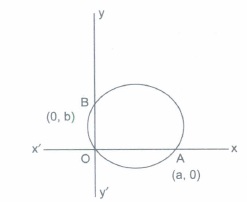
Thus, the equation of the required circle is
\(\left(x-\frac{a}{2}\right)^{2}+\left(y-\frac{b}{2}\right)^{2}=\left(\frac{a}{2}\right)^{2}+\left(\frac{b}{2}\right)^{2} \)
\(\Rightarrow\left(\frac{2 x-a}{2}\right)^{2}+\left(\frac{2 y-b}{2}\right)^{2}=\frac{a^{2}+b^{2}}{4} \)
\(\Rightarrow 4 x^{2}-4 a x+a^{2}+4 y^{2}-4 b y+b^{2}=a^{2}+b^{2} \)
\(\Rightarrow 4 x^{2}+4 y^{2}-4 a x-4 b y=0 \)
⇒ x2 + y2- ax - by = 0
which is required equation of circle.
6.
Let the equation of the required circle be (x – h)2 + (y – k)2 = r2.
Since the radius of the circle is 5 and its centre lies on the x-axis, k = 0 and r = 5.
Now, the equation of the circle becomes (x – h)2 + y2 = 25.
It is given that the circle passes through point (2, 3).
\(\therefore(2-h)^{2}+3^{2}=25 \)
\(\Rightarrow(2-h)^{2}=25-9 \)
\(\Rightarrow(2-h)^{2}=16 \)
\(\Rightarrow 2-h=\pm \sqrt{16}=\pm 4 \)
\(\text { If } 2-h=4, \text { then } h=-2 . \)
\(\text { If } 2-h=-4, \text { then } h=6 .\)
Equation of required circle is
(x - 6)2 + (y - 0)2 = (5)2
⇒ x2 + 36 - 12x + y2 = 25
⇒ x2 + y2 - 12x + 11 = 0
When h=-2
Equation of required circle is
(x + 2)2 + (y - 0)2 = (5)2
⇒ x2 + 4 + 4x + y2 = 25
⇒ x2 + y2 + 4x - 21 = 0
7.
The equation of the circle is
(x - h)2 + (y - k)2 = r2.....(i)
Since the circle passes through point (2, 3)
∴ (2 - h)2 + (3 - k)2 = r2
⇒ 4 + h2 - 4h + 9 + k2 - 6k = r2
⇒ h2 + k2 - 4h - 6k + 13 = r2 ...(ii)
Also the circle passes through point (-1, 1)
∴ (-1-h)2 + (1- k)2 = r2
⇒ 1 + h2 + 2h + 1 + k2 - 2k = r2
⇒ h2 + k2 + 2h - 2k + 2 = r2...(iii)
From (ii) and (iii), we have
h2 + k2 - 4h - 6k + 13 = h2 + k2 + 2h - 2k + 2
⇒ -6h-4k=-11
⇒ 6h + 4k = 11...(iv)
Since the centre (h, k) of the circle lies on the line x - 3y - 11 = 0
∴ h- 3k-11 = 0
⇒ h - 3k = 11...(v)
Solving (iv) and (v), we have
h=\(\frac { 7 }{ 2 } \) and k=\(\frac { -5 }{ 2 } \)
Putting these values of hand k in (ii), we have
\(\left( \frac { 7 }{ 2 } \right) ^{ 2 }+\left( \frac { -5 }{ 2 } \right) ^{ 2 }-\frac { 4\times 7 }{ 2 } -6\frac { -5 }{ 2 } \)=r2
⇒ \(\frac { 49 }{ 4 } +\frac { 25 }{ 4 } \)-14+15+13=r2
⇒ r2=\(\frac { 65 }{ 2 } \)
Thus equation of required circle is
\(\left( x-\frac { 7 }{ 2 } \right) ^{ 2 }+\left( y+\frac { 5 }{ 2 } \right) ^{ 2 }=\frac { 65 }{ 2 } \)
⇒ x2+\(\frac { 49 }{ 4 } \)-7x+y2+\(\frac { 25 }{ 4 } \)+5y=\(\frac { 65 }{ 2 } \)
⇒ 4x2 +49-28x+4y2 +25+20y= 130
⇒ 4x2 + 4y2 - 28x + 20y - 56 = 0
⇒ 4(x2 + y2 - 7x + 5y - 14) = 0
⇒ x2 + y2 - 7x + 5y - 14 =0.
8.
The equation of the circle is
(x - h)2 + (y - k)2 = r2... (i)
Since the circle passes through point (4, 1)
∴ (4 - h)2 + (1 - k)2 = r2
⇒ 16 + h2 - 8h + 1 + k2 - 2k = r2
⇒ h2 + k2 - 8h - 2k + 17 = r2...(ii)
Also the circle passes through point (6, 5)
∴ (6 - h)2 + (5 - k)2 = r2
⇒ 36 + h2 - 12h + 25 + k2 - 10k = r2
⇒ h2 + k2 - 12h - 10k + 61 = r2...(iii)
From (ii)and (iii), we have
h2+ k2-8h-2k+ 17=h2+ k2-12h-10k+61
⇒ 4h+ 8k= 44
⇒ h + 2k = 11....(iv)
Since the centre (h, k) of the circle lies on the line 4x + y = 16
∴ 4h + k = 16 ...(v)
Solving (iv) and (v), we have h = 3 and k = 4
Putting value of hand k in (ii), we have
(3)2 + (4)2 - 8 x 3 - 2 x 4 + 17 = r2
∴ r2=10
Thus equation of required circle is
⇒ (x - 3)2 + (y - 4)2 = 10
⇒ x2 + 9 - 6x + y2 + 16 - 8y = 10
⇒ x2 + y2 - 6x - 8y + 15 =0.
9.
Let AB be a rod of length 12 cm and P(x, y) be any point on the rod such that PA = 3 cm and PB = 9 cm.
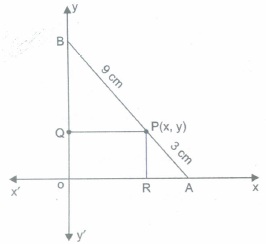
Let AR = a and BQ = b
Then ΔARP ~ ΔPQB
∴ \(\frac { AR }{ PQ } =\frac { AP }{ PB } \)
∴ \(\frac { a }{ x } =\frac { 3 }{ 9 } \) ⇒ 9a=3a ⇒ a=\(\frac { x }{ 3 } \)
and \(\frac { BQ }{ BP } =\frac { PR }{ PA } \)
∴ \(\frac { b }{ 9 } =\frac { y }{ 3 } \) ⇒ 3b=9y ⇒ b=3y
Now OR + AR = x + a = x+\(\frac { x }{ 3 } =\frac { 4x }{ 3 } \)
OB = OQ + BQ = y + b = y + 3y = 4y
In right angled ΔAOB
AB2= OA2+ OB2
∴ (12)2 = \(\left( \frac { 4x }{ 3 } \right) ^{ 2 }\)+(4y)2
⇒ 144=\(\frac { 16{ x }^{ 2 } }{ 9 } \)+16y2
⇒ \(\frac { 16{ x }^{ 2 } }{ 9\times 144 } +\frac { 16{ y }^{ 2 } }{ 144 } \) =1 ⇒ \(\frac { { x }^{ 2 } }{ 81 } +\frac { { y }^{ 2 } }{ 9 } \)=1
which is required locus of point P and which represents an ellipse.
10.
Here foci are (0, ±\(\sqrt10\)) which lie on y-axis.
So the equation of hyperbola in standard form is \(\frac { { y }^{ 2 } }{ { a }^{ 2 } } -\frac { { x }^{ 2 } }{ { b }^{ 2 } } \)=1
∴ foci (0, ± c) is (0, ± \(\sqrt10\)) a = \(\sqrt10\)
We know that c2 = a2 + b2
∴ (\(\sqrt10\))2 = a2 + b2 ⇒ b2 = 10 - a2
Since the hyperbola passes through (2, 3)
∴ \(\frac { 9 }{ a^{ 2 } } -\frac { 4 }{ { b }^{ 2 } } \)=1
⇒ \(\frac { 9 }{ a^{ 2 } } -\frac { 4 }{ 10-{ a }^{ 2 } } \)=1
⇒ \(\frac { 9(10-{ a }^{ 2 })-4{ a }^{ 2 }={ a }^{ 2 }(10-{ a }^{ 2 }) }{ { a }^{ 2 }(10-{ a }^{ 2 }) } \)
⇒ a4 - 23a2 + 90 = 0
⇒ a4 - 18a2 - 5a2 + 90 = 0
⇒ (a2 - 18) (a2 - 5) = 0
⇒ a2 = 18 or a2 = 5
When a2= 18 then b2= 10-18=-8 (which is not possible)
When a2 = 5 then b2 = 10 - 5 = 5
Thus required equation of hyperbola is
\(\frac { { y }^{ 2 } }{ 5 } -\frac { { x }^{ 2 } }{ 5 } \)=1

11th Standard CBSE Syllabus & Materials
11th Standard CBSE
CBSE 11th Business Studies Forms of Business Organisation Sample Question Papers Study Material - QB365 Set A
NEW11th Standard CBSE
CBSE 11th Business Studies Business, Trade and Commerce Sample Question Papers Study Material - QB365 Set A
NEW11th Standard CBSE
CBSE 11th Physics Waves Sample Question Papers Study Material - QB365 Set A
NEW11th Standard CBSE
CBSE 11th Physics Kinetic Theory Sample Question Papers Study Material - QB365 Set A



CBSE 11th Standard CBSE Subjects
CBSE Standards









