
 100% FREE ACCESS
11th Standard CBSE Syllabus & Materials
11th Standard CBSE
CBSE 11th Economics PART-A - Presentation of Data - New Sample Question Papers Study Material - QB365 Set A
NEW11th Standard CBSE
CBSE 11th Economics PART-A - Organisation of Data - New Sample Question Papers Study Material - QB365 Set A
NEW11th Standard CBSE
CBSE 11th Economics PART-A - Collection of Data - New Sample Question Papers Study Material - QB365 Set A
NEW11th Standard CBSE
CBSE 11th Economics PART-A - Introduction to Economics and Statistics - New Sample Question Papers Study Material - QB365 Set A
NEW11th Standard CBSE
CBSE 11th Business Studies International Trade Sample Question Papers Study Material - QB365 Set A
NEW11th Standard CBSE
CBSE 11th Business Studies Evolution and Fundamentals of Business Sample Question Papers Study Material - QB365 Set A

Published on: 03/12/2018
From the chapter Kinetic Theory, some of the important questions are covered in this question paper.
Questions are covered from the creative as well as previous year question paper.
Download CBSE Class 11th Standard CBSE Physics question papers, sample papers, important questions, and previous year solved papers in PDF format. Get free study materials, NCERT solutions, and exam preparation resources for Class 11th Standard CBSE Physics
Questions + Answers key
Take MCQ Physics Test
1.
Chlorine and carbon dioxide gases are maintained at 27°C. Which gas will have higher average molar kinetic energy of translation and why?
2.
What is the kinetic energy per molecule of a gas whose pressure is P?
3.
The absolute temperature of the gas is increased 3 times. What will be the increase in root mean square velocity of the gas molecules?
4.
The pressure of a gas at - 173°C is 1 atmosphere. Keeping the volume constant, to what temperature should the gas be heated so that its pressure becomes 2 atmosphere.
5.
The ratio of vapour densities of two gases at the same temperature is 6 : 9. Compare the r.m.s. velocities of their molecules.
6.
Calculate the mean free path of a molecule of a gas at room temperature and one atmospheric pressure.The radius of the gas molecules (avg) is 2 x 10⁻¹⁰m?
7.
What will be the internal energy of 8g of oxygen at STP?
8.
If there are f degrees of freedom with n moles of a gas, then find the internal energy possessed at a temperature T.
9.
If a molecule having N atoms has k number of constraints, how many degree of freedom does the gas possess?
10.
A tank used for filling helium balloons has a volume of 0.6 m3 and contains 2.0 mol of helium gas at 20.0\(^{0}\)C. Assuming that the helium behaves like an ideal gas.
(i) what is the total translational kinetic energy of the molecules of the gas?
(ii) what is the average kinetic energy per molecule?
11.
A flask contains argon and chlorine in the ratio of 2:1 by mass. The temperature of the mixture is 27 °C. Obtain the ratio of (i) average kinetic energy per molecule, and (ii) root mean square speed vrms of the molecules of the two gases. Atomic mass of argon = 39.9 u; Molecular mass of chlorine = 70.9 u.
12.
Molar volume is the volume occupied by 1 mol of any (ideal) gas at standard temperature and pressure (STP : 1 atmospheric pressure, 0 °C). Show that it is 22.4 litres.
13.
If a gas is heated, its temperature increases. On the basis of kinetic theory of gases, explain.
14.
When air is pumped into a cycle tyre the volume and pressure of the air in the tyre both are increased." What about Boyle's law in this case?
15.
What is the value of \(\gamma\) to monoatomic gas ?
16.
Explain, why it is not possible to increase the temperature of a gas while keeping its volume and pressure constant?
17.
The velocities of ten particles in ms-1 are 0, 2, 3, 4, 4, 4, 5, 5, 6, 9. Calculate (i) Average speed and (ii) r.m.s. speed.
18.
An enclosure of volume four litres contains a mixture of 8 g of oxygen, 14 g of nitrogen and 22 g of carbon dioxide. If the temperature of the mixture is 27°C, find the pressure of the mixture of gases. Given R = 8.315 J K-1 mol-1
19.
Three moles of a diamotic gas is mixed with two moles of monoatomic gas.What will be the molecular specific heat of the mixture at constant volume? [given,R = 8.31 J mol-1K-1 ]
20.
A vessel contains two non-reacting gases, i.e. neon (monoatonic) and oxygen (diatomic). The ratio of their partial pressures is 3:2. Estimate the ration of number of molecules
21.
One mole of a monoatomic gas is mixed with three moles of a diatomic gas. What is the molar specific heat of the mixture at constant volume. (R = 8.31 J mol-1 K-1)
22.
At what temperature is the root mean square speed of oxygen atom equal to the r.m.s. speed of helium gas atom at -100C? Atomic mass of oxygen = 32 and that of helium = 4.0.
23.
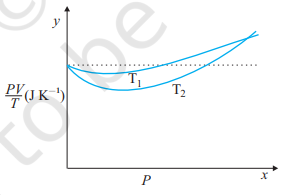
Following figure shows plot of PV/T versus P for 1.00 x 10⁻³ kg of oxygen gas at two different temperatures.
(a) What does the dotted plot signify?
(b) Which is true: T1 > T2 or T1 < T2?
(c) What is the value of PV/T where the curves meet on the y-axis?
(d) If we obtained similar plots for 1.00 x 10⁻³ kg of hydrogen, would we get the same value of PVIT at the point where the curves meet on the y-axis? If not, what mass of hydrogen yields the same value of PV If (Jor low pressure high temperature region of the plot)? (Molecular mass of H2 = 2.02 u, of O2 = 32.0 u, R = 8.31 J mot-1 K-1)
24.
An oxygen cylinder of volume 30 L has an initial gauge pressure of 15 atm and a temperature of 270C. After some oxygen is withdraw from the cylinder, the gauge pressure drop to 11 atm and its temperature drops to 170 C.Estimate mass of oxygen taken out of the cylinder (R = 8.3 L mol-1K-1, molecular mass of O2= 32)
1.
Both gases have same value of average translational kinetic energy per mole because their temperatures are equal and \(\bar { { E } } =\frac { 3 }{ 2 } RT\)
2.
\(\frac { 3{ k }_{ B }T }{ 2 } \)
3.
Since C\(\propto \sqrt { T } \)
Therefore, the r.m.s. velocity becomes \(\sqrt { 3C } \)
Hence, increase in r.m.s. velocity = \(\sqrt { 3C } \) - C
= 0.732 C
4.
P1/T1=P2/T2 or T2=P2 T2/P1 = \(\frac { 2\times (273-173) }{ 1 } \) = 200 K =-730C
5.
The ratio of r.m.s velocities is given as
\(\frac { { { C }_{ 1 } } }{ { C }_{ 2 } } =\sqrt { \frac { { M }_{ 2 } }{ { M }_{ 1 } } } =\sqrt { \frac { { \rho }_{ 2 } }{ { \rho }_{ 1 } } } \)
\(\frac { { C }_{ 1 } }{ { C }_{ 2 } } =\sqrt { \frac { 9 }{ 6 } } =\sqrt { 3 } :\sqrt { 2 } \)
6.
Given, T = 270C = 273 + 27 = 300K,
p = 1atm = 1.01 x 10⁵N/m2
d = 2 x 2 x 10-10m = 4 x 10⁻¹⁰
\(\therefore \ Mean\ free\ path,\ \lambda ={ K }_{ B }T/\sqrt { 2 } \pi { d }^{ 2 }p\)
\(\\ =\frac { 1.38\times { 10 }^{ -23 }\times 300 }{ 1.414\times 3.14(4\times { 10 }^{ -10 })^{ 2 }1.013\times { 10 }^{ 5 } } =5.75\times { 10 }^{ -8 }m\)
7.
Oxygen is a diatomic gas.
Number of moles of O2 gas
\(=\frac { Atomic\ wt. }{ Molecular\ wt. } =\frac { 8 }{ 32 } \)
\(\\ =\frac { 1 }{ 4 } =0.25\)
\(\\ \therefore \ Energy\ associated\ with\ 1\ mole\ of\ oxygen\)
\(\\ U=\frac { 5 }{ 2 } RT\)
\(\\ \therefore \ Internal\ enreyg\ of\ 8g\ of\ oxygen=0.25\times \frac { 5 }{ 2 } \times 8.31\times 273=1417.9J\)
8.
For 1 mole with f degrees of freedom,
Internal energy, U = 1 x Cv x T = f2/RT
For n moles, U = nCvT = nf2/RT
9.
Degree of freedom, f = 3N - K.
10.
(i) We know that (KE)trans = \(\frac { 3 }{ 2 }\) nRT
Given, n=2 mol, T = 273 + 20 = 293 K
\(\Rightarrow\) (KE)trans =\( \frac { 3 }{ 2 }\) (2)(8.31)(293)
= 7.3 x 10³J
(ii) Average KE per molecule
= \(\frac { 1 }{ 2 }\) \({ mv }_{ rms }^{ -2 }\)
= \(\frac { 3 }{ 2 }\) kT
=\(\frac { 3 }{ 2 } \)(1.38\(\times \)\({ 10 }^{ -23 }\))(293)
= 6.07 x 10⁻²¹ J
11.
The important point to remember is that the average kinetic energy (per molecule) of any (ideal) gas (be it monatomic like argon, diatomic like chlorine or polyatomic) is always equal to (3/2) kB T. It depends only on temperature, and is independent of the nature of the gas.
(i) Since argon and chlorine both have the same temperature in the flask, the ratio of average kinetic energy (per molecule) of the two gases is 1:1.
(ii) Now ½ m vrms2 = average kinetic energy per molecule = (3/2) ) kB T where m is the mass of a molecule of the gas. Therefore,
\( \frac{(v^2_rms)_{Ar}}{(v_rms)cl_2}\) = \( \frac{(m)cl}{(m)_{Ar}}\) =\(\frac{M_{cl}}{M_{Ar}}\) = \(\frac{70.9}{39.9}\) = 1.777
where M denotes the molecular mass of the gas. (For argon, a molecule is just an atom of argon.) Taking square root of both sides,
\(\frac{(v_{rms})_{Ar}}{(v_{rms})_cl_2}\) = 1.333
You should note that the composition of the mixture by mass is quite irrelevant to the above calculation. Any other proportion by mass of argon and chlorine would give the same answers to (i) and (ii), provided the temperature remains unaltered.
12.
As for one mole of ideal gas, pV =\(\mu\)RT
pV = RT
V = \(\frac{RT}{p}\)
Putting , R = 8.31 Jmol-1K-1, T = 273 K
p = 1 atm = 1.013 \(\times \)105 N -m-2
v = \(\frac{8.31\times273}{1.013\times10^5}\)
= 0.0224 m3
= 22.4 L [ \(\therefore\) 1 m3 = 103L ]
13.
If a gas is heated, then the root mean square velocity of its molecules is increased.
∴ Vrms ∝ √T
∴ The temperature of the gas increases .
14.
When air is pumped, more molecules are pumped and Boyle's law is stated for situation where number of molecules constant.
15.
For monoatomic gas, N =1
The total degree of freedom = 3
\( C_V=\frac{3 R}{2} \)
\( \text { Since } C_P=C_V+R \)
\( C_P=\frac{3 R}{2}+R \)
\( C_P=\frac{5 R}{2}\)
\( Y=\frac{\frac{5 R}{2}}{\frac{3 R}{2}} \)
\( Y=\frac{5}{3}=1.66
\)
16.
According to kinetic theory of gases,
\(p=\frac { 1 }{ 3 } { P }^{ { C }^{ 2 } }=\frac { 1 }{ 3 } \frac { M }{ V } { C }^{ 2 }\)
\(=\frac { 1 }{ 3 } \frac { M }{ V } KT\)
\( T\propto PV\) \((\because { C }^{ 2 }=KT.\)When k is constant)
Now as T is directly proportional to the product of P and V. If P and V are constant, then T is also constant.
17.
(i) Average speed,
\({ v }_{ av }=\frac { 0+2+3+4+4+4+5+5+6+9 }{ 10 } \)
\(=\frac { 42 }{ 10 } =4.2\quad ms^{ -1 }\)
(ii) R.M.S. Speed,
\({ v }_{ rms }=\left[ \frac { { (0) }^{ 2 }+{ (2) }^{ 2+ }{ (3) }^{ 2 }+{ (4) }^{ 2 }+{ (4) }^{ 2 }+{ (4) }^{ 2 }+{ (5) }^{ 2 }+{ (5) }^{ 2 }+{ (6) }^{ 2 }+{ (9) }^{ 2 } }{ 10 } \right] ^{ 1/2 }\)
\(=\left[ \frac { 228 }{ 10 } \right] ^{ 1/2 }=4.77\quad ms^{ -1 }\)
18.
Temperature T = 300K
Volume V = 4 litre = 4 x 10⁻³ m3
The pressure exerted by a gas is given by
\(p=\frac { nRT }{ V } =\frac { mass }{ molecular\ weight } \times \frac { RT }{ V } \)
Pressure exerted by oxygen P1= \(\\ \frac { 8 }{ 32 } \frac { RT }{ V } =\frac { 1 }{ 4 } \frac { RT }{ V } \)
Pressure exerted by nitrogen P2 = \(\frac { 14 }{ 28 } \frac { RT }{ V } =\frac { 1 }{ 2 } \frac { RT }{ V } \)
Pressure exerted by carbon dioxide P3 = \(\\ \frac { 22 }{ 44 } \frac { RT }{ V } =\frac { 1 }{ 2 } \frac { RT }{ V } \)
From Dalton's law of partial pressures, the total pressure exerted by the mixture is given by
P = P1 + P2 + P3
\(\\ \frac { 1 }{ 4 } \frac { RT }{ V } =\frac { 5 }{ 4 } \times \frac { 8.315\times 300 }{ 4\times 10^{ -3 } } \)
= 7.79 x 10⁵ N m-2
19.
\(For\ a\ monoatomic\ gas,\ i.e.\gamma =\frac { 5 }{ 3 }\)
\( \\ { C }_{ { V }_{ \gamma } }=\frac { R }{ \gamma -1 } =\frac { R }{ \frac { 5 }{ 3 } -1 } =\frac { 3 }{ 2 } R\)
\(\\ For\ a\ diamotic\ gas,\ i.e.\ \gamma =\frac { 7 }{ 5 }\)
\( \\ { C }_{ V }=\frac { R }{ \frac { 7 }{ 5 } -1 } =\frac { 5 }{ 2 } R\)
\(\\ By\ conservation\ of\ energy,\)
\(\\ { C }_{ { V }_{ mixture } }=\frac { { \mu }_{ 1 }{ C }_{ { V }_{ 1 } }+{ \mu }_{ 2 }{ C }_{ { V }_{ 2 } } }{ { \mu }_{ 1 }+{ \mu }_{ 2 } } \)
\(=\frac { 2\times \frac { 3 }{ 2 } R+3\times \frac { 5 }{ 2 } R }{ 2+3 } =\frac { 3R+7.5R }{ 5 } =2.1\ R\)
20.
Partial pressure of a gas in a mixture is the pressure it would have for the same volume and temperature if it alone occupied the vessel. (The total pressure of a mixture of non-reactive gases is the sum of partial pressures due to its constituent gases.) Each gas (assumed ideal) obeys the gas law. Since V and T are common to the two gases, we have P1V=μ1,RT and P2V=μ2RT, i.e. (P1/P2)=(μ1/μ2). Here 1 and 2 refer to neon and oxygen respectively. Since (P1/P2)=(3/2) (given), (μ1/μ2)=3/2.
(i) By definition μ1=(N1/NA) and u2=(N2/NA) where N1 and N2 are the number of molecules of 1 and 2, and NA is the Avogadro.s number. Therefore, (N1/N2)=(μ1/μ2)=3/2.
(ii) We can also write μ1=(m1/M1) and μ2=(m2/M2) where m1 and m2 are the masses of 1 and 2, and M1 and M2 are their molecular masses. (Both m1 and M1, as well as m2 and M2 should be expressed in the same units). If ρ1 and ρ2 are the mass densities of 1 and 2 respectively, we have
\( \frac{\rho_1}{\rho_2}=\frac{m_1 / V}{m_2 / V}=\frac{m_1}{m_2}=\frac{\mu_1}{\mu_2} \times\left(\frac{M_1}{M_2}\right) \)
\(=\frac{3}{2} \times \frac{20.2}{32.0}=0.947
\)
21.
2.25 R
22.
We know that r.m.s. speed is given by
\(\\ { v }_{ rms }=\left[ \frac { 3PV }{ M } \right] ^{ 1/2 }=\left[ \frac { 3RT }{ M } \right] ^{ 1/2 }\)
If (vrms)l be the r.m.s. speed of oxygen and (vrms)be the r.m.s. of helium gas at temperature T1 and T2 respectively.
\({ (v }_{ rms })_{ 1 }=\left[ \frac { 3RT_{ 1 } }{ { M }_{ 1 } } \right] ^{ 1/2 }\quad and\quad { (v }_{ rms })_{ 2 }=\left[ \frac { 3RT_{ 2 } }{ { M }_{ 2 } } \right] ^{ 1/2 }\)
\(or\quad \frac { { (v }_{ rms })_{ 1 } }{ { (v }_{ rms })_{ 2 } } =\left[ \frac { { M }_{ 2 }{ T }_{ 1 } }{ { M }_{ 1 }{ T }_{ 1 } } \right] ^{ 1/2 }\)
here \({ (v }_{ rms })_{ 1 }={ (v }_{ rms })_{ 2 },{ M }_{ 1 }=32,{ M }_{ 2 }=4.0;\)
T1 = ?,T2 = -10 + 273 = 263K
\(\\ \therefore \ 1=\left[ \frac { 4\times { T }_{ 1 } }{ 32\times 263 } \right] ^{ 1/2 }\)
\(\\ or\quad { T }_{ 1 }=\frac { 32\times 263 }{ 4 } =2104K\)
23.
(a) The dotted plot corresponds to 'ideal' gas behaviour as it is parallel to P-axis and it tells that value of PV /T remains same even when P is changed
(b) The upper position of PV /T shows that its value is lesser for T1, thus T1> T2. This is because the curve at T1 is more close to dotted plot than the curve at T2. Since the behaviour of a real gas approaches the perfect gas behaviour, as the tempera lure is increased
(c) Where the two curves meet, the value of PV / T on y-axis is equal to \(\mu \)R Since ideal gas
equation for \(\mu \) moles is PV = \(\mu \)RT
\(where,\ \mu =\frac { 1.00\times 10^{ -3 }kg }{ 32\times 10^{ -3 }kg } =\frac { 1 }{ 32 } \)
\(\therefore \ value\ of\frac { PV }{ T } \mu R=\frac { 1 }{ 32 } \times 8.31\quad { JK }^{ -1 }\)
(d) If we obtained similar plots for 1.00 x 10⁻³ kg of hydrogen, we will not get the same value of \(\frac { PV }{ T } \) at the point, where the curves meet on the y-axis. This is because molecular mass of hydrogen is different from that of oxygen.
For the same value of \(\frac { PV }{ T } \) mass of hydrogen required is obtained from
\(\frac { PV }{ T } nR=\frac { m }{ 2.02 } \times 8.31=0.26\)
\(\\ m=\frac { 2.02\times 0.26 }{ 8.31 } gram=6.32\times { 10 }^{ -2 }gram\)
24.
Initially in the oxygen cylinder, V1=30 litre =\(30 \times 10^{-3} \mathrm{~m}^3\),
\(P_1=15 a t m=15 \times 1.01 \times 10^5 \mathrm{~Pa}, T_1=27+273 =300 \mathrm{~K}\)
If the cylinder contains n1 mole of oxygen gas, then \(P_1 V_1=n_1 R T_1\)
or
\(n_1=\frac{P_1 V_1}{R T_1}=\frac{\left(15 \times 1.01 \times 10^5\right) \times\left(30 \times 10^{-3}\right)}{8.3 \times 300} =18.253\)
For oxygen moleculaer weight, M=32 g
Initial mass of oxygen in the cylinder cylinder,
\(m_1=n_1 M=18.253 \times 32=548.1 g\)
Finally in the oxygen gas in the cylinder, let n2 moles of oxygen be left,
Here,
\( V_2=30 \times 10^{-3} \mathrm{~m}^3, P_2=11 \times 1.01 \times 10^5 \mathrm{~Pa}, T_2 =17+273=290 \mathrm{~K}\)
Now,
\( n_2=\frac{P_2 V_2}{R T_2}=\frac{\left(11 \times 1.01 \times 10^5\right) \times\left(30 \times 10^{-3}\right)}{8.3 \times 290} =13.847 \)
\( \therefore \text { Final mass of oxygen gas in the cylinder, } m_2=13.847 \times 32=453.1 \mathrm{~g} \)
\( \therefore \text { Mass of the oxygen gas withdrawn }=m_1-m_2=584.1-453.1=131.0 \mathrm{~g} . \)

11th Standard CBSE Syllabus & Materials
11th Standard CBSE
CBSE 11th Business Studies Forms of Business Organisation Sample Question Papers Study Material - QB365 Set A
NEW11th Standard CBSE
CBSE 11th Business Studies Business, Trade and Commerce Sample Question Papers Study Material - QB365 Set A
NEW11th Standard CBSE
CBSE 11th Physics Waves Sample Question Papers Study Material - QB365 Set A
NEW11th Standard CBSE
CBSE 11th Physics Kinetic Theory Sample Question Papers Study Material - QB365 Set A



CBSE 11th Standard CBSE Subjects
CBSE Standards









