
 100% FREE ACCESS
11th Standard CBSE Syllabus & Materials
11th Standard CBSE
CBSE 11th Economics PART-A - Presentation of Data - New Sample Question Papers Study Material - QB365 Set A
NEW11th Standard CBSE
CBSE 11th Economics PART-A - Organisation of Data - New Sample Question Papers Study Material - QB365 Set A
NEW11th Standard CBSE
CBSE 11th Economics PART-A - Collection of Data - New Sample Question Papers Study Material - QB365 Set A
NEW11th Standard CBSE
CBSE 11th Economics PART-A - Introduction to Economics and Statistics - New Sample Question Papers Study Material - QB365 Set A
NEW11th Standard CBSE
CBSE 11th Business Studies International Trade Sample Question Papers Study Material - QB365 Set A
NEW11th Standard CBSE
CBSE 11th Business Studies Evolution and Fundamentals of Business Sample Question Papers Study Material - QB365 Set A

Published on: 25/09/2019
Laws of Motion
Download CBSE Class 11th Standard CBSE Physics question papers, sample papers, important questions, and previous year solved papers in PDF format. Get free study materials, NCERT solutions, and exam preparation resources for Class 11th Standard CBSE Physics
Questions + Answers key
Take MCQ Physics Test
1.
State Newton's third law of motion. Discuss its consequences
2.
State Newton's second law of motion. How does it help to measure force? Also state the units of force.
3.
A disc revolves with a speed of 33\(1\over3\) rpm and has a radius of 15 cm. Two coins are placed at 4 cm and 14 cm away from the centre of the record. If the coefficient of friction between the coins and record is 0.15, which of the coins will revolve with the record?
4.
A truck starts from rest and accelerates uniformly at 2.0 m s-2. At t = 10 s, a stone is dropped by a person standing on the top of the truck (6 m high from the ground). What are the (a) velocity, and (b) acceleration of the stone at t = 11s ? (Neglect air resistance.)
5.
A stone of mass 0.20 kg is tied to one end of a string of length 80 cm, holding the other end, the stone is whirled into a vertical circle. What is the minimum speed of the stone at the lowest point so that it just completes the circle. What is the tension in string at lowest point of the circular path ? ( g = 10 m / s2)
6.
Give the magnitude and direction of the net force acting on a kite skillfully held stationary in the sky.
7.
Give the magnitude and direction of the net force acting on a cork of mass 10 g floating on water.
8.
A hammer weighing 1 kg moving with the speed of 20 m / s strikes the head of a nail driving it 20 cm into a wall. Neglecting the mass of the nail, calculate
(i) the acceleration during the impact
(ii) the time interval during the impact
(iii) the impulse.
1.
Newton's third law of motion states that for any action, there is equal and opposite reaction.
So, if a body applies a force F12 on body 2 (action), then body 2 also applies a force F21 on body 1 but in opposite direction, then
F21 = - F12
In terms of magnitude
|F21| = |F12|
It is very important to note that F12 and F21 though are equal in magnitude and opposite in direction yet act on different points or else no motion will be possible.
For example, hands pull up a chest expander (spring) and spring in turn exerts force on the arms. A football pressed reacts on the foot with the same force and so on.
The most important consequence of the third law of motion is the law of conservation of linear momentum and its application in collision problems.
Since F12 - F21 and F = m\(\triangle v\over \triangle t\)
\(\therefore m_1{\triangle v_1\over \triangle t}=-m_2{\triangle v_2\over \triangle t}\)
Here \(\triangle t\) is the time for which the bodies come in contact during impact. This is same for the two bodies of masses m1and m2 and having velocity changes \(\triangle v_1\) and\(\triangle v_2\) respectively.
Therefore,
m1\(\triangle v_1\)= m2 \(\triangle v_2\)
or m1 \(\triangle v_1\)+ m2 \(\triangle v_2\) = 0
Let u1, u2 and v1,v2 be the initial and final velocities of the two masses before and after collision, then,
m1 (v1 -u1) = - m2 (v2 - u2)
or m1 u1 + m2 u2 = m1 v1 + m2 v2
Momentum before impact = Momentum after impact.
(This is known as the law of conservation of momentum).
2.
Newton's second law of motion states that the rate of change of momentum of a rigid body is directly proportional to the force applied on it.
The law implies that when a bigger force is applied on a body of given mass, its linear momentum changes faster and vice-versa. The momentum will change in the direction of the applied force.
Let, m = mass of a body,
\(\overrightarrow{v}\)= velocity of the body
\(\therefore\)The linear momentum of the body
\(\overrightarrow{p}=m\overrightarrow{v}\) .............(i)
Now, suppose \(\overrightarrow{F}\) = external force applied on the body in the direction of motion of the body.
\(\triangle \overrightarrow{p}\)= a small change in linear momentum of the body in a small time \(\triangle t\).
Rate of change of linear momentum of the body = \({\triangle \overrightarrow{p}\over \triangle t}\)
According to Newton's second law,
\({\triangle \overrightarrow{p}\over \triangle t} \propto \overrightarrow{F} \ or \ \overrightarrow{F} \propto {\triangle \overrightarrow{p}\over \triangle t} \)
or \(\overrightarrow {F}=k{\triangle \overrightarrow{p}\over \triangle t}\) ..................(ii)
where k is a constant of proportionality.
Taking the\(\triangle t \rightarrow 0,\) the term \(={\triangle \overrightarrow{p}\over \triangle t}\) becomes the derivative or differential coefficient of \(\overrightarrow{p}\) w.r.t. time t. It is denoted by \({d\overrightarrow{p}\over dt}\) .
\(\therefore \overrightarrow{F}=k{d\overrightarrow p \over dt}\)
Using eqn (i), \(\overrightarrow{F}=k{d \over dt}(m\overrightarrow{v})=km{d\overrightarrow{v}\over dt}\)
\(\overrightarrow {F}=km\overrightarrow{a}\)
where \(\overrightarrow{a}={d\overrightarrow{v}\over dt}\) represents acceleration of the body
The value of constant of proportionality k depends on the units adopted for measuring the force.
Now, putting k=1
\(\overrightarrow{F}=m\overrightarrow{a},\) This gives mean of measuring force.
Units of Force: Force in SI units is measured in 'newton' or N. From the relation \(\overrightarrow{F}=m\overrightarrow{a},\) we can see that a newton force is that force which produces 1 ms-2 acceleration in a body of mass 1 kg.
1 newton = 1 kilogram x 1 metre/ second2
\(\Rightarrow\) 1 N = 1 kg x 1 ms-2 = 1 kg x ms-2=1kg ms-2
In CGS system, force is measured in 'dyne'.
1 dyne = 1 gram x 1 cm s-2 = 1 g cm s-2
Since 1 N = 1 kg ms-2 = 1000 g x 100 cm s-2
= 105 g cm s-2= 105 dyne.
\(\Rightarrow\)IN = 105 dyne.
or 1 dyne = 10-5 N.
3.
If the coin is to revolve with the record, then the force of friction must be enough to provide the necessary centripetal force.
\(\therefore mr \ \omega^2 \le \mu_s mg \ or \ r \le {\mu_s mg\over m \omega^2}or \ r \le {\mu_s g\over \omega^2}\)
frequency = \(33{1\over2}rpm={100\over 3}rpm ={100\over 3\times 60}rps\)
The problems in which centripetal force is obtained from force of friction, start with the following equation:
m r\(\omega^2 \le \mu_s \ mg\)
\(\omega =2\pi \times {100\over 3\times 60}rad s^{-1}={10\over 9}\pi rad s^{-1}\)
\({\mu_s g\over \omega ^2}={0.15\times 10\over ({10\over 9}\pi)^2}m=0.12m=12cm\)
The condition (r \(\le\)12cm) is satisfied by the coin placed at 4cm from the centre of the record. So, the coin at 4 cm will revolve with the record.
4.
u = 0, a = 2 ms-2, t = 10s
Using equation, v = u + at, we get
v = 0 + 2 x 10 = 20 ms-1
(a) Let us first consider horizontal motion. The only force acting on the stone is force of gravity which acts vertically downwards.
Its horizontal component is zero. Moreover, air resistance is to be neglected. So, horizontal motion is uniform motion.
\(\therefore\)v x = v = 20 ms-1
Let us now consider vertical motion which is controlled by force of gravity.
u=0, a = g = 10 ms-2, t = (11 - 10) s = 1s
Using v =u + at, vy = 0 + 10 x 1 = 10 ms-1
Resultant velocity,
\(v=\sqrt{V^2_x+V^2_y}\)
\(v=\sqrt{20^2+10^2}ms^{-1}\)
\(=\sqrt{500}ms^{-1}\)
= 22.36 ms-1
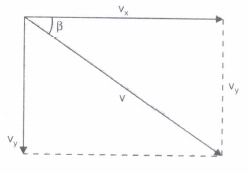
\(tan \beta ={v_y\over v_x}={10\over20}={1\over2}=0.5\)
or \(\beta =\)tan-1 (0.5) = 26.56°
or \(\beta =\) 26° 34'. This angle is with the horizontal.
(b) The moment the stone is dropped from the car, horizontal force on the stone is zero. The only acceleration of the stone is that due to gravity. This gives a vertically downward acceleration of 10 ms-2. This is also the net acceleration of the stone.
5.
Here m = 0.2 kg
r = 80 cm = 0.8 m
\(\therefore\)Vmin at the lowest point so that the stone is just able to complete the circle.
\(=\sqrt{5gr}\)
\(=\sqrt{5\times 10\times 0.8}\)
\(=\sqrt{40}\)
= 6.32 m/s-1
Now tension in the string at the lower point of the circular path = \({m V^2_{min}\over r}+mg\)
\(=5mg+mg [\because {mV^2_{min}\over r}=5mg]\)
= 6mg
= 6 x 0.2 x 10
= 12 N.
6.
Force F = ma, therefore force acting on a particle in unaccelerated (a = 0) motion is zero.
As kite is held stationary in the sky, therefore acceleration of the kite is zero. Therefore, net force acting on the car F = ma = 0.
7.
Force F = ma, therefore force acting on a particle in unaccelerated (a = 0) motion is zero.
In floating condition, the weight of the body is balanced by the upthrust. Therefore, net force acting on a cork floating on water = 0
8.
Here, m = 1kg, u = 20 m/s
s = 10 cm = 0.1 m
v = 0, a= ?
(a) As,
\(v^2=u^2+2 a s\)
\( \therefore 0=(20)^2+2 . a \cdot(0.1) \)
\( \Rightarrow a=-\frac{400}{2 \times 0.1}=-2000 \mathrm{~m} / \mathrm{s}^2 \)
b) v=u+a t
\( \therefore 0=20+(-2000) t \)
\( \Rightarrow t=\frac{20}{2000} \)
\(=\frac{1}{100}=0.01 \mathrm{sec}\)
c) Impulse = F. t
=m(v-u)
=1(0-20)
=-20 N.s.

11th Standard CBSE Syllabus & Materials
11th Standard CBSE
CBSE 11th Business Studies Forms of Business Organisation Sample Question Papers Study Material - QB365 Set A
NEW11th Standard CBSE
CBSE 11th Business Studies Business, Trade and Commerce Sample Question Papers Study Material - QB365 Set A
NEW11th Standard CBSE
CBSE 11th Physics Waves Sample Question Papers Study Material - QB365 Set A
NEW11th Standard CBSE
CBSE 11th Physics Kinetic Theory Sample Question Papers Study Material - QB365 Set A



CBSE 11th Standard CBSE Subjects
CBSE Standards









