
 100% FREE ACCESS
11th Standard CBSE Syllabus & Materials
11th Standard CBSE
CBSE 11th Economics PART-A - Presentation of Data - New Sample Question Papers Study Material - QB365 Set A
NEW11th Standard CBSE
CBSE 11th Economics PART-A - Organisation of Data - New Sample Question Papers Study Material - QB365 Set A
NEW11th Standard CBSE
CBSE 11th Economics PART-A - Collection of Data - New Sample Question Papers Study Material - QB365 Set A
NEW11th Standard CBSE
CBSE 11th Economics PART-A - Introduction to Economics and Statistics - New Sample Question Papers Study Material - QB365 Set A
NEW11th Standard CBSE
CBSE 11th Business Studies International Trade Sample Question Papers Study Material - QB365 Set A
NEW11th Standard CBSE
CBSE 11th Business Studies Evolution and Fundamentals of Business Sample Question Papers Study Material - QB365 Set A

Published on: 04/10/2019
Mechanical Properties of Solids
Download CBSE Class 11th Standard CBSE Physics question papers, sample papers, important questions, and previous year solved papers in PDF format. Get free study materials, NCERT solutions, and exam preparation resources for Class 11th Standard CBSE Physics
Questions + Answers key
Take MCQ Physics Test
1.
A boy's catapult is made of a rubber cord 42 cm long and 6 mm in diameter. The boy stretches the cord by 20 cm. Find the Young's modulus of the rubber if a stone weighing 0.02 kg when catapulated flies with a velocity of 20 ms-1. Disregard the change in the cross-section of the cord in stretching.
2.
What do you understand by Poisson's ratio? Find the value of Poisson's ratio at which the volume of a wire does not change when the wire is subjected to a tension.
3.
Determine the poission's ratio of the material of wire whose volume remains constant under an external normal stress.
4.
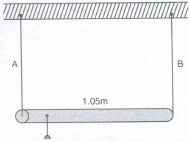
A rod of length 1.05 m having negligible mass is supported at its ends by two wires of steel (wire A) and aluminium (wire B) of equal lengths as shown in figure. The cross-sectional areas of wires A and Bare 1.0 mm? and 2.0 mm2, respectively. At what point along the rod should a mass m be suspended in order to produce (a) equal stresses and (b) equal strains in both steel and aluminium wires.
5.
What is the density of water at a depth where pressure is 80.0 atm, given that its density at the surface is 1.03 × 10³ kg m–3?
6.
Four identical hollow cylindrical columns of mild steel support a big structure of mass 50,000 kg. The inner and outer radii of each column are 30 cm and 60 cm respectively. Assuming the load distribution to be uniform, calculate the compressional strain of each column. Young's modulus, \(\Upsilon \) = 2.0 x 10¹¹ Pa.
7.
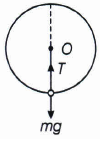
A 14.5 kg mass, fastened to the end of a steel wire of unstretched length 1.0 m, is whirled in a vertical circle with an angular velocity of 2 rev/s at the bottom of the circle. The cross-sectional area of the wire is 0.065 cm2 . Calculate the elongation of the wire when the mass is at the lowest point of its path.
8.
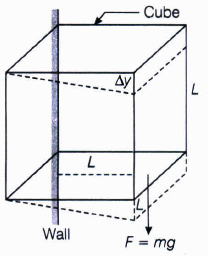
The edge of an aluminium cube is 10 cm long. One face of the cube is firmly fixed to a vertical wall. A mass of 100 kg is then attached to the opposite face of the cube. The shear modulus of aluminium is 25 GPa. What is the vertical deflection of this face?
9.
Two wires of equal cross-section but one made of steel and the other copper are joined end to end. When the combination is kept under tension, the elongation in the two wires is found to be equal. Given Young's moduli of steel and copper are 2.0 x 10¹¹ Nm-2 and 1.1 x 10¹¹Nm-2 Find the ratio between the lengths of steel and copper wires
10.
What is the length of a wire that breaks under its own weight when suspended vertically? Breaking stress = 5 x 10⁷ Nm-2 and density of the material of the wire = 3 x 10³ kg/m3
1.
Due to extension produced in the cord, energy is stored in it which is converted into kinetic energy when the stone flies away. Assuming that there is no loss of energy in this process, the kinetic energy of the stone is given by
W = \(\frac{1}{2}\)mv2 = 4J
This must be equal to the work done in stretching the cord.
Using the equation.
W = \(\frac{1}{2}\)FΔl = 4J
Where F is the stretching force. Since
Δl = 20 cm = 0.2 m
F= \(\frac { 4\times 2 }{ 0.2 } \)= 40 N
Stress = \(\frac { F }{ A } =\frac { 40 }{ { \pi r }^{ 2 } } \)
Now, r = 3 mm = 3 x 10⁻³ m
Hence, Stress = \(\frac { 40 }{ \pi (3\times 10^{ - })^{ 2 } } \)=1.415 x 10⁶ Nm-2
But Strain = \(\frac { 20 }{ 42 } \)=0.476
Young's modulus = \(\Upsilon =\frac { 1.415\times { 10 }^{ 6 } }{ 0.476 } \)
= 2.97 x 10⁶ Nm-2.
2.
For Poisson's ratio, see text.
Poisson's ratio
where r is the radius of the wire and l its length.
Volume of the wire before expansion V1
Volume of the wire after expansion
V2 = \(\pi\)(r-Δr)2(l+Δl)
If the volume is to remain unchanged during expansion, we require that
V1 = V2, i.e.,
\(\pi\)r2l = \(\pi\)[r2-2r Δr + (Δr)2](l+Δl)
= \(\pi\)r2(l+Δl)-2\(\pi\)r Δrl-2r Δr Δl \(\pi\) + (Δr)2(l+Δl)\(\pi\)
or 2\(\pi\)r Δrl =\(\pi\)r2 Δl + terms containing the product of Δr and Δl, which can be neglected.
Hence \(\frac { \triangle r/r }{ \triangle l/l } =\frac { 1 }{ 2 } \)
or σ = 0.5
Thus the volume of the wire does not change if the Poisson's ratio of the material of the wire is 0.5.
3.
Let volume of the wire before the expansion
V1 = \({ \pi r }^{ 2 }l\)
Volume of the wire after expansion
V2 = \(\pi \)(r-Δr)2 x (l+Δl)
But volume remains same during the expansion
∴ \({ \pi r }^{ 2 }l\) = \(\pi \)(r-Δr)2 x (l+Δl)
r2l = (r2+Δr2-2r x Δr) x (l x Δl)
=r2(l+Δl) + Δr2(l+Δl)-2r x Δr(l+Δl)
=r2l + r2 x Δl + Δr2l + Δr2 x Δl - 2rΔr x Δl
⇒ 2rΔrl = r2Δl [Rejecting the higher power of Δr and Δr x Δl]
⇒ \(\frac { r.\triangle r.l }{ r^{ 2 }.\triangle l } =\frac { 1 }{ 2 } \)
⇒ \(\frac { \frac { \triangle r }{ r } }{ \frac { \triangle l }{ l } } =\frac { 1 }{ 2 } \)
\(\sigma =\frac { 1 }{ 2 } \)=0.5.
Therefore, if the volume of the wire does not change, the value of the poission ratio o is maximum equal to 0.5.
4.
For steel wire A, l1 =I; Az = 1 mm2: \(\Upsilon \)1 = 2 x 10¹¹ Nm-2
For aluminium wire B, l2= I; A2 = 2mm2; \(\Upsilon \)2 = 7 x 10¹⁰ Nm-2
(a) Let mass m be suspended from the rod at distance x from the end where wire A is connected. Let F1 and F2 be the tensions in two wires and there is equal stress in two wires, then
\(\frac { { F }_{ 1 } }{ { A }_{ 1 } } =\frac { { F }_{ 2 } }{ { A }_{ 2 } } \Rightarrow \frac { { F }_{ 1 } }{ { F }_{ 2 } } =\frac { { A }_{ 1 } }{ { A }_{ 2 } } =\frac { 1 }{ 2 } \) ...(i)
Taking moment of forces about the point of suspension of mass from the rod, we have
F1x = F2(1.05 - x) or \(\frac { 1.05-x }{ x } =\frac { { F }_{ 1 } }{ F_{ 2 } } =\frac { 1 }{ 2 } \)
or 2.10-2x = x ⇒ x = 0.70 m = 70 cm
(b) Let mass m be suspended from the rod at distance x from the end where wire A is connected. Let F1 and F2 be the tension in the wires and there is equal strain in the two wires i.e.,
\(\frac { { F }_{ 1 } }{ { A }_{ 1 }{ \Upsilon }_{ 1 } } =\frac { F_{ 2 } }{ { A }_{ 2 }{ \Upsilon }_{ 2 } } \Rightarrow \frac { { F }_{ 1 } }{ { F }_{ 2 } } =\frac { { A }_{ 1 }{ \Upsilon }_{ 1 } }{ { A }_{ 2 }{ \Upsilon }_{ 2 } } =\frac { 1 }{ 2 } \times \frac { 2\times 10^{ 11 } }{ 7\times 10^{ 10 } } =\frac { 10 }{ 7 } \)
As the rod is stationary, so F1x = F2 (1.05 - x) or \(\frac { 1.05-x }{ x } =\frac { { F }_{ 1 } }{ { F }_{ 2 } } =\frac { 10 }{ 7 } \)
⇒ 10x = 7.35 - 7x or x = 0.4324 m
= 43.2 cm.
5.
Compressibility of water,
k =\(\frac{1}{B}\) = 45.8 x 10⁻¹¹ Pa-1
Change in pressure,
Δp = 80 atm - 1 atm
= 79 atm = 79 x 1.013 x 105 Pa.
\(\rho \)=1.03 x 10³ kg m-3
As B = \(\frac { \triangle p.V }{ \triangle V } \) or \(\frac { \triangle V }{ V } =\frac { \triangle p }{ B } =\triangle p\times \frac { 1 }{ B } \)=Δp x k
or \(\\ \frac { \triangle V }{ V } \)=\(\frac { \triangle V }{ V } =\frac { (M/\rho )-(M/\rho ') }{ (M/\rho ) } =1-\frac { \rho }{ { \rho }^{ ' } } \)
or \(\frac { \rho }{ { \rho }^{ ' } } =1-\frac { \triangle V }{ V } \)
or \({ \rho }^{ ' }=\frac { \rho }{ 1-(\triangle V/V) } \)
or \({ \rho }^{ ' }=\frac { 1.03\times 10^{ 3 } }{ 1-3.665\times 10^{ -3 } } =\frac { 1.03\times 10^{ 3 } }{ 0.996 } \)
= 1.034 x 10³ kg/m3.
6.
Here total mass to be supported, M = 50,000 kg
∴ Total weight of the structure to be supported = Mg
= 50,000 x 9.8 N
Since this weight is to be supported by 4 columns,
∴ Compressional force on each column (F) is given by
F = \(\frac { Mg }{ 4 } =\frac { 50,000\times 9.8 }{ 4 } \)N
Inner radius of a column, r1= 30 cm = 0.3 m
Outer radius of a column, r2 = 60 cm = 0.6 m.
∴ Area of cross-section of each column is given by
A = \(\pi ({ r }_{ 2 }^{ 2 }-{ r }_{ 1 }^{ 2 })\)
= \(\pi \)[(0.6)2-(0.3)2] = 0.27\(\pi \) m2.
Young's modulus, \(\Upsilon \) = 2 x 10¹¹ Pa.
Compressional strain of each column =?
\(\Upsilon \)= \(\\ \frac { Compressional\ force \ area }{ Compressional\ Strain } \)
= \(\frac { F/A }{ Compressional\ Strain } \)
or Compressional strain of each column
= \(\frac { F }{ A\gamma } =\frac { 50,000\times 9.8\times 7 }{ 4\times 0.27\times 22\times 2\times 10^{ 11 } } \)
= 0.722 x 10⁻⁶
∴ Compressional strain of all columns is given by
= 0.722 x 10-6 x 4 = 2.88 x 10-6
= 2.88 x 10⁻⁶.
7.
Given, mass(m) = 14 .5kg
Length of wire (l ) = 1 m
Angular frequency (v) = 2 revls
Angular velocity (\(\omega \)) = 2\(\pi \)v
= 2\(\pi \)\(\times \)2 rad/s = 4\(\pi \) rad/s
Area of cross-section of wire (A) = 0.065 cm2
= 6.5 \(\times \)10-6 m2
Young's modulus for steel (Y) = 2 \(\times \) 1011 N/m2.
At lowest point of the vertical circle, T - mg = ml\({ \omega }^{ 2 }\)
or T= mg + m\({ \omega }^{ 2 }\)
= (14.5\(\times \)9.8)+14.5\(\times \)1\(\times \)\({ (4\pi ) }^{ 2 }\)
= 14.5(9.8+16\({ \pi }^{ 2 }\))
= 14.5(9.8\(\times \)16\(\times \)9.87) [\(\because \) \({ \pi }^{ 2 }\)=9.87]
= 14.5\(\times \) 167.72N=2431.94 N
Young's modulus (Y) =\(\frac { Stress }{ Strain } =\frac { (T/A) }{ \Delta l/l } =\frac { Tl }{ A.\Delta l } \)
\(\therefore \Delta l=\frac { T.l }{ A.Y } =\frac { 2431.94\times 1 }{ 6.5\times { 10 }^{ -6 }\times 2\times { 10 }^{ 11 } } \)
= 1.87\(\times \)10-3 m =1.87 mm
8.
Given, side of a cube (l) = 10 cm = 0.1 m
Area of its each face (A) = l2 = (0.1)2 = 0.01 m2
Load(m) = 100 kg
Tangential force acting on one face of the cube, F = mg = 100\(\times \) 9.8 =980 N
Shear stress acting on this face = \(\frac { F }{ A } \) = \(\frac { 980 }{ 0.01 } \) N/m2
= 9.8 \(\times \)104 N/m2
Shear modulus of aluminium (\(\eta \)) = 25 GPa
= 25\(\times \) 109 N/m2
Shear modulus (\(\eta \))=\(\frac { Shearing\ stress }{ Shearing\ strain } \)
or shearing strain \(\left( \frac { \Delta L }{ L } \right) \) = \(\frac { Shearing\ stress }{ Shear\ modulus } \)
or \(\Delta L\) = \(\frac { Shearing\ stress }{ Shear\ modulus } \) \(\times \) L = \(\frac { 9.8\times { 10 }^{ 4 } }{ 25\times { 10 }^{ 9 } } \)\(\times \) 0.1
= 0.0392 \(\times \)10-5m
= 3.92 \(\times \) 10-7m
9.
As the cross sections of the wires are equal and same tension exists in both the stresses developed are equal. Lelt the origin/Al lengths of the steel wire and the copper wire be Ls and Lc respectively and the elongation in each wire be I.
\(\frac{l}{L_s}=\text { stres } \frac{s}{2.0 \times 10^{11} \mathrm{~nm}^{-2}} \)....(i)
and \(\frac{l}{L_c}=\) stres \(\frac{s}{1.1 \times 10^1 \mathrm{Nm}^{-2}} \)..ii
Dividing ii by i
\(\frac{L_s}{L_c}=\frac{2.0}{1.1}=20: 11\)
10.
1.67 km

11th Standard CBSE Syllabus & Materials
11th Standard CBSE
CBSE 11th Business Studies Forms of Business Organisation Sample Question Papers Study Material - QB365 Set A
NEW11th Standard CBSE
CBSE 11th Business Studies Business, Trade and Commerce Sample Question Papers Study Material - QB365 Set A
NEW11th Standard CBSE
CBSE 11th Physics Waves Sample Question Papers Study Material - QB365 Set A
NEW11th Standard CBSE
CBSE 11th Physics Kinetic Theory Sample Question Papers Study Material - QB365 Set A



CBSE 11th Standard CBSE Subjects
CBSE Standards









