
 100% FREE ACCESS
11th Standard CBSE Syllabus & Materials
11th Standard CBSE
CBSE 11th Economics PART-A - Presentation of Data - New Sample Question Papers Study Material - QB365 Set A
NEW11th Standard CBSE
CBSE 11th Economics PART-A - Organisation of Data - New Sample Question Papers Study Material - QB365 Set A
NEW11th Standard CBSE
CBSE 11th Economics PART-A - Collection of Data - New Sample Question Papers Study Material - QB365 Set A
NEW11th Standard CBSE
CBSE 11th Economics PART-A - Introduction to Economics and Statistics - New Sample Question Papers Study Material - QB365 Set A
NEW11th Standard CBSE
CBSE 11th Business Studies International Trade Sample Question Papers Study Material - QB365 Set A
NEW11th Standard CBSE
CBSE 11th Business Studies Evolution and Fundamentals of Business Sample Question Papers Study Material - QB365 Set A

Published on: 24/09/2019
Motion in a Plane
Download CBSE Class 11th Standard CBSE Physics question papers, sample papers, important questions, and previous year solved papers in PDF format. Get free study materials, NCERT solutions, and exam preparation resources for Class 11th Standard CBSE Physics
Questions + Answers key
Take MCQ Physics Test
1.
State the reason , whether the following algebraic operations with scalar and vector physical quantities are meaningful.
adding a component of a vector to the same vector.
2.
State the reason , whether the following algebraic operations with scalar and vector physical quantities are meaningful
Adding any two vectors
3.
State the reason , whether the following algebraic operations with scalar and vector physical quantities are meaningful
Adding a scalar to a vector of dimensions
4.
If the horizontal range of projectile be a and the maximum height attained by it is b, then prove that the velocity of projectile is \([2g({b+{a^2\over 16b}})]^{1/2}\)
5.
Define angular velocity and angular acceleration. The total speed V1of a projectile at its greatest height is \(\sqrt{6\over7}\) of its speed V2 when it is at half its greatest height. Show that the angle of projection is 30°.
6.
A particle is thrown over a triangle from one end of a horizontal base that grazing the vertex falls on the other end of the base. If \(\alpha\) and \(\beta\) be the base angles and \(\theta\) the angle of projection; prove that: tan \(\theta\) = tan \(\alpha\)+ tan\(\beta\)
7.
Mathematically describe the motion of a particle along a plane (or along a two-dimensional plane).
8.
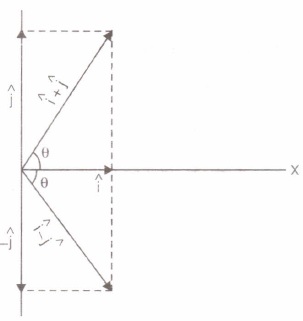
\(\hat { i } \) and \(\hat { j } \) are unit vectors along x- and y- axis respectively. What is the magnitude and direction of the vectors \(\hat { i } \)+\(\hat { j } \) , and \(\hat { i } \)-\(\hat { j } \) ? What are the components of a vector \(\overset\rightarrow{A}\) =2\(\hat { i } \)+3\(\hat { j } \)along the directions \(\hat { i } \) + \(\hat { j } \) and \(\hat { i } \) - \(\hat { j } \) ? [You may use graphical method]
9.
A ball rolls of the top of a stairway with horizontal velocity of 1.8 m/s. The steps are 0.24 m high and 0.2 m wide. Which step will the ball hit first? Take g=9.8 m/s2
10.
If A and B are two vectors such that \(\left| A\times B \right| =\sqrt { 3 } A.B\) Then,
Also, find the value of \(\left| A\times B \right| \)
1.
Yes, adding a component of a vector of the same vector is meaningful because both vectors are of same dimensions
2.
No,adding any two vectors is not meaningful because only vectors of the same dimensions i.e. having same unit can be added.
3.
No adding a scalar to a vector of the same dimensions is not meaningful because a scalar cannot be added to a vector
4.
Maximum height = b =\(u^2sin^2\theta\over 2g\)
or \(sin^2 \theta={2bg\over u^2}\)
Horizontal range, a =\({u^2sin2\theta\over 2g }={u^2sin\theta cos \theta\over g }\)
\(\Rightarrow 2 sin \theta cos \theta={ag\over u^2}\)
or \(4 sin^2 \theta cos^2 \theta={a^2g^2\over u^4}\)
\(\Rightarrow 4 sin^2 \theta (1-sin^2 \theta)={a^2g^2\over u^4}\) ............(i)
or \( 4({2bg\over u^2})[{1-{2bg\over u^2}}]={a^2g^2\over u^4}\)
or \({8bg\over u^2}-{16b^2g^2\over u^4}={a^2g^2\over u^4}\)
\(\Rightarrow a^2g^2+16b^2g^2=u^28bg\)
or \(u^2={a^2g^2+16b^2g^2\over 8bg}\)
or \(u=[2g(b+{a^2\over 16b})]^{1/2}\)
5.
For the definition of angular velocity and angular acceleration, see text.
Numerical. Velocity at highest point = u cos \(\theta\) = V1 (given)
\(h_{max}={u^2sin^2\theta\over 2g}\)
Vertical velocity at \({h_{max}\over 2}=V_{2y}=\sqrt{u^2sin^2\theta 2g{h_{max}\over 2}}\)
or \(V_{2y}=\sqrt{u^2sin^2\theta (1-{1\over 2})}\)
\(={u \ sin \theta\over \sqrt{ 2}}\)
V2x = u cos \(\theta\)
\(V_2=\sqrt{V^2_{2x}+V^2_{2y}}\)
\(=\sqrt{u^2cos^2\theta +{u^2 \ sin^2 \theta\over { 2}}}\)
Given, \(V_1=\sqrt{6\over 7}V_2\)
\(\therefore {u \ cos \theta \over u\sqrt{cos^2\theta+{sin^2 \theta\over2}}}=\sqrt{6\over 7}\)
Squaring both the sides
\( { \ cos^2 \theta \over {cos^2\theta+{sin^2 \theta\over2}}}={6\over 7}\)
or \( {1 \over {1+{tan^2 \theta\over2}}}={6\over 7}\)
or \(1+{tan^2 \theta\over2}={7\over 6}\Rightarrow{tan^2 \theta\over2}={7\over 6}-1={1\over6}\)
or \(tan \theta =\sqrt{2\over 6}={1\over \sqrt{3}}\)
\(\therefore \ \theta =tan^{-1}({1\over \sqrt{3}})=30^o\).
6.
The statement in the question is shown in the diagram,
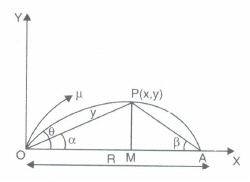
tan \(\alpha={y\over x}\) and tan \(\beta ={y\over MA}={y\over R-x},\) where R is horizontal range
\(\therefore\) tan \(\alpha\)+ tan\(\beta ={y\over x}+{y\over R-x}\)
\(={(R-x+x)y\over x(R-x)}={yR\over x(R-x)}\)
or tan \(\alpha\)+ tan\(\beta ={yR\over x(R-x)}\) ..........(i)
Again, x =(u cos \(\theta\)) t ..........(ii)
y=(u sin \(\theta\)) t -\({1\over2}\)gt2 ...........(iii)
From (ii) and (iii), we have
y = x tan \(\theta =[1-{xg\over 2u^2 cos^2\theta tan \theta}]\)
Putting, \(R={2u^2sin \theta cos \theta\over g}\)
we get y=\(x=tan \theta[1-{xg \over2u^2 cos\theta sin \theta}]\)
\(=xtan\theta[1-{x\over R}]\)
or \({y\over x}=tan \theta({R-x\over R})\) .........(iv)
Putting (iv) in (i), we get
tan \(\alpha\)+ tan\(\beta ={yR\over x(R-x)} =tan \theta\)
\(\therefore\) tan \(\alpha\)+ tan\(\beta =tan \theta\).
7.
Consider motion of a particle in x-y plane.
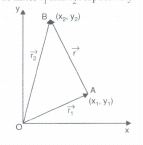
Displacement. Let the particle be at position A having position vector \(\vec{r_1}\) at time t1 where \(\vec{r_1}=(x_1\hat{i}+y_1\hat{j}).\) At time t2, the object reaches point B having position vector\(\vec{r_2}\) where \(\vec{r_2}=(x_2\hat{i}+y_2\hat{j}).\)
\(\therefore\) Displacement of the particle during the time (t2 - t1) will be
\(\vec{r}\) or \(\vec{r_{12}}=\vec{r_2}-\vec{r_1}=(x_2-x_1)\hat i +(y_2-y_1)\hat{j}, \ where | \vec{r}|=\sqrt{(x_2-x_1)^2+(y_2-y_1)^2}\)
Velocity. If motion be uniform then uniform velocity may be defined as the displacement covered per unit time i.e.,
Velocity \(\vec{v}={\triangle \overrightarrow {r} \over t }={\overrightarrow{r_2}-\overrightarrow {r_1}\over t_2 -t_1}={(x_2-x_1)\over(t_2-t_1)}\hat{i}+{(y_2-y_1)\over(t_2-t_1)}\hat{j}=v_x\hat{i}+v_y\hat{j}\)
where Vx=\({x_2-x_1\over t_2-t_1},v_y={y_2-y_1\over t_2-t_1}and |\vec{v}|=\sqrt{v^2_x+v^2_y}\) .
Acceleration. If velocity of particle is variable then time rate of change of velocity is the acceleration \(\vec{a}\) . If \(\vec{v_1}\) and \(\vec{v_2}\) be the velocities of the particle at times t1 and t2 respectively and acceleration be uniform, then
\(\vec{a}={\triangle \vec{v}\over \triangle t}={\vec{v_2}-\vec{v_1}\over t_2-t_1}\)
\(={(v_{2x}\hat{i}+v_{2y}\hat{j})-(v_{1x}\hat{i}+v_{1y}\hat{j})\over (t_2-t_1)}\)
\(={(v_{2x}-v_{1x})\over (t_2-t_1)}\hat{i}+{(v_{2y}-v_{1y})\over (t_2-t_1)}\hat{j}\)
\(=a_x\hat{i}+a_y\hat{j}\)
where \(a_x={v_{2x}-v_{1x}\over t_2-t_1},a_y={v_{2y}-v_{1y}\over t_2-t_1} \ and \ |\vec{a}|=\sqrt{a^2_x+a^2_y}\)
8.
(i) \(\hat { i } \) + \(\hat { j } \) =\(\sqrt { \left( 1 \right) ^{ 2 }+\left( 1 \right) ^{ 2 }+2\times 1\times 1\times cos\quad 90^{ 0 } } =\sqrt { 2 } \) = 1.414 units
tan\(\theta \) = \(\frac{1}{1}\)=1, \(\therefore\) \(\theta \) = 45°
So the vector \(\hat { i } \) + \(\hat { j } \) makes an angle of 45° with x-axis.
(ii) \(\left| \hat { i } -\hat { j } \right| \sqrt { \left( 1 \right) ^{ 2 }+\left( 1 \right) ^{ 2 }-2\times 1\times 1\times cos\quad 90^{ 0 } } \)
=\(\sqrt{2}\) = 1.414 units
The vector \(\hat { i } \) - \(\hat { j } \)makes an angle of -45° with .r-axis.
(iii) Let us now determine the component of \(\overset { \rightarrow }{ A } \)= 2\(\hat { i } \)+3\(\hat { j } \)in the direction of \(\hat { i } \) + \(\hat { j } \) .
Let \(\overset { \rightarrow }{ B } \) = \(\hat { i } \) + \(\hat { j } \)
\(\overset { \rightarrow }{ A } \).\(\overset { \rightarrow }{ B } \) cos \(\theta \) =(A cos \(\theta \))B
So the component of \(\overset { \rightarrow }{ A } \) in the direction of \(\overset { \rightarrow }{ B } \) =\(\frac { \overset { \rightarrow }{ A } .\overset { \rightarrow }{ B } }{ B } \)
=\(\frac { \left( 2\hat { i } +3\hat { j } \right) .\left( \hat { i } +\hat { j } \right) }{ \sqrt { \left( 1 \right) ^{ 2 }+\left( 1 \right) ^{ 2 } } } =\frac { 2\hat { i } .\hat { i } +2\hat { i } .\hat { j } .\hat { i } +3\hat { j } .\hat { j } }{ \sqrt { 2 } } =\frac { 5 }{ \sqrt { 2 } } \)units
( iv) Component of \(\overset { \rightarrow }{ A } \) in the direction of \(\hat { i } \) - \(\hat { j } \)=\(\hat { i } -\hat { j } =\frac { \left( 2\hat { i } +3\hat { j } \right) .\left( \hat { i } -\hat { j } \right) }{ \sqrt { 2 } } =-\frac { 1 }{ \sqrt { 2 } } \)units.
9.
Let the ball strike the nth step of stairs.
∴ Vertical distance travelled \(=\mathrm{ny}=\mathrm{n} \times 0.2=\frac{1}{2} \mathrm{gt}^2\)
Horizontal distance travelled \(=\mathrm{nx}=\mathrm{ut}\)
\(\Rightarrow \mathrm{t} =\frac{\mathrm{nx}}{\mathrm{u}} \)
\(\mathrm{ny} =\frac{1}{2} \mathrm{gt}^2=\frac{1}{2} \mathrm{~g}\left(\frac{\mathrm{nx}}{\mathrm{u}}\right)^2=\frac{1}{2} \mathrm{~g} \frac{\mathrm{n}^2 \mathrm{x}^2}{\mathrm{u}^2} \)
\(\Rightarrow \mathrm{n} =\frac{2 \mathrm{u}^2 \mathrm{y}}{\mathrm{gx^{2 }}} \)
\(=\frac{2 \times 1.8^2 \times 0.2}{9.8 \times 0.2^2} \approx 3.3\)
So, Fourth step.
10.
\(\sqrt { { A }^{ 2 }+B^{ 2 }+AB } \)

11th Standard CBSE Syllabus & Materials
11th Standard CBSE
CBSE 11th Business Studies Forms of Business Organisation Sample Question Papers Study Material - QB365 Set A
NEW11th Standard CBSE
CBSE 11th Business Studies Business, Trade and Commerce Sample Question Papers Study Material - QB365 Set A
NEW11th Standard CBSE
CBSE 11th Physics Waves Sample Question Papers Study Material - QB365 Set A
NEW11th Standard CBSE
CBSE 11th Physics Kinetic Theory Sample Question Papers Study Material - QB365 Set A



CBSE 11th Standard CBSE Subjects
CBSE Standards









