
 100% FREE ACCESS
11th Standard CBSE Syllabus & Materials
11th Standard CBSE
CBSE 11th Economics PART-A - Presentation of Data - New Sample Question Papers Study Material - QB365 Set A
NEW11th Standard CBSE
CBSE 11th Economics PART-A - Organisation of Data - New Sample Question Papers Study Material - QB365 Set A
NEW11th Standard CBSE
CBSE 11th Economics PART-A - Collection of Data - New Sample Question Papers Study Material - QB365 Set A
NEW11th Standard CBSE
CBSE 11th Economics PART-A - Introduction to Economics and Statistics - New Sample Question Papers Study Material - QB365 Set A
NEW11th Standard CBSE
CBSE 11th Business Studies International Trade Sample Question Papers Study Material - QB365 Set A
NEW11th Standard CBSE
CBSE 11th Business Studies Evolution and Fundamentals of Business Sample Question Papers Study Material - QB365 Set A

Published on: 03/10/2019
System of Particles and Rotational Motion
Download CBSE Class 11th Standard CBSE Physics question papers, sample papers, important questions, and previous year solved papers in PDF format. Get free study materials, NCERT solutions, and exam preparation resources for Class 11th Standard CBSE Physics
Questions + Answers key
Take MCQ Physics Test
1.
Discuss the rolling motion of a cylinder on an inclined plane.
2.
Prove the theorem of parallel axes.[Hint: If the centre of mass of chosen the origin\(\sum { { m }_{ i }r_{ i } } =0\)]
3.
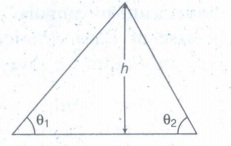
A solid sphere rolls down two different inclined planes of the same heights but different angles of inclination.
(a) Will it reach the bottom with the same speed in each case?
(b) Will it take longer to roll down one plane than the other?
(c) If so, which one and why?
4.
From a uniform disk of radius R, a circular hole of radius R/2 is cut out. The centre of the hole is at R/2 from the centre of the original disc. Locate the centre of gravity of the resulting flat body.
5.
Find the components along the x, y, z axes of the angular momentum l of a particle, whose position vector is r with components x, y, z and momentum is p with components Px,Py and Pz. Show that if the particle moves only in the x-y plane the angular momentum has only a z-component.
6.
Show that a.(b × c) is equal in magnitude to the volume of the parallelepiped formed on the three vectors , a, b and c.
7.
A cylinder is released from rest from the top of an incline of inclination \(\theta \) and length l. If the cylinder rolls without slipping. What will be its speed when it reaches the bottom?
8.
A man stands on a rotating platform with his arms stretched horizontally holding a 5 kg weight in each hand. The angular speed of the platform in 30 rpm. The man then brings his arms close to his body with the distance of each weight from the axis changing from 90 cm to 20 cm. The moment of inertia of the man together with the platform may be taken to be constant and equal to 7.6 kg-m2.
Is kinetic energy conserved in the process? If not, from where does the change come about?
9.
Find the centre of mass for a solid cone of base radius r and height h.
10.
In given pulley mass system, mass m1 = 500 g, m2 = 460 g and the pulley has a radius of 5 cm. When released from rest, heavier mass falls through 7.50 cm in 5 s. There is no slippage between pulley and string.
(i) What is magnitude of acceleration of mass?
(ii) What is magnitude of pulley's angular acceleration?
1.
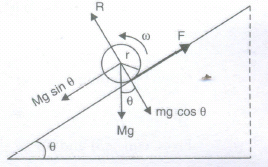
Consider a spherical body of mass M and radius r, rolling down on an inclined plane without slipping. Let the angle of inclination of the plane is \(\theta\) with the horizontal (Seefig.)
It \(\omega\) be the angular velocity of the body, then the linear velocity of the body is
\(v=r\omega\)................1
The various forces acting on the body are:
(a) The weight (Mg) of the body in the vertically downward direction
(b) Normal reaction (R) of the surface of the plane on the body which acts vertically upward.
(c) The force of friction (F) which acts opposite to the direction of motion of the body. Resolve Mg into two components:
\(\rightarrow\) Mg cos 8 is the horizontal component, which is equal and opposite to the normal reaction
i.e, R=Mg cos \(\theta\) .............2
\(\rightarrow\) Mg sin 8 is the vertical component, which acts in the direction of the motion of the body
\(\therefore\) Net force acting in the direction of motion of the body = Mg sin\(\theta\) - F
Let a = acceleration of the body
Therefore, equation of motion of the body is given by,
Ma = Mg sin \(\theta\) - F ...........3
The external torque acting on the body is produced by the force of friction (F) and its lever arm is r (the radius of the spherical body) [The lines of action of Mg and R pass through the centre of mass of body and hence do not contribute anything to the torque about the centre of mass].
\(\therefore \tau=Fr\)..........4
If \(\alpha\) be the angular acceleration produced in the body whose moment of inertia is I, then
\(\tau=I\alpha\)............5
From eqns (iv) and (v), we get
\(Fr=I\alpha\ or\ F=I\frac{\alpha}{r}\)................6
Using eqn. (vi) in eqn. (iii), we get
\(\therefore Ma=Mgsin\theta-I\frac{\alpha}{r}\)
\(a=r\alpha\ or \alpha=\frac{a}{r}\)
\(\therefore Ma=Mgsin\theta-I\frac{a}{r^2}\Rightarrow a=gsin\theta-\frac{Ia}{Mr^2}\)
\(a(1+\frac{I}{Mr^2})=gsin\theta\)
\(a=\frac{gsin\theta}{1+(\frac{I}{Mr^2})}\)
\(\alpha=\frac{a}{r}=\frac{gsin\theta}{r[1+\frac{I}{Mr^2}]}\)
Substituting this value in eqn. (vi), we get
\(F=\frac{I}{r}.\frac{gsin\theta}{r[1+\frac{I}{Mr^2}]}=\frac{Igsin\theta}{r^2[1+\frac{I}{Mr^2}]}\)
This is the force of friction, required by the body to roll down an inclined plane without slipping.
2.
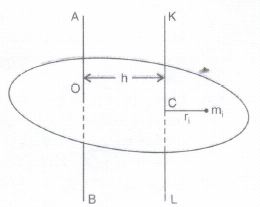
Theorem of parallel axes: According to this A theorem, moment of inertia of a rigid body about any axis AB is equal to moment of inertia of the body about another axis KL passing through centre of mass Cof the body in a direction parallel to AB, plus the product of total mass M of the body and square of the perpendicular distance between the two parallel axes.
If h is perpendicular distance between the axes AB and KL, then
Suppose rigid body is made up of n particles m1,m2,...mi,.....mn at perpendicular distances r1,r2,...ri,.....rn respectively from the axis KL passing through centre of mass C of the body.
If r i is the perpendicular distance of the particle of mass mi from KL then
\({ I }_{ KL }=\sum _{ i }^{ }{ { m }_{ i }{ r }_{ i }^{ 2 } } \) ...(i)
The perpendicular distance of ith particle from the axis
AB = (ri+n)
or IAB = \(\sum _{ i }^{ }{ { m }_{ i } } ({ r }_{ 1 }+h)^{ 2 }\)
=\(\sum _{ i }^{ }{ { m }_{ i } } ({ r }_{ i }^{ 2 }+h^{ 2 }+2{ r }_{ i }h)\)
= \(\sum _{ i }^{ }{ { m }_{ i }{ r }_{ i }^{ 2 } } +\sum _{ i }^{ }{ { m }_{ i }{ h }^{ 2 } } +2h\sum _{ i }^{ }{ { m }_{ i }{ r }_{ i } } \) ...(ii)
As the body is balanced about the centre of mass, the algebraic sum of the moments of the weights of all particles about an axis passing through C must be zero.
\(\sum _{ i }^{ }{ ({ m }_{ i }g) } { r }_{ i }=0\quad or\quad 8\sum _{ i }^{ }{ { m }_{ i }{ r }_{ i } } \)
or \(\sum _{ i }^{ }{ { m }_{ i }{ r }_{ i } } =0\) ...(iii)
From equation (ii), we have
IAB = \({ I }_{ AB }=\sum _{ i }^{ }{ { m }_{ i }{ r }_{ i }^{ 2 } } +\left( \sum _{ }^{ }{ { m }_{ i } } \right) { h }^{ 2 }+0\)
or IAB=IKL + Mh2
where IKL =\(\sum _{ i }^{ }{ { m }_{ i }{ r }_{ i }^{ 2 } } \) and M =\(\sum { { m }_{ i } } \)
3.
(a) Using law of conservation of energy
\(\frac { 1 }{ 2 } mv^{ 2 }+\frac { 1 }{ 2 } I{ \omega }^{ 2 }\)=mgh
or \(\frac { 1 }{ 2 } mv^{ 2 }+\frac { 1 }{ 2 } \left( \frac { 2 }{ 5 } m{ R }^{ 2 } \right) \frac { { v }^{ 2 } }{ { R }^{ 2 } } =mgh\)
or \(\frac { 7 }{ 10 } v^{ 2 }=gh\) or v =\(\sqrt { \frac { 10gh }{ 7 } } \)
Since h is same for both the inclined planes therefore v is the same
(b)
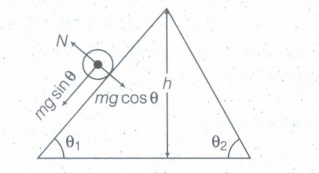
\(l=\frac { 1 }{ 2 } \left( \frac { g\quad sin\quad \theta }{ 1+\frac { { K }^{ 2 } }{ { R }^{ 2 } } } \right) { t }^{ 2 }=\frac { g\quad sin\theta }{ 2\left( 1+\frac { 2 }{ 5 } \right) } { t }^{ 2 }=\frac { 5gsin\theta }{ 14 } { t }^{ 2 }\)
or \(t=\sqrt { \frac { 14l }{ 5g\quad sin\quad \theta } } \)
Now, sin \(\theta\)=\(\frac { h }{ l } \) or l =\(\frac { h }{ sin\theta } \)
∴ \(t=\frac { 1 }{ sin\quad \theta } \sqrt { \frac { 14h }{ 5g } } \)
Lesser the value of,\(\theta\) more will be t.
(c) Clearly, the solid sphere will take longer to roll down the plane with smaller inclination.
4.
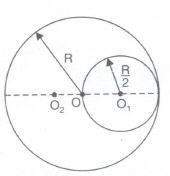
Let from a bigger uniform disc of radius R with centre O a smaller circular hole of radius\(\frac { R }{ 2 } \) with its centre at O1 (where OO1= \(\frac { R }{ 2 } \)) is cut out. Let centre of gravity or the centre of mass of remaining flat body be at O2 where OO2 = x. If σ be mass per unit area, then mass of whole disc M1 = \(\pi\)R2σ and mass of cut out part
M2 = \(\pi\)\(\left( \frac { R }{ 2 } \right) ^{ 2 }\) σ =\(\frac { 1 }{ 4 } \) \(\pi\)R2σ = \(\frac { { M }_{ 1 } }{ 4 } \)
∴ x = \(\frac { { M }_{ 1 }\times (0)-{ M }_{ 2 }({ OO }_{ 1 }) }{ { M }_{ 1 }-{ M }_{ 2 } } =\frac { 0-\frac { { M }_{ 1 } }{ 4 } \times \frac { R }{ 2 } }{ { M }_{ 1 }-\frac { { M }_{ 1 } }{ 4 } } =-\frac { R }{ 6 } \)
i.e O2 is at distance \(\frac { R }{ 6 } \)from centre of disc on diametrically opposite side to centre of hole.
5.
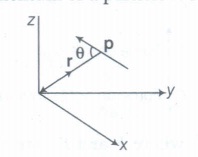
We know that angular momentum \(\vec { l } \) of a particle having position vector \(\vec { r } \) and momentum \(\vec { p } \) is given by
\(\vec { l } \) = \(\vec { r } \)\(\times\)\(\vec { p } \)
But, \(\vec { r } \)= [x\(\vec { i} \)+ y\(\vec { j} \)+ z\(\vec { k} \)] where x,y,z are the components of
\(\vec { r } \)and\(\vec { p } \) = [px\(\vec { i} \)+ py\(\vec { j} \)+ pz\(\vec { k} \)]
∴ \(\vec { l } \) = \(\vec { r } \)\(\times\)\(\vec { p } \) [x\(\vec { i} \)+ y\(\vec { j} \)+ z\(\vec { k} \)]\(\times\)[px\(\vec { i} \)+ py\(\vec { j} \)+ pz\(\vec { k} \)]
or (lx\(\vec { i} \)+ ly\(\vec { j} \)+ lz\(\vec { k} \)) = \(\left| \begin{matrix} \hat { i } & \hat { j } & \hat { k } \\ x & y & z \\ { p }_{ x } & { p }_{ y } & { p }_{ z } \end{matrix} \right| \)
=(ypz - zpy)\(\vec { i} \) +(zpx - xpz)\(\vec { j} \)+(xpy - ypx)\(\vec { k} \)
From this relation, we conclude that
lx= ypz - zpy, ly= zpx - xpz and lz = xpy - ypx
If the given particle moves only in the x - y plane, then z = 0 and pz = 0 and hence,
\(\vec { l } \)=(xpy-ypx)\(\hat { k } \) ,which is only the .z-comonent of \(\vec { l } \)
It means that for a particle moving only in the x - y plane, the angular momentum has only the z-component
6.
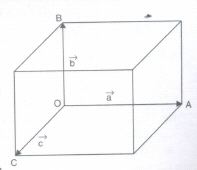
Let a parallelopiped be formed on the three vectors
\(\vec { OA } \)= \((\vec { a } ),\) \(\vec { OB} \) = \(\vec { b } \) and \(\vec { OC } \)=\(\vec { c } \)
Now, \(\vec { b } \) \(\times\)\(\vec { c } \)= bc sin 90o \(\hat { n } \)=bc \(\hat { n } \)
where \(\hat { n } \) is unit vector along \(\vec { OA } \) perpendicular to the plane containing \(\vec { b } \) and \(\vec { c } \)
Now \(\vec { a } \)(\(\vec { b } \) \(\times\)\(\vec { c } \)) = (a) (bc) cos 0o
= a b c
which is equal in magnitude to the volume of the parallelopiped.
7.
\(v=\sqrt { \frac { 4 }{ 3 } gl\sin { \theta } } \).
8.
KE is not conserved in process.
Kfinal > Kinitial
Muscular work done by the man in folding his arms is converted into KE.
9.
In this question we are given a solid uniform cone of radius R and height h, we need to find the center of mass from the vertex. We need to use the below diagram to understand the problem.
Let us consider the radius of the base of the cone to be R and height is h.
We will consider a small circular cross section of radius ‘z’ and thickness ‘dr’ from a distance ‘r’ from the vertex of the solid cone.
Consider two triangles ABC and AOD. These triangles are similar triangles, so we can write,
AB/AO=BC/OD
This can be expressed as,
r/h=z/R…… (1)
The volume of the small volume element considered is, dV=πz2dr,
which can be written in terms of r from equation (1). So we get,
\(d V=\frac{\pi R^2 r^2}{h^2} d r\) ...(2)
Center of mass for continuous mass distribution is given by the formula,
\(C . M=\frac{1}{M} \int r \rho \frac{\pi R^2 r^2}{h^2} d r \)
\( \Longrightarrow C . M=\frac{\pi R^2 \rho}{M h^2} \int r^3 d r\)
The limits of integration are from 0 to h, so
\(C . M=\frac{\pi R^2 \rho}{M h^2} \int_0^h r^3 d r\)
On integrating and applying the limits we get,
\(C . M=\frac{\pi R^2 \rho h^2}{4 M}\)
Substituting M as \(M=\rho V=\frac{\rho}{3 \pi R^2 h}\), we can write
\(\mathrm{C} \cdot \mathrm{M}=\frac{3 h}{4}\)
At height \(\frac { h }{ 4 } \) from the point, O. O is at the centre of the base of the cone
10.
(i) a = 6 x 10⁻² m/s2
(ii) \(\alpha \) = 1.20 rad/s2

11th Standard CBSE Syllabus & Materials
11th Standard CBSE
CBSE 11th Business Studies Forms of Business Organisation Sample Question Papers Study Material - QB365 Set A
NEW11th Standard CBSE
CBSE 11th Business Studies Business, Trade and Commerce Sample Question Papers Study Material - QB365 Set A
NEW11th Standard CBSE
CBSE 11th Physics Waves Sample Question Papers Study Material - QB365 Set A
NEW11th Standard CBSE
CBSE 11th Physics Kinetic Theory Sample Question Papers Study Material - QB365 Set A



CBSE 11th Standard CBSE Subjects
CBSE Standards









