
 100% FREE ACCESS
11th Standard CBSE Syllabus & Materials
11th Standard CBSE
CBSE 11th Economics PART-A - Presentation of Data - New Sample Question Papers Study Material - QB365 Set A
NEW11th Standard CBSE
CBSE 11th Economics PART-A - Organisation of Data - New Sample Question Papers Study Material - QB365 Set A
NEW11th Standard CBSE
CBSE 11th Economics PART-A - Collection of Data - New Sample Question Papers Study Material - QB365 Set A
NEW11th Standard CBSE
CBSE 11th Economics PART-A - Introduction to Economics and Statistics - New Sample Question Papers Study Material - QB365 Set A
NEW11th Standard CBSE
CBSE 11th Business Studies International Trade Sample Question Papers Study Material - QB365 Set A
NEW11th Standard CBSE
CBSE 11th Business Studies Evolution and Fundamentals of Business Sample Question Papers Study Material - QB365 Set A

Published on: 11/10/2019
Thermodynamics
Download CBSE Class 11th Standard CBSE Physics question papers, sample papers, important questions, and previous year solved papers in PDF format. Get free study materials, NCERT solutions, and exam preparation resources for Class 11th Standard CBSE Physics
Questions + Answers key
Take MCQ Physics Test
1.
When a system is taken from state i to state f along the path iaf, it is found that the heat Q absorbed by the system is 50 cal. and work done W by the system is equal to 20 cal. along the path ibf; Q = 36 cal
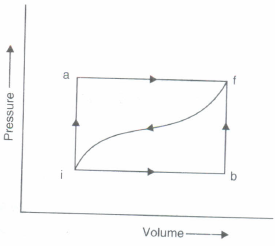
(i) What is W along the path ibf?
(ii) If W = -13 cal. for the curved return path fi what is Q for this path?
(iii) Take U, = 10 cal, what is Uf?
(iv) If Ub = 22 cal. what are Q for the processes bf and ib?
2.
State Carnot theorem. The motor in a refrigerator has power output 250 watt. The freezing compartment is at 270 K and outside air at 300 K. Assuming ideal efficiency, what is the amount of heat that can be extracted from the freezing compartment in 10 minutes? What is the shortest time in which 10 kg of water at 273 K can be converted into ice? J = 4.2 x 10³ J kcal-1.
3.
The efficiency of a Carnot engine is 1/2. If the sink temperature is reduced by 100o C, then engine efficiency becomes 2/3. Find
(i) sink temperature
(ii) source temperature
(iii) Explain, why a Carnot engine cannot have 100% efficiency?
4.
Two cylinders A and B of equal capacity are connected to each other via a stopcock. A contains a gas at standard temperature and pressure. B is completely evacuated. The entire system in thermally insulated. The stopcock is suddenly opened. Answer the following
(a) What is the change in internal energy of the gas?
(b) What is the change in temperature of the gas?
(c) Do the intermediate states of the system (before settling to the final equilibrium state) lie on its p - V - T surface?
5.
A Carnot cycle is performed by 1 mole of air (r = 1.4) initially at 327o C. Each stage represents a compression or expansion in the ratio 1:6 (a) Calculate the lowest temperature
(b) Calculate network done during each side
(c) Calculate efficiency of the engine
Take R = 8.31 J/ mol-K
1.
According to first law of thermodynamics
dQ = dU + dW
or Q = Uf - Ui + W
Uf = internal energy
in final state and U, internal energy in initial state For path i a f.
Q = +50 cal, and W = 20 cal
∵ Uf - Ui = Q - W = 50 - 20 = 30 cal
Here it should be remembered that the change in internal energy between i and f state remains the same i.e., 20 cal. whatever path is followed.
(i) For path ibf,
Q = 36 cal. and dU = Uf - Ui = 30 cal
W = Q - (Uf - Ui) = 36 - 30 = 6 cal.
(ii) For path fi,
W = -13 ca!. dU = 30 cal
∴ Q = W + (Uf - Ui) = .13 - 30 = -43 cal.
(iii) Ui = 10cal
dU = Uf - Ui = 30
∴ Uf = 30 + Ui = 30 + 10 = 40 cal.
(iv) For process bf, volume is constant i.e., workdone is zero
∴ Q dU = Uf - Ub = 40 - 22 = 18 cal.
For path ib,
∴ Q = Qibf - Qbf = 36 - 18 = 18 cal.
2.
We know that
\(β={Q\over W}={Q_2\over Q_1-Q_2}={T_2\over T_1-T_2}\)
Here,
T1 = 300 K, T2 = 270K
W = 250 W = 250 Js-1
Q ?, t = ?
\(∴\ Q_2=Wβ=W\left(T_2\over T_1-T_2\right)\)
\(=250\left(270\over 300-270\right)\)
\(=250\times{270\over 30}\)
= 2250 J S-1
(i) Let Q be the heat extracted from the freezing compartment in 10 minutes
∴ Q = Q2 x 10 min = 2250 x 10 x 60
= 1350000 J
\(={135\times10^4\over 4.2\times10^3}kcal = 321.4 kcal\)
(ii) Heat required to convert 1 kg of water at 273 K into ice,
Q' = m x L = 1 x 80 kcal
= 80 x 4.2 x 103 J
Let Q' be extracted in a time t.
∴ Rate of extraction of heat from freezing compartment
\(={80\times4.2\times10^3\over t}J S^{-1}\)
This rate must be equal to Q2
i.e., \(2250={80\times4.2\times10^3\over t}\)
\(∴\ \ t={80\times4.2\times10^3\over 2250}=149.33s\)
3.
Efficiency , \(\eta =1-\frac { { T }_{ 2 } }{ { T }_{ 1 } } \)
where, T2 = sink temperature
T1 = source temperature.
\(1-\frac { { T }_{ 2 } }{ { T }_{ 1 } } =\frac { 1 }{ 2 } \quad ...(i)\)
\(\\ 1-\left( \frac { { T }_{ 2 }-100 }{ { T }_{ 1 } } \right) =\frac { 2 }{ 3 } \ ...(ii)\)
From Eq. (i), \(\frac { { T }_{ 2 } }{ { T }_{ 1 } } =\frac { 1 }{ 2 } \) and Eq. (ii)
\(\frac { { T }_{ 2 }-100 }{ { T }_{ 1 } } =\frac { 1 }{ 3 } \)
On dividing, we get
\(\frac { { T }_{ 2 } }{ { T }_{ 2 }-100 } =\frac { 3 }{ 2 } \Rightarrow { T }_{ 2 }=300K\)
(ii) Substituting in Eq.(i) T1 = 600K
(iii) As efficiency, \({ \eta }_{ 2 }\Rightarrow 1-\frac { { T }_{ 2 } }{ { T }_{ 1 } } \)
It equals to 1 only when \(\frac { { T }_{ 2 } }{ { T }_{ 1 } } =0\quad or\quad { T }_{ 2 }=0K\)
But absolute zero is not possible.
4.
(a). As there is no work done by or on the system, also there is no heat interaction, therefore internal energy of the system remains the same.
Change in internal energy, \(\triangle \)U = 0, as work is done on or by the gas.
(b). The expansion of the gas is not due to any external work done on the system and hence, temperature of the system will not change.
(c). Free expansion is a very fast process and it cannot be controlled. As the intermediate states are non-equilibrium states, hence they can’t be on the P−V−T surface of the system.
5.
неге, \(\frac{V_1}{V_2}=\frac{1}{6}, \gamma=1.4\),
\(T_1=327^{\circ} \mathrm{C}=327+273=600 \mathrm{~K}\)
(a) For an adiabatic change,
\( T_2 V_2^{\gamma-1}=T_1 V_1^{\gamma-1} \)
\(T_2=T_1\left(\frac{V_1}{V_2}\right)^{\gamma-1}=600\left(\frac{1}{6}\right)^{1.4-1} \)
\( =600 \times 0.4884=293 \mathrm{~K}=293-273 =20^{\circ} \mathrm{C}\)
This is lowest temperature.
(b) Net work done during each cycle by 1 mole of air.
\( W=R T_1 \log _e \frac{V_2}{V_1}-R T_2 \log _e \frac{V_3}{V_4} \)
\(=R\left(T_1-T_2\right) \log _e \frac{V_2}{V_1}\left(\therefore \frac{V_3}{V_4}=\frac{V_2}{V_1}\right) \)
\( =2.303 R\left(T_1-T_2\right) \log _{10} \frac{V_2}{V_1} \)
\(=2.303 \times 8.31(600-293) \log _{10} 6 \)
\( W=2.303 \times 8.31 \times 307 \times 0.7782 =4572.2 J\)
(C) \(\eta=1-\frac{T_2}{T_1}=1-\frac{293}{600}=\frac{307}{600}\)
\(=0.512=51.2 \%\)

11th Standard CBSE Syllabus & Materials
11th Standard CBSE
CBSE 11th Business Studies Forms of Business Organisation Sample Question Papers Study Material - QB365 Set A
NEW11th Standard CBSE
CBSE 11th Business Studies Business, Trade and Commerce Sample Question Papers Study Material - QB365 Set A
NEW11th Standard CBSE
CBSE 11th Physics Waves Sample Question Papers Study Material - QB365 Set A
NEW11th Standard CBSE
CBSE 11th Physics Kinetic Theory Sample Question Papers Study Material - QB365 Set A



CBSE 11th Standard CBSE Subjects
CBSE Standards









