
 100% FREE ACCESS
11th Standard CBSE Syllabus & Materials
11th Standard CBSE
CBSE 11th Economics PART-A - Presentation of Data - New Sample Question Papers Study Material - QB365 Set A
NEW11th Standard CBSE
CBSE 11th Economics PART-A - Organisation of Data - New Sample Question Papers Study Material - QB365 Set A
NEW11th Standard CBSE
CBSE 11th Economics PART-A - Collection of Data - New Sample Question Papers Study Material - QB365 Set A
NEW11th Standard CBSE
CBSE 11th Economics PART-A - Introduction to Economics and Statistics - New Sample Question Papers Study Material - QB365 Set A
NEW11th Standard CBSE
CBSE 11th Business Studies International Trade Sample Question Papers Study Material - QB365 Set A
NEW11th Standard CBSE
CBSE 11th Business Studies Evolution and Fundamentals of Business Sample Question Papers Study Material - QB365 Set A

Published on: 30/07/2019
Laws of Motion
Download CBSE Class 11th Standard CBSE Physics question papers, sample papers, important questions, and previous year solved papers in PDF format. Get free study materials, NCERT solutions, and exam preparation resources for Class 11th Standard CBSE Physics
Questions + Answers key
Take MCQ Physics Test
1.
What is the angle between frictional force and instantaneous velocity of the body moving over a rough surface?
2.
What is the angle of friction between two surfaces in contact, if coefficient of friction is \(\sqrt{3}?\)
3.
A person driving a car suddenly applies the brakes on seeing a child on the road ahead. If he is not wearing seat belt, he falls forward and hits his head against the steering wheel. Why ?
4.
A person of mass 50 kg stands on a weighing scale on a lift. If the lift is descending with a downwards acceleration of 9 m/s2 , what would be the reading of the weighing scale ?
When a lift descends with a downward acceleration 8, V the apparent weight of a body of mass m is given by w' = R = m (g - a)
5.
A passenger of mass 72.2 kg is riding in an elevator while standing on a platform scale. What does the scale read when the elevator cab is
(i) descending with constant velocity
(ii) ascending with constant acceleration, 3.5 m/s2?
6.
A force of 36 dyne is inclined to the horizontal at an angle of 60\(^0\) . Find the acceleration in a mass of 18 g that moves in a horizontal diraction.
7.
The distance travelled by a moving body is directly proportional to time. Is any external force acting on it ?
8.
Calculate the force acting on a body which changes the momentum of the body at the rate of 1 kg m/s2.
9.
A force of 1 N acts on a body of mass 1 g. Calculate the acceleration produced in the body.
10.
Bodies of larger mass need greater initial effort to put them in motion. why ?
11.
A 20 kg box is gently placed on a rough inclined plane of inclination 30° with horizontal. The coefficient of sliding friction between the box and the plane is 0.4. Find the acceleration of the box down the incline.
12.
A body of mass 500 g tied to a string of length 1 m is revolved in the vertical circle with a constant speed. Find the minimum speed at which there will not be any slack on the string. Take g = 10 ms-2·
13.
A helicopter of mass 1000 kg reises with a vertical acceleration of 15m /s2. The crew and the passengers weigh 300 kg. Give the magnitude and direction of the
(i) force on floor by the crew and passengers.
(ii) action of the rotor of the helicopter on the surrounding air
(iii) force on the helicopter due to the surrounding air, take g = 10 m/s2.
14.
A body of mass 5 kg is acted upon by two perpenticular forces 8 N and 6 N . Find the magnitude and direction of the acceleration.
15.
An artificial satellite of mass 2500 kg is orbiting around the earth with a speed of 4 kms-1 at a distance of 10-4 from the earth. Calculate the centripetal force action on it.
16.
A uniform rod is made to lean between a rough vertical wall and the ground. Show that the least angle at which the rod can be leaned without slipping is given by \(\theta =tan ^{-1}({1-\mu_1 \mu_2\over 2\mu_2})\) where \(\mu\)1 and \(\mu\)2 stand for the coefficient of friction between
(i) the rod and the wall and
(ii) the rod and the ground.
17.
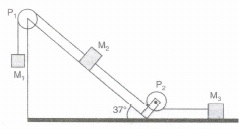
Masses M1, M2 and M3 are connected by light strings which pass over pulleys P1 and P2 as shown. The masses move such that the string between P1 and P2 is parallel to incline and the string between P2 and M3 is horizontal, M2 = M3 = 4kg. The coefficient of kinetic friction between masses and tile surface is 0.25. The angle of inclination of plane is 37° to the horizontal. If the mass M1 moues downwards with uniform velocity, find M1 and the tension in the horizontal string. Given g = 9.8 m/s2 and sin 37° = 3/5.
18.
A male astronaut 82 kg and a female astronaut 64 kg are floating side by side in space.
(i) Determine the acceleration of each astronaut if the woman pushes on the man with a force of 16 N (left)
(ii) How will your answer change if the man pushes with 16 N (Right) on the woman instead?
(iii) How will your answer change if they both reach out and push on each other's shoulders with a force of 16 N?
19.
The physical quantity which is equal to the change in momentum of a body is known as _______.
acceleration
Impulse
reaction
force
20.
Water is poured from a height of 10m into an empty barrel at the rate of 1 litre per second. If the weight of the barrel is 10 kg, the weight indicated at time t = 60 s will be _______.
71.4 kg
68.6 kg
70.0 kg
84.0 kg.
21.
A force of 200 N is required to push a car of mass 500 kg slowly at constant speed on a level road. If a force of 500 N is applied, the acceleration of the car (in m S-2) will be_______.
zero
0.2
0.6
1.0.
22.
A block of mass M is pulled along a horizontal frictionless surface by a rope of mass m. Force P is applied at one end of the rope. The force which the rope exerts on the block is: _______.
\({P\over M-m}\)
\({PM\over m+M}\)
\({P\over M(m+M)}\)
\({Pm\over M-m}\)
23.
If the tension in the cable supporting an elevator is equal to the weight of the elevator, the elevator may _______.
going up with uniform speed
going down with non-uniform speed
going up with increasing speed
going down with increasing speed
1.
The angle is 180°, because force of friction always opposes the relative motion.
2.
Since \(tan \theta =\mu =\sqrt{3}\)
\(\theta =tan ^{-1}(\sqrt{3})\Rightarrow \theta =60^o\)
3.
When a person driving a car suddenly applies the brakes, the lower part of the body slower down with the car while upper part of the body continues to move forward due to inertia of motion. If driver is not wearing seat belt, then he falls forward and his head hit against the steering wheel.
4.
When a lift descending with a downward acceleration a, the apparent weight of a body of mass m is given by w' = R = m (g - a)
Given, Mass of the person, m = 50 kg
Descending acceleration, a = 9 m/s2
Acceleration due to gravity, g = 10 m/s2
Apparent weight of the person,
R = m ( g - a ) = 50 ( 10 - 9 ) = 50 N
\(\therefore \) Reading of the weighing scale = \(\frac { R }{ g } \) = \(\frac { 50 }{ 10 } \) = 5 kg
5.
Given, mass, m = 72.2 kg
Gravity acceleration, g = 9.8 m/s2
Scale reading = apparent weight = R = ?
(i) While descending with constant velocity, a = 0
\(\therefore \) R = mg
R = 72.2 x 9.8
\(\Longrightarrow \) R = 707.56 N
(ii) While ascending with a = 3.2 m/s2
R = m ( g + a )
R = 72.2 ( 9.8 + 3.2 ) = 938.6 N
6.
Given, F = 36 dyne at an angle of 6000 .
∴∴ Component of force along x-direction
Fx = F cos 6000 = 36 x 1/2 = 18 dyne
But Fx = max ,
ax = \(\frac{F_x}{m} =\frac {18}{18} = 1\) cm/s2
7.
When S ∝ t, so acceleration = 0, Therefore, no external force is acting on the body.
8.
We know that, F = rate of change of momentum
F = 1 kg-m/s2 = 1 N
9.
Fiven F = 1N, m = 1 g = 10-3 kg
Now, F = ma ⟹ a = \(\frac{F}{m} = \frac{1}{10^{-3}}\)
= 103 m/s2
10.
According to the Newton's second law of motion. F = ma, for given acceleration a if m is large. F should be more i.e. greater force will be required to put a larger mass in motion.
11.
In solving inclined plane problems, the x and y directions along which the forces are to be considered, may be taken as shown. The components of weight of the box are
(i) mg sin \(\alpha\)acting down the plane and
(ii) mg cos \(\alpha\) acting perpendicular to the plane.
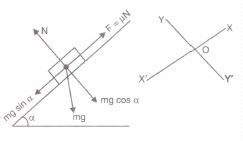
N = mg cos \(\alpha\)
mg sin \(\alpha\) -\(\mu\) N =ma
mg sin \(\alpha\) -\(\mu\) mg cos \(\alpha\) =ma
a = g sin \(\alpha\) -\(\mu\)g cos \(\alpha\)
= g (sin \(\alpha\) - \(\mu\)cos \(\alpha\))
= 9.8 ( \({1\over 2}\) - 0.4 x\({\sqrt{3}\over 2}\))
= 4.9 x 0.3072 = 1.505 m/S2
The box accelerates down the plane at 1.505 m/S2
12.
The tension T in the string will provide the necessary centripetal force \({m v^2\over r}\)
\(i.e., T={m v^2\over r}\)
Here m 500 g = \({1\over2}kg;r=1m\)
\(\therefore T={1\over 2}v^2N\) ..........(1)
There will not be slack if T \(\ge\) weight of the body
i.e., T\(\ge\)mg
\(or {1\over2}v^2\ge{1\over 2}\times 10\)
\(v^2 \ge 10 or v\ge \sqrt{10}ms^{-1}\)
= 3.162 ms-1.
13.
\(\because \) Mass of the helicopter, m1 = 1000 kg
Mass of the crew and the passengers, m2 = 300 kg
Acceleration of the helicopter, a = 15 m/ s2
Acceleration due to gravity, g = 10 m/s2
(i) Let R, be the reaction applied by the floor on the crew and the passengers.
-S.png)
R1- m2g = m2a
or
R1= m2g + m2a = m2(g+a)
= 300(10 + 15) = 7500N(upward direction)
(ii) Action of the rotor of the helicopter on the surrounding air
= ( m1 + m2 ) g + ( m1 + m2 ) a
= ( m1 + m2 ) ( g + a )
= ( 1000 + 300 ) x (10 + 15 )
= 1300 x 25 = 32500 N
Force (action ) of the rotor of the helicopter on the surrounding air = 32500 N (downward)
14.
Given: The mass of the body is 5 kgand the two perpendicular forces are 8 N and 6 N.
The forces on the body are shown below:
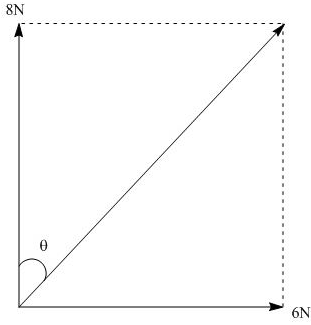
The resultant force is given as,
F R = 8 2 + 6 2 = 64+36 =10 N
The tangent of the angle is given as,
tanθ= 6 8 θ= tan −1 ( 3 4 ) =37°
Newton’s second law of the motion is given as,
F=ma
By substituting the given values in the above expression, we get
10 N=( 5 kg )a a=2 m/ s 2
Thus, the magnitude of acceleration is 2 m/ s 2 and its direction is along the direction of the resultant force. The direction of resultant force is at an angle of 37° with 8 N force.
15.
Given, r =104 km = 104 \(\times \) 1000 m = 107 m,
m = 2500 kg
v = 4 kms-1 = 4\(\times \)103 ms-1
Now,centripeta force is F = \(\frac { m{ v }^{ 2 } }{ r } \)
F = \(\frac { 2500\times (4\times { 10 }^{ 3 }{ ) }^{ 2 } }{ { 10 }^{ 7 } } =\frac { 2500\times 16\times { 10 }^{ 6 } }{ { 10 }^{ 7 } }\)
\( \\ F=\quad \frac { 250\times 16\times { 10 }^{ 7 } }{ { 10 }^{ 7 } }\)
\(= 4000N\)
16.
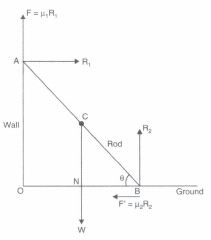
Figure shows the various forces acting on the rod AB when it is leaning between the wall and the ground without slipping.
Since the rod is in equilibrium, the net force as well as the net torque on it must each be zero. Considering the forces acting on the rod: we have
\(R_1+(-F')=0 or \ R_1 =\mu_2 R_2\) and \(R_2+F+(-W)=0 or \ R_2 +\mu_1 R_1=W\)
Considering next the moments of all forces about A, we have
R2 x 0 B = W x 0 N + \(\mu\)2R2 x OA or R2 x A B cos\(\theta =W \times {AB cos \theta \over 2}+\mu_2 R_2 \times AB sin \theta\)
\(or \ (R_2 -{W\over 2})cos \theta =(\mu_2 R_2)sin \theta\)
\(or \ tan \theta ={({R_2-{W\over 2}})\over \mu_2 R_2}\)
Now W= R2 + \(\mu\)1R1 = R2 + \(\mu\)1 ( \(\mu\)2 R2)
=R2 (1 +\(\mu\)1\(\mu\)2)
\(\therefore R_2-W/2 =R_2-{R_2\over 2}(1+\mu_1 \mu_2)\)
\(={R_2 \over 2}-{R_2\over 2}\mu_1 \mu_2={R_2 \over 2}(1-\mu_1 \mu_2)\)
\(\therefore tan \theta ={R_2\over 2}{(1-\mu_1 \mu_2)\over \mu_2 R_2}={(1-\mu_1\mu_2)\over 2\mu_2}\)
or \(\theta= tan^{-1} \{ {(1-\mu_1\mu_2)\over 2\mu_2} \}\)
17.
Considering the mass M1, since it moves down with uniform speed
T1= M1g ......(i)
For mass M2, T1 = T2+μM2g cos370 + M2g sin370 ....(ii)
For mass M3, T2 = μM3g .....(iii)
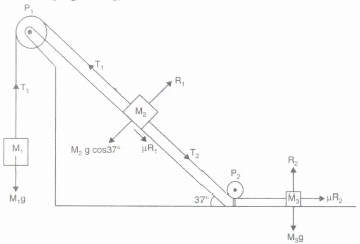
Substituting for T1 and T2 from (i) and (iii) respectively in (ii),
M1g = μM3g + μM2g cos370 + M2g sin370
M1=μM3 + μM2 cos370 + M2 sin370
cos370 =\(\frac{4}{5}\); sin370=\(\frac{3}{5}\); μ=\(\frac{1}{4}\)
∴ M1 =\(\frac { 1 }{ 4 } \times 4+\frac { 1 }{ 4 } \times 4\times \frac { 4 }{ 5 } +4\times \frac { 3 }{ 5 } \)
=\(1+\frac { 4 }{ 5 } +\frac { 12 }{ 5 } \)=4.2 kg
T2 = μM3g =\(\frac{1}{4}\) x 4 x 9.8 = 9.8 N.
18.
(i) aM = 0.2 m / s2, aW = .25 m
(ii) No change
(iii) aM = 2,62 m/ s2 , aW = 2 m /s2
19.
(b)
Impulse
20.
(a)
71.4 kg
21.
(d)
1.0.
22.
(b)
\({PM\over m+M}\)
23.
(a)
going up with uniform speed

11th Standard CBSE Syllabus & Materials
11th Standard CBSE
CBSE 11th Business Studies Forms of Business Organisation Sample Question Papers Study Material - QB365 Set A
NEW11th Standard CBSE
CBSE 11th Business Studies Business, Trade and Commerce Sample Question Papers Study Material - QB365 Set A
NEW11th Standard CBSE
CBSE 11th Physics Waves Sample Question Papers Study Material - QB365 Set A
NEW11th Standard CBSE
CBSE 11th Physics Kinetic Theory Sample Question Papers Study Material - QB365 Set A



CBSE 11th Standard CBSE Subjects
CBSE Standards









