
 100% FREE ACCESS
11th Standard CBSE Syllabus & Materials
11th Standard CBSE
CBSE 11th Economics PART-A - Presentation of Data - New Sample Question Papers Study Material - QB365 Set A
NEW11th Standard CBSE
CBSE 11th Economics PART-A - Organisation of Data - New Sample Question Papers Study Material - QB365 Set A
NEW11th Standard CBSE
CBSE 11th Economics PART-A - Collection of Data - New Sample Question Papers Study Material - QB365 Set A
NEW11th Standard CBSE
CBSE 11th Economics PART-A - Introduction to Economics and Statistics - New Sample Question Papers Study Material - QB365 Set A
NEW11th Standard CBSE
CBSE 11th Business Studies International Trade Sample Question Papers Study Material - QB365 Set A
NEW11th Standard CBSE
CBSE 11th Business Studies Evolution and Fundamentals of Business Sample Question Papers Study Material - QB365 Set A

Published on: 31/07/2019
Work,Energy and Power
Download CBSE Class 11th Standard CBSE Physics question papers, sample papers, important questions, and previous year solved papers in PDF format. Get free study materials, NCERT solutions, and exam preparation resources for Class 11th Standard CBSE Physics
Questions + Answers key
Take MCQ Physics Test
1.
What is the nature of force involved in the winding of a watch?
2.
Can kinetic energy of a body be negative? Can potential energy be negative?
3.
Find the work done in pulling and pushing a roller through 100 m horizontally when a force of 1500 N is acting a chain making an angle of 600 with ground. Assume the floor to be smooth .
4.
In a game of tug of war , one team is slowly giving way to the other.Which team is doing positive work and which team nagative?
5.
Calculate the power of a motor which is capable of raising of water in 5 min from a well 120 m deep.
6.
Is the total linear momentum conserved during the short time of an elastic of two balls?
7.
If the momentum and total energy is conserved, then define the collision is occurred?
8.
What is the coefficient of restitution?
9.
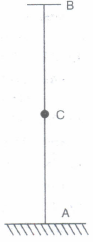
A body of mass 2kg is at rest at a height of 10 m above the ground. Calculate its potential energy and kinetic energy after it has fallen through half the height. Also find the velocity at this instant.
10.
When a 300 g mass is hung from a vertical spring, it stretches from equilibrium by 10 cm.What work is required to stretch it by next 5 cm?
11.
A block of mass 1.2 kg moving at a speed of 20cm/s collides head-on with a similar block kept at rest. The coefficient of restitution is 3/5, find the loss of kinetic energy during collision.
12.
To simulate car accidents, auto manufacturers study the collisions of moving cars with mounted springs of different spring constants. Consider a typical simulation with a car of mass 1000 kg moving with a speed 18.0 km/h on a smooth road and colliding with a horizontally mounted spring of spring constant 5.25 × 10 3 N m–1 . What is the maximum compression of the spring ?
13.
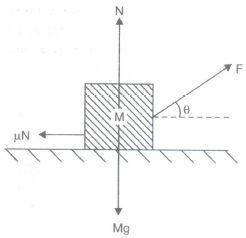
A block of mass M is pulled along a horizontal surface by applying a force at an angle \(\theta\) with horizontal. Coefficient of friction between block and surface is \(\mu\). If the block travels with uniform velocity, find the work done by this applied force during a displacement d of the block.
14.
State if each of the following staement is true or false. Give reasons for your answer.
(i) Total energy of a system is always conserved, no matter what internal and external forces on the body are present?
(ii) Work done in the motion of a body over a closed loop is zero for every force in nature.
(iii) In an inelastic collision, the final kinetic energy is always less than the initial kinetic energy of the system.
15.
The work done by the external forces on a system equals the change in
total energy
kinetic energy
potential energy
none of these
16.
A heavy stone is thrown from a cliff of height h with a speed v. The stone will hit the ground with maximum speed if it is thrown
vertically downward
vertically upward
horizontally
the speed does not depend on the initial direction
17.
Equal masses (m each) are attached at the two ends of a string passing over two pulleys. Another mass is attached at the centre of the string. In order that there is no sag in the string, this mass should be
m
m/2
2 m
Zero
18.
A body is moving unidirectionally under the influence of a source of constant power. Its displacement in time t is proportional to
t1/2
t
t3/2
t2
19.
A body is initially at rest. It undergoes one-dimensional motion with constant acceleration. The power delivered to it at time t is proportional to
t1/2
t
t3/2
t2
1.
As the energy is recoverable therefore the force is conservative force.
2.
Kinetic energy of a body cannot be negative because it is given by \(\frac { 1 }{ 2 } \) mv2 and is always positive whether v is -ve or +ve. The gravitational potential energy of a body may be negative or positive.
3.
Here, force F = 1500N
and Displacement , s = 100 m, \(\theta\) = 600
\(\therefore\) Work done , W = Fs cos \(\theta\)
= 1500\(\times\)100\(\times\)cos(600)
= 1500\(\times\)100\(\times\) \(\frac{1}{2} \)
= 75000 J
= 75 kJ
4.
The winning team ( i.e the team which is pulling the other team towards itself ) is doing positive work and the losing team ( i.e. the team slowly giving way to the other ) is doing negative work. )
5.
Here, the volume of water raised V = 2000 L
Density of water, p =1kg/L
Therefore mass of water raised, m = vp = 2000 x 1 = 2000kg
Power, \(P=\frac { W }{ t } =\frac { mgh }{ t } =\frac { 2000\times 9.8\times 120 }{ 5\times 60 } =7840 \ W\ \)
\(\ 7.840\ kW\ \ [1kW=1000\quad W\)
6.
During the short interval of an elastic collision, total linear momentum is conserved.
7.
Collision in which momentum and total energy remained onserved and total kinetic energy of the colliding particles remain constant both before and after the collision, is clled elastic collision.
8.
The value is almost always less than one due to initial translational kinetic energy being lost to rotational kinetic energy, plastic deformation, and heat. It can be more than 1 if there is an energy gain during the collision from a chemical reaction, a reduction in rotational energy, or another internal energy decrease that contributes to the post-collision velocity.
\(\text { Coefficient of restitution }(e)=\frac{\mid \text { Relative velocity after collision } \mid}{\mid \text { Relative velocity before collision } \mid}\)
9.
Total energy at B = kinetic energy + potential energy
= 0 + mgh
= 2 \(\times\) 9.8 \(\times\)10
= 196 J
As it descends half the height, it loses potential energy which is given by
\(=mg\frac { h }{ 2 } \)
\(=\frac { 1 }{ 2 } mgh=98\ J\)
\(\therefore\) its potential energy at C = (196 - 98) = 98 J
The loss of potential energy = gain in kinetic energy
= 196 - 98
= 98 J
But \(K.E.=\frac { 1 }{ 2 } { mv }^{ 2 }\)
\(\therefore \quad \frac { 1 }{ 2 } \times 2\times { v }^{ 2 }=98\)
\(\Rightarrow \ { v }^{ 2 }=98\ or\ v=7\sqrt { 2 } m/s\)
10.
We can calculate spring constant of spring by first information.
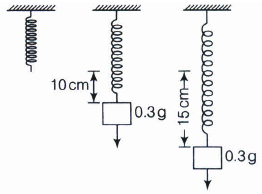
Work done by a vertical spring is = 0.3 g = k[10\(\times \) 10-2]
2 = k\(\times \)0.1\(\Rightarrow \) k = \(\frac { 3 }{ 0.1 } =30\frac { N }{ m } \)
Extra work required to stretch it by next 5 cm.
W = \(\frac { 1 }{ 2 } k{ x }_{ 2 }^{ 2 }\)-\(\frac { 1 }{ 2 } k{ x }_{ 1 }^{ 2 }\)
W = \(\frac { 1 }{ 2 } \times 30\left[ { \left( 15\times { 10 }^{ -2 } \right) }^{ 2 }-{ \left( 10\times { 10 }^{ -2 } \right) }^{ 2 } \right] \)
W = 15[225-100] \(\times { 10 }^{ -4 }\) = 15\(\times \)125\(\times { 10 }^{ -4 }\) J
W = 0.1875 J
11.
Here, \(m_1=1.2 \mathrm{~kg}, u_1=20 \mathrm{~cm} / \mathrm{s}, m_2=1.2 \mathrm{~kg}, u_2=0\)
If v1 and v2 are velocities of the two blocks after collision, then accordin to the principle of conservation of momentum, \(m_1 u_1+m_2 u_2=m_1 v_1+m_2 v_2\)
\(1.2 \times 20+0=1.2 v_1+1.2 v_2 \therefore v_1+v_2=20(\mathrm{~cm} / \mathrm{s}) \ldots(\mathrm{i})\)
velocity of approach \(=u_1-u_2=20 \mathrm{~cm} / \mathrm{s}\), velocity of separation \(=v_2-v_1\)
By definition, \(e=\frac{v_2-v_1}{u_1-u_2}\)
\(\frac{3}{5}=\frac{v_2-v_1}{20} \therefore v_2-v_1=\frac{20 \times 3}{5}=12 \text {.. }\)
From (i) and (ii), \(v_1=4 \mathrm{~cm} / \mathrm{s}, v_2=16 \mathrm{~cm} / \mathrm{s}\)
Loss in K.E.
\( =\frac{1}{2} m_1 u_1^2-\frac{1}{2}\left(m_1\right) v_1^2-\frac{1}{2} m_2 v_2^2=\frac{1}{2} \)
\( \times 1.2\left(\frac{20}{100}\right)^2-\frac{1}{2}(1.2)\left(\frac{4}{100}\right)^2-\frac{1}{2} \times 1.2\left(\frac{16}{100}\right)^2 \)
\( =2.4 \times 10^{-2}-0.096 \times 10^{-2}-1.536 \times 10^{-2}\)
\(7.7\times { 10 }^{ -3 }\)
12.
At maximum compression the kinetic energy of the car is converted entirely into the potential energy of the spring.
The kinetic energy of the moving car is
\(K=\frac{1}{2} m v^{2}\)
\(=\frac{1}{2} \times 10^{3} \times 5 \times 5\)
K = 1.25 x 10⁴ J
where we have converted 18 km h–1 to 5 m s–1 [It is useful to remember that 36 km h–1 = 10 m s–1]. At maximum compression xm , the potential energy V of the spring is equal to the kinetic energy K of the moving car from the principle of conservation of mechanical energy.
\(V=\frac{1}{2} k x_{m}^{2}\)
= 1.25 x 10⁴ J
We obtain
xm = 2.00 m
We note that we have idealised the situation. The spring is considered to be massless. The surface has been considered to possess negligible friction.
13.
The forces acting on the block are shown in Figure. As the block moves with uniform velocity the forces add up to zero.
\(\therefore \ F\ cos\ \theta =\mu N\) ...........(i)
F sin \(\theta\) + N = Mg ...........(ii)
Eliminating N from equtions (i) and (ii)
F cos \(\theta\) = \(\mu\) (Mg - F sin \(\theta\))
\(F=\frac { \mu Mg }{ cos\theta +\mu sin\theta } \)
Work done by this force during a displacement d
\(W=F.d\ cos\ \theta =\frac { \mu Mgd\ cos\theta }{ cos\theta +\mu sin\theta } \)
14.
(i) False, internal as well as external forces can change the kinetic energy.Again forces of conservative may change the potential energy of a system.
(ii) False, for non-conservative force the work done over a closed loop is not zero.
(iii) It is usually true but not always true.As an exmple in the exlposion of a cracker final kinetic energy is greater than the initial kinetic energy. Again final kinetic energy of gun-bullet system after firing is more than initial kinetic energy before collision.
15.
(a)
total energy
16.
(d)
the speed does not depend on the initial direction
17.
(d)
Zero
18.
(b)
t
19.
(b)
t

11th Standard CBSE Syllabus & Materials
11th Standard CBSE
CBSE 11th Business Studies Forms of Business Organisation Sample Question Papers Study Material - QB365 Set A
NEW11th Standard CBSE
CBSE 11th Business Studies Business, Trade and Commerce Sample Question Papers Study Material - QB365 Set A
NEW11th Standard CBSE
CBSE 11th Physics Waves Sample Question Papers Study Material - QB365 Set A
NEW11th Standard CBSE
CBSE 11th Physics Kinetic Theory Sample Question Papers Study Material - QB365 Set A



CBSE 11th Standard CBSE Subjects
CBSE Standards









