
 100% FREE ACCESS
11th Standard CBSE Syllabus & Materials
11th Standard CBSE
CBSE 11th Economics PART-A - Presentation of Data - New Sample Question Papers Study Material - QB365 Set A
NEW11th Standard CBSE
CBSE 11th Economics PART-A - Organisation of Data - New Sample Question Papers Study Material - QB365 Set A
NEW11th Standard CBSE
CBSE 11th Economics PART-A - Collection of Data - New Sample Question Papers Study Material - QB365 Set A
NEW11th Standard CBSE
CBSE 11th Economics PART-A - Introduction to Economics and Statistics - New Sample Question Papers Study Material - QB365 Set A
NEW11th Standard CBSE
CBSE 11th Business Studies International Trade Sample Question Papers Study Material - QB365 Set A
NEW11th Standard CBSE
CBSE 11th Business Studies Evolution and Fundamentals of Business Sample Question Papers Study Material - QB365 Set A

Published on: 25/09/2019
Work, Energy and Power
Download CBSE Class 11th Standard CBSE Physics question papers, sample papers, important questions, and previous year solved papers in PDF format. Get free study materials, NCERT solutions, and exam preparation resources for Class 11th Standard CBSE Physics
Questions + Answers key
Take MCQ Physics Test
1.
A particle of mass 0.2 kg, has an initial speed of 5 ms-1 at the bottom of a rough inclined plane of inclination 30° and vertical height 0.5 m. What is the speed of the particle as it reaches the top of the inclived plane?
[Take \(\mu\) = \(\frac { 1 }{ \sqrt { 3 } } \), g = 10 ms-2]
2.
Two identical balls A and B undergo a perfectly elastic two dimensional collision. Initially A is moving with a speed of 10 ms-1 and B is at rest. Due to collision A is scattered through angle of 30°. What are the speed of A and B after the collision?
3.
Prove that when a particle suffers an oblique elastic collision with another particle of equal mass and initially at rest, the two particles would move in mutually perpendicular rections after collisions.
4.
A particle of mass m moving with an initial velcocity u collides inelastically with a particle of mass M initially at rest. if the collision is completely inelastic, then find expressions for
(i) final velocity of combined entity and
(ii) loss in kinetic energy during collision.
5.
Calculate work done in raising a stone of mass 5 kg of specific gravity 3 immersed in water from a depth of 6 m to 1 m below surface of water ( g = 10 ms-2 )
6.
Answer carefully with reasons
(a) In an elastic collision of two billiard balls, is the total kinetic energy conserved during the short time of collision of the balls i.e. when they are in contact?
(b) Is the total linear momentum conserved during the short time of an elastic collision of two balls ?
(c) What are the answers to (a) and (b) for an inelastic collision ?
(d) If the potential energy of two billiard balls depends only on the separation distance between their centres, is the collision elastic or inelastic ? (Note, we are talking here of potential energy corresponding to the force during collision, not gravitational potential energy).
7.
State if each of the following staement is true or false. Give reasons for your answer.
(i) Total energy of a system is always conserved, no matter what internal and external forces on the body are present?
(ii) Work done in the motion of a body over a closed loop is zero for every force in nature.
(iii) In an inelastic collision, the final kinetic energy is always less than the initial kinetic energy of the system.
8.
A running man has half the kinetic energy that a boy of his mass has. the man speeds up by 1.0 m/s and then same energy as the boy. what were the original speeds of the man and the boy?
9.
A stone of mass 0.4 kg is thrown vertically upward wit a speed of 9.8 m/s/ Find the potential and kinetic energies after half second?
1.
\(sin\ 30°=\frac { h }{ AB } \)
\(\frac { 1 }{ 2 } =\frac { 0.5 }{ AB } \)
\(\therefore\) AB = 1 m
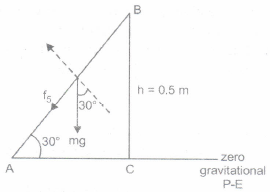
Force of friction between the particle and the inclined plane
= \(\mu\) N
= \(\mu\) \(\times\) mg cos \(\theta\)
\(=\frac { 1 }{ \sqrt { 3 } } \times 0.2\times 10\times cos30°\)
\(=\frac { 1 }{ \sqrt { 3 } } \times 0.2\times 10\times \frac { \sqrt { 3 } }{ 2 } \)
= 1 N
\(\therefore\) The work done by the particle in moving from A to B against the force of friction
=\(\mu\) mg cos \(\theta\) \(\times\) AB
= 1 N \(\times\) 1 m
= 1J
Let \(\overrightarrow { v } \) be the velocity of the particle of B
\(\therefore\) w = change in energy from A to B
\(1J=\left[ \frac { 1 }{ 2 } \times 0.2\times { (5) }^{ 2 }+0 \right] -\left[ \frac { 1 }{ 2 } \times 0.2\times { V }^{ 2 }+0.2\times 10\times 0.5 \right] \)
\(\Rightarrow \quad 1=2.5-[0.1\quad { V }^{ 2 }+1]\)
\(\Rightarrow \quad 1=2.5-0.1\quad { V }^{ 2 }-1\)
\(\Rightarrow\) 0.1 V2 = 1.5 - 1
\(\Rightarrow\) 0.1 V2 = 0.5
\(\Rightarrow\) V2 = 5
\(\Rightarrow\) V = \(\sqrt { 5 } \) = 2.24 ms-1
2.
The balls A and B are identical
\(\therefore\) masses are same, \(\theta\) = 30°
\(\therefore \quad \phi =90°-30°=60°\)
Initiallly v1 = 10 ms-1 and v2 = 0
\(\therefore\) According to law of conservation of momentum for x-component.
u = v1 cos 30° + v2 cos 60°
\(10={ v }_{ 1 }\times \frac { \sqrt { 3 } }{ 2 } +{ v }_{ 2 }\times \frac { 1 }{ 2 } \)
\(\therefore \quad \sqrt { 3 } { v }_{ 1 }+{ v }_{ 2 }=20\) (i)
For y-component,
0 = v1 sin 30° - v2 sin 60°
\(0={ v }_{ 1 }\times \frac { 1 }{ 2 } -{ v }_{ 2 }\times \frac { \sqrt { 3 } }{ 2 } \)
\(\therefore { v }_{ 1 }=\sqrt { 3 } { v }_{ 2 }\) (ii)
From eq. (i) and (ii) we get
\(\sqrt { 3 } \times \sqrt { 3 } { v }_{ 2 }+{ v }_{ 2 }=20\)
\(\Rightarrow { 3v }_{ 2 }+{ v }_{ 2 }=20\)
\(\Rightarrow \quad 4{ v }_{ 2 }=20\)
\(\therefore \quad { v }_{ 2 }=5\quad { ms }^{ -1 }\)
From eq. (ii)
\({ v }_{ 1 }=\sqrt { 3 } \times 5=5\sqrt { 3 } \)ms-1
Here, the velocities of A and B are \(\sqrt [ 5 ]{ 3 } { ms }^{ -1 }\) and 5 ms-1 respectively.
3.
Let a particle A of mass m and having velocity u collides with particle B of equal mass but at rest. Let the collision be oblique elastic collision and after collision the balls A and B move with velocities v1 and v2 respectively inclined at an angle e from each other.
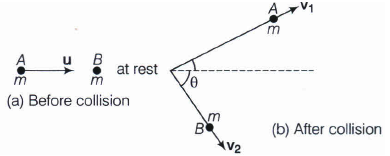
Applying principle of conservation of linear momentum, we get
mu = mv1 + mv2 or u = v1+v2
or u2 = ( v1+v2).( v1+v2)
= v12 + v22 + 2v1v2 \(\cos { \theta } \) .... (i)
Again as total KE before collision = total KE after collision
\(\therefore \ \quad \frac { 1 }{ 2 } \)mu2 = \( \frac { 1 }{ 2 } \)mv12 + \( \frac { 1 }{ 2 } \)mv22
\(\Rightarrow \) u2 = v12 + v22 ...(ii)
Comparing Eqs, (i) and (ii), we get 2v1v2 \(\cos { \theta } \) =0
As in an oblique collision both v1 and v2 are finite, hence \(\cos { \theta } \) = 0
\(\Rightarrow \) \(\theta =\cos ^{ -1 }{ (0) } =\frac { \pi }{ 2 } \)
Thus, particles A and B are moving in mutually perpendicular directions after the collision.
4.
(i) Let a particle of mass m moving with an initial velocity u collides inelastically with another particle of mass M initially at rest. Let after collision, the combined entity moves with a velocity v.Then, from the conservation of linear momentum, we have
mu + 0 = (m + M) v
\(\Rightarrow \quad v=\frac{m u}{m+M}\)
(ii) Initial kinetic energy of system before collision
\(K=\frac { 1 }{ 2 } m{ \mu }^{ 2 }\)
and final kinetic energy of system after collision
\({ k }^{ ' }=\frac { 1 }{ 2 } (m+M){ v }^{ 2 }=\frac { 1 }{ 2 } (m+M).\left( \frac { { mu }^{ 2 } }{ m+M } \right) \)
Therefore Loss in kinetic energy during collision
\(=\frac { 1 }{ 2 } m{ \mu }^{ 2 }-\frac { 1 }{ 2 } \frac { m{ \mu }^{ 2 } }{ 2(m+M) } \)
\(=\frac { 1 }{ 2 } m{ \mu }^{ 2 }\left[ 1-\frac { m }{ M+m } \right] =\frac { 1 }{ 2 } m{ \mu }^{ 2 }.\left( \frac { M }{ M+m } \right) \)
and fractional loss in kinetic energy during collision
\(\frac { \Delta K }{ K } =\frac { M }{ M+m } \)
5.
As the stone weight acts downwards and upthrust acts upwards
Thus, net weight of stone can be calculated.
specific gravity = Relative density = \(\frac{Density\ of \ stone}{Density\ of \ water}\)
thus, density of stone = 3 \(\times \)10 8kg/m3
Volume of stone = \( \frac{mass \ of\ stone}{Density \ of \ stone}\)
= \( \frac{5}{3\times10^3}\)
= \(\frac{5}{3}\) \(\times \)103m3
Upthrust on stone = Weight of liquid displaced
= \(\frac{5}{3}\)\(\times \) 10-3\(\times \) \(\rho\) water\(\times \)g
= \(\frac{5}{3}\) \(\times \)10-3 \(\times \)103\(\times \)10
= \(\frac{50}{3}\) N
Thus, net weight of stone,
mg' = mg - upthrust
mg' = (5 \(\times \)10-\(\frac{50}{3}\))
=\( \frac{100}{3}\) N
Now force required to raise the stone , F= \( \frac{100}{3}\) N
Work required to raise the stone
W = Fd = \(\frac{100}{3} \) \(\times \) 5
= \(\frac{500}{3}\) J
= 166.6 J
6.
(a) No, the total kinetic energy, does not remin conserved during the short time whwn two billiard balls are in contact. At that time, balls are at rest and their KE has been transfor,med into elastic potential energy of balls.
(b) Yes, In an elastic collision, the total linear momentum of the system always remains conserved.
(c) No, In an inelastic collision, there is always a loss of kinetic energy, i.e., the total kinetic energy of the billiard balls before collision will always be greater than that after collision.
Yes, The total linear momentum of the system of billiards balls will remain conserved even in the case of an inelastic collision.
(d) Elastic,In the given case, the forces involved are conservation. This is because they depend on the separation between the centres of the billiard balls. Hence, the collision is elastic.
7.
(i) False, internal as well as external forces can change the kinetic energy.Again forces of conservative may change the potential energy of a system.
(ii) False, for non-conservative force the work done over a closed loop is not zero.
(iii) It is usually true but not always true.As an exmple in the exlposion of a cracker final kinetic energy is greater than the initial kinetic energy. Again final kinetic energy of gun-bullet system after firing is more than initial kinetic energy before collision.
8.
Let M= mass of man, m= mass of boy V= speed of m a n, v= speed of boy
Given \(\frac{1}{2} M V^2=\frac{1}{2}\left(\frac{1}{2} m v^2\right)\), As \(m=\frac{M}{2}\)
So \(\frac{1}{2} M V^2=\frac{1}{2}\left(\frac{1}{2} \times \frac{M}{2} m v^2\right)\)
Hence \(v^2=4 V^2\) or v=2 V
When the man speeds up by 1 m/s, then we get
\(\frac{1}{2} M(V+1)^2=\frac{1}{2} m v^2=\frac{1}{2} \frac{M}{2}\left(4 V^2\right)\)
or \((V+1)^2=2 V^2\) or \(V^2-2 V-1=0\)
Solving we get \(V=2.4 \mathrm{~ms}^{-1}\) and \(v=2 V=4.8 \mathrm{~ms}^{-1}\)
9.
Here, mass, m=0.4 kg, speed, u = 9.8 ms-1,
acceleration, \(\mathrm{a}=-\mathrm{g}=-9.8 \mathrm{~m} / \mathrm{s}^2\) and time, \(t=\frac{1}{2} \mathrm{~s}\)
From equation of motion
\(s=u t+\frac{1}{2} a t^2=\left(9.8 \times \frac{1}{2}\right)+\left(-\frac{1}{2} \times 9.8 \times \frac{1}{2} \times \frac{1}{2}\right)=3.67 \mathrm{~m}\)
therefore Potential energy \(=m g h=(0.4)(9.8)(3.67)=14.386 J\)

11th Standard CBSE Syllabus & Materials
11th Standard CBSE
CBSE 11th Business Studies Forms of Business Organisation Sample Question Papers Study Material - QB365 Set A
NEW11th Standard CBSE
CBSE 11th Business Studies Business, Trade and Commerce Sample Question Papers Study Material - QB365 Set A
NEW11th Standard CBSE
CBSE 11th Physics Waves Sample Question Papers Study Material - QB365 Set A
NEW11th Standard CBSE
CBSE 11th Physics Kinetic Theory Sample Question Papers Study Material - QB365 Set A



CBSE 11th Standard CBSE Subjects
CBSE Standards









