
 100% FREE ACCESS
11th Standard CBSE Syllabus & Materials
11th Standard CBSE
CBSE 11th Economics PART-A - Presentation of Data - New Sample Question Papers Study Material - QB365 Set A
NEW11th Standard CBSE
CBSE 11th Economics PART-A - Organisation of Data - New Sample Question Papers Study Material - QB365 Set A
NEW11th Standard CBSE
CBSE 11th Economics PART-A - Collection of Data - New Sample Question Papers Study Material - QB365 Set A
NEW11th Standard CBSE
CBSE 11th Economics PART-A - Introduction to Economics and Statistics - New Sample Question Papers Study Material - QB365 Set A
NEW11th Standard CBSE
CBSE 11th Business Studies International Trade Sample Question Papers Study Material - QB365 Set A
NEW11th Standard CBSE
CBSE 11th Business Studies Evolution and Fundamentals of Business Sample Question Papers Study Material - QB365 Set A

Published on: 21/10/2025
Download CBSE Class 11th Standard CBSE Chemistry question papers, sample papers, important questions, and previous year solved papers in PDF format. Get free study materials, NCERT solutions, and exam preparation resources for Class 11th Standard CBSE Chemistry
Questions + Answers key
Take MCQ Chemistry Test
1.
Zinc can displace Cu from aqueous CuSO4 solution but Ag cannot.
2.
What is the wavelength for the electron accelerated by 1.0 x 10⁴ volts?
3.
Name different blocks of elements in the periodic table. Give general electronic configuration of each block.
4.
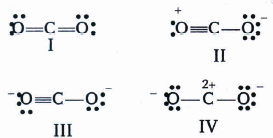
What is resonance? what are the guidelines for writing resonating structures. Out of the following four resonance structure for the CO2 molecule, which are important for describing in the molecules and why?
5.
What volume of 0.250 M HCl (aq) is required to react completely with 22.6 g of sodium carbonate according to the reaction ?
\({ Na }_{ 2 }{ CO }_{ 3 }(s)+2HCi(aq)\longrightarrow 2NaCl(aq)+{ H }_{ 2 }o(l)+{ CO }_{ 2 }(g)\)
6.
Give reasons for the following:
\(\mathbf{H}_{2}^{+} \text {and } \mathbf{H}_{2}^{-}\) ions have same bond order but \(\mathbf{H}_{2}^{+}\) are more stable than \(\mathbf{H}_{2}^{-}\)
7.
Calculate the number of moles of NaOH in 27 cm3 of 0.15 M NaOH solution.
8.
The electronic energy of the ground state of hydrogen atom works out to be -1.312 x 10⁶J mol-1. What change will occur in the position of electron in this atom if energy of 9.84 x 10⁵J mol-1 is added to the hydrogen atom?
9.
In the reactions given below, identify the species undergoing oxidation and reduction:
\( 3 \mathrm{Fe}_{3} \mathrm{O}_{4}(\mathrm{~s})+8 \mathrm{Al}(\mathrm{s}) \rightarrow 9 \mathrm{Fe} (\mathrm{s}) +4 \mathrm{Al}_{2} \mathrm{O}_{3}(\mathrm{~s}) \)
10.
Name the species that will be isoelectronic with the following atoms or ions
(i) Na
(ii) Cl-
(iii) Ca2+
(iv) Rb+
11.
(a) Explain the formation of ionic bond with two examples.
(b) Discuss the conditions which favour the formation of ionic bond
12.
Balance the following equations by the oxidation number method.
\({ MnO }_{ 2 }+{ C }_{ 2 }{ O }_{ 4 }^{ 2- }\longrightarrow { Mn }^{ 2+ }+{ CO }_{ 2 }\)
13.
Which of the following order of energies of molecular orbitals of N2 is correct?
\( \left(\pi 2 p_{y}\right)<\left(\sigma 2 p_{z}\right)<\left(\pi^{*} 2 p_{x}\right) \approx\left(\pi^{*} 2 p_{y}\right) \)
\(\left(\pi 2 p_{y}\right)>\left(\sigma 2 p_{z}\right)>\left(\pi^{*} 2 p_{x}\right) \approx\left(\pi^{*} 2 p_{y}\right) \)
\(\left(\pi 2 p_{y}\right)<\left(\sigma 2 p_{z}\right)>\left(\pi^{*} 2 p_{x}\right) \approx\left(\pi^{*} 2 p_{y}\right) \)
\(\left(\pi 2 p_{y}\right)>\left(\sigma 2 p_{z}\right)<\left(\pi^{*} 2 p_{x}\right) \approx\left(\pi^{*} 2 p_{y}\right)\)
14.
Ionic radii vary in ______.
inverse proportion to the effective nuclear charge.
inverse proportion to the square of effective nuclear charge.
direct proportion to the screening effect.
direct proportion to the square of screening effect.
15.
1 g of M2CO3 on treatment with excess HCl produces 0.01186 moles of CO2. The molar mass of M2CO3 in g mol-1 is _______.
1186
84.3
118.6
11.86
16.
If a reaction is carried out in acidic medium then which is used-to balance the equation?
H+ ions
OH- ions
H- ions
O2- ions
17.
Lewis dot structure of CO, \(\mathrm{NO}_{2}^{-}\) and \(\mathrm{CO}_{3}^{2-}\)are I, II and III respectively
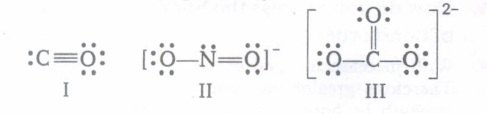
Which of the above structure(s) is/are wrong?
Only I
Only II
Only III
All of these
18.
The given reaction, X(g) + e- ⟶ X-(g) is an example of ______.
electron gain enthalpy
electron loss enthalpy
ionisation enthalpy
Both (a) and (c)
19.
Which of the following options does not represent ground state electronic configuration of an atom?
\(1 s^{2} 2 s^{2} 2 p^{6} 3 s^{2} 3 p^{6} 3 d^{8} 4 s^{2}\)
\(1 s^{2} 2 s^{2} 2 p^{6} 3 s^{2} 3 p^{6} 3 d^{9} 4 s^{2}\)
\(1 s^{2} 2 s^{2} 2 p^{6} 3 s^{2} 3 p^{6} 3 d^{10} 4 s^{1}\)
\(1 s^{2} 2 s^{2} 2 p^{6} 3 s^{2} 3 p^{6} 3 d^{5} 4 s^{1}\)
20.
An electron is moving in Bohr's fourth orbit. Its de-Broglie wavelength is λ Calculate the circumference of the fourth orbit.
2 λ
4 λ
4/λ
2/λ
21.
The empirical formula and molecular mass of a compound are CH2O and 180 g respectively. What will be the molecular formula of the compound?
C9H18O9
CH2O
C6H12O6
C2H4O2
22.
Which of the following is most powerful oxidizing agent in the following
O3
KMnO4
H2O2
K2Cr2O7
23.
Assertion: The ratio by volume of gaseous reactants and products is in agreement with their molar ratio.
Reason: Volume of a gas is inversely proportional to the number of moles of a gas.
Codes:
(a) Assertion is correct, reason is correct; reason is a correct explanation for assertion.
(b) Assertion is correct, reason is correct; reason is not a correct explanation for assertion
(c) Assertion is correct, reason is incorrect
(d) Assertion is incorrect, reason is correct.
24.
25.
Assertion: The decomposition of hydrogen peroxide to form water and oxygen is an example of disproportionation reaction.
Reason: The oxygen of peroxide is in -1 oxidation state and it is converted to zero oxidation state in O2 and -2 oxidation state in H2O.
Codes:
(a) Both Assertion and Reason are true and Reason is the correct explanation of Assertion.
(b) Both Assertion and Reason are true but Reason is not the correct explanation of Assertion.
(c) Assertion is true but Reason is false.
(d) Both Assertion and Reason are false.
26.
Assertion: Sodium chloride formed by the action of chlorine gas on sodium metal is a stable compound.
Reason: This is because sodium and chloride ions acquire octet in sodium chloride formation.
Codes:
(a) Both Assertion and Reason are true and Reason is the correct explanation of Assertion.
(b) Both Assertion and Reason are true but Reason is not the correct explanation of Assertion.
(c) Assertion is true but Reason is false.
(d) Both Assertion and Reason are false.
27.
Assertion: All isotopes of a given element show the same type of chemical behaviour.
Reason: The chemical properties of an atom are controlled by the number of electrons in the atom.
Codes:
(a) Both Assertion and Reason are true and Reason is the correct explanation of Assertion.
(b) Both Assertion and Reason are true but Reason is not the correct explanation of Assertion.
(c) Assertion is true but Reason is false.
(d) Both Assertion and Reason are false.
28.
29.
30.
31.
The attractive force which holds the two atoms together is called chemical bond. Covalent bond is formed by equal sharing of electrons. Coordinate bond is formed by unequal sharing of electrons. Ionic bond is formed by transfer of electrons from one atom to another. Octet rule, although very useful but it is not universally applicable. According to valence bond theory, covalent bond is formed by overlapping of half filled atomic orbitals resulting in lowering of energy and more stability. Bond order is the number of bonds between atoms in a molecule. Higher the bond order, more will be stability and bond dissociation enthalpy but smaller bond length. Polarity of covalent bond depends upon difference in electronegativity. Covalent character of bond depends upon polarising power, smaller cation and bigger anions have higher polarising power. VSEPR theory helps to predict shapes of molecules.
(a) Write the, electron dot structure of N2O.
(b) What are ions present in CsI3?
(c) Out of CN+, CN-, NO, which has highest bond order?
(d) What is correct order of repulsion bp - bp, lp - lp and lp - bp?
(e) Draw the structure of XeOF4 on the basis of VSEPR theory.
(f) Which out of B2 ,CO, \(\mathrm{O}_{2}^{2-}\) and NO+ are paramagnetic and why?
32.
Chemistry play an important role in human needs for food, health care products and improving life. Cis platin and taxol are used in chemotherapy, AZT (Azidothymidine) is used for AIDS. SI units are international units of measurement. Matter is classified into elements, compounds and mixtures, which can be homogeneous as well as heterogeneous. A mixture can be separated by physical methods, compounds can be separated by chemical methods only. Atomic mass is average of masses of isotopes depending upon their natural abundance. Empirical formula is calculated with the help of percentage composition of elements in a compound and molecular mass helps to calculate molecular formula. A chemical equation must be balanced so as to follow laws of chemical combination.
(a) Express 2.54 mm into S.I units.
(b) Out of milk, diamond, air, petrol which is pure substance?
(c) Balance the equation: NO2 + H2 O \(\rightarrow\) HNO3 + NO
(d) What is percentage of Na in Na2CO3 ? (Na = 23u, C = 12, O = 16u)
(e) \({ }_{17}^{35} \mathrm{Cl} \text { and }{ }_{17}^{37} \mathrm{Cl}\) are in ratio of 3 : 1 in nature. What is atomic mass of CI?
(f) What is empirical formula of C6H12O6?
(g) Chlorophyll contains 2.68% magnesium atoms. Calculate mass of magnesium atoms in 2 g of chlorophyll.
1.
Zinc is more reactive than Cu but Ag is less reactive than Cu.
2.
Step I. Calculation of the velocity of electron Energy (kinetic energy) of electron =1.0 x 10⁴ volts.
= 1.0 x 104 x 1.6 x 10-19 J = 1.6 x 10⁻¹⁵ J
= 1.6 x 10⁻¹⁵ kg m2 S-2
or 1/2 mv2 = 1.6 x 10⁻¹⁵ kg m2 s-2
or v =\(\left( \frac { 2\times 1.6\times 10^{ -15 }kgm^{ 2 }s^{ -2 } }{ (9.1x10^{ -31 }kg) } \right) ^{ 1/2 }\)= 5.93 x 10⁷ ms-1
Step II. Calculation of the wavelength of electron According to de Broglie equation,
\(\lambda =\frac { h }{ mv } ;\lambda =\frac { (6.626\times10^{ -34 }kgm^{ 2 }s^{ -1 }) }{ (9.1\times10^{ -31 }kg)\times(5.93\times10^{ 7 }ms^{ -1 }) } \) = 1.22\(\times \)10-11m.
3.
Elements in the long form of the periodic table have been divided into four blocks i.e., s, p, d and f This division is based upon the name of the orbital which receives the last electron. General electronic configuration of
s-block elements: ns1- 2 where n = 2 - 7
p-block elements: ns2 np1 - 6 where n = 2 - 6
d-block elements: (n -1) d1-10 ns0 - 2 where n = 4 - 7
f-block elements: (n - 2) f0 -14 (n -1)d0-1 ns2 where n = 6 - 7
4.
I and II are more important as the I is non-polar and (II) has more number of covalent bonds and negative charge on more electronegative atom and positive charge on more eletropositive element.
5.
1.7 L
6.
It is because electron present in anti-bonding orbital in H2 destabilize the molecular ion slightly more than bonding electron stabilizes due to higher energy.
7.
\(\mathbf{M}=n \times \frac{1000}{\text { Volume of solution in } \mathrm{cm}^{3}}\)
\(\Rightarrow \ 0.15=n \times \frac{1000}{27 \mathrm{~cm}^{3}}\)
\(\Rightarrow\) n = 0.00405 moles
8.
\(\Delta \mathrm{E}=-1.312 \times 10^{6} \mathrm{~J}\left(\frac{1}{n_{2}^{2}}-\frac{1}{n_{1}^{2}}\right)\)
9.84 x 10⁵J mol-1 = +1.312 x 10⁶ J \(\left(\frac{1}{1}-\frac{1}{n_{2}^{2}}\right)\)
\(\Rightarrow \ \frac{9.84}{13.12}=1-\frac{1}{n_{2}^{2}} \Rightarrow \frac{3}{4}=1-\frac{1}{n_{2}^{2}}\)
\(\Rightarrow \ \frac{1}{n_{2}^{2}}=\frac{1}{4} \Rightarrow n_{2}^{2}=4 \Rightarrow n_{2}=2\)
9.
Aluminium is oxidised because oxygen is added to it. Ferrous ferric oxide (Fe3O4) is reduced because oxygen has been removed from it.
10.
Isoelectronic species are those which have same number of electrons.
(i) Na has 10 electrons.Therefore, the species
N3-, O2-, F-, Mg2+, Al3+ etc., each of which has also 10 electrons and hence, isoelectronic with it
(ii) Cl- has 18 electrons. Therefore, the species P3-, S2-, Ar, K+ and Ca2+, each one of which contains 18 electrons and hence , isoelectronic with it.
(iii) Ca2+ has 18 electrons. Therefore, the species P3-, S2-, Ar and K+, each of which also contains 18 electrons and hence, isoelectronic with it.
(iv) Rb+ has 36 electrons. Therefore, the species Br-, Kr or Sr2+ each of which also has 36 electrons and hence, isoelectronic with it.
11.
(a) An ionic or electrovalent bond is formed by the complete transferrence of one or more electrons from one atom to another.
Examples:
(i) Formation of (NaCl)
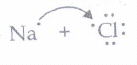 \(\longrightarrow\)\(\left[ \underset { 2,8 }{ Na } ^{ + } \right] \quad \left[ \overset { .. }{ :\underset { ..\\ 2,8,8 }{ CI } } : \right] \) or NaCI
Formation of (CaF2)
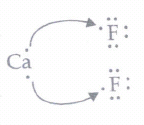 \(\longrightarrow\)\(\left[ \underset { 2,8,8 }{ Ca } \right] ^{ 2+ }\quad \left[ \overset { .. }{ :\underset { .. }{ F } : } \right] ^{ \\ - }\\ \quad \quad \quad \quad \quad \quad \left[ \overset { .. }{ :\underset { \quad ..\\ (2,8) }{ F } : } \right] ^{ - }\) or CaF2
(b) Conditions favourable for the formation of ionic bond:
(i) Lesser the ionization enthalpy, easier will be the removal of an electron i.e., formation of a positive ion and hence greater the chances of formation of ionic bond.
(ii) Higher is the electron affinity, more is the energy released and stabler will be the negative ion produced. Consequently, the probability of formation of ionic bond will be enhanced
12.
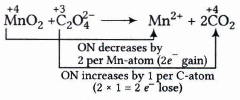
Increase and decrease in oxidation number is already balanced. Add 4H+ towards LHS of the equation to balance charge.
\({ MnO }_{ 2 }+{ C }_{ 2 }{ O }_{ 4 }^{ 2- }+{ 4H }^{ + }\longrightarrow { Mn }^{ 2+ }+{ 2CO }_{ 2 }\)
Add 2 H2O towards RHS of the equation to balance H-atoms
\({ MnO }_{ 2 }+{ C }_{ 2 }{ O }_{ 4 }^{ 2- }+{ 4H }^{ + }\longrightarrow { Mn }^{ 2+ }+{ 2CO }_{ 2 }+{ 2H }_{ 2 }O\)
This represents a balanced redox reaction.
13.
(a)
\( \left(\pi 2 p_{y}\right)<\left(\sigma 2 p_{z}\right)<\left(\pi^{*} 2 p_{x}\right) \approx\left(\pi^{*} 2 p_{y}\right) \)
14.
(a)
inverse proportion to the effective nuclear charge.
15.
(b)
84.3
16.
(a)
H+ ions
17.
(a)
Only I
18.
(a)
electron gain enthalpy
19.
(b)
\(1 s^{2} 2 s^{2} 2 p^{6} 3 s^{2} 3 p^{6} 3 d^{9} 4 s^{2}\)
20.
(b)
4 λ
21.
(c)
C6H12O6
22.
(a)
O3
23.
(c) Assertion is correct, reason is incorrect
24.
25.
(a) Both Assertion and Reason are true and Reason is the correct explanation of Assertion.
26.
(a) Both Assertion and Reason are true and Reason is the correct explanation of Assertion.
27.
(a) Both Assertion and Reason are true and Reason is the correct explanation of Assertion.
28.
29.
30.
31.
(a)
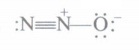
(b) Cs+ and \(\mathrm{I}_{3}^{-}\)
(c) \(\mathrm{CN}(14): \sigma 1 s^{2} \sigma^{*} 1 s^{2} \sigma 2 s^{2} \sigma^{*} 2 s^{2} \pi^{2} p_{x}^{2} \pi^{2} p_{y}^{2} \sigma 2 p_{z}^{2}\)
\(\mathrm{BO}=\frac{1}{2}(10-4)=\frac{6}{2}=3\)
(d) lp - lp> lp - bp > bp - bp [bp is bond pair, lp is lone pair]
(e)
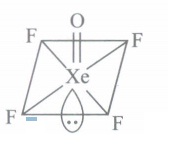
(f) \(\mathrm{B}_{2}(10): \sigma 1 s^{2} \sigma^{*} 1 s^{2} \sigma 2 s^{2} \sigma^{*} 2 s^{2} \pi^{2} p_{x^{1}} \pi^{2} p_{y^{1}}\) is paramagnetic due to presence of two unpaired electrons.
32.
(a) 2.54 x 10- 3 m.
(b) Diamond.
(c) 3NO2 + H2O \(\rightarrow\) 2HNO3 + NO
(d) \(\% \text { of } \mathrm{Na}=\frac{\text { Total mass of } \mathrm{Na}}{\text { Molar mass }} \times 100\)
\(=\frac{46}{106} \times 100=43.39 \%\)
(e) \(\frac{3 \times 35+1 \times 37}{4}=35.5\)
(f) CH2O
(g) Mass of magnesium atoms \(=2 \times \frac{2.68}{100}\)
\(=\frac{5.36}{100}=0.0536 \mathrm{~g}\)

11th Standard CBSE Syllabus & Materials
11th Standard CBSE
CBSE 11th Business Studies Forms of Business Organisation Sample Question Papers Study Material - QB365 Set A
NEW11th Standard CBSE
CBSE 11th Business Studies Business, Trade and Commerce Sample Question Papers Study Material - QB365 Set A
NEW11th Standard CBSE
CBSE 11th Physics Waves Sample Question Papers Study Material - QB365 Set A
NEW11th Standard CBSE
CBSE 11th Physics Kinetic Theory Sample Question Papers Study Material - QB365 Set A



NCERT Books

Syllabus

Exam Pattern

Sample Question Papers

Previous year Question Papers

Important Notes

MCQ Practice test

NCERT Exemplers

Case study Questions

Image Based Questions

Passage based Questions

HOT Questions

Value Based Questions

Model Questions Papers
NCERT ( Book Back ) Questions

Assertion and Reason
Important Questions And Answers

CBSE 11th Standard CBSE Subjects
CBSE Standards







