
 100% FREE ACCESS
11th Standard CBSE Syllabus & Materials
11th Standard CBSE
CBSE 11th Economics PART-A - Presentation of Data - New Sample Question Papers Study Material - QB365 Set A
NEW11th Standard CBSE
CBSE 11th Economics PART-A - Organisation of Data - New Sample Question Papers Study Material - QB365 Set A
NEW11th Standard CBSE
CBSE 11th Economics PART-A - Collection of Data - New Sample Question Papers Study Material - QB365 Set A
NEW11th Standard CBSE
CBSE 11th Economics PART-A - Introduction to Economics and Statistics - New Sample Question Papers Study Material - QB365 Set A
NEW11th Standard CBSE
CBSE 11th Business Studies International Trade Sample Question Papers Study Material - QB365 Set A
NEW11th Standard CBSE
CBSE 11th Business Studies Evolution and Fundamentals of Business Sample Question Papers Study Material - QB365 Set A

Published on: 21/10/2025
Download CBSE Class 11th Standard CBSE Chemistry question papers, sample papers, important questions, and previous year solved papers in PDF format. Get free study materials, NCERT solutions, and exam preparation resources for Class 11th Standard CBSE Chemistry
Questions + Answers key
Take MCQ Chemistry Test
1.
Consider the reactions given below. On the basis of these reactions find out which of the algebric relations given in options (a) to (d) is correct?
(i) \(
\mathrm{C}(g)+4 \mathrm{H}(g) \longrightarrow \mathrm{CH}_{4}(g) ;
\Delta_{r} H=x \mathrm{~kJ} \mathrm{~mol}^{-1}
\)
(ii)\(
\text { C(graphite, } s)+2 \mathrm{H}_{2}(g) \longrightarrow \mathrm{CH}_{4}(g) ;
\Delta_{r} H \doteq y \mathrm{~kJ} \mathrm{~mol}^{-1}
\)
x = y
x = 2y
x > y
x < y
2.
The spontaneity means, having the potential to proceed without the assistance of external agency. The processes which occur spontaneously are______.
flow of heat from colder to warmer body.
gas in a container contracting into one corner.
gas expanding to fill the available volume.
burning carbon in oxygen to give carbon dioxide.
3.
If the bond energies of H-H, Br-Br and H-Br are 433, 192 and 364 kJ mol-1, respectively, then \(\Delta \mathbf{H}^{\circ}\) for the reaction. \(\mathbf{H}_{2}(g)+\operatorname{Br}(g) \longrightarrow 2 \mathrm{HBr}(g) \text { is }\) ______.
-261 kJ
-103 kJ
+261 kJ
-1031 kJ
4.
The enthalpy of vapourisation of a liquid is 30 kJ mol-1 and enthalpy of vapourisation is 75 J mol-1. The boiling point of the liquid at 1 atm is ______.
250 K
400 K
450 K
600 K
5.
A gas is allowed to expand in a well insulated container against a constant external pressure of 2.5 atm from an initial volume of 2.50 L to a final volume of 4.50 L. The change in internal energy in Joule's will be ______.
- 500 J
- 506 J
+ 505 J
1136.25 J
6.
CO is isoelectronic with ______.
NO+
N2
SnCl2
\(\mathrm{NO}_{2}^{-}\)
7.
Which of the following isoelectronic and isostructural
\( \mathrm{CO}_{3}^{2-}, \mathrm{NO}_{3}^{0-} \)
\( \mathrm{ClO}_{3}^{-}, \mathrm{CO}_{3}^{2-} \)
\(\mathrm{SO}_{3}^{2-}, \mathrm{NO}_{3}^{-} \)
\(\mathrm{ClO}_{3}^{-}, \mathrm{SO}_{3}^{2-}\)
8.
Which of the following molecules aU bonds not equal?
PCl5
SF6
BF3
AIF3
9.
Which of the following is an electron deficient molecule?
C2H6
B2H6
SiH4
PH3
10.
The correct order of dipole moment is ______.
CH4 < NF3 < NH3 < H2O
NF3 < CH4 < NH3 < H2O
CH4 < NH3 < NF3 < H2O
< H2O < NH3 < NF3 < CH4
11.
Which of the following, is correct when decrease in entropy has been taken place?
Temperature of a crystalline solid is raised from 0 K to 115 K
A liquid crystallises into a solid
\(2 \mathrm{NaHCO}_{3}(s) \stackrel{\Delta}{\longrightarrow} \mathrm{Na}_{2} \mathrm{CO}_{3}(s)+\mathrm{CO}_{2}(g)+\mathrm{H}_{2} \mathrm{O}(g)\)
\(\mathrm{H}_{2}(\mathrm{~g}) \longrightarrow 2 \mathrm{H}(\mathrm{g})\)
12.
Which of the following properties is the measure of the degree of randomness or disorder in the system?
Entropy
Enthalpy
Internal energy
None of these
13.
Maximum entropy will be in which of the following?
Ice
liquid water
snow
water vapour
14.
Lattice enthalpies are determined by ______.
Born-Haber cycle
Hess' law
lattice cycle
None of these
15.
Calculate the difference between Cp and Cv for 10 moles of an ideal gas.
83.14 J
8.314 J
831.4 J
0.831 J
16.
A reaction, A + B ⟶ 7 C + D + q is found to have a positive entorpy change. The reaction will be ______.
possible at high temperature
possible only at low temperature
not possible at any temperature
possible at any temperature
17.
For both reversible and irreversible expansion of an ideal gas, under isothermal condition, ______.
\(\Delta U=0, \Delta S_{\text {total }} \neq 0\)
\(\Delta U \neq 0, \Delta S_{\text {total }}=0\)
\(\Delta U \neq 0, \Delta S_{\text {total }}=0\)
\(\Delta U \neq 0, \Delta S_{\text {total }} \neq 0\)
18.
The sign of ΔG for a spontaneous and non-spontaneous process respectively are ______.
positive and negative
negative and positive
zero and positive
positive and zero
19.
Select the incorrect expression from the following
\(\Delta S_{\text {total }}=\Delta S_{\text {system }}+\Delta S_{\text {surr }}\)
\(\Delta S_{\text {surr }}=\frac{\Delta H_{\text {surr }}}{T}=-\frac{\Delta H_{\text {sys }}}{T}\)
\(\Delta S_{\text {total }}<0 \text { (spontaneous process) }\)
\(\Delta G=\Delta H-T \Delta S\)
20.
Which one of the following reaction has ΔSo greater than zero?
\(\mathrm{CaO}+\mathrm{CO}_{2}(g) \rightleftharpoons \mathrm{CaCO}_{3}(s)\)
\(\mathrm{NaCl}(a q) \rightleftharpoons \mathrm{NaCl}(s)\)
\(\mathrm{NaNO}_{3}(s) \rightleftharpoons \mathrm{Na}^{+}(a q)+\mathrm{NO}_{3}^{-}(s q)\)
\(\mathrm{N}_{2}(g)+3 \mathrm{H}_{2}(\mathrm{~g}) \rightleftharpoons 2 \mathrm{NH}_{3}(\mathrm{~g})\)
21.
The enthalpy change when one mole of solute dissolves in a specified amount of solvent is called ______.
enthalpy of dilution
enthalpy of solution
enthalpy of association
enthalpy of dissociation
22.
For the reaction, \(\mathrm{NaCl}(s) \longrightarrow \mathrm{Na}^{+}(g)+\mathrm{Cl}^{-}(g)\) Identify the enthalpy involved in the above reaction ______.
enthalpy of hydration
lattice enthalpy
enthalpy of solution
enthalpy of dissociation
23.
Enthalpy change for the reaction \(4 \mathrm{H}(g) \longrightarrow 2 \mathrm{H}_{2}(g) \text { is }-869.6 \mathrm{~kJ}\) The dissociation energy of H-H bond is ______.
-869.6 kJ
+434.8 KJ
+217.4 kJ
-434.8 kJ
24.
In the given reaction, \(\mathrm{H}_{2}(g) \longrightarrow 2 \mathrm{H}(g) ; \quad \Delta H=435.0 \mathrm{~kJ} \mathrm{~mol}^{-1}\) The enthalpy change is known as ______.
enthalpy of formation
enthalpy of atomisation
bond dissociation enthalpy
Both (b) and (c)
25.
For the given reaction, \(\mathrm{CH}_{4}(g)+2 \mathrm{O}_{2}(g) \longrightarrow \mathrm{CO}_{2}(g)+2 \mathrm{H}_{2} \mathrm{O}(l)\) the correct expression for \(\Delta_{r} H \text { is }\) ______.
\( {\left[H_{m}\left(\mathrm{CO}_{2}, g\right)+2 H_{m}\left(\mathrm{O}_{2}, g\right)\right]-\left[2 H_{m}\left(\mathrm{H}_{2} \mathrm{O}, l\right)\right.} \left.+H_{m}\left(\mathrm{CH}_{4}, g\right)\right] \)
\( {\left[2 H_{m}\left(\mathrm{O}_{2}, g\right)+H_{m}\left(\mathrm{CH}_{4}, g\right)\right]-\left[H_{m}\left(\mathrm{CO}_{2}, g\right)\right.} \left.+2 H_{m}\left(\mathrm{H}_{2} \mathrm{O}, l\right)\right] \)
\( {\left[H_{m}\left(\mathrm{CO}_{2}, g\right)+2 H_{m}\left(\mathrm{H}_{2} \mathrm{O}, l\right)\right]-\left[H_{m}\left(\mathrm{CH}_{4}, g\right)\right.} \left.+2 H_{m}\left(\mathrm{O}_{2}, g\right)\right] \)
\( {\left[H_{m}\left(\mathrm{CO}_{2}, g\right)+H_{m}\left(\mathrm{H}_{2} \mathrm{O}, l\right)\right]-\left[H_{m}\left(\mathrm{CH}_{4}, \mathrm{~g}\right)\right.} \left.+2 H_{m}\left(\mathrm{O}_{2}, g\right)\right] \)
26.
The enthalpies of elements in their standard states are taken as zero. The enthalpy of formation of a compound______.
is always negative
is always positive
may be positive or negative
is never negative
27.
For the reaction \(\mathrm{N}_{2}(g)+3 \mathrm{H}_{2}(g) \rightleftharpoons 2 \mathrm{NH}_{3}(g) ; \Delta H\) is ______.
\(\Delta U-2 R T\)
\(\Delta U-R T\)
\(\Delta U+R T\)
\(\Delta U+2 R T\)
28.
Which of the following combinations of atomic orbitals will give antibonding n-molecular orbital (assume Z-axis as internuclear axis).
\(2 s+2 p_{z}\)
\(2 p_{y}+2 p_{y}\)
\(2 p_{x}-2 p_{x}\)
\(2 p_{z}-2 p_{z}\)
29.
The boiling point of a substance increases with increase in ______.
intermolecular hydrogen bonding
intramolecular hydrogen bonding
molecular mass
Both (a) and (c)
30.
The correct decreasing order of the boiling points of given compounds is ______.
HF > H2O > NH3
H2O > HF > NH3
NH3 > HF> H2O
NH3 > H2O > HF
31.
In which of the following substances will hydrogen bond be strongest?
HCI
H2O
HI
H2S
32.
If Nb is the number of electrons occupying bonding orbitals and Na the number of electrons occupying the antibonding orbitals, then the molecule will be stable if ______.
Nb > Na
Nb < Na
Nb = Na
Nb < Na
33.
Which of the following angle corresponds to sp2 hybridisation?
90o
120o
180o
109o
34.
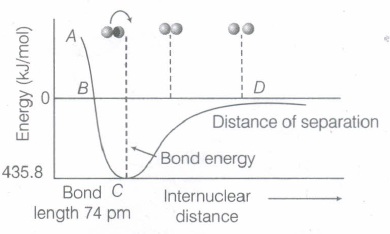
The above potential energy curve is given for the formation of H2 molecule as a function of internuclear distance of H-atoms. At what point in the curve H2 is found in the most stable state?
A
B
C
D
35.
The valence bond theory explains the shape, the formation and directional properties of bonds in polyatomic molecules like CH4, NH3 and H2O etc, in terms of ______.
overlapping of atomic orbitals
hybridisation of atomic orbitals
Both (a) and (b)
None of the above
36.
VBTtheory is based on the ______.
knowledge of atomic orbitals and electronic configuration of elements
overlapping criteria and the hybridisation of atomic orbitals
the principles of variation and superposition
All of the above
37.
Sidgwick and Powell proposed the VSEPR theory which was further developed and refined by ______.
Johann Dobereiner
Werner Heisenberg
Nyholm and Gillespie
Neils Bohr
38.
Which theory can be best understood by considering the formation of the chlorine molecule, C12?
Lewis theory
Langmuir theory
Lewis-Langmuir theory
Kossel-Lewis theory
39.
The product of the magnitude of the charge and the distance between the centres of positive and negative charge is called ______.
charge ratio
dipole moment
current flow
magnetic moment
40.
Lewis postulated that atoms achieve the stable octet when they are linked by ______.
ionic bonds
covalent bonds
coordinate bonds
chemical bonds
41.
For an endothermic reaction ______.
\(\Delta\)H is-ve
\(\Delta\)H is+ve
\(\Delta\)H is zero
none of these
42.
For a cyclic process, the change in internal energy of the system is ______.
always +ve
equal to zero
always -ve
none of the above
43.
Thermodynamics is applicable to ______.
macroscopic system only
microsopic system only
homogeneous system only
heterogeneous system only
44.
The molecule Ne2 does not exist because ______.
Nb > Na
Nb = Na
Nb < Na
None of these
45.
A molecule or ion is stable if: ______.
Nb = Na
Nb < Na
Na < Nb
Na - Nb =+ve
1.
(c)
x > y
2.
(d)
burning carbon in oxygen to give carbon dioxide.
3.
(b)
-103 kJ
4.
(b)
400 K
5.
(b)
- 506 J
6.
(a)
NO+
7.
(a)
\( \mathrm{CO}_{3}^{2-}, \mathrm{NO}_{3}^{0-} \)
8.
(a)
PCl5
9.
(c)
SiH4
10.
(a)
CH4 < NF3 < NH3 < H2O
11.
(b)
A liquid crystallises into a solid
12.
(a)
Entropy
13.
(d)
water vapour
14.
(a)
Born-Haber cycle
15.
(a)
83.14 J
16.
(d)
possible at any temperature
17.
(a)
\(\Delta U=0, \Delta S_{\text {total }} \neq 0\)
18.
(b)
negative and positive
19.
(c)
\(\Delta S_{\text {total }}<0 \text { (spontaneous process) }\)
20.
(c)
\(\mathrm{NaNO}_{3}(s) \rightleftharpoons \mathrm{Na}^{+}(a q)+\mathrm{NO}_{3}^{-}(s q)\)
21.
(b)
enthalpy of solution
22.
(b)
lattice enthalpy
23.
(b)
+434.8 KJ
24.
(b)
enthalpy of atomisation
25.
(c)
\( {\left[H_{m}\left(\mathrm{CO}_{2}, g\right)+2 H_{m}\left(\mathrm{H}_{2} \mathrm{O}, l\right)\right]-\left[H_{m}\left(\mathrm{CH}_{4}, g\right)\right.} \left.+2 H_{m}\left(\mathrm{O}_{2}, g\right)\right] \)
26.
(c)
may be positive or negative
27.
(a)
\(\Delta U-2 R T\)
28.
(c)
\(2 p_{x}-2 p_{x}\)
29.
(d)
Both (a) and (c)
30.
(b)
H2O > HF > NH3
31.
(b)
H2O
32.
(a)
Nb > Na
33.
(b)
120o
34.
(c)
C
35.
(c)
Both (a) and (b)
36.
(d)
All of the above
37.
(c)
Nyholm and Gillespie
38.
(c)
Lewis-Langmuir theory
39.
(b)
dipole moment
40.
(d)
chemical bonds
41.
(b)
\(\Delta\)H is+ve
42.
(b)
equal to zero
43.
(a)
macroscopic system only
44.
(b)
Nb = Na
45.
(c)
Na < Nb

11th Standard CBSE Syllabus & Materials
11th Standard CBSE
CBSE 11th Business Studies Forms of Business Organisation Sample Question Papers Study Material - QB365 Set A
NEW11th Standard CBSE
CBSE 11th Business Studies Business, Trade and Commerce Sample Question Papers Study Material - QB365 Set A
NEW11th Standard CBSE
CBSE 11th Physics Waves Sample Question Papers Study Material - QB365 Set A
NEW11th Standard CBSE
CBSE 11th Physics Kinetic Theory Sample Question Papers Study Material - QB365 Set A



NCERT Books

Syllabus

Exam Pattern

Sample Question Papers

Previous year Question Papers

Important Notes

MCQ Practice test

NCERT Exemplers

Case study Questions

Image Based Questions

Passage based Questions

HOT Questions

Value Based Questions

Model Questions Papers
NCERT ( Book Back ) Questions

Assertion and Reason
Important Questions And Answers

CBSE 11th Standard CBSE Subjects
CBSE Standards







