
 100% FREE ACCESS
11th Standard CBSE Syllabus & Materials
11th Standard CBSE
CBSE 11th Economics PART-A - Presentation of Data - New Sample Question Papers Study Material - QB365 Set A
NEW11th Standard CBSE
CBSE 11th Economics PART-A - Organisation of Data - New Sample Question Papers Study Material - QB365 Set A
NEW11th Standard CBSE
CBSE 11th Economics PART-A - Collection of Data - New Sample Question Papers Study Material - QB365 Set A
NEW11th Standard CBSE
CBSE 11th Economics PART-A - Introduction to Economics and Statistics - New Sample Question Papers Study Material - QB365 Set A
NEW11th Standard CBSE
CBSE 11th Business Studies International Trade Sample Question Papers Study Material - QB365 Set A
NEW11th Standard CBSE
CBSE 11th Business Studies Evolution and Fundamentals of Business Sample Question Papers Study Material - QB365 Set A

Published on: 21/10/2025
Download CBSE Class 11th Standard CBSE Chemistry question papers, sample papers, important questions, and previous year solved papers in PDF format. Get free study materials, NCERT solutions, and exam preparation resources for Class 11th Standard CBSE Chemistry
Questions + Answers key
Take MCQ Chemistry Test
1.
Which out of NH3 and NF3 has higher dipole moment and why ?
2.
Is there any change in the hybridisation of B and N atoms as a result of the following reaction?
\({ BF }_{ 3 }+{ NH }_{ 3 }\longrightarrow { F }_{ 3 }B.{ NH }_{ 3 }\)
3.
Use molecular orbital theory to explain why the Be2 molecule does not exist.
4.
Explain the structure of \(\mathrm{CO}_{3}^{2-}\) ion in terms of resonance.
5.
In the following pair of the compound, which one is more covalent and why?
(i) AgCl, AgI
(ii) BeCl2 , MgCl2
(iii) SnCl2 , SnCl4
(iv) CuO, CuS
6.
Draw diagrams showing the formation of a double bond and a triple bond between carbon atoms in C2 H4 and C2 H2 molecules.
7.
Decreasing order of stability.
\( \mathbf{O}_{2}>\mathbf{0}_{2}^{+}>\mathbf{O}_{2}^{2-}>\mathbf{O}_{2}^{-} \)
\(\mathbf{O}_{2}^{-}>\mathbf{O}_{2}^{2-}>\mathbf{O}_{2}^{+}>\mathbf{O}_{2} \)
\(\mathbf{O}_{2}^{+}>\mathbf{O}_{2}>\mathbf{O}_{2}^{-}>\mathbf{O}_{2}^{2-} \)
\(\mathbf{O}_{2}^{2-}>\mathbf{O}_{2}^{-}>\mathbf{O}_{2}>\mathbf{O}_{2}^{+} \)
8.
Which of the following combinations of atomic orbitals will give antibonding n-molecular orbital (assume Z-axis as internuclear axis).
\(2 s+2 p_{z}\)
\(2 p_{y}+2 p_{y}\)
\(2 p_{x}-2 p_{x}\)
\(2 p_{z}-2 p_{z}\)
9.
\(\psi^{\prime}\) expressed as wave function can represent ______.
probability of an electron
amplitude of the electron waves
electron wave function
Both (a) and (c)
10.
The mixing of one s and one p- orbital resulting in the formation of two equivalent sp- hybrid orbitals. Which of the following orbitals are used for sp- hybridisation by convention.
s and Px
s and Py
s and Pz
None of the above
11.
Why do the deviations occur from idealised shape of H2O and NH3 molecules?
Same hybridisation
Different hybridisation
Repulsive effect
None of these
12.
Which theory can be best understood by considering the formation of the chlorine molecule, C12?
Lewis theory
Langmuir theory
Lewis-Langmuir theory
Kossel-Lewis theory
13.
The molecule H₂O has a bent shape due to two lone pairs on oxygen. Each O–H bond is polar because of oxygen’s high electronegativity. The net dipole moment is not zero due to the asymmetrical geometry, making H₂O a polar molecule. In contrast, CO₂, despite having polar bonds, is non-polar overall due to its linear geometry.
1. Which of the following best explains why H₂O is polar but CO₂ is not?
(a) H₂O has ionic bonds
(b) CO₂ has no dipole moment
(c) H₂O has lone pairs causing bent shape
(d) CO₂ has unshared electrons
2. Which property depends directly on molecular polarity?
(a) Boiling point
(b) Molar mass
(c) Ionisation energy
(d) Bond enthalpy
3. The bond angle in H₂O is approximately:
(a) 180°
(b) 120°
(c) 109.5°
(d) 104.5°
14.
15.
Assertion : Lone pair-lone pair repulsive interactions are greater than lone pair-bond pair and bond pair-bond pair interactions.
Reason : The space occupied by lone pair electrons is more as compared to bond pair electrons.
Codes:
(a) Assertion is correct, reason is correct; reason is a correct explanation for assertion.
(b) Assertion is correct, reason is correct; reason is not a correct explanation for assertion
(c) Assertion is correct, reason is incorrect
(d) Assertion is incorrect, reason is correct.
16.
1.
In NH3 and NF3, the difference in electronegativity is nearly same but the dipole moment of NH3 = (1.46D)
For Example, NF3 = (0.24D)
In NH3, the dipole moments of the three N - H bonds are in the same direction as the lone pair of electron. But in NF3, the dipole moments of the three N.- F bonds are in the direction opposite to that of the lone pair. Therefore, the resultant dipole moment in NH3 is more than in NF3
2.
In BF3 , there are 3 bond pairs 0 lone pair, so boron is sp2 hybridised and in NH3, there are 3 bond pairs and 1 lone pair, so nitrogen is sp3 hybridised. After the reaction hybridisation of boron changes to sp3 but hybridisation of nitrogen remains the same becuase N shares its lone pair with electron deficient B.
3.
Electronic configuration of Be2 molecule (4 + 4 = 8)
σ1s2,σ1s2,σ1s2,σ1s2
Bond order=1/2[Nb−Na]=1/2(4−4)=0
Since, bond order in zero, so Be2 does not exist.
4.
The single Lewis structure based on the presence of two single bonds and one double bond between carbon and oxygen atoms is inadequate to represent the molecule accurately as it represents unequal bonds. According to the experimental findings, all carbon to oxygen bonds in \(\mathrm{CO}_{3}^{2-}\) are equivalent. Therefore the carbonate ion is best described as a resonance hybrid of the canonical forms I, II, and III shown below.
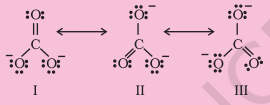
Resonance in \(\mathrm{CO}_{3}^{2-}\) I, II and III represent the three canonical forms.
5.
(a) AgI is more covalent that AgCl. This is because I- ion is larger in size than Cl- ion and hence, is more polarised than Cl ion.-
(b) BeCl2 is more covalent than MgCl2 . This is because Be2+ ion is smaller in size than Mg2+ ion and hence has the greater polarising power.
(c) SnCl4 is more covalent than SnCl2 . This is because Sn4+ ion has greater charge and smaller size than Sn2+ ion and hence has greater polarising power.
(d) CuS is more covalent than CuO. This is because S2- ion has larger size than O2- ion and hence is more polarised than O2- ion.
6.
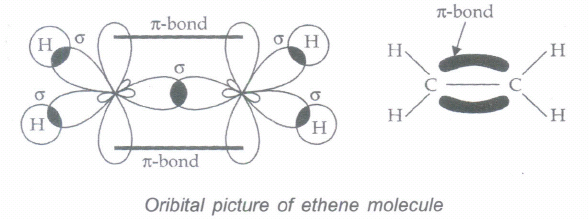
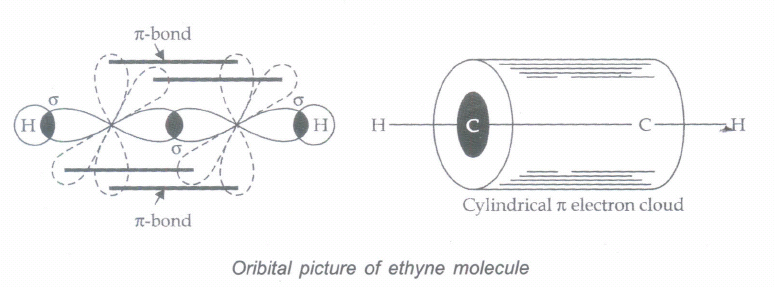
7.
(c)
\(\mathbf{O}_{2}^{+}>\mathbf{O}_{2}>\mathbf{O}_{2}^{-}>\mathbf{O}_{2}^{2-} \)
8.
(c)
\(2 p_{x}-2 p_{x}\)
9.
(b)
amplitude of the electron waves
10.
(c)
s and Pz
11.
(c)
Repulsive effect
12.
(c)
Lewis-Langmuir theory
13.
1.(c) H₂O has lone pairs causing bent shape
Explanation: Bent shape causes dipoles not to cancel → net polarity in H₂O
2.(a) Boiling point
Explanation:Polar molecules have stronger intermolecular forces (H-bonding) → higher boiling point.
3.(d) 104.5°
Explanation: Due to 2 lone pairs on oxygen → more repulsion → bond angle reduced to 104.5°
14.
15.
(a) Assertion is correct, reason is correct; reason is a correct explanation for assertion.
Explanation:
While the lone pairs are localised on the central atom, each bonded pair is shared between two atoms. As a result, the lone pair electrons in a molecule occupy more space as compared to the bonding pairs of electrons. This results in greater repulsion between lone pairs of electrons as compared to the lone pair -bond pair and bond pair – bond pair repulsions.
16.

11th Standard CBSE Syllabus & Materials
11th Standard CBSE
CBSE 11th Business Studies Forms of Business Organisation Sample Question Papers Study Material - QB365 Set A
NEW11th Standard CBSE
CBSE 11th Business Studies Business, Trade and Commerce Sample Question Papers Study Material - QB365 Set A
NEW11th Standard CBSE
CBSE 11th Physics Waves Sample Question Papers Study Material - QB365 Set A
NEW11th Standard CBSE
CBSE 11th Physics Kinetic Theory Sample Question Papers Study Material - QB365 Set A



NCERT Books

Syllabus

Exam Pattern

Sample Question Papers

Previous year Question Papers

Important Notes

MCQ Practice test

NCERT Exemplers

Case study Questions

Image Based Questions

Passage based Questions

HOT Questions

Value Based Questions

Model Questions Papers
NCERT ( Book Back ) Questions

Assertion and Reason
Important Questions And Answers

CBSE 11th Standard CBSE Subjects
CBSE Standards







