
 100% FREE ACCESS
11th Standard CBSE Syllabus & Materials
11th Standard CBSE
CBSE 11th Economics PART-A - Presentation of Data - New Sample Question Papers Study Material - QB365 Set A
NEW11th Standard CBSE
CBSE 11th Economics PART-A - Organisation of Data - New Sample Question Papers Study Material - QB365 Set A
NEW11th Standard CBSE
CBSE 11th Economics PART-A - Collection of Data - New Sample Question Papers Study Material - QB365 Set A
NEW11th Standard CBSE
CBSE 11th Economics PART-A - Introduction to Economics and Statistics - New Sample Question Papers Study Material - QB365 Set A
NEW11th Standard CBSE
CBSE 11th Business Studies International Trade Sample Question Papers Study Material - QB365 Set A
NEW11th Standard CBSE
CBSE 11th Business Studies Evolution and Fundamentals of Business Sample Question Papers Study Material - QB365 Set A

Published on: 21/10/2025
Download CBSE Class 11th Standard CBSE Chemistry question papers, sample papers, important questions, and previous year solved papers in PDF format. Get free study materials, NCERT solutions, and exam preparation resources for Class 11th Standard CBSE Chemistry
Questions + Answers key
Take MCQ Chemistry Test
1.
For which of the following processes ΔS is negative ______.
\(\mathrm{H}_{2}(g) \longrightarrow 2 \mathrm{H}(g)\)
\(\mathrm{N}_{2}(g, 1 \mathrm{~atm}) \longrightarrow \mathrm{N}_{2}(g, 5 \mathrm{~atm})\)
\(2 \mathrm{SO}_{3}(g) \longrightarrow 2 \mathrm{SO}_{2}(g)+\mathrm{O}_{2}(g)\)
\(\mathrm{C}(\text { diamond }) \longrightarrow \mathrm{C}(\text { graphite })\)
2.
Consider the reactions given below. On the basis of these reactions find out which of the algebric relations given in options (a) to (d) is correct?
(i) \(
\mathrm{C}(g)+4 \mathrm{H}(g) \longrightarrow \mathrm{CH}_{4}(g) ;
\Delta_{r} H=x \mathrm{~kJ} \mathrm{~mol}^{-1}
\)
(ii)\(
\text { C(graphite, } s)+2 \mathrm{H}_{2}(g) \longrightarrow \mathrm{CH}_{4}(g) ;
\Delta_{r} H \doteq y \mathrm{~kJ} \mathrm{~mol}^{-1}
\)
x = y
x = 2y
x > y
x < y
3.
Which of the following statements is correct?
The presence of reacting species in a covered beaker is an example of open system.
There is an exchange of energy as well as matter between the system and the surroundings in a closed system.
The presence of reactants in a closed vessel made up of copper is an example of a closed system.
The presence of reactants in a thermos flask or any other closed insulated vessel is an example of a closed system.
4.
The standard enthalpies of formation of CO2(g), H2O(l) and glucose(s) at 25°C are -400 kJ/mol, -300 kJ/mol and -1300 kl/mol-1 respectively. The standard enthalpy of combustion per gram of glucose of 25°C is ______.
+2900 kJ
-2900 kJ
-16.11 kJ
+16.11 kJ
5.
Two moles of an ideal gas is expanded isothermally and reversibly from 1 L to 10 L at 300 K. The enthalpy change (in kJ) for the process is______.
11.4 kJ
-11.4 kJ
0 kJ
4.8 kJ
6.
Which of the following are state functions?
Enthalpy
Heat
Free energy
Work
7.
In an exothermic reaction, heat is evolved, and system loses heat to the surrounding. For such system______.
qp will be negative
ΔrH will be negative
qp will be positive
ΔrH will be positive
8.
On the basis of thermochemical equations (i), (ii) and (iii), find out which of the algebric relationships given in options (a) to (d) is correct.
\(
\text { (i) } \mathrm{C} \text { (graphite) }+\mathrm{O}_{2}(g) \longrightarrow \mathrm{CO}_{2}(g)
\Delta_{r} \boldsymbol{H}=\boldsymbol{x} \mathbf{k J} \mathrm{mol}^{-1}
\)
\(\text { (ii) } \mathrm{C} \text { (graphite) }+\frac{1}{2} \mathrm{O}_{2}(g) \longrightarrow \mathrm{CO}(g)
\Delta_{r} \boldsymbol{H}=\boldsymbol{y} \mathbf{k J} \mathbf{m o l}^{-1}
\)
\(\text { (iii) } \mathrm{CO}(g)+\frac{1}{2} \mathrm{O}_{2}(g) \longrightarrow \mathrm{CO}_{2}(g)
\Delta_{r} \boldsymbol{H}=z \mathrm{~kJ} \mathrm{~mol}^{-1}
\)
z = x + y
x = y - z
x = y + z
y = 2z - x
9.
The pressure-volume work for an ideal gas can be calculated by using the expression w = \(-\int_{v_{t}}^{v_{f}} p_{e x} d V\)- The work can also be calculated from the pV-plot by using the area under the curve within the specified limits. When an ideal gas is compressed (a) reversibly or (b) irreversibly from volume Vi to Vf Choose the correct option.
w (reversible) = w (irreversible)
w (reversible) < w (irreversible)
w (reversible) > w (irreversible)
w (reversible) = w (irreversible) + \(\boldsymbol{p}_{e x^{}} \Delta \mathbf{V}\)
10.
During complete combustion of one mole of butane, 2658 kJ of heat is released. The thermochemical reaction for above change is ______.
\( 2 \mathrm{C}_{4} \mathrm{H}_{10}(g)+13 \mathrm{O}_{2}(g) \longrightarrow 8 \mathrm{CO}_{2}(g)+10 \mathrm{H}_{2} \mathrm{O}(l) \Delta_{c} \mathrm{H}=-2658.0 \mathrm{~kJ} \mathrm{~mol}^{-1} \)
\( \mathrm{C}_{4} \mathrm{H}_{10}(g)+\frac{13}{2} \mathrm{O}_{2}(g) \longrightarrow 4 \mathrm{CO}_{2}(g)+5 \mathrm{H}_{2} \mathrm{O}(g) \Delta_{c} \mathbf{H}=-1329.0 \mathrm{~kJ} \mathrm{~mol}^{-1} \)
\( \mathrm{C}_{4} \mathrm{H}_{10}(\mathrm{~g})+\frac{13}{2} \mathrm{O}_{2}(g) \longrightarrow 4 \mathrm{CO}_{2}(g)+5 \mathrm{H}_{2} \mathrm{O}(l) \Delta_{c} \mathrm{H}=-2658.0 \mathrm{~kJ} \mathrm{~mol}^{-1} \)
\( \mathrm{C}_{4} \mathrm{H}_{10}(g)+\frac{13}{2} \mathrm{O}_{2}(g) \longrightarrow 4 \mathrm{CO}_{2}(g)+5 \mathrm{H}_{2} \mathrm{O}(l) \Delta_{c} \mathbf{H}=+2658.0 \mathrm{~kJ} \mathrm{~mol}^{-1} \)
11.
The volume of gas is reduced to half from its original volume. The specific heat will be ___________.
reduce to half
be doubled
remain constant
increase four times
12.
If the bond energies of H-H, Br-Br and H-Br are 433, 192 and 364 kJ mol-1, respectively, then \(\Delta \mathbf{H}^{\circ}\) for the reaction. \(\mathbf{H}_{2}(g)+\operatorname{Br}(g) \longrightarrow 2 \mathrm{HBr}(g) \text { is }\) ______.
-261 kJ
-103 kJ
+261 kJ
-1031 kJ
13.
For the process, \(\mathrm{H}_{2} \mathrm{O}(l) \longrightarrow \mathrm{H}_{2} \mathrm{O}(g) \text { at } \mathrm{T}=100^{\circ} \mathrm{C}\) and 1 atm, the correct choice is ______.
\( \Delta \mathbf{S}_{\text {System }}>\mathbf{0} \text { and } \Delta \mathbf{S}_{\text {Surr }}<\mathbf{0} \)
\(\Delta \mathbf{S}_{\text {System }}>\mathbf{0}, \Delta \mathbf{S}_{\text {Surr }}>\mathbf{0} \)
\(\Delta \mathbf{S}_{\text {System }}<\mathbf{0} \text { and } \Delta \mathbf{S}_{\text {Surr }}>\mathbf{0} \)
\(\Delta \mathbf{S}_{\text {System }}<\mathbf{0}, \Delta \mathbf{S}_{\text {Surr }}<\mathbf{0} \)
14.
The enthalpy of vapourisation of a liquid is 30 kJ mol-1 and enthalpy of vapourisation is 75 J mol-1. The boiling point of the liquid at 1 atm is ______.
250 K
400 K
450 K
600 K
15.
The correct thermodynamic conditions for the spontaneous reaction at all temperature is ______.
ΔH < 0 and ΔS > 0
ΔH < 0 and ΔS < 0
ΔH < 0 and ΔS = 0
ΔH > 0 and ΔS < 0
16.
For a given reaction, ΔH = 35.5 kJ mol-1 and ΔS = 83.6 Jk-1 mol-1, The reaction is spontaneous at ______. (assume that ΔH and ΔS do not vary with temperature)
T > 425 K
All temperature
T > 298 K
T < 425 K
17.
A gas is allowed to expand in a well insulated container against a constant external pressure of 2.5 atm from an initial volume of 2.50 L to a final volume of 4.50 L. The change in internal energy in Joule's will be ______.
- 500 J
- 506 J
+ 505 J
1136.25 J
18.
Maximum entropy will be in which of the following?
Ice
liquid water
snow
water vapour
19.
Lattice enthalpies are determined by ______.
Born-Haber cycle
Hess' law
lattice cycle
None of these
20.
The bond dissociation energies of H2, CI2 and HCl are 104, 58 and 103 kcal mol-1 respectively. The enthalpy of formation of HCI would be ______.
-22 kcal mol-1
- 44 kcal mol-1
+44 kcal mol-1
+22 kcal mol-1
21.
Calculate the difference between Cp and Cv for 10 moles of an ideal gas.
83.14 J
8.314 J
831.4 J
0.831 J
22.
The value of \(\Delta_{r} G^{\circ}\) is equal to ______.
- 2.303 RT log K
+ 2.303 RT log K
\(\Delta_{r} H^{\circ}-T \Delta_{r} S^{\circ}\)
Both (a) and (c)
23.
For both reversible and irreversible expansion of an ideal gas, under isothermal condition, ______.
\(\Delta U=0, \Delta S_{\text {total }} \neq 0\)
\(\Delta U \neq 0, \Delta S_{\text {total }}=0\)
\(\Delta U \neq 0, \Delta S_{\text {total }}=0\)
\(\Delta U \neq 0, \Delta S_{\text {total }} \neq 0\)
24.
Entropy is ______.
a thermodynamic concept
a state function
independent of path
All of the above
25.
What will be the value of logarithm of equilibrium constant K p if the standard free energy change of a reaction is ΔGo = -115 kJ at 298 K will be______.
2.303
13.83
2.015
20.15
26.
Which of the following expression is correct for a reversible process in a state of equilibrium?
\(\Delta G=-2.30 R T \log K\)
\(\Delta G=2.30 R T \log K\)
\(\Delta G^{\circ}=-2.303 R T \log K\)
\(\Delta G^{\circ}=2.303 R T \log K\)
27.
Which of the following is not correct?
ΔG is zero for a reversible reaction
ΔG is positive for a spontaneous reaction
ΔG is negative for a spontaneous reaction
ΔG is positive for a non-spontaneous reaction.
28.
Select the incorrect expression from the following
\(\Delta S_{\text {total }}=\Delta S_{\text {system }}+\Delta S_{\text {surr }}\)
\(\Delta S_{\text {surr }}=\frac{\Delta H_{\text {surr }}}{T}=-\frac{\Delta H_{\text {sys }}}{T}\)
\(\Delta S_{\text {total }}<0 \text { (spontaneous process) }\)
\(\Delta G=\Delta H-T \Delta S\)
29.
The entropy change can be calculated by using the expression \(\Delta S=q_{\mathrm{rev}} / T\) When water freezes in a glass beaker, choose the correct statement amongst the following.
ΔS (system) decreases but ΔS (surroundings) remains the same
ΔS (system) increases but ΔS (surroundings) decreases
ΔS (system) decreases but ΔS (surroundings) increases
ΔS (system) decreases but ΔS (surroundings) also decreases
30.
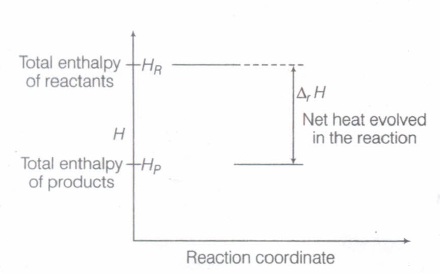
The above diagram represents ______.
enthalpy for exothermic reactions
enthalpy for endothermic reactions
entropy for exothermic reactions
entropy for endothermic reactions
31.
In the given reaction, \(\mathrm{Na}(s) \longrightarrow \mathrm{Na}(g)\) The enthalpy of atomisation is same as the ______.
enthalpy of dissociation
enthalpy of sublimation
enthalpy of association
enthalpy of vaporisation
32.
Which of the following statement is correct for the reaction?
\(
\mathrm{CaO}(s)+\mathrm{CO}_{2}(g) \longrightarrow \mathrm{CaCO}_{3}(s)
\Delta_{r} H^{\circ}=-178.3 \mathrm{~kJ} \mathrm{~mol}^{-1}
\)
\(\Delta_{r} H^{\circ} \text { is }\) is the enthalpy of formation of CaCO3
\(\Delta_{r} H^{\circ}\) is not the enthalpy of formation of CaCO3
\(\Delta_{r} H^{\circ}\)is the enthalpy of combustion of CaCO3
None of the above
33.
The enthalpy change when one mole of solute dissolves in a specified amount of solvent is called ______.
enthalpy of dilution
enthalpy of solution
enthalpy of association
enthalpy of dissociation
34.
For the reaction, \(\mathrm{NaCl}(s) \longrightarrow \mathrm{Na}^{+}(g)+\mathrm{Cl}^{-}(g)\) Identify the enthalpy involved in the above reaction ______.
enthalpy of hydration
lattice enthalpy
enthalpy of solution
enthalpy of dissociation
35.
Hess's law is based on ______.
law of conservation of mass
law of conservation of energy
law of active mass
Both (a) and (b)
36.
If the sublimation energy and enthalpy of fusion of I2 are 57.3 kJ mol-1 and 15.5kJ mol-1, respectively then, calculate the enthalpy of vaporisation of I2______.
\(-72.8 \mathrm{~kJ} \mathrm{~mol}^{-1}\)
\(72.8 \mathrm{~kJ} \mathrm{~mol}^{-1}\)
\(-41.8 \mathrm{~kJ} \mathrm{~mol}^{-1}\)
\(+41.8 \mathrm{~kJ} \mathrm{~mol}^{-1}\)
37.
For the given reaction, \(\mathrm{CH}_{4}(g)+2 \mathrm{O}_{2}(g) \longrightarrow \mathrm{CO}_{2}(g)+2 \mathrm{H}_{2} \mathrm{O}(l)\) the correct expression for \(\Delta_{r} H \text { is }\) ______.
\( {\left[H_{m}\left(\mathrm{CO}_{2}, g\right)+2 H_{m}\left(\mathrm{O}_{2}, g\right)\right]-\left[2 H_{m}\left(\mathrm{H}_{2} \mathrm{O}, l\right)\right.} \left.+H_{m}\left(\mathrm{CH}_{4}, g\right)\right] \)
\( {\left[2 H_{m}\left(\mathrm{O}_{2}, g\right)+H_{m}\left(\mathrm{CH}_{4}, g\right)\right]-\left[H_{m}\left(\mathrm{CO}_{2}, g\right)\right.} \left.+2 H_{m}\left(\mathrm{H}_{2} \mathrm{O}, l\right)\right] \)
\( {\left[H_{m}\left(\mathrm{CO}_{2}, g\right)+2 H_{m}\left(\mathrm{H}_{2} \mathrm{O}, l\right)\right]-\left[H_{m}\left(\mathrm{CH}_{4}, g\right)\right.} \left.+2 H_{m}\left(\mathrm{O}_{2}, g\right)\right] \)
\( {\left[H_{m}\left(\mathrm{CO}_{2}, g\right)+H_{m}\left(\mathrm{H}_{2} \mathrm{O}, l\right)\right]-\left[H_{m}\left(\mathrm{CH}_{4}, \mathrm{~g}\right)\right.} \left.+2 H_{m}\left(\mathrm{O}_{2}, g\right)\right] \)
38.
The enthalpies of elements in their standard states are taken as zero. The enthalpy of formation of a compound______.
is always negative
is always positive
may be positive or negative
is never negative
39.
The mathematical expression of first law of thermodynamics is ______.
\(\Delta U=q\)
\(\Delta U=W\)
\(\Delta U=q+W\)
\(\Delta U=W_{\mathrm{ad}}\)
40.
For the process to occur under adiabatic conditions, the correct condition is ______.
Δ T = 0
Δ p = 0
q = 0
w = 0
41.
Choose the correct answer. A thermodynamic state function is a quantity
used to determine heat changes
whose value is independent of path
used to determine pressure volume work
whose value depends on temperature only
42.
Thermodynamics is not concerned about ______.
energy changes involved in a chemical reaction
the extent to which a chemical reaction proceeds
the rate at which a reaction proceeds
the feasibility of a chemical reaction
43.
Which one is the correct unit for entropy?
KJ mol
JK-1 mol
JK-1 mol -1
KJ mol-1
44.
The process depicted by the equation.
H2O (s) \(\rightarrow\) H2O (l)
\(\Delta\)H = +1.43 kcal represents
fusion
melting
evaporation
boiling
45.
Which of the following always has a negative value?
heat of reaction
heat of solution
heat of combustion
heat of formation
46.
Which of the following relation is true?
Cp > cu
cu > Cp
Cp = Cu
Cp = C;u= 0
47.
Which of the following properties is not a function of state?
concentration
internal energy
enthalpy
entropy
48.
For a cyclic process, the change in internal energy of the system is ______.
always +ve
equal to zero
always -ve
none of the above
49.
An isochoric process takes place at constant ______.
temperature
pressure
volume
concentration
50.
Thermodynamics is applicable to ______.
macroscopic system only
microsopic system only
homogeneous system only
heterogeneous system only
51.
52.
53.
Assertion : A room can be cooled by opening the door of a refrigerator in a closed room.
Reason : Heat flows from lower temperature (refrigerator) to higher temperature (room).
Codes:
A) If both assertion and reason are true and the reason is the correct explanation of the assertion.
B) If both assertion and reason are true but reason is not the correct explanation of the assertion.
C) If assertion is true but reason is false.
D) If the assertion and reason both are false.
E) If assertion is false but reason is true.
54.
55.
56.
57.
58.
59.
60.
Assertion (A): In an isothermal process, the internal energy of an ideal gas remains unchanged.
Reason (R): Internal energy of an ideal gas depends only on temperature.
Codes:
(a) Both Assertion (A) and Reason (R) are true, and Reason (R) is the correct explanation of Assertion (A).
(b) Both Assertion (A) and Reason (R) are true, but Reason (R) is not the correct explanation of Assertion (A).
(c) Assertion (A) is true, but Reason (R) is false.
(d) Assertion (A) is false, but Reason (R) is true.
61.
62.
Assertion : The sum of q + w is a state function.
Reason : Work and heat are state functions.
Codes:
(a) Assertion and reason both are correct statements and reason is correct explanation for assertion.
(b) Assertion and reason both are correct statements but reason is not correct explanation for assertion.
(c) Assertion is correct statement but reason is wrong statement.
(d) Assertion is wrong statement but reason is correct statement.
63.
Assertion : Sublimation of the solid is nonspontaneous.
Reason : Sublimation is endothermic process.
Codes:
(a) Assertion and reason both are correct statements and reason is correct explanation for assertion.
(b) Assertion and reason both are correct statements but reason is not correct explanation for assertion.
(c) Assertion is correct statement but reason is wrong statement.
(d) Assertion is wrong statement but reason is correct statement.
64.
65.
Assertion : Decrease in free energy causes spontaneous reaction.
Reason : Spontaneous reactions are invariable exothermic reactions.
Codes:
(a) Assertion and reason both are correct statements and reason is correct explanation for assertion.
(b) Assertion and reason both are correct statements but reason is not correct explanation for assertion.
(c) Assertion is correct statement but reason is wrong statement.
(d) Assertion is wrong statement but reason is correct statement.
66.
67.
68.
Assertion: Combustion of all organic compounds is an exothermic reaction.
Reason: The enthalpies of all elements in their standard state are zero.
Codes:
(a) Both Assertion and Reason are true and Reason is the correct explanation of Assertion.
(b) Both Assertion and Reason are true but Reason is not the correct explanation of Assertion.
(c) Assertion is true but Reason is false.
(d) Both Assertion and Reason are false.
69.
Assertion: Heat capacity is the amount of heat required to raise the temperature of a body by 1 K.
Reason: Heat capacity is an extensive property and it depends upon the size of the body.
Codes:
(a) Both Assertion and Reason are true and Reason is the correct explanation of Assertion.
(b) Both Assertion and Reason are true but Reason is not the correct explanation of Assertion.
(c) Assertion is true but Reason is false.
(d) Both Assertion and Reason are false.
70.
Assertion: An isolated system is the one which can neither exchange matter nor energy with the surroundings.
Reason: It should be noted that every system is perfectly isolated.
Codes:
(a) Both Assertion and Reason are true and Reason is the correct explanation of Assertion.
(b) Both Assertion and Reason are true but Reason is not the correct explanation of Assertion.
(c) Assertion is true but Reason is false.
(d) Both Assertion and Reason are false.
1.
(b)
\(\mathrm{N}_{2}(g, 1 \mathrm{~atm}) \longrightarrow \mathrm{N}_{2}(g, 5 \mathrm{~atm})\)
2.
(c)
x > y
3.
(c)
The presence of reactants in a closed vessel made up of copper is an example of a closed system.
4.
(c)
-16.11 kJ
5.
(b)
-11.4 kJ
6.
(a)
Enthalpy
7.
(a)
qp will be negative
8.
(c)
x = y + z
9.
(b)
w (reversible) < w (irreversible)
10.
(b)
\( \mathrm{C}_{4} \mathrm{H}_{10}(g)+\frac{13}{2} \mathrm{O}_{2}(g) \longrightarrow 4 \mathrm{CO}_{2}(g)+5 \mathrm{H}_{2} \mathrm{O}(g) \Delta_{c} \mathbf{H}=-1329.0 \mathrm{~kJ} \mathrm{~mol}^{-1} \)
11.
(d)
increase four times
12.
(b)
-103 kJ
13.
(b)
\(\Delta \mathbf{S}_{\text {System }}>\mathbf{0}, \Delta \mathbf{S}_{\text {Surr }}>\mathbf{0} \)
14.
(b)
400 K
15.
(b)
ΔH < 0 and ΔS < 0
16.
(b)
All temperature
17.
(b)
- 506 J
18.
(d)
water vapour
19.
(a)
Born-Haber cycle
20.
(a)
-22 kcal mol-1
21.
(a)
83.14 J
22.
(d)
Both (a) and (c)
23.
(a)
\(\Delta U=0, \Delta S_{\text {total }} \neq 0\)
24.
(d)
All of the above
25.
(d)
20.15
26.
(c)
\(\Delta G^{\circ}=-2.303 R T \log K\)
27.
(b)
ΔG is positive for a spontaneous reaction
28.
(c)
\(\Delta S_{\text {total }}<0 \text { (spontaneous process) }\)
29.
(c)
ΔS (system) decreases but ΔS (surroundings) increases
30.
(a)
enthalpy for exothermic reactions
31.
(b)
enthalpy of sublimation
32.
(b)
\(\Delta_{r} H^{\circ}\) is not the enthalpy of formation of CaCO3
33.
(b)
enthalpy of solution
34.
(b)
lattice enthalpy
35.
(b)
law of conservation of energy
36.
(d)
\(+41.8 \mathrm{~kJ} \mathrm{~mol}^{-1}\)
37.
(c)
\( {\left[H_{m}\left(\mathrm{CO}_{2}, g\right)+2 H_{m}\left(\mathrm{H}_{2} \mathrm{O}, l\right)\right]-\left[H_{m}\left(\mathrm{CH}_{4}, g\right)\right.} \left.+2 H_{m}\left(\mathrm{O}_{2}, g\right)\right] \)
38.
(c)
may be positive or negative
39.
(c)
\(\Delta U=q+W\)
40.
(c)
q = 0
41.
(b)
whose value is independent of path
42.
(b)
the extent to which a chemical reaction proceeds
43.
(c)
JK-1 mol -1
44.
(a)
fusion
45.
(c)
heat of combustion
46.
(a)
Cp > cu
47.
(a)
concentration
48.
(b)
equal to zero
49.
(c)
volume
50.
(a)
macroscopic system only
51.
52.
ΔQ=0
. As,
ΔQ=ΔU+ΔW=0
Þ
ΔU=−ΔW
. Also in adiabatic process, temperature of gas changes.
53.
D) If the assertion and reason both are false.
Explanation:
When the door of refrigerator is kept open, heat rejected by the refrigerator to the room will be more than the heat taken by the refrigerator from the room (by an amount equal to work done by the compressor). Therefore, temperature of room will increase and so it will be warmed gradually. As according to 2nd law of thermodynamics, heat cannot be transferred on its own, from a body at lower temperature to another at higher temperature.
54.
55.
56.
57.
58.
59.
60.
(a) Both Assertion (A) and Reason (R) are true, and Reason (R) is the correct explanation of Assertion (A).
Explanation:
Since temperature is constant in an isothermal process, and internal energy U of an ideal gas depends only on temperature, ΔU=0.
61.
62.
(c) Assertion is correct statement but reason is wrong statement.
Explanation:
∆E = q + w Internal energy is a state function, but not q or w.
63.
(d) Assertion is wrong statement but reason is correct statement.
Explanation:
Sublimation of the solid is spontaneous due to increase in entropy.
64.
65.
(c) Assertion is correct statement but reason is wrong statement.
Explanation:
Exothermic reactions are spontaneous at low temperature but becomes non-spontaneous at high temperature.
66.
67.
68.
(b) Both Assertion and Reason are true but Reason is not the correct explanation of Assertion.
69.
(b) Both Assertion and Reason are true but Reason is not the correct explanation of Assertion.
70.
(c) Assertion is true but Reason is false.

11th Standard CBSE Syllabus & Materials
11th Standard CBSE
CBSE 11th Business Studies Forms of Business Organisation Sample Question Papers Study Material - QB365 Set A
NEW11th Standard CBSE
CBSE 11th Business Studies Business, Trade and Commerce Sample Question Papers Study Material - QB365 Set A
NEW11th Standard CBSE
CBSE 11th Physics Waves Sample Question Papers Study Material - QB365 Set A
NEW11th Standard CBSE
CBSE 11th Physics Kinetic Theory Sample Question Papers Study Material - QB365 Set A



NCERT Books

Syllabus

Exam Pattern

Sample Question Papers

Previous year Question Papers

Important Notes

MCQ Practice test

NCERT Exemplers

Case study Questions

Image Based Questions

Passage based Questions

HOT Questions

Value Based Questions

Model Questions Papers
NCERT ( Book Back ) Questions

Assertion and Reason
Important Questions And Answers

CBSE 11th Standard CBSE Subjects
CBSE Standards







