
 100% FREE ACCESS
11th Standard CBSE Syllabus & Materials
11th Standard CBSE
CBSE 11th Economics PART-A - Presentation of Data - New Sample Question Papers Study Material - QB365 Set A
NEW11th Standard CBSE
CBSE 11th Economics PART-A - Organisation of Data - New Sample Question Papers Study Material - QB365 Set A
NEW11th Standard CBSE
CBSE 11th Economics PART-A - Collection of Data - New Sample Question Papers Study Material - QB365 Set A
NEW11th Standard CBSE
CBSE 11th Economics PART-A - Introduction to Economics and Statistics - New Sample Question Papers Study Material - QB365 Set A
NEW11th Standard CBSE
CBSE 11th Business Studies International Trade Sample Question Papers Study Material - QB365 Set A
NEW11th Standard CBSE
CBSE 11th Business Studies Evolution and Fundamentals of Business Sample Question Papers Study Material - QB365 Set A

Published on: 21/10/2025
Download CBSE Class 11th Standard CBSE Chemistry question papers, sample papers, important questions, and previous year solved papers in PDF format. Get free study materials, NCERT solutions, and exam preparation resources for Class 11th Standard CBSE Chemistry
Questions + Answers key
Take MCQ Chemistry Test
1.
Explain, why Be2 molecule does not exist by using molecular orbital theory.
2.
Out of elements of Group 17, 18, I in the sequence placed in modem periodic table.
(i) Which elements have negative electron gain enthalpy.
(ii) Which elements have more metallic behaviour?
(iii) Which elements have zero electronic behaviour (zerovalent)?
3.
Account for the following
(a) HNO3 acts only as an oxidising agent while HNO2 can act both as reducing and oxidising agent.
(b) ClO4 - does not show disproportionation reaction.
(c) Ozone acts as an oxidising agent
4.
(i) Which orbitals are filled with electrons in third period?
(ii) Which of the lanthanoids is man-made element?
(iii) To which series do man-made elements belong?
5.
The first shell may contain up to 2 elements, the second up to8, the third shell up to 18, and the fourth shell up to 32.Explain this arrangement in terms of quantum numbers.
6.
Neon gas is generally used in signboards, If it emits strongly at 616 nm,(i) calculate energy of quantum (or photon).
(ii) calculate number of quanta present if it produces 2J of energy.
7.
A sample of NaNO3 weighing 0.38 g is placed in a 50.0 mL measuring flask. The flask is then filled with water up to the mark on the neck. What is the molarity of the solution?
8.
Give correct reason for the following:
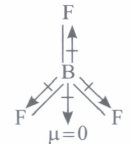
BF3 has a zero dipole moment although the B--F bonds are polar.
9.
Suggest a scheme of classification of the following redox reactions.
\(2 \mathrm{NO}_{2}(\mathrm{~g})+20 \mathrm{H}^{-}(\mathrm{aq}) \longrightarrow \mathrm{NO}_{2}^{-}(\mathrm{aq})+\mathrm{NO}_{3}^{-}(\mathrm{aq})+\mathrm{H}_{2} \mathrm{O}(\mathrm{l})\)
10.
Why air is not always regarded as homogeneous mixture?
11.
Predict the formulae of the stable binary compounds that would be formed by the combination of the following pairs of elements.
Silicon and oxygen
12.
The magnitude of charge on the electron is \(4.8\times { 10 }^{ -10 }\) esu. What is the charge on the nucleus of a helium atom?
13.
In acidic medium, dichromate ions oxidise ferrous sulphate to ferric sulphate and itself gets reduced to Cr3+ ions. Write a balanced equation to represent this redox reaction. (Use ion electron method).
14.
(a) How many σ and \(\pi\) bonds are present in CH2 = CH - C \(\equiv \) CH
(b) Why \({ H }_{ 2 }^{ - }\) is more stable than \({ H }_{ 2 }^{ - }\) ?
(c) Why is B2 molecule paramagnetic?
15.
PbO and PbO2 react with HCl according to following chemical equations
\(2PbO+4HCl\longrightarrow { 2PbCl }_{ 2 }+{ 2H }_{ 2 }O\\ { PbO }_{ 2 }+4HCl\longrightarrow { PbCl }_{ 2 }+{ Cl }_{ 2 }+{ 2H }_{ 2 }O\)
16.
On the basis of VSEPR theory, predict the shapes of the following
(a) \({ NH }_{ 2 }^{ - }\)
(b) O3
17.
Which of the following solution is strongest oxidising agent?
\(\mathbf{M n O}_{4}^{-} \text {in acidic medium }\)
\(\mathbf{M n} \mathbf{O}_{4}^{-} \text {in basic medium }\)
MnO2 in basic medium
\(\mathrm{CrO}_{4}^{2-} \text { in basic medium }\)
18.
In which of the following pairs, the two species are isostructural ______.
\( \mathrm{BrO}_{3}^{-} \text {and } \mathrm{XeO}_{3} \)
\(\mathrm{SF}_{4} \text { and } \mathrm{XeF}_{4} \)
\(\mathrm{SO}_{3}^{2-} \text { and } \mathrm{NO}_{3}^{-} \)
\( \mathrm{BF}_{3} \text { and } \mathrm{NF}_{3} \)
19.
Decreasing order of stability.
\( \mathbf{O}_{2}>\mathbf{0}_{2}^{+}>\mathbf{O}_{2}^{2-}>\mathbf{O}_{2}^{-} \)
\(\mathbf{O}_{2}^{-}>\mathbf{O}_{2}^{2-}>\mathbf{O}_{2}^{+}>\mathbf{O}_{2} \)
\(\mathbf{O}_{2}^{+}>\mathbf{O}_{2}>\mathbf{O}_{2}^{-}>\mathbf{O}_{2}^{2-} \)
\(\mathbf{O}_{2}^{2-}>\mathbf{O}_{2}^{-}>\mathbf{O}_{2}>\mathbf{O}_{2}^{+} \)
20.
Which of the following is not an example of redox reaction?
\(\mathrm{CuO}+\mathrm{H}_{2} \longrightarrow \mathrm{Cu}+\mathrm{H}_{2} \mathrm{O}\)
\(\mathrm{Fe}_{2} \mathrm{O}_{3}+3 \mathrm{CO} \longrightarrow 2 \mathrm{Fe}+3 \mathrm{CO}_{2}\)
\(2 \mathrm{~K}+\mathrm{F}_{2} \longrightarrow 2 \mathrm{KF}\)
\(\mathrm{BaCl}_{2}+\mathrm{H}_{2} \mathrm{SO}_{4} \longrightarrow \mathrm{BaSO}_{4}+2 \mathrm{HCl}\)
21.
Which of the following compounds is/are amphoteric in nature?
Cl2O7
Al2O3
As2O3
Both (b) and (c)
22.
If travelling at same speeds, which of the following matter waves have the shortest wavelength?
Electron
Alpha particle ( He2+)
Neutron
Proton
23.
The ionisation enthalpy of hydrogen atom is 1.312 x 10⁶ J mol-1. The energy required to excite the electron in the atoms from n1 = 1 to n2 = 2 is_______.
6.56 x 10⁵ J mol-1
9.84 x 10⁵ J mol-1
7.56 x 10⁵J mol-1
8.51 x 10⁵ J mol-1
24.
In the following reaction, \(\mathrm{MnO}_{2}+4 \mathrm{HCl} \longrightarrow \mathrm{MnCl}_{2}+2 \mathrm{H}_{2} \mathrm{O}+\mathrm{Cl}_{2}\) 2 moles of Mn02 react with 4 moles of HCl to form 11.2 LCl2 at STP. Thus, percent yield of Cl2 is _______.
25%
50%
100%
75%
25.
The highest ionization energy is exhibited by _____.
halogens
alkaline earth metals
transition metals
noble gases
26.
The empirical formula of sucrose is _______.
CH2O
CHO
C12H22 O11
C(H2 O)2
27.
Chemistry plays an important role in human needs for food, health care products, and improving life. Cis platin and taxol are used in chemotherapy, and AZT (Azidothymidine) is used for AIDS. SI units are international units of measurement. The matter is classified into elements, compounds, and mixtures, which can be homogeneous as well as heterogeneous. A mixture can be separated by physical methods, compounds can be separated by chemical methods only. Atomic mass is the average of masses of isotopes depending upon their natural abundance. The empirical formula is calculated with the help of the percentage composition of elements in a compound and molecular mass helps to calculate the molecular formula. A chemical equation must be balanced so as to follow the laws of chemical combination.
1.Which of the following are used in chemotherapy?
A) Taxol
B) AZT
C) Cis platin
D) A and C
E) A, B, and C
2.What are SI units?
A) Chemical formulas
B) Units of time
C) International units of measurement
D) Isotopes
3.How can a compound be separated?
A) Physical methods
B) Chemical methods
C) Both physical and chemical methods
D) None of the above
4.What does the atomic mass of an element represent?
A) Mass of a single atom
B) Mass of all isotopes combined
C) Average mass of isotopes based on natural abundance
D) Mass of the most common isotope
5.Which of the following statements is true regarding a chemical equation?
A) It does not need to be balanced
B) It must be balanced according to the laws of chemical combination
C) It represents only the physical states of the reactants
D) It includes only empirical formulas
28.
29.
30.
Assertion: Though the central atom of both NH3 and Hp molecules are Sp3 hybridized, yet H-N-H bond angle is greater than that of H-O-H.
Reason: This is because nitrogen atom has one lone pair and oxygen atom has two lone pairs.
Codes:
(a) Both Assertion and Reason are true and Reason is the correct explanation of Assertion.
(b) Both Assertion and Reason are true but Reason is not the correct explanation of Assertion.
(c) Assertion is true but Reason is false.
(d) Both Assertion and Reason are false.
31.
Assertion: Electron gain enthalpy becomes less negative as we go down a group.
Reason: Size of the atom increases on going down the group and the added electron would be farther from the nucleus.
Codes:
(a) Both Assertion and Reason are true and Reason is the correct explanation of Assertion.
(b) Both Assertion and Reason are true but Reason is not the correct explanation of Assertion.
(c) Assertion and Reason both are wrong statement.
(d) Assertion is wrong statement but Reason is correct statement.
32.
33.
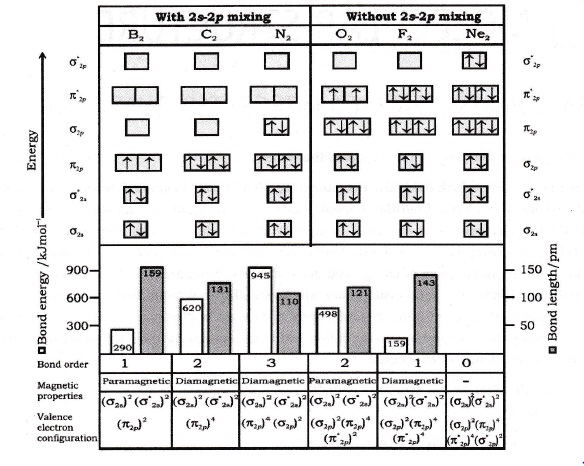
Table shows the molecular orbital occupancy and molecular properties for B2, C2, N2, O2, F2, and Ne2. Observe this figure and answer the questions based on this diagram and related studied concepts.
MO occupancy and molecular properties for B2 through Ne2.
(a) Why does bond enthalpy of N2 is higher than O2?
(b) Why is Ne2 not formed according to M.O. theory?
(c) Why F2 diamagnetic where as O2 paramagnetic?
(d) Arrange B2, C2, N2, O2, F2 in increasing order of stability. Give reason.
(e) Why is F2 more reactive than O2 ?
(f) Arrange B2, C2, N2, O2, F2 in increasing order of bond length.
(g) What is speciality of double bond in C2?
(h) How are C2 and Li2 molecules detected?
34.
An ionic compound has 3-D crystal lattice in which positive and negative charges are equal. The crystal lattice is stabilised by enthalpy of lattice formation, bond length, bond angle, bond enthalpy, bond order and bond polarity have significant effect on properties of compounds. All the properties of certain compounds cannot be explained by single structure, more than one structure of a compound to explain its property are called resonating structures.
Dipole moment depends upon polarity and shapes of molecules. Shapes of molecules can be determined by VSEPR theory as well as hybridisation sp, Sp2, Sp3, Sp3d, Sp3 d2 are linear, trigonal planar, tetrahedral, trigonal bipyramidal and octahedral geometery respectively. Hydrogen bond is formed between hydrogen and F, O, N. Intra-molecular H-bonding is within the molecules which is weaker than inter molecular H-bonding, between the molecules.
(a) Why does CO2 have zero dipole moment?
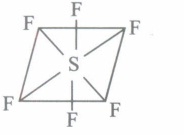
(b) What is hybridisation of 'S' in SF6 and its shape?
(c) Why do all bonds in \(\mathrm{CO}_{3}^{2-}\) have equal bond length?
(d) Why is o-nitropbenol steam volatile, p-nitropbenol is not?
(e) Wby is bond angle in H2 O is more tban H2 S?
(f) Why is bond \(\sigma\) stronger than \(\pi\)-bond?
(g) Arrange NaCl, NaBr, NaF. NaI in increasing order of ionic character.
35.
Study the table of electron gain enthalpies of some main group elements and answer the questions that follow based on table and related concepts.
| Group 1 | \(\Delta_{\mathrm{eg}} \mathbf{H}\) | Group 16 | \(\Delta_{\mathrm{eg}} \mathbf{H}\) | Group 17 | \(\Delta_{\mathrm{eg}} \mathbf{H}\) | Group 0 | \(\Delta_{\mathrm{eg}} \mathbf{H}\) |
| H | -73 | He | +48 | ||||
| Li | -60 | O | -141 | F | -328 | Ne | +116 |
| Na | -53 | S | -200 | CI | -349 | Ar | +96 |
| K | -48 | Se | -195 | Br | -325 | Kr | +96 |
| Rb | -47 | Te | -190 | I | -295 | Xe | +77 |
| Cs' | -46 | Po | -175 | At | -270 | Rn | +68 |
(a) Why do group 1 elements have low electron gain enthalpies?
(b) Why is electron gain enthalpy of sulphur more than oxygen?
(c) Why do noble gases have +ve electron gain enthalpies?
(d) Arrange P, S, CI, F is increasing order of electron gain enthalpeis.
36.
Stoichiometry is a section of chemistry that involves calculation based on chemical equations. Chemical equations are governed by laws of chemical combination. Mass of reactants is equal to mass of products. Compound obtained from different methods contain the same elements in the fixed ratio by mass. Mole is a counting unit, equal to 6.022 x 10²³ particles.
One mole is also equal to molar mass expressed in grams. One mole of every gas at STP has volume equal to 22.4 L. The reacting species which are consumed in the reaction completely is called limiting reagent which decides amount of products formed. Concentration of solution is expressed in terms of molarity, molality and mole fraction.
(a) Calculate number of moles of NH3 formed by reaction of 2 moles of N2 and 2 moles of H2.
\(\mathbf{N}_{2}(g)+3 \mathbf{H}_{2}(g) \longrightarrow 2 \mathrm{NH}_{3}(g)\)
(b) Calculate number of electrons in 18 g of H2 O. [Atomic number of H = 1 ,O = 8]
(c) Calculate the molality of 1 M NaCI solution having density 1.10 g cm-3. (Molar mass = 58.5 g mol-1)
(d) Define mole fraction.
(e) In aqueous solution of glucose Xglucose = 0.1, what is XH2O = ?
1.
Electronic configuration of Be = 1s2 2s2
M.O. configuration of Be2 = \((\sigma 1 s)^{2}\left(\sigma^{*} 1 s\right)^{2}(\sigma 2 s)^{2}\)\(
\left(\sigma^{*} 2 s\right)^{2}
\)
\(\text { Bond order of } \mathrm{Be}_{2}=\frac{1}{2}(4-4)=0
\)
Since bond order is zero it does not exist.
2.
(i) Group 17 elements (ns2np5) because they can gain electron easily.
(ii) Group 1 element (ns1) because they can lose electron easily.
(iii) Group 18 elements have stable electronic configuration. They cannot lose or gain electron.
3.
(a) The oxidation number of nitrogen in HNO3 is +5 thus increase in oxidation number +5 does not occur hence HNO3 cannot act as reducing agent but acts as an oxidising agent. In HNO2 oxidation number of nitrogen is +3, it can decrease or increase with range of -3 to +5, hence it can act as both oxidising and reducing agent.
(b) Chlorine is in maximum oxidation state +7 in CIO4 so it does not show the disproportionation reaction.
(c) Because it decomposes to give nascent oxygen.
4.
(i) In third period, 3s and 3p orbitals are filled.
(ii) Promethium (Pm) with atomic number 61 is a man-made lanthanoid.
(iii) Actinoid series (f-block elements).
5.
For the first shell \(l=2,{ m }_{ 1 }=-2,-1,0,+1,+2,{ m }_{ s }=\pm { 1 }/{ 2 }.-{ 1 }/{ 2 }\).it can have 2 electrons both with opposite spins.
\(For\quad n=2,\)
\( l=0,{ m }_{ l }=0,{ m }_{ s }=+{ 1 }/{ 2 },{ -1 }/{ 2 }\)
\( l=0,{ m }_{ 1 }=-1,0,+1,{ m }_{ s }=+{ 1 }/{ 2 },{ -1 }/{ 2 }.\)
\(Therefore, \ a \ total \ of \ 2+6=8 \ electrons \ are \ present\)
\(For\quad n=3,\quad when\)
\( l=0,{ m }_{ l }=0,{ m }_{ s }=+{ 1 }/{ 2 },{ -1 }/{ 2 }\)
\( l=0,{ m }_{ 1 }=-1,0,+1,{ m }_{ s }=+{ 1 }/{ 2 },{ -1 }/{ 2 }.\)
\( l=2,{ m }_{ 1 }=-2,-1,0,+1,+2,{ m }_{ s }=\pm { 1 }/{ 2 }.-{ 1 }/{ 2 }\)
\( Therefore,a \ total \ of \ 2+6+10=18 \ electrons \ are \ present.\)
\( For \ n=4,when\)
\(l=0,{ m }_{ 1 }=-1,0,+1,{ m }_{ s }=+{ 1 }/{ 2 },{ -1 }/{ 2 }.\)
\( l=0,{ m }_{ 1 }=-1,0,+1,{ m }_{ s }=+{ 1 }/{ 2 },{ -1 }/{ 2 }.\)
\(l=2,{ m }_{ 1 }=-2,-1,0,+1,+2,{ m }_{ s }=\pm { 1 }/{ 2 }.-{ 1 }/{ 2 }\)
\(l=3,{ m }_{ 1 }=-3,-2,-1,0,+1+2,+3,\)
\( { m }_{ s }=\pm { 1 }/{ 2,-{ 1 }/{ 2 } }\)
\(Therefore \ a \ total \ of \ 2+6+10+14=32 \ electrons \ are \ present.\)
6.
(i) Energy of quantum (or photon),
E = hv = 6.626 x10⁻³⁴ J s x 4.870 x 10¹⁴s-1
= 32.268 x 10⁻²⁰J
(ii) Number of quanta present = \(\frac { Total\ energy\ produced }{ Energy\ of\ 1\ quanta } \)
= \(\frac { 2J }{ 32.27\times10^{ -20 }J } \simeq \ 6.2x10^{ 18 }quanta\)
7.
Formula mass of \(\mathrm{NaNO}_3=23+14+48=85\)
\( 0.38 \mathrm{gNaNO}=23+14+48=85 \)
\( 0.38 \mathrm{gNaNO}=\frac{0.38}{85} \mathrm{~mol}=0.0045 \mathrm{~mol} \)
\( \text { Molarity of the solution }=\frac{0.0045 \mathrm{~mol}}{0.050 \mathrm{~L}}=0.090 \mathrm{M}
\)
8.
It is due to planar structure, individual dipoles get canceled.
9.
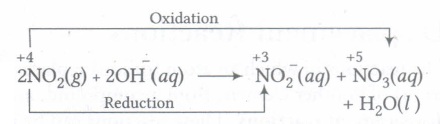
Since, in the above reaction, the same element undergoes oxidation as well as reduction, so it is an example of disproportionation reaction.
10.
This is due to the presence of dust particles.
11.
| Element | Group number | Electrons in valence shell | Valency | Formulae of binary compound |
| Group 14 | 4 | 4 | \({ SiO }_{ 2 }\) | |
| 6 | 8 - 6 = 2 |
12.
Helium nucleus contains 2 protons and charge of a proton is same as that of an electron.
Therefore, the charge on the nucleus of a helium atom is (+2)×4.8×10−10=+9.6×10⁻¹⁰ esu
13.
The equation for the given reaction is
\(\mathrm{Cr}_{2} \mathrm{O}_{7}^{2-}(a q)+\mathrm{FeSO}_{4}+\underset{\begin{array}{l} \text { Shows acidic } \\ \text { medium } \end{array}}{\longrightarrow}\) Cr3+ +Fe2(SO4)3
Balancing of this equation by ion electron method involves the following steps.
Step I Converting unbalanced equation into ionic form It can be achieved by splitting the ionic compounds into constituent ions and by cancelling spectator ions.
\( \mathrm{Cr}_{2} \mathrm{O}_{7}^{2-}(a q)+\mathrm{Fe}^{2+}(a q)+\mathrm{SO}_{4}^{2-}(a q)+\mathrm{H}^{+}(a q) \longrightarrow \mathrm{Cr}^{3+}(a q)+\mathrm{Fe}^{3+}(a q)+\mathrm{SO}_{4}^{2-}(a q) \)
Here \(\mathrm{SO}_{4}^{2-}\) is the spectator ion so after leaving it, the reaction becomes
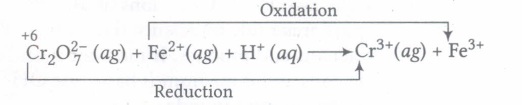
Step II Splitting the equation into two halves
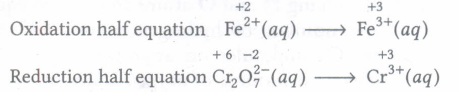
Step III Balancing all elements other than H and O
Here, oxidation half reaction is already balanced with respect to Fe atoms but to balance reduction half reaction, we have to multiply the Cr3+ by 2.
\(\mathrm{Cr}_{2} \mathrm{O}_{7}^{2-}(a q) \longrightarrow 2 \mathrm{Cr}^{3+}(a q)\)
Step IV Balancing H and O-atoms In oxidation half reaction, there is no need to balance H and a atoms, as in it these are not present. In reduction half reaction, we have to add 7H2O towards product side to balance a-atoms and then add 14H+ towards reactant side to balance H-atoms.
\(\mathrm{Cr}_{2} \mathrm{O}_{7}^{2-}+\underset{\underset{\mathrm{o}}{\mathrm{H}} \text { balance }}{14 \mathrm{H}^{+}} \longrightarrow 2 \mathrm{Cr}^{3+}+\underset{\begin{array}{l} \text { to balance } \\ \text { O-atoms } \end{array}}{7 \mathrm{H}_{2} \mathrm{O}}\)
Step V Balancing of charge
(i) \(\underset{+2}{\mathrm{Fe}}^{2+} \longrightarrow \underset{+3}{\mathrm{Fe}^{3+}}\)
So, we have to add one electron towards Fe3+ side.
Thus, \(\mathrm{Fe}^{2+} \longrightarrow \mathrm{Fe}^{3+}+e^{-}\)
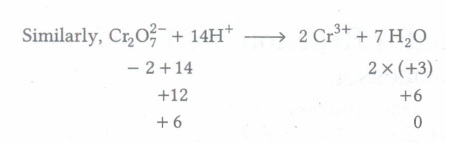
So, we have to add 6e- towards the reactant side.
\(\mathrm{Cr}_{2} \mathrm{O}_{7}^{2-}+14 \mathrm{H}^{+}+6 e^{-} \longrightarrow 2 \mathrm{Cr}^{3+}+7 \mathrm{H}_{2} \mathrm{O}\)
(ii) \(\left[\mathrm{Fe}^{2+} \longrightarrow \mathrm{Fe}^{3+}+e^{-}\right] \times 6 \text { to }\) equalise number of electrons.
Step VI Adding the half reactions On adding the half reaction, we get the overall balanced equation.
\( 6 \mathrm{Fe}^{2+}(a q)+\mathrm{Cr}_{2} \mathrm{O}_{7}^{2-}(a q)+14 \mathrm{H}^{+}(a q) \longrightarrow 6 \mathrm{Fe}^{3+}(a q)+2 \mathrm{Cr}^{3+}(a q)+7 \mathrm{H}_{2} \mathrm{O}(l) \)
Step VII Verification of balanced equation Since, the number of atoms of each element are equal on both the sides, so it is a balanced chemical equation.
Further; \( 6 \mathrm{Fe}^{2+}(a q)+\mathrm{Cr}_{2} \mathrm{O}_{7}^{2-}(a q)+14 \mathrm{H}^{+}(a q) \longrightarrow \mathrm 6 {Fe}^{3+}(a q)+2 \mathrm{Cr}^{3+}(a q)+7 \mathrm{H}_{2} \mathrm{O}(l) \)
6 x ( + 2)+ (- 2) + 14 (+ 1)\(\equiv\) 6 x ( + 3) + 2 x ( + 3) 12 - 2 + 14 \(\equiv\) 18 + 6 \(\Rightarrow\) 24 = 24
Thus, the equation is also balanced with respect to charge.
Step VIII Conversion of ionic equation into molecular form As we know \(\mathrm{SO}_{4}^{2-} \) is the spectator ion, and there are 6 \(\mathrm{Fe}^{2+}\) (Which require 6 \(\mathrm{SO}_{4}^{2-} \) ions) and 14H+ions (that require 7 \(\mathrm{SO}_{4}^{2-} \)ions), so, we have to add 13 \(\mathrm{SO}_{4}^{2-} \) ions on both the sides.
\(6 \mathrm{Fe}^{2+}(a q)+6 \mathrm{SO}_{4}^{2-}(a q)+\mathrm{Cr}_{2} \mathrm{O}_{7}^{2-}(a q)+14 \mathrm{H}^{+}(a q)\) \( =+7 \mathrm{SO}_{4}^{2-}(a q) \longrightarrow 6 \mathrm{Fe}^{3+}(a q)+9 \mathrm{SO}_{4}^{2-}(a q) +2 \mathrm{Cr}^{3+}+3 \mathrm{SO}_{4}^{2-}(a q)+7 \mathrm{H}_{2} \mathrm{O}+\mathrm{SO}_{4}^{2-} \)
\( \text { or } 6 \mathrm{FeSO}_{4}+\mathrm{Cr}_{2} \mathrm{O}_{7}^{2-}(a q)+7 \mathrm{H}_{2} \mathrm{SO}_{4} \longrightarrow 3 \mathrm{Fe}_{2}\left(\mathrm{SO}_{4}\right)_{3}+\mathrm{Cr}_{2}\left(\mathrm{SO}_{4}\right)_{3}+7 \mathrm{H}_{2} \mathrm{O}+\mathrm{SO}_{4}^{2-} \)
14.
(a) No. of σ bonds = 7
No. of \(\pi\) bonds = 3
(b) Both the ions have the same bond order (0.5) but they differ in their configuration.
\({ H }_{ 2 }^{ + }\) ion = [ σls]1,
\({ H }_{ 2 }^{ - }\) ion = [ σ1s]2 [ σ x = s]1
Since, \({ H }_{ 2 }^{ - }\) ion has an electron in the antibonding molecular orbital, it is therefore less stable.
The molecular orbital configuration of B2 is given
B2: [σ1s]2 [σ*1s]2 [σ2s]2 [σ*2s]2 [\(\pi\)2px]1[\(\pi\) x 2py]1
Since, B2 has two unpaired electrons, it is paramagnetic
15.
Writing the oxidation number of each element above its symbol in the following reactions
\(\overset { +2-2 }{ \underset { Basic \ oxide }{ 2PbO } } +\overset { +1-1 }{ \underset { Acid }{ 4HCl } } \longrightarrow \overset { +2-1 }{ 2Pb{ Cl }_{ 2 } } +\overset { +1 }{ { 2H }_{ 2 } } \overset { -2 }{ O } \)
In this reaction, oxidation number of each element remains same hence, it is not a redox reaction. In fact, it is an example of acid-base reaction .
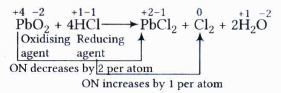
\(\overset { +4 }{ Pb } \overset { -2 }{ { O }_{ 2 } } +\overset { +1-1 }{ 4HCl } \longrightarrow \overset { +2 }{ Pb } \overset { -1 }{ { Cl }_{ 2 } } +\overset { 0 }{ { Cl }_{ 2 } } +\overset { +1 }{ { 2H }_{ 2 } } \overset { -2 }{ O } \)
In PbO2 Pb is in +4 oxidation state than +4 Pb in +2 oxidation state is more stable. So, Pb in +4 oxidation state (PbO2 ) acts as an oxidising agent.
It oxidises Cl- and Cl2 and itself gets reduced to Pb2+
16.
(i) Shape of \({ NH }_{ 2 }^{ - }\)
Number of valence electrons on central N atom = 5 + 1 (due to one unit negative charge)
Number of atoms linked to it = 2
Total number of electron pairs around
\(N=\frac { 6+2 }{ 2 } =4\) and number of bond pairs = 2
Number of lone pairs = 4 - 2 = 2. Thus, the ion is of the type AB2E2. Hence, it has bent shape (V-shape).
(ii) Shape of O3
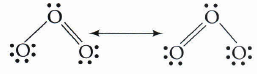
While predicting geometry of molecules containing the double (or multiple) bond is considered as one electron pair. e.g. in case of ozone, its two resonating structures are

Thus, the central O-atom is considered to have two bond pairs and one lone pair, i.e. it is of the type AB2 E. Hence, it is a bent molecule. Thus, the two reasonating structures will be
17.
(b)
\(\mathbf{M n} \mathbf{O}_{4}^{-} \text {in basic medium }\)
18.
(a)
\( \mathrm{BrO}_{3}^{-} \text {and } \mathrm{XeO}_{3} \)
19.
(c)
\(\mathbf{O}_{2}^{+}>\mathbf{O}_{2}>\mathbf{O}_{2}^{-}>\mathbf{O}_{2}^{2-} \)
20.
(d)
\(\mathrm{BaCl}_{2}+\mathrm{H}_{2} \mathrm{SO}_{4} \longrightarrow \mathrm{BaSO}_{4}+2 \mathrm{HCl}\)
21.
(d)
Both (b) and (c)
22.
(b)
Alpha particle ( He2+)
23.
(b)
9.84 x 10⁵ J mol-1
24.
(b)
50%
25.
(b)
alkaline earth metals
26.
(c)
C12H22 O11
27.
1. D) A and C
2. C) International units of measurement
3. B) Chemical methods
4. C) Average mass of isotopes based on natural abundance
5. B) It must be balanced according to the laws of chemical combination
28.
29.
30.
(a) Both Assertion and Reason are true and Reason is the correct explanation of Assertion.
31.
(d) Assertion is wrong statement but Reason is correct statement.
32.
33.
(a) It is because \((\mathrm{N} \equiv \mathrm{N})\) , N2 has triple bond which has higher bond dissociation enthalpy than \(\mathrm{O}_{2}(\mathrm{O}=\mathrm{O})\) which has double bond.
(b) It is because its bond order is zero.
\(\text { B.O. }=\frac{1}{2}\left(N_{b}-N_{a}\right)=\frac{1}{2}(10-10)=0\)
(c) It is because F2 does not have unpaired electron whereas O2 has unpaired electron.
(d) F2< B2 < O2 < C2 < N2. Higher the bond order, more is stability, more is bond dissociation enthalpy.
(e) It is because F2 has lower bond dissociation enthalpy than O2.
(f)
| N2 | < | O2 | < | C2 | < | F2 | < | B2 |
| 110 | 121 | 131 | 145 | 159 pm. |
(g) The double bond in C2 consist of both \(\pi\) bonds because of the presence of four electrons in two \(\pi\) molecular orbitals.
(e) C2 and Li2 molecules are detected only in vapour phase.
34.
(a) It is linear molecule, dipoles are equal and opposite, net dipole moment is zero.\(\mathrm{O} \stackrel{\leftrightarrow}{=} \mathrm{C} \stackrel{\leftrightarrow}{=} 0\)
(b) In SF6,'S' has sp3d2 hybridisation, octahedral shape.
(c) It is due to resonance.
(d) It is because o-nitrophenol has weak intra molecular H-bonds, where as p-nitrophenol has little stronger inter molecular H-bonds.
(e) 'S' is bigger in size, less electronegative than O.
(f) In \(\sigma\) bond extent of overlapping is more than \(\pi\)-bond.
(g) NaI < NaBr < NaCl < NaF.
35.
(a) It is because they have large size, least effective nuclear charge and electropositive elements.
(b) It is due to inter electronic repulsion in 'O' due to exceptionally small size than 'S', therefore, less energy is released on gaining electron.
(c) It is because they have stable electronic configuration and energy is needed to overcome repulsion between valence electrons and electron to be added.
(d) P < S < F < Cl.
36.
(a) 1 mole of N2 needs 3 moles of H2 ,
Therefore, 2 moles of N2 needs 6 moles of H2 .
But we have only 2 moles of H2 , so H2 is limiting reagent.
3 moles of H2 gives 2 moles of NH2.
2 moles of H2 gives \(\frac{2}{3} \times 2=1.33\) moles of NH3 .
(b) 18 g of water (1 mole) containing 10 x 6.022 x 1023 electrons = 6.022 x 1024 electrons.
[ \(\because\)1 molecule of H2O = 2 + 8 = 10 e)
(c) 'M is molarity
'd is density of solution
'm' is molality
\(m=\frac{M \times 1000}{1000 \times d-M \times \text { Molar mass }}\)
\(=\frac{1 \times 1000}{1000 \times 1.10-1 \times 58.5}\)
\(=\frac{1000}{1100-58.5}=\frac{1000}{1041.5}=m=0.96 \mathrm{~mol} / \mathrm{kg} .\)
(d) It is ratio of number of moles of solute (component) to the total number of moles of solute and solvent (all components).
(e) Xglucose + xH2O = 1
\(\Rightarrow\) XH2O = 1 - 0.1 = 0.9

11th Standard CBSE Syllabus & Materials
11th Standard CBSE
CBSE 11th Business Studies Forms of Business Organisation Sample Question Papers Study Material - QB365 Set A
NEW11th Standard CBSE
CBSE 11th Business Studies Business, Trade and Commerce Sample Question Papers Study Material - QB365 Set A
NEW11th Standard CBSE
CBSE 11th Physics Waves Sample Question Papers Study Material - QB365 Set A
NEW11th Standard CBSE
CBSE 11th Physics Kinetic Theory Sample Question Papers Study Material - QB365 Set A



NCERT Books

Syllabus

Exam Pattern

Sample Question Papers

Previous year Question Papers

Important Notes

MCQ Practice test

NCERT Exemplers

Case study Questions

Image Based Questions

Passage based Questions

HOT Questions

Value Based Questions

Model Questions Papers
NCERT ( Book Back ) Questions

Assertion and Reason
Important Questions And Answers

CBSE 11th Standard CBSE Subjects
CBSE Standards







