
 100% FREE ACCESS
11th Standard CBSE Syllabus & Materials
11th Standard CBSE
CBSE 11th Economics PART-A - Presentation of Data - New Sample Question Papers Study Material - QB365 Set A
NEW11th Standard CBSE
CBSE 11th Economics PART-A - Organisation of Data - New Sample Question Papers Study Material - QB365 Set A
NEW11th Standard CBSE
CBSE 11th Economics PART-A - Collection of Data - New Sample Question Papers Study Material - QB365 Set A
NEW11th Standard CBSE
CBSE 11th Economics PART-A - Introduction to Economics and Statistics - New Sample Question Papers Study Material - QB365 Set A
NEW11th Standard CBSE
CBSE 11th Business Studies International Trade Sample Question Papers Study Material - QB365 Set A
NEW11th Standard CBSE
CBSE 11th Business Studies Evolution and Fundamentals of Business Sample Question Papers Study Material - QB365 Set A

Published on: 21/10/2025
Download CBSE Class 11th Standard CBSE Chemistry question papers, sample papers, important questions, and previous year solved papers in PDF format. Get free study materials, NCERT solutions, and exam preparation resources for Class 11th Standard CBSE Chemistry
Questions + Answers key
Take MCQ Chemistry Test
1.
What is the oxldanon number of Sin Na2S4O6 and Na2SO3?
2.
What is a redox couple?
3.
Balance thefollowing redox reactions by ion-electron method - H2O2(aq) +Fe2+ (aq) \(\rightarrow\)Mn2+(aq) + \(HS{ O }_{ 4 }^{ - }\)
4.
Suggest a scheme of classification of the following redox reactions :
(a) N2 (g) + O2 (g) → 2 NO (g)
(b) 2Pb(NO3) 2(s) → 2PbO(s) + 4 NO2 (g) + O2 (g)
(c) NaH(s) + H2O(l) → NaOH(aq) + H2 (g)
(d) 2NO2(g) + 2OH– (aq) → NO2 – (aq) + NO3 – (aq)+H2O(l)
5.
Why is anode called oxidation electrode, whereas cathode is called reduction electrode?
6.
Find the value of n in 4MnO4-+8H+ +ne- \(\rightarrow\) Mn2+ +4H2O
7.
Balance the following equation by the oxidation number method.
\({ Fe }^{ 2+ }+{ H }^{ + }+{ Cr }_{ 2 }{ O }_{ 7 }^{ -2 }\longrightarrow { Cr }^{ 3+ }+{ Fe }^{ 3+ }+{ H }_{ 2 }O\)
8.
Write the net ionic equation for the reaction of potassium dichromate(VI),K2Cr 207 with sodium sulphite,Na2So3, in an acid solution to give chromium(III) ion and the sulphate ion.
9.
Balance the equation:
\(\mathbf{H}^{+}+\mathbf{M n O}_{4}^{-}+\mathbf{F e}^{2+} \longrightarrow \mathbf{F e}^{3+}+\mathbf{M n}^{2+}+\mathbf{H}_{2} \mathbf{O}\) (Acidic medium)
10.
Write correctly the balanced equations for the following redox reactions using half reactions.
\(\mathrm{I}^{-}+\mathrm{O}_{2}(g)+\mathrm{H}_{2} \mathrm{O} \longrightarrow \mathrm{I}_{2}+\mathrm{OH}^{-}\)
11.
(a) Give two important functions of salt bridge.
(b) Balance the following equation by oxidation number method
Fe2+ + Cr2\({ O }_{ 7 }^{ 2- }\) + H+ \(\rightarrow\) Fe3+ + Cr3+ + H2O
12.
Depict the galvanic cell in which the reaction, Zn(s) + 2Ag+aq) \(\rightarrow\) Zn2+(aq) + 2Ag(s) takes place, Further show:
(i) which of the electrode is negatively charged,
(ii) the carriers of the current in the cell, and
(iii) individual reaction at each electrode.
13.
Which of the following statement(s) is/are not true about the following decomposition reaction.
\(2 \mathrm{KClO}_{3} \longrightarrow 2 \mathrm{KCl}+3 \mathrm{O}_{2}\)
Potassium is undergoing oxidation
Chlorine is undergoing oxidation
Oxygen is reduced
None of the species are undergoing oxidation or reduction
14.
\(x \mathbf{K M n O}_{4}+\mathbf{N H}_{3} \longrightarrow y \mathbf{K N O}_{3}+\mathbf{M n O}_{2}+\mathbf{K O H}+\mathbf{H}_{2} \mathbf{O}\)______.
x = 4, Y = 6
x = 8, y = 6
x = 3, y = 8
x = 8, y = 3
15.
Solution of potassium chloride or ammonium nitrate in salt-bridge usually solidified by boiling with ______.
agar-agar
starch
cellulose
glycogen
16.
In Daniell cell, electrons flow from ______.
cathode to anode
anode to cathode
copper to zinc
\(\mathrm{SO}_{4}^{2-} \text { to } \mathrm{Cu}^{2+}\)
17.
In the reaction between copper nitrate solution and zinc, copper ions are reduced by gaining electrons from ______.
copper
nitrogen
zinc
oxygen
18.
In the given reaction, 2Na + S \(\rightarrow\) 7 Na2S, sulphur is ______.
oxidised
reduced
reducing agent
None of these
19.
Which of the following are not redox reactions?
Mg + N2 \(\rightarrow\) Mg3N2
K4[Fe (CN)6] + H2S04 + H20 \(\rightarrow\) K2S04 + CO + FeS04 + (NH4)2S04
\({ S }_{ 2 }{ O }_{ 3 }^{ 2- }\longrightarrow S{ O }_{ 4 }^{ 2- }+S\)
\(AgCl+{ NH }_{ 3 }\longrightarrow [Ag\left( { NH }_{ 3 } \right) 2]Cl\)
20.
The oxidation number of carbon 'is zero in ______.
HCHO
CH2Cl2
C12H22O11
All the above
1.
N2S4O6;
+ 2 + 4x - 12 = 0
4x = 10
x = +2,5
Na2SO3
+ 2 + x - 6 = 0
x = +4

The middle'S' atoms have zero oxidation number and other two'S' atoms have +5 each
Average oxiIdan on number is \(\frac{5+5}{4}\)=2.5
2.
A redox couple consists of oxidised and reduced form of the same substance taking part in the oxidation or reduction half reaction.
3.
Oxidation half equation Fe2+ (aq)\(\rightarrow\)Fe3+(aq) + e-.......(i)
Reduction half equation : H2O2 (aq) + 2H+(aq) + 2e- \(\rightarrow\) 2H2O(l)......(ii)
Multiply Eq, (i) 2 and add it to Eq. (ii), we have
H2O2(aq) + 2Fe2+ (aq) + 2H+ (aq) \(\rightarrow\) 2F3+ (aq) + 2H2O(l)
4.
A) In the given reaction, the compound nitric oxide is formed by the combination of the elemental substances, nitrogen and oxygen. Therefore, this is an example of combination redox reaction
B) The given reaction involves the breaking down of lead nitrate into three components. Therefore, this is categorized under Decomposition redox reaction
C) Hydrogen of water has been displaced by hydride ion into dihydrogen gas. Therefore, this may be called as Displacement redox reaction.
D) This reaction involves disproportion of NO2 (+4 state) into NO−2 (+3 state) and NO−3 (+5 state). Therefore, this reaction is an example of disproportion redox reaction.
5.
At the anode, loss of electrodes takes place, ie. oxidation takes place, whereas cathode, a gain of electrodes takes place, ie. reduction takes place.Therefore, the cathode is called reduction electrode and anode is called oxidation electrode.
6.
4MnO4-+8H+ +ne- → Mn2+ +4H2O
-1 + 8 + n = +2
-1 - 2+ 8 + n = 0
n = - 5 or 5e-
7.
Oxidation number method
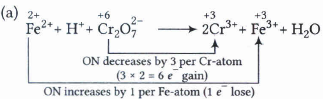
(Multiply Cr3+ by 2 because there are 2Cr atoms in \({ Cr }_{ 2 }{ O }_{ 7 }^{ 2- }\)ion).
Balance increase and decrease in oxidation number
\({ 6Fe }^{ 2+ }+{ H }^{ + }+{ Cr }_{ 2 }{ O }_{ 7 }^{ 2- }\longrightarrow { 2Cr }^{ 3+ }+{ 6Fe }^{ 3+ }+{ H }_{ 2 }O\)
Balance charge by multiplying H+ by 14.
\({ 6Fe }^{ 2+ }+{ 14H }^{ + }+{ Cr }_{ 2 }{ O }_{ 7 }^{ 2- }\longrightarrow { 2Cr }^{ 3+ }+{ 6Fe }^{ 3+ }+{ H }_{ 2 }O\)
Balance H and O-atoms by multiplying H2O by 7.
\({ 6Fe }^{ 2+ }+{ 14H }^{ + }+{ Cr }_{ 2 }{ O }_{ 7 }^{ 2- }\longrightarrow { 2Cr }^{ 3+ }+{ 6Fe }^{ 3+ }+{ 7H }_{ 2 }O\)
This represents a balanced redox reaction.
8.
Step I : The skeletal ionic equation is:
eg. \(C{ r }_{ 2 }{ O }_{ 7 }^{ 2- }(aq)+{ SO }_{ 3 }^{ 2- }(aq)\longrightarrow { Cr }^{ 3+ }(aq)+{ SO }_{ 4 }^{ 2- }(aq)\)
Step II : Assign oxidation numbers for Cr and S
\(\overset { +6 }{ C{ r }_{ 2 } } \overset { -2 }{ { O }_{ 7 }^{ 2- } } (aq)+\overset { +4-2 }{ { SO }_{ 3 }^{ 2- } } (aq)\longrightarrow \overset { +3 }{ { Cr }^{ 3+ } } (aq)+\overset { +6 }{ S } \overset { -2 }{ { O }_{ 4 }^{ 2- }(aq) } \)
This indicates that the dichromate ion is the oxidant and the sulphite ion is the reductant.
Step 3 : Calculate the increase and decrease of oxidation number, and make them equal: from step-2 we can notice that there is change in oxidation state of chromium and sulphur. Oxidation state of chromium changes form +6 to +3. There is decrease of +3 in oxidation state of chromium on right hand side of the equation. Oxidation state of sulphur changes from +4 to +6. There is an increase of +2 in the oxidation state of sulphur on right hand side. To make the increase and decrease of oxidation state equal, place numeral 2 before cromium ion on right hand side and numeral 3 before sulphate ion on right hand side and balance the chromium and sulphur atoms on both the sides of the equation. Thus we get
+6 -2 +4 -2 +3 +6 -2
\(Cr_{ 2 }O_{ 7 }^{ 2- }(aq)+{ 3SO }_{ 3 }^{ 2- }(aq)\longrightarrow 2Cr^{ 3+ }(aq)+3{ SO }_{ 4 }^{ 2- }(aq)\)
Step 4: As the reaction occurs in the acidic medium, and further the ionic charges are not equal on both the sides, add 8H+ on the left to make ionic charges equal
\(Cr_{ 2 }O_{ 7 }^{ 2- }(aq)+{ 3SO }_{ 3 }^{ 2- }(aq)\longrightarrow 2Cr^{ 3+ }(aq)+3{ SO }_{ 4 }^{ 2- }(aq)\)
Step 5: Finally, count the hydrogen atoms, and add appropriate number of water molecules (i.e., 4H2O) on the right to achieve balanced redox change.
\(Cr_{ 2 }O_{ 7 }^{ 2- }(aq)+{ 3SO }_{ 3 }^{ 2- }(aq)+{ 8H }^{ + }(aq)\longrightarrow 2C{ r }^{ 3+ }(aq)+{ 3SO }_{ 3 }^{ 2- }(aq)+4{ H }_{ 2 }O\)
9.
\(\begin{array}{r} \mathrm{H}^{+}+\mathrm{MnO}_{4}^{-}+\mathrm{Fe}^{2+} \longrightarrow \mathrm{Fe}^{3+}+\mathrm{Mn}^{2+}+\mathrm{H}_{2} \mathrm{O} {[\text { Acidic medium }]} \\ \mathrm{MnO}_{4}^{-} \longrightarrow \mathrm{Mn}^{2+} \\ 5 \mathrm{e}^{-}+8 \mathrm{H}^{+}+\mathrm{MnO}_{4}^{-} \longrightarrow \mathrm{Mn}^{2+}+4 \mathrm{H}_{2} \mathrm{O} \quad \ldots(i) \\ {\left[\mathrm{Fe}^{2+} \longrightarrow \mathrm{Fe}^{3+}+\mathrm{e}\right] \times 5 \quad \ldots(i i)} \\ \hline 8 \mathrm{H}^{+}+5 \mathrm{Fe}^{2+}+\mathrm{MnO}_{4}^{-} \longrightarrow 5 \mathrm{Fe}^{3+}+\mathrm{Mn}^{2+}+4 \mathrm{H}_{2} \mathrm{O} \end{array}\)
10.
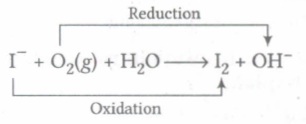
Here, I- is oxidised to I2 and O2(g) is reduced to OH-.
\(4 \mathrm{I}+\mathrm{O}_{2}(\mathrm{~g})+2 \mathrm{H}_{2} \mathrm{O} \longrightarrow 4 \mathrm{OH}^{-}+2 \mathrm{I}_{2}\)
11.
a) (i) It completes the internal circuit.
(ii) It maintains the electrical neutrality
b) Fe2+ + Cr2\({ O }_{ 7 }^{ 2- }\) + H+ \(\rightarrow\) Fe3+ + Cr3+ + H2O
.png)
12.
The given redox reaction is Zn(S) + 2Ag+ (aq) \(\rightarrow\) Zn2+ (aq) + 2Ag(s)
Since Zn gets oxidised to Zn2+ ions, and Ag + gets reduced to Ag metal, therefore,oxidation occurs at the zinc electrode and reduction occurs at the silver electrode. Thus, galvanic cell corresponding to the above redox reaction may be depicted as:
Zn|Zn2+ (aq) || ag+ (aq)| Ag
(i) Since oxidation occurs at the zinc electrode, therefore, electrons accumulate on the zinc electrode and hence, zinc electrode is negatively charged.
(ii) The ions carry current. The electrons flow from Zn to Ag electrode while the current flows from Ag to Zn electrode.
(iii) The reactions occurring at the two electrodes are
Zn(s) \(\rightarrow\) Zn2+ (aq) + 2e-
Ag+ (aq) \(\rightarrow\) + e- Ag(s)
13.
(a)
Potassium is undergoing oxidation
14.
(d)
x = 8, y = 3
15.
(a)
agar-agar
16.
(b)
anode to cathode
17.
(c)
zinc
18.
(b)
reduced
19.
(d)
\(AgCl+{ NH }_{ 3 }\longrightarrow [Ag\left( { NH }_{ 3 } \right) 2]Cl\)
20.
(d)
All the above

11th Standard CBSE Syllabus & Materials
11th Standard CBSE
CBSE 11th Business Studies Forms of Business Organisation Sample Question Papers Study Material - QB365 Set A
NEW11th Standard CBSE
CBSE 11th Business Studies Business, Trade and Commerce Sample Question Papers Study Material - QB365 Set A
NEW11th Standard CBSE
CBSE 11th Physics Waves Sample Question Papers Study Material - QB365 Set A
NEW11th Standard CBSE
CBSE 11th Physics Kinetic Theory Sample Question Papers Study Material - QB365 Set A



NCERT Books

Syllabus

Exam Pattern

Sample Question Papers

Previous year Question Papers

Important Notes

MCQ Practice test

NCERT Exemplers

Case study Questions

Image Based Questions

Passage based Questions

HOT Questions

Value Based Questions

Model Questions Papers
NCERT ( Book Back ) Questions

Assertion and Reason
Important Questions And Answers

CBSE 11th Standard CBSE Subjects
CBSE Standards







