
 100% FREE ACCESS
11th Standard CBSE Syllabus & Materials
11th Standard CBSE
CBSE 11th Economics PART-A - Presentation of Data - New Sample Question Papers Study Material - QB365 Set A
NEW11th Standard CBSE
CBSE 11th Economics PART-A - Organisation of Data - New Sample Question Papers Study Material - QB365 Set A
NEW11th Standard CBSE
CBSE 11th Economics PART-A - Collection of Data - New Sample Question Papers Study Material - QB365 Set A
NEW11th Standard CBSE
CBSE 11th Economics PART-A - Introduction to Economics and Statistics - New Sample Question Papers Study Material - QB365 Set A
NEW11th Standard CBSE
CBSE 11th Business Studies International Trade Sample Question Papers Study Material - QB365 Set A
NEW11th Standard CBSE
CBSE 11th Business Studies Evolution and Fundamentals of Business Sample Question Papers Study Material - QB365 Set A

Published on: 21/10/2025
Download CBSE Class 11th Standard CBSE Chemistry question papers, sample papers, important questions, and previous year solved papers in PDF format. Get free study materials, NCERT solutions, and exam preparation resources for Class 11th Standard CBSE Chemistry
Questions + Answers key
Take MCQ Chemistry Test
1.
Derive the structure of (i) 2-Chlorohexane, (ii) Pent-4-en-2-ol, (iii) 3- Nitrocyclohexene, (iv) Cyclohex-2-en-1-ol, (v) 6-Hydroxyheptanal.
2.
Discuss the factors that influence the magnitude of ionization enthalpy. What are the general trends of variation of ionization enthalpy in the periodic table? Explain.
3.
In a reaction A + B2 → AB2 Identify the limiting reagent, if any, in the following reaction mixtures.
(i) 300 atoms of A + 200 molecules of B
(ii) 2 mol A + 3 mol B
(iii) 100 atoms of A + 100 molecules of B
(iv) 5 mol A + 2.5 mol B
(v) 2.5 mol A + 5 mol B
4.
How many significant figures are present in the following?
(i) 0.0025
(ii) 208
(iii) 5005
(iv) 126,000
(v) 500.0
(vi) 2.0034
5.
(a) What do you understand by Homolytic fission?
(b) What are carbanions? Give an example.
6.
(i) Write the electronic configurations of the following ions: (a) H– (b) Na+ (c) O2– (d) F–
(ii) What are the atomic numbers of elements whose outermost electrons are represented by (a) 3s1 (b) 2p3 and (c) 3p5 ?
(iii) Which atoms are indicated by the following configurations ? (a) \([He]2s^{ 1 }\) (b) \([Ne]3s^{ 2 }3p^{ 3 }\) (c) \([Ar]4s^{ 2 }3d^{ 1 }\)
7.
How would you justify the presence of 18 elements in the 5th period of the Periodic Table?
8.
What are the atomic numbers of elements whose outermost electrons are represented by
a) 3s2
b) 2p3
c) 3p5 ?
9.
Which of the following are isoelectronic species i.e., those having the same number of electrons?
Na+,K+,Mg2+,Ca2+,S2-,Ar
10.
Determine the molecular formula of an oxide of iron, in which the mass per cent of iron and oxygen are 69.9 and 30.1, respectively.
11.
A compound contains 4.07% hydrogen, 24.27% carbon and 71.65% chlorine. Its molar mass is 98.96 g. What are its empirical and molecular formulas?
12.
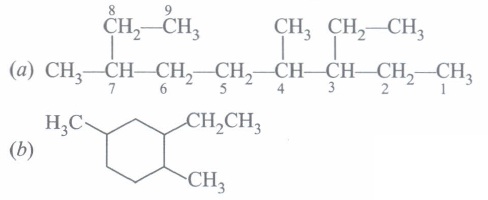
Give IUPAC name of the following:
13.
State the Modern Periodic Law.
14.
How many σ and π bonds are present in each of the following molecules?
(a) HC≡CCH=CHCH3
(b) CH2=C=CHCH3
15.
Name the species that will be isoelectronic with the following atoms or ions
(i) Na
(ii) Cl-
(iii) Ca2+
(iv) Rb+
16.
What is the basic difference in approach between the Mendeleev’s Periodic Law and the Modern Periodic Law?
17.
What is the difference between atomic mass and mass number?
18.
Considering the elements B, C, N, F, and Si, the correct order of their non-metallic character is :
B > C > Si > N > F
Si > C > B > N > F
F > N > C > B > Si
F > N > C > Si > B
19.
Which one of the following statements is incorrect in relation to ionization enthalpy?
Ionization enthalpy increases for each successive electron.
The greatest increase in ionization enthalpy is experienced on removal of electron from core noble gas configuration.
End of valence electrons is marked by a big jump in ionization enthalpy.
Removal of electron from orbitals bearing lower n value is easier than from orbital having higher n value.
20.
Anything that influences the valence electrons will affect the chemistry of the element. Which one of the following factors does not affect the valence shell?
Valence principal quantum number (n)
Nuclear charge (Z)
Nuclear mass
Number of core electrons
21.
Which of the following is a homo cyclic alicyclic compound?


22.
If the bond distance in chlorine molecule (Cl2 ) is 198 pm, then the radius of chlorine is ______.
198 pm
49.5 pm
99 pm
24.75 pm
23.
The elements in which electrons are progressively filled in 4f-orbital are called______.
actinoids
transition elements
lanthanoids
halogens
24.
The number of radial nodes for 3p orbital is ______
3
4
2
1
25.
Total number of orbitals associated with third shell will be ______
2
4
9
3
26.
The hybridization state of a carbocation is ______.
Sp4
sp3
sp2
sp
27.
The orbital with n = 3 and 1 = 2 is _______.
3s
3p
3d
3j
28.
de Broglie equation is _______.
\(\lambda =\frac { h }{ mv } \)
\(\lambda =\frac { hv }{ m } \)
\(\lambda =\frac { mv }{ h } \)
\(\lambda =hmv\)
29.
The best and latest technique for isolation, purification and separation of organic compounds is _______.
Crystallisation
Distillation
Sublimation
Chromatography.
30.
In the Lassaigne’s test for nitrogen in an organic compound, the Prussian blue colour is obtained due to the formation of: ______.
Na4[Fe(CN)6]
Fe4[Fe(CN)6]3
Fe2[Fe(CN)6]
Fe3[Fe(CN)6]4
31.
Diagonal relationships are shown by _____.
Be and Al
Mg and Al
Li and Mg
Band P
32.
The highest ionization energy is exhibited by _____.
halogens
alkaline earth metals
transition metals
noble gases
33.
One mole of CO2 contains _______.
6.02 x 10²³atoms of C
3 g of CO2
6.02 x 10²³atoms of O
18.1 x 10²³ molecules of CO2
34.
Observe the group shown in figure and answer the questions that follow based on the graph and related studied concepts.
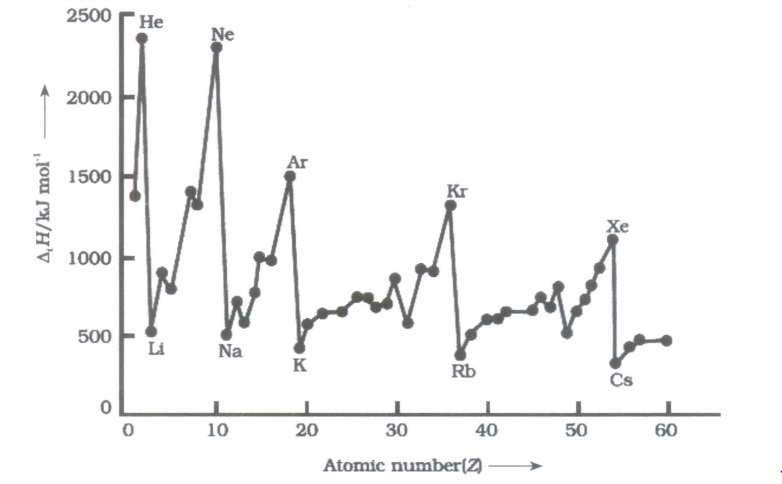
(a) Which group elements have lowest ionisation enthalpy and why?
(b) Which group element have highest ionisation enthalpy and why?
(c) Why is ionisation enthalpy of Be more than B?
(d) Why does 'N' have higher ionisation enthalpy than O?
35.
Stoichiometry is a section of chemistry that involves calculation based on chemical equations. Chemical equations are governed by laws of chemical combination. Mass of reactants is equal to mass of products. Compound obtained from different methods contain the same elements in the fixed ratio by mass. Mole is a counting unit, equal to 6.022 x 10²³ particles.
One mole is also equal to molar mass expressed in grams. One mole of every gas at STP has volume equal to 22.4 L. The reacting species which are consumed in the reaction completely is called limiting reagent which decides amount of products formed. Concentration of solution is expressed in terms of molarity, molality and mole fraction.
(a) Calculate number of moles of NH3 formed by reaction of 2 moles of N2 and 2 moles of H2.
\(\mathbf{N}_{2}(g)+3 \mathbf{H}_{2}(g) \longrightarrow 2 \mathrm{NH}_{3}(g)\)
(b) Calculate number of electrons in 18 g of H2 O. [Atomic number of H = 1 ,O = 8]
(c) Calculate the molality of 1 M NaCI solution having density 1.10 g cm-3. (Molar mass = 58.5 g mol-1)
(d) Define mole fraction.
(e) In aqueous solution of glucose Xglucose = 0.1, what is XH2O = ?
1.
(i) ‘hexane’ indicates the presence of 6 carbon atoms in the chain. The functional group chloro is present at carbon 2. Hence, the structure of the compound is CH3CH2CH2CH2CH(Cl)CH3.
(ii) ‘pent’ indicates that parent hydrocarbon contains 5 carbon atoms in the chain. ‘en’ and ‘ol’ correspond to the functional groups C=C and -OH at carbon atoms 4 and 2 respectively. Thus, the structure is CH2 = CHCH2CH (OH)CH3
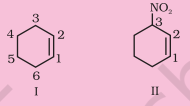
(iii) Six membered ring containing a carbon-carbon double bond is implied by cyclohexene, which is numbered as shown in (I). The prefix 3-nitro means that a nitro group is present on C-3. Thus, complete structural formula of the compound is (II). Double bond is suffixed functional group whereas NO2 is prefixed functional group therefore double bond gets preference over –NO2 group:
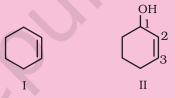
(iv) ‘1-ol’ means that a -OH group is present at C-1. OH is suffixed functional group and gets preference over C=C bond. Thus the structure is as shown in (II):
(v) ‘heptanal’ indicates the compound to be an aldehyde containing 7 carbon atoms in the parent chain. The ‘6-hydroxy’ indicates that -OH group is present at carbon 6. Thus, the structural formula of the compound is:CH3CH(OH)CH2CH2CH2CH2CHO. Carbon atom of –CHO group is included while numbering the carbon chain.
2.
Factors affecting Ionization enthalpy.
(i) Atomic size. With the increase in atomic size, the number of electron shells increases and thus the force of attraction between the electrons and the nucleus decreases. Therefore the ionization enthalpy decreases.
(ii) Nuclear charge. As the nuclear charge increases the attraction for the electron also increases that's why ionization enthalpy increases.
(iii) Screening or shielding effect. In a multi-electron atom, the electron present in the inner shells shield the electrons in the valence shell as a result these electrons experience less attraction from the nucleus. This leads to lesser ionization enthalpy.
Variation along a period. On moving from left to right in a period the nuclear charge increases and the atomic size decreases as a result ionization enthalpies are expected to increase.
Variation within a group. On moving down the group as the atomic size of the elements increases that's why ionization enthalpy decreases down the group
3.
A limiting reagent determines the extent of a reaction. It is the reactant which is the first to get consumed during a reaction, thereby causing the reaction to stop and limiting the amount of products formed.
(i) According to the given reaction, 1 atom of A reacts with 1 molecule of B. Thus, 200 molecules of B will react with 200 atoms of A, thereby leaving 100 atoms of A unused. Hence, B is the limiting reagent.
(ii) According to the reaction, 1 mol of A reacts with 1 mol of B. Thus, 2 mol of A will react with only 2 mol of B. As a result, 1 mol of B will not be consumed. Hence, A is the limiting reagent.
(iii) According to the given reaction, 1 atom of A combines with 1 molecule of B. Thus, all 100 atoms of A will combine with all 100 molecules of B. Hence, the mixture is stoichiometric where no limiting reagent is present.
(iv) 1 mol of atom A combines with 1 mol of molecule B. Thus, 2.5 mol of B will combine with only 2.5 mol of A. As a result, 2.5 mol of A will be left as such. Hence, B is the limiting reagent.
(v) According to the reaction, 1 mol of atom A combines with 1 mol of molecule B. Thus, 2.5 mol of A will combine with only 2.5 mol of B and the remaining 2.5 mol of B will be left as such. Hence, A is the limiting reagent.
4.
Significant figures are meaningful digits which are known with certainty plus one which is estimated or uncertain. The uncertainty is indicated by writing the certain digits and the last uncertain digit.
There are certain rules for determining the number of significant figures. These are stated below:
1. All non-zero digits in a number are significant
2. The zeros between two non-zero digits are always significant
3. The zeros written to the left of the first non-zero digit in a number are non-significant. They simply indicate the position of the decimal point.
4. All zeros placed to the right of a decimal point in a number are significant.
(i) 0.0025 - There are 2 significant figures.
(ii) 208 - There are 3 significant figures.
(iii) 5005 - There are 4 significant figures.
(iv) 126,000 - There are 3 significant figures.
(v) 500.0 - There are 4 significant figures.
(vi) 2.0034 - There are 5 significant figures.
5.
Homolytic fission is breaking of a bond in such a manner that each atom takes one electron each to form free radicals.
\(A-B\longrightarrow A.+B\)
(b) Organic ions which contain a negatively charged carbon atom are called carbanions. e.g., \(\overset { \ominus }{ { CH }_{ 3 } } \) is carbanion.
6.
(i) a) 1H = 1s1, H- = 1s2
b) 11Na = 1s22s2, 2p6, 3s1, Na+ = 1s22s22p6
c) 8O = 1s22s2, 2p2, 2p4, O2- = 1s22s22p6
d) 9F = 1s22s2,2p5, F- = 1s22s22p6.
(ii) To obtain an atomic number of an element fill the orbitals in order of their increasing energies up to the given orbital configuration.
a) 1s22s2, 2p6, 3s2 (Z = 12)
b) 1s22s2, 2p3 (Z = 7)
c) 1s22s2, 2p6, 3s2,3p5 (Z = 17).
(iii) a) [He]2s1 represents 3Li (lithium)
b) [Ne] 3s23p3 represents 15P (phosphorus)
c) [Ar]4s23d1 represent 21Sc (scandium)
7.
When n = 5, l = 0, 1, 2, 3. The order in which the energy of the available orbitals 4d, 5s and 5p increases is 5s < 4d < 5p. The total number of orbitals available are 9. The maximum number of electrons that can be accommodated is 18; and therefore 18 elements are there in the 5th period.
8.
To obtain an atomic number of an element fill the orbitals in order of their increasing energies up to the given orbital configuration.
a) 1s22s2, 2p6, 3s2 (Z = 12)
b) 1s22s2, 2p3 (Z = 7)
c) 1s22s2, 2p6, 3s2,3p5 (Z = 17).
9.
Isoelectronic species have the same number of electrons but different atomic numbers. Number of positive charge shows the number of electrons lost and number of negative charges shows the number of electrons gained by an atom. Calculation of number of electrons have been shown below.
\(_{ 11 }Na^{ + }=11-1=10{ e }^{ - }, \ _{ 19 }K^{ + }=19-1=18{ e }^{ - },\)
\(_{ 12 }Na^{ 2+ }=12-2=10{ e }^{ - }, \ _{ 20 }Na^{ 2+ }=20-2=18{ e }^{ - },\)
\(_{ 16 }S^{ 2- }=16+2=18{ e }^{ - }, \ _{ 18 }Ar=18{ e }^{ - }\)
Hence, isoelectronic species are
\(Na^{ + }and \ Mg^{ 2+ } \ { k }^{ + },{ Ca }^{ 2+ },{ s }^{ 2- } \ and \ Ar\)
10.
Since 69.9% and 30.1% of iron and oxygen are present in 100 grams of iron oxide.
Step I - Calculation of number of moles
Number of moles of iron present in 100 gram of iron oxide\( =\frac{\text{ weight in grams (iron)}}{\text{molecular weight of iron}} =\frac{69.9}{55.8}\)=1.25mole
Number of moles of oxygen present in 100 gram of iron oxide \(= \frac{\text{weight in grams (oxygen) }}{ \text{molecular weight of oxygen}}=\frac{30.1}{16}\)=1.88moles
Step II - Calculation of ratio of number of moles of iron to number of moles of oxygen
Ratio of iron to oxygen \(=\frac{ 1.25}{1.88} = \frac{1}{1.5}\)
On multiplying the given ration with 2 we get 2/3
Hence the empirical formula of iron oxide is Fe2O3
Step III - Calculation of n
Emphirical formula = Fe2O3 = (2 x 55.85) + (3 x 16.00) = 159.7 g mol-1
Molar mass of Fe2O3=159.69
n = \(\frac{molar mass}{ emphirical formula mass } \) = \(\frac{159.8}{159.7}\) = 1
11.
Step 1. Conversion of mass per cent to grams : Since we are having mass per cent, it is convenient to use 100 g of the compound as the starting material. Thus, in the 100 g sample of the above compound, 4.07g hydrogen, 24.27g carbon and 71.65g chlorine are present.
Step 2. Convert into number moles of each element : Divide the masses obtained above by respective atomic masses of various elements. This gives the number of moles of constituent elements in the compound
Moles of hydrogen = \(\frac{4.07 \mathrm{~g}}{1.008 \mathrm{~g}}=4.04\)
Moles of carbon = \(\frac{24.27 \mathrm{~g}}{12.01 \mathrm{~g}}=2.021\)
Moles of chlorine = \(\frac{71.65 \mathrm{~g}}{35.453 \mathrm{~g}}=2.021\)
Step 3. Divide each of the mole values obtained above by the smallest number amongst them : Since 2.021 is smallest value, division by it gives a ratio of 2:1:1 for H:C:Cl. In case the ratios are not whole numbers, then they may be converted into whole number by multiplying by the suitable coefficient.
Step 4. Write down the empirical formula by mentioning the numbers after writing the symbols of respective elements : CH2Cl is, thus, the empirical formula of the above compound.
Step 5. Writing molecular formula : (a) Determine empirical formula mass by adding the atomic masses of various atoms present in the empirical formula.
For CH2Cl, empirical formula mass is
12.01 + (2 x 1.008) + 35.453
= 49.48 g
(b) Divide Molar mass by empirical formula mass
\(\frac{\text { Molar mass }}{\text { Empirical formula mass }}=\frac{98.96 \mathrm{~g}}{49.48 \mathrm{~g}}\)
= 2 = (n)
(c) Multiply empirical formula by n obtained above to get the molecular formula
Empirical formula = CH2Cl, n = 2. Hence molecular formula is C2H4Cl2.
12.
(a) 3-Ethyl-4,7-dimethyl nonane
(b) 1-Ethyl-2, 5-dimethyl cyclohexane
13.
Modem Periodic Law states that physical and chemical properties of the elements are a periodic function of their atomic numbers.
14.
(a) σC – C: 4; σC–H : 6; πC=C :1; π C≡C:2
(b) σC – C: 3; σC–H: 6; πC=C: 2.
15.
Isoelectronic species are those which have same number of electrons.
(i) Na has 10 electrons.Therefore, the species
N3-, O2-, F-, Mg2+, Al3+ etc., each of which has also 10 electrons and hence, isoelectronic with it
(ii) Cl- has 18 electrons. Therefore, the species P3-, S2-, Ar, K+ and Ca2+, each one of which contains 18 electrons and hence , isoelectronic with it.
(iii) Ca2+ has 18 electrons. Therefore, the species P3-, S2-, Ar and K+, each of which also contains 18 electrons and hence, isoelectronic with it.
(iv) Rb+ has 36 electrons. Therefore, the species Br-, Kr or Sr2+ each of which also has 36 electrons and hence, isoelectronic with it.
16.
Mendeleev's periodic law : It states that the properties of the elements are a periodic function of their atomic weights
Modern periodic law : It states that the properties of the elements are a periodic function of their atomic numbers. Thus, change in the base of classification of elements from atomic weight to atomic number is the basic difference between Mendeleev's periodic law and the modern periodic law.
17.
Mass number is a whole number because it is the sum of the number of protons and number of neutrons whereas atomic mass is fractional because it is the average relative mass.
18.
In a period, the non-metallic character increases from left to right. Thus, among B, C, Nand F, non-metallic character decreases in the order: F > N> C> B. However, within a group, non-metallic character decreases from top to bottom. Thus, C is more non-metallic than Si. Therefore, the correct sequence of decreasing non-metallic character is: F> N> C> B > Si, i.e., option (c) is correct.
19.
(d)
Removal of electron from orbitals bearing lower n value is easier than from orbital having higher n value.
20.
(c)
Nuclear mass
21.
(b)
22.
(a)
198 pm
23.
(c)
lanthanoids
24.
(d)
1
25.
(c)
9
26.
(c)
sp2
27.
(c)
3d
28.
(a)
\(\lambda =\frac { h }{ mv } \)
29.
(d)
Chromatography.
30.
(b)
Fe4[Fe(CN)6]3
31.
(c)
Li and Mg
32.
(b)
alkaline earth metals
33.
(a)
6.02 x 10²³atoms of C
34.
(a) Group 1 because they have largest atomic size.
(b) Group 18 because they have stable electronic configuration.
(c) Be(1s2 2s2). It is because 'Be' has completely filled s-orbital which is more stable therefore, needs higher energy to remove electrons than B(1s2 2s2 2p1).
(d) It is because 'N' has half filled orbital which is more stable and more energy is needed to remove electron in 'N' than O.
35.
(a) 1 mole of N2 needs 3 moles of H2 ,
Therefore, 2 moles of N2 needs 6 moles of H2 .
But we have only 2 moles of H2 , so H2 is limiting reagent.
3 moles of H2 gives 2 moles of NH2.
2 moles of H2 gives \(\frac{2}{3} \times 2=1.33\) moles of NH3 .
(b) 18 g of water (1 mole) containing 10 x 6.022 x 1023 electrons = 6.022 x 1024 electrons.
[ \(\because\)1 molecule of H2O = 2 + 8 = 10 e)
(c) 'M is molarity
'd is density of solution
'm' is molality
\(m=\frac{M \times 1000}{1000 \times d-M \times \text { Molar mass }}\)
\(=\frac{1 \times 1000}{1000 \times 1.10-1 \times 58.5}\)
\(=\frac{1000}{1100-58.5}=\frac{1000}{1041.5}=m=0.96 \mathrm{~mol} / \mathrm{kg} .\)
(d) It is ratio of number of moles of solute (component) to the total number of moles of solute and solvent (all components).
(e) Xglucose + xH2O = 1
\(\Rightarrow\) XH2O = 1 - 0.1 = 0.9

11th Standard CBSE Syllabus & Materials
11th Standard CBSE
CBSE 11th Business Studies Forms of Business Organisation Sample Question Papers Study Material - QB365 Set A
NEW11th Standard CBSE
CBSE 11th Business Studies Business, Trade and Commerce Sample Question Papers Study Material - QB365 Set A
NEW11th Standard CBSE
CBSE 11th Physics Waves Sample Question Papers Study Material - QB365 Set A
NEW11th Standard CBSE
CBSE 11th Physics Kinetic Theory Sample Question Papers Study Material - QB365 Set A



NCERT Books

Syllabus

Exam Pattern

Sample Question Papers

Previous year Question Papers

Important Notes

MCQ Practice test

NCERT Exemplers

Case study Questions

Image Based Questions

Passage based Questions

HOT Questions

Value Based Questions

Model Questions Papers
NCERT ( Book Back ) Questions

Assertion and Reason
Important Questions And Answers

CBSE 11th Standard CBSE Subjects
CBSE Standards







