
 100% FREE ACCESS
11th Standard CBSE Syllabus & Materials
11th Standard CBSE
CBSE 11th Economics PART-A - Presentation of Data - New Sample Question Papers Study Material - QB365 Set A
NEW11th Standard CBSE
CBSE 11th Economics PART-A - Organisation of Data - New Sample Question Papers Study Material - QB365 Set A
NEW11th Standard CBSE
CBSE 11th Economics PART-A - Collection of Data - New Sample Question Papers Study Material - QB365 Set A
NEW11th Standard CBSE
CBSE 11th Economics PART-A - Introduction to Economics and Statistics - New Sample Question Papers Study Material - QB365 Set A
NEW11th Standard CBSE
CBSE 11th Business Studies International Trade Sample Question Papers Study Material - QB365 Set A
NEW11th Standard CBSE
CBSE 11th Business Studies Evolution and Fundamentals of Business Sample Question Papers Study Material - QB365 Set A

Published on: 21/10/2025
Download CBSE Class 11th Standard CBSE Chemistry question papers, sample papers, important questions, and previous year solved papers in PDF format. Get free study materials, NCERT solutions, and exam preparation resources for Class 11th Standard CBSE Chemistry
Questions + Answers key
Take MCQ Chemistry Test
1.
Anything that influences the valence electrons will affect the chemistry of the element. Which one of the following factors does not affect the valence shell?
Valence principal quantum number (n)
Nuclear charge (Z)
Nuclear mass
Number of core electrons
2.
Which of the following electrodes will act as anodes, when connected to Standard Hydrogen Electrode?
\(\mathrm{Al} / \mathrm{Al}^{3+} \ \ \mathrm{E}^{\ominus}=-1.66 \)
\(\mathrm{Fe} / \mathrm{Fe}^{2+} \ \mathrm{E}^{\ominus}=-0.44\)
\(\mathrm{Cu} / \mathrm{Cu}^{2+} \ \mathrm{E}^{\Theta}=+0.34 \)
\( \mathrm{F}_{2}(\mathrm{~g}) / 2 \mathrm{~F}^{-}(a q) \ \mathrm{E}^{\Theta}=+2.87\)
3.
Identify the correct statements with reference to the given reaction
\(\mathrm{P}_{4}+3 \mathrm{OH}^{-}+3 \mathrm{H}_{2} \mathrm{O} \longrightarrow \mathrm{PH}_{3}+3 \mathrm{H}_{2} \mathrm{PO}_{2}^{-}\)
Phosphorus is undergoing reduction only.
Phosphorus is undergoing oxidation only
Phosphorus is undergoing oxidation as well as reduction.
Hydrogen is undergoing neither oxidation nor reduction.
4.
The more positive the value of EO, the greater is the tendency of the species to get reduced. Using the standard electrode potential of redox couples given below find out which of the following is the strongest oxidising agent.
Eo values:
\(
\mathrm{Fe}^{3+} / \mathrm{Fe}^{2+}=+0.77 ; \mathrm{I}_{2}(\mathrm{~s}) / \mathrm{I}=+0.54
\)
\(\mathrm{Cu}^{2+} / \mathrm{Cu}=+0.34 ; \mathrm{Ag}^{+} / \mathrm{Ag}=+0.80 \mathrm{~V}
\)
\( \mathrm{Fe}^{3+} \)
\(\mathrm{I}_{2}(\mathrm{~s}) \)
\(\mathrm{Cu}^{2+} \)
\(\mathrm{Ag}^{+} \)
5.
Which of the following is not a redox reaction?
\( \mathrm{CaCO}_{3} \longrightarrow \mathrm{CaO}+\mathrm{CO}_{2} \)
\(2 \mathrm{H}_{2}+\mathrm{O}_{2} \longrightarrow 2 \mathrm{H}_{2} \mathrm{O} \)
\(2 \mathrm{Na}+2 \mathrm{H}_{2} \mathrm{O} \longrightarrow 2 \mathrm{NaOH}+\mathrm{H}_{2} \)
\(\mathrm{MnCl}_{3} \longrightarrow \mathrm{MnCl}_{2}+\frac{1}{2} \mathrm{Cl}_{2} \)
6.
Which of the following metal displacement reaction will not take place and why?
\(\mathbf{C u}+\mathbf{M g}^{2+} \longrightarrow \)
\( \mathrm{Mg}+\mathrm{Cu}^{2+} \longrightarrow \)
\(\mathbf{P b}+\mathbf{A g}^{+} \longrightarrow \)
\( \mathrm{Zn}+\mathrm{Cu}^{2+} \longrightarrow\)
7.
Standard reduction frotential of X, Y, Z are -1.2 v, + 0.5 v, -3.0 v respectively, the reducing power of the metals will be ______.
Y > Z > X
Y > X > Z
Z > X > Y
X > Y > Z
8.
The oxidation state of Cr in CrO5 is ______.
+10
+5
+6
+3
9.
Which of the following solution is strongest oxidising agent?
\(\mathbf{M n O}_{4}^{-} \text {in acidic medium }\)
\(\mathbf{M n} \mathbf{O}_{4}^{-} \text {in basic medium }\)
MnO2 in basic medium
\(\mathrm{CrO}_{4}^{2-} \text { in basic medium }\)
10.
The statement that is not correct for periodic classification of elements is:
The properties of elements are periodic function of their atomic numbers.
Non metallic elements are less in number than metallic elements.
For transition elements, the 3d-orbitals are filled with electrons after 3p-orbitals and before 4s-orbitals.
The first ionisation enthalpies of elements generally increase with increase in atomic number as we go along a period.
11.
Which of the following statements are correct?
Helium has the highest first ionisation enthalpy in the periodic table.
Chlorine has less negative electron gain enthalpy than fluorine.
Mercury and bromine are liquids at room temperature.
In any period, atomic radius of alkali metal is the highest.
12.
The electronegativities of C, N, Si and P are in order of ______.
Si < P < C < N
Si < P < N < C
P < Si < N < C
P < Si < C < N
13.
Which elements is expected to have lowest ionisation enthalpy?
Sr
As
Xe
S
14.
In the p3-, S2- and CI- ions, the increasing order of size is ______.
CI-, S2-, P3-
P3-, S2-, CI-
S2-, CI-, P3-
S2-, P3-, CI-
15.
Which of the following sets of quantum numbers are correct?
n = 1
l = 1
ml = +2
n = 2
l = 1
ml = +1
n = 3
l = 2
ml = -2
n = 3
l = 4
ml = -2
16.
Out of the following pairs of electrons, identify the pairs of electrons present in degenerate orbitals: _______.
\((i) n=3, l=2, m_{l}=-2, m_{s}=-\frac{1}{2} \)
\((ii) n=3, l=2, m_{l}=-1, m_{s}=-\frac{1}{2}\)
\((i) n=3, l=1, m_{l}=1, m_{s}=+\frac{1}{2} \)
\((ii) n=3, l=2, m_{l}=1, m_{s}=+\frac{1}{2}\)
\((i) n=4, l=1, m_{l}=1, m_{s}=+\frac{1}{2} \)
\((ii) n=3, l=2, m_{l} \doteq 1, m_{s}=+\frac{1}{2}\)
\((i) n=3, l=2, m_{l}=+2, m_{s}=-\frac{1}{2} \)
\((ii) n=3, l=2, m_{l}=+2, m_{s}=+\frac{1}{2}\)
17.
Which of the following is wrong statement?
The uncertainty principle is \(\Delta x . \Delta v \geq \frac{h}{4 \pi} \text { . }\)
Half filled and fully filled orbitals have greater stability due to greater exchange energy, greater symmetry and more balanced arrangement
The energy of 2s orbital is less than the energy of 2p-orbitals in case of hydrogen like atoms.
de Broglie wavelength, \(\lambda=\frac{h}{2 \pi} .\)
18.
Which of the following statements concerning the quantum numbers are correct?
Angular quantum number determines the three dimensional shape of the orbital.
The principal quantum number determines the orientation and energy of the orbital.
Magnetic quantum number determines the size of the orbital.
Spin quantum number of an electron determines the orientation of the spin of electron relative to the chosen axis
19.
Magnetic moment 2.83 BM is given by which of the following ions? [Atomic number Ti = 22, Cr = 24, Mn = 25, i = 28]
Ti3+
Ni2+
Cr2+
Mn2+
20.
The ration of de Broglie wavelengths of a deuterium atom to that of α-particles, when the velocity of the former is 5 times greater than of latter is_______.
4
0.2
2
0.4
21.
The rods of transition metals such as copper and zinc where potential difference is generated, are termed as ______.
electrodes
cathodes
anodes
None of these
22.
Water molecule is formed by the reaction,\(2 \mathrm{H}_{2}+\mathrm{O}_{2} \longrightarrow 2 \mathrm{H}_{2} \mathrm{O}\) What does happen in this reaction?
Electrons are transferred from H to O-atom
Electrons are transferred from O to H-atom
Electrons are accepted by H from O-atom
Electrons are donated by O to H-atom
23.
Which is the best description of behaviour of bromine in the given equation?
\(\mathrm{H}_{2} \mathrm{O}+\mathrm{Br}_{2} \longrightarrow \mathrm{HBr}+\mathrm{HOBr}\)
Proton acceptor
Both oxidised and reduced
Oxidised
Reduced
24.
The algebraic sum of the oxidation number of all the atoms in a compound must be ______.
+1
-1
zero
None of these
25.
An element if present in the free or the uncombined state, its each atom bears an oxidation number ______.
more than 1
less than 1
more than 2
zero
26.
The given reaction, CUSO4 \(+\mathrm{Zn} \longrightarrow \mathrm{Cu}+\mathrm{ZnSO}_{4}\) is an example of ______.
metal displacement reaction
non-metal displacement reaction
metal-addition reaction
non-metal addition reaction
27.
The reaction, 2H2 \(0(l) \stackrel{\Delta}{\longrightarrow} 2 \mathrm{H}_{2}(g)+0_{2}(g)\) is anexample of ______.
addition reaction
decomposition reaction
displacement reaction
None of these
28.
Using the standard electrode potential, find out the pair between which redox reaction is not feasible.
\(
E^{\ominus} \text { values: } \mathrm{Fe}^{3+} / \mathrm{Fe}^{2+}=+0.77 ; \mathrm{I}_{2} / \mathrm{I}^{-}=+0.54\)
\(\mathrm{Cu}^{2+} / \mathrm{Cu}=+0.34 ; \mathrm{Ag}^{+} / \mathrm{Ag}=+0.80 \mathrm{~V}
\)
Fe3+ and I-
Ag+ and Cu
Fe3+ and Cu
Ag and Fe3+
29.
In Daniell cell, electrons flow from ______.
cathode to anode
anode to cathode
copper to zinc
\(\mathrm{SO}_{4}^{2-} \text { to } \mathrm{Cu}^{2+}\)
30.
Consider the following chemical reaction \(\mathrm{MnO}_{4}^{-}(a q)+\mathrm{I}^{-}(a q) \longrightarrow \mathrm{MnO}_{2}(s)+\mathrm{I}_{2}(s)\) Which of the following reactions is an oxidation half-reaction?
\(\mathrm{MnO}_{4}^{-}(a q) \longrightarrow \mathrm{MnO}_{2}(s)\)
\(\mathrm{I}^{-}(a q) \longrightarrow \mathrm{I}_{2}(s)\)
Both (a) and (b)
None of the above
31.
To balance the charges which of the following is added to one side of the half-reaction?
Proton
Hydrogen
Oxygen
Electrons
32.
In the reaction, \(2 \mathrm{Na}_{2} \mathrm{~S}_{2} \mathrm{O}_{3}+\mathrm{I}_{2} \rightarrow \mathrm{Na}_{2} \mathrm{~S}_{4} \mathrm{O}_{6}+2 \mathrm{NaI}\) I2 acts as ______.
oxidising agent
reducing agent
oxidising as well as reducing agent
None of the above
33.
In the reaction, \(2 \mathrm{KClO}_{3} \longrightarrow 2 \mathrm{KCl}+30_{2}\) the elements which have been oxidised and reduced respectively are ______.
chlorine and oxygen
oxygen and chlorine
potassium and oxygen
oxygen and potassium
34.
In the reaction, 4Na + O2 \(\rightarrow\) 2Na2O, sodium acts as a/an ______.
oxidising agent
reducing agent
complexing agent
None Of these
35.
In the given reaction, 2Na + S \(\rightarrow\) 7 Na2S, sulphur is ______.
oxidised
reduced
reducing agent
None of these
36.
In which of the following compounds, an element exhibits two different oxidation states?
\(\mathrm{NH}_{2} \mathrm{OH}\)
\(\mathrm{NH}_{4} \mathrm{NO}_{3}\)
\(\mathrm{N}_{2} \mathrm{H}_{4}\)
\(\mathrm{N}_{3} \mathrm{H}\)
37.
Thiosulphate reacts differently with iodine and bromine in the reactions given below
\( 2 \mathrm{~S}_{2} \mathrm{O}_{3}^{2-}+\mathrm{I}_{2} \rightarrow \mathrm{S}_{4} \mathrm{O}_{6}^{2-}+2 \mathrm{I}^{-} \)
\(\mathrm{S}_{2} \mathrm{O}_{3}^{2-}+2 \mathrm{Br}_{2}+5 \mathrm{H}_{2} \mathrm{O} \rightarrow 2 \mathrm{SO}_{4}^{2-}+4 \mathrm{Br}^{-}+10 \mathrm{H}^{+} \)
Which of the following statements justifies the above dual behaviour of thiosulphate?
Bromine is a stronger oxidant than iodine
Bromine is a weaker oxidant than iodine
Thiosulphate undergoes oxidation by bromine and reduction by iodine in these reactions
Bromine undergoes oxidation and iodine undergoes reduction in these reactions
38.
Which of the following reactions represent(s) redox process?
Electrochemical process for extraction of highly reactive metals and non-metals
Manufacturing of caustic soda
Corrosion of metals
All of the above
39.
In the given reaction, \(\mathrm{CH}_{2}=\mathrm{CH}_{2}(g)+\mathrm{H}_{2}(g) \longrightarrow \mathrm{CH}_{3}-\mathrm{CH}_{3}(g)\) ethene undergoes ______.
reduction process
oxidation process
addition process
All of these
40.
Which of the following processes takes place in oxidation?
Addition of oxygen
Addition of hydrogen
Removal of oxygen
Removal of chlorine
41.
The oxide formed by the element on extreme right and in the left of periodic table are generally ______.
acidic, amphoteric respectively
acidic, basic respectively
neutral, amphoteric respectively
basic, neutral respectively
42.
Which of the following groups of elements have highly negative electron gain enthalpy?
Group-16
Group-17
Group-14
Both (a) and (b)
43.
What effect is observed, on the size of an atom when an electron is removed and in another case an electron is added to the same atom?
Size increases and decreases respectively
Size decrease and increases respectively
Size increases in both cases
Size decreases in both cases
44.
According to IUPAC,total number of groups and periods in the periodic table respectively are ______.
16, 9
18, 7
18, 9
13, 7
45.
Which of the following properties is inversely related to electronegativity?
Non-metallic properties
Metalloid properties
Ionic properties
Metallic properties
46.
Which of the following compounds is/are amphoteric in nature?
Cl2O7
Al2O3
As2O3
Both (b) and (c)
47.
Which of the following is/ are general characteristics of an atom with high electronegativity?
Tendency to form positive ions
Small atomic size
High ionisation potential
Both (b) and (c)
48.
Among halogens, the correct order of amount of energy released in electron gain (electron gain enthalpy) is ______.
F > Cl > Br > I
F > Cl > Br > I
F < CI > Br > I
F < Cl < Br < I
49.
In general second ionisation enthalpy of an atom will be ______.
higher than the first ionisation enthalpy
equal to the first ionisation enthalpy
higher than the third ionisation enthalpy
equal to the third ionisation enthalpy
50.
The first ionisation enthalpies of Na, Mg, AI and Si are in the order______.
Na < Mg > Al < Si
Na > Mg > Al > Si
Na < Mg < Al < Si
Na > Mg > Al < Si
51.
Consider the isoelectronic species, Na+.Mg2+, F- and O2-. The correct order of increasing length of their radii is ______.
\(\mathrm{F}^{-}<\mathrm{O}^{2-}<\mathrm{Mg}^{2+}<\mathrm{Na}^{+}\)
\(\mathrm{Mg}^{2+}<\mathrm{Na}^{+}<\mathrm{F}^{-}<\mathrm{O}^{2-}\)
\(\mathrm{O}^{2-}<\mathrm{F}^{-}<\mathrm{Na}^{+}<\mathrm{Mg}^{2+}\)
\(\mathrm{O}^{2-}<\mathrm{F}^{-}<\mathrm{Mg}^{2+}<\mathrm{Na}^{+}\)
52.
Which of the following radii reflect an increase in size of an atom?
van der Waals' radius
Metallic radius
Covalent (non-metallic) radius
Both (b) and (c)
53.
Out of the four blocks in which periodic table is divided, helium belongs which block?
s-block
p-block
d-block
f-block
54.
3d-transition series of elements starts with scandium which has the electronic configuration _____.
3d1 4s2
3d1 4s1
3d2 4s2
3d3 4s2
55.
General outer electronic configuration of d-block elements is _____.
\((n-1) d^{1-10} n s^{3}\)
\((n+1) d^{1-10} n s^{0-2}\)
\((n-1) d^{1-10} n s^{0-2}\)
\((n-1) d^{0} n s^{0-2}\)
56.
Predict the position of an element having the electronic configuration \(1 s^{2} 2 s^{2} 2 p^{6} 3 s^{2} 3 p^{6} 3 d^{5} 4 s^{1}\) _____.
Period 4, group 6
Period 6, group 4
Period 3, group 1
Period 4, group 5
57.
The symbol and name according to the IUPAC system for the element with atomic number = 120,respectively are _____.
Ubn and unbinilium
Ubn and unbiunium
Ubn and unnilbium
Ubn and unnilium
58.
Who developed the long form of the periodic table?
Niels Bohr
Moseley
Mendeleef
Lothar Meyer
59.
Elements having similar outer shell electronic configuration in their atoms are arranged in _____.
groups
vertical columns
families
All of these
60.
Which of the following statements is incorrect?
Mendeleev's arranged elements in horizontal rows and vertical columns
Mendeleev's arranged elements in order of their increasing atomic number
Mendeleev's system of classifying elements was more elaborate than that of Lother Meyer
None of the above
61.
The atomic numbers of elements X, Y, and Z are 19,21and 25 respectively. The number of electrons present in the M-shell of these elements follow the order _______.
Z > X > Y
X > Y > Z
Z > Y > X
Y > Z > X
62.
The only series of lines appear in the visible region of the electromagnetic spectrum of hydrogen is _______.
Lyman series
Balmer series
Paschep series
Pfund series
63.
Major development(s) responsible for the formulation of Bohr's model of atom were _______.
dual character of the electromagnetic radiation
experimental results regarding atomic spectra which can be explained only by assuming quantised electronic energy levels in atoms
Both (a) and (b)
None of the above
64.
Which of the following statements is/are correct regarding Rutherford scattering experiment?
Most of the α-particles passed through the gold foil remain undeflected
A small fraction of the α-particles was deflected by small angles
A very few a-particles (1 in 20000) bounced back, i.e. were deflected by nearly 180o
All of the above
65.
Number of angular nodes for 4 d orbital is ______
4
3
2
1
66.
Orbital angular momentum depends on _________
l
n and l
n and m
m and s
67.
The probability density plots of Is and 2s orbitals are given in figure.
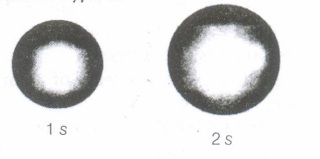
The density of dots in a region represents the probability density of finding electrons in the region.
On the basis of above diagram which of the following statements is incorrect?
1s and 2s orbitals are spherical in shape
The probability of finding the electron is maximum near the nucleus
The probability of finding the electron at a given distance is equal in all directions
The probability density of electrons for 2s orbital decreases uniformly as distance from the nucleus increases
68.
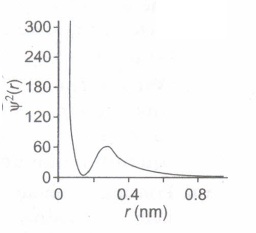
The plot of orbital wave function \(\psi\),(r) as a function of distance r of the electron from the nucleus for 2s orbital is _______.
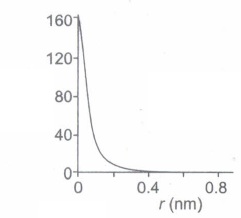
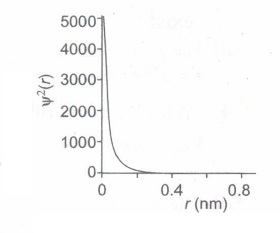
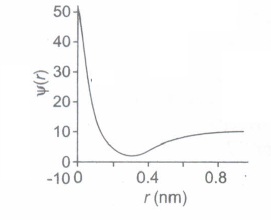
69.
The correct set of four quantum numbers for the valence electrons of rubidium atom (Z = 37) is _______.
\(5,0,0,+\frac{1}{2}\)
\(5,1,0,+\frac{1}{2}\)
\(5,1,1,+\frac{1}{2}\)
\(5,0,1,+\frac{1}{2}\)
70.
Probability of finding an electron at a point with in an atom is_______.
equal to the \(|\psi|^{2}\) 12at that point
proportional to the \(|\psi|^{2}\) 12at that point
inversely proportional to the \(|\psi|^{2}\) at the point
None of the above
71.
In atom, an electron is moving with a speed of 600 m/ s with an accuracy of 0.005%. Certainty with which the position of the electron can be located is_______. (h = 6.6 x 10⁻³⁴ kg m2 s-1, mass of electron, em = 6.6 x 10⁻³¹ kg)
1.52 x 10⁻⁴ m
5.10 x 10⁻³ m
1.92 x 10⁻³ m
3.84 x 10⁻³ m
72.
Which of the following statement is not correct regarding Bohr's model of hydrogen atom?
Energy of the electrons in the orbit is quantized
The electron in the orbit nearest to the nucleus has the lowest energy
Electrons revolve in different orbits around the nucleus
The position and velocity of the electrons in the orbit cannot be determined simultaneously
73.
An electron is moving in Bohr's fourth orbit. Its de-Broglie wavelength is λ Calculate the circumference of the fourth orbit.
2 λ
4 λ
4/λ
2/λ
74.
Calculate the wavelength (in nanometer) associated with a proton moving at 1.0 x 10³ms' _______.(Mass of proton = 1.67 x 10⁻²⁷ kg and h = 6.63 x 10⁻³⁴Js)
0.032 nm
0.40 nm
2.5 nm
14.0 nm
75.
Which of tM following is the energy of a possible excited state of hydrogen?
+13.6eV
-6.8 eV
-3.4eV
+6.8eV
76.
The first line in the Balmer series in the H atom will have the frequency _______.
3.29 x 10¹⁵ S-1
4.57 x 10¹⁴ S-1
8.22 x 10¹⁵ S-1
8.02 x 10¹⁴ S-1
77.
The ionisation enthalpy of hydrogen atom is 1.312 x 10⁶ J mol-1. The energy required to excite the electron in the atoms from n1 = 1 to n2 = 2 is_______.
6.56 x 10⁵ J mol-1
9.84 x 10⁵ J mol-1
7.56 x 10⁵J mol-1
8.51 x 10⁵ J mol-1
78.
The electronic transition from n = 2 to n = 1will produce the shortest wavelength in (where, n = principal quantum number) _______.
He+
H
H+
Li2+
79.
Which of the following conclusions could not be derived from Rutherford's a-particle scattering experiment?
Most of the space in the atom is empty
The radius of the atom is about 10-10 m while that of nucleus is 10-15 m
Electrons move in a circular path of fixed energy called orbits
Electrons and the nucleus are held together by electrostatic forces of attraction
80.
The orbital with n = 3 and 1 = 2 is _______.
3s
3p
3d
3j
81.
The idea of stationary orbits was first given by _______.
Rutherford
J.J. Thomson
Niels Bohr
Max Planck
82.
The Balmer series in the spectrum of hydrogen atom falls in _______.
ultraviolet region
visible region
infrared region
none of these
83.
In a sodium atom (atomic number = 11 and mass number = 23) and the number of neutrons is _______.
equal to the number of protons
less than the number of protons
greater than the number of protons
none of these
84.
Cathode rays are deflected by _______.
electric field only
electric and magnetic field
magnetic field only
none of these
85.
The oxidation number of carbon 'is zero in ______.
HCHO
CH2Cl2
C12H22O11
All the above
86.
Among the following molecules, in which does bromine show the maximum oxidation number?
Hg2 (Br03)2
Br - Cl
KBrO4
Br2
87.
Which of the following species are not known?
AgOH
PbI4
PI5
SH6
88.
In halogens, which of the following, increases from iodine to fluorine?
Bond length
Electronegativity
The ionization energy of the element
Oxidizing power
89.
Which of the following oxides is neutral?
Sn02
CO
Al2O3
Na2O
90.
The highest ionization energy is exhibited by _____.
halogens
alkaline earth metals
transition metals
noble gases
1.
(c)
Nuclear mass
2.
(a)
\(\mathrm{Al} / \mathrm{Al}^{3+} \ \ \mathrm{E}^{\ominus}=-1.66 \)
3.
(c)
Phosphorus is undergoing oxidation as well as reduction.
4.
(d)
\(\mathrm{Ag}^{+} \)
5.
(d)
\(\mathrm{MnCl}_{3} \longrightarrow \mathrm{MnCl}_{2}+\frac{1}{2} \mathrm{Cl}_{2} \)
6.
(a)
\(\mathbf{C u}+\mathbf{M g}^{2+} \longrightarrow \)
7.
(a)
Y > Z > X
8.
(c)
+6
9.
(b)
\(\mathbf{M n} \mathbf{O}_{4}^{-} \text {in basic medium }\)
10.
(c)
For transition elements, the 3d-orbitals are filled with electrons after 3p-orbitals and before 4s-orbitals.
11.
(a)
Helium has the highest first ionisation enthalpy in the periodic table.
12.
(a)
Si < P < C < N
13.
(a)
Sr
14.
(a)
CI-, S2-, P3-
15.
(b)
n = 2
l = 1
ml = +1
16.
(a)
\((i) n=3, l=2, m_{l}=-2, m_{s}=-\frac{1}{2} \)
\((ii) n=3, l=2, m_{l}=-1, m_{s}=-\frac{1}{2}\)
17.
(c)
The energy of 2s orbital is less than the energy of 2p-orbitals in case of hydrogen like atoms.
18.
(a)
Angular quantum number determines the three dimensional shape of the orbital.
19.
(b)
Ni2+
20.
(d)
0.4
21.
(a)
electrodes
22.
(a)
Electrons are transferred from H to O-atom
23.
(b)
Both oxidised and reduced
24.
(c)
zero
25.
(d)
zero
26.
(a)
metal displacement reaction
27.
(b)
decomposition reaction
28.
(d)
Ag and Fe3+
29.
(b)
anode to cathode
30.
(b)
\(\mathrm{I}^{-}(a q) \longrightarrow \mathrm{I}_{2}(s)\)
31.
(d)
Electrons
32.
(a)
oxidising agent
33.
(b)
oxygen and chlorine
34.
(b)
reducing agent
35.
(b)
reduced
36.
(a)
\(\mathrm{NH}_{2} \mathrm{OH}\)
37.
(a)
Bromine is a stronger oxidant than iodine
38.
(d)
All of the above
39.
(a)
reduction process
40.
(a)
Addition of oxygen
41.
(b)
acidic, basic respectively
42.
(d)
Both (a) and (b)
43.
(b)
Size decrease and increases respectively
44.
(b)
18, 7
45.
(d)
Metallic properties
46.
(d)
Both (b) and (c)
47.
(d)
Both (b) and (c)
48.
(c)
F < CI > Br > I
49.
(a)
higher than the first ionisation enthalpy
50.
(a)
Na < Mg > Al < Si
51.
(d)
\(\mathrm{O}^{2-}<\mathrm{F}^{-}<\mathrm{Mg}^{2+}<\mathrm{Na}^{+}\)
52.
(a)
van der Waals' radius
53.
(b)
p-block
54.
(a)
3d1 4s2
55.
(c)
\((n-1) d^{1-10} n s^{0-2}\)
56.
(a)
Period 4, group 6
57.
(a)
Ubn and unbinilium
58.
(a)
Niels Bohr
59.
(d)
All of these
60.
(b)
Mendeleev's arranged elements in order of their increasing atomic number
61.
(c)
Z > Y > X
62.
(b)
Balmer series
63.
(c)
Both (a) and (b)
64.
(d)
All of the above
65.
(c)
2
66.
(a)
l
67.
(d)
The probability density of electrons for 2s orbital decreases uniformly as distance from the nucleus increases
68.
(c)
69.
(a)
\(5,0,0,+\frac{1}{2}\)
70.
(b)
proportional to the \(|\psi|^{2}\) 12at that point
71.
(c)
1.92 x 10⁻³ m
72.
(d)
The position and velocity of the electrons in the orbit cannot be determined simultaneously
73.
(b)
4 λ
74.
(b)
0.40 nm
75.
(c)
-3.4eV
76.
(b)
4.57 x 10¹⁴ S-1
77.
(b)
9.84 x 10⁵ J mol-1
78.
(d)
Li2+
79.
(c)
Electrons move in a circular path of fixed energy called orbits
80.
(c)
3d
81.
(c)
Niels Bohr
82.
(b)
visible region
83.
(c)
greater than the number of protons
84.
(b)
electric and magnetic field
85.
(d)
All the above
86.
(c)
KBrO4
87.
(c)
PI5
88.
(c)
The ionization energy of the element
89.
(b)
CO
90.
(b)
alkaline earth metals

11th Standard CBSE Syllabus & Materials
11th Standard CBSE
CBSE 11th Business Studies Forms of Business Organisation Sample Question Papers Study Material - QB365 Set A
NEW11th Standard CBSE
CBSE 11th Business Studies Business, Trade and Commerce Sample Question Papers Study Material - QB365 Set A
NEW11th Standard CBSE
CBSE 11th Physics Waves Sample Question Papers Study Material - QB365 Set A
NEW11th Standard CBSE
CBSE 11th Physics Kinetic Theory Sample Question Papers Study Material - QB365 Set A



NCERT Books

Syllabus

Exam Pattern

Sample Question Papers

Previous year Question Papers

Important Notes

MCQ Practice test

NCERT Exemplers

Case study Questions

Image Based Questions

Passage based Questions

HOT Questions

Value Based Questions

Model Questions Papers
NCERT ( Book Back ) Questions

Assertion and Reason
Important Questions And Answers

CBSE 11th Standard CBSE Subjects
CBSE Standards







