
 100% FREE ACCESS
11th Standard CBSE Syllabus & Materials
11th Standard CBSE
CBSE 11th Economics PART-A - Presentation of Data - New Sample Question Papers Study Material - QB365 Set A
NEW11th Standard CBSE
CBSE 11th Economics PART-A - Organisation of Data - New Sample Question Papers Study Material - QB365 Set A
NEW11th Standard CBSE
CBSE 11th Economics PART-A - Collection of Data - New Sample Question Papers Study Material - QB365 Set A
NEW11th Standard CBSE
CBSE 11th Economics PART-A - Introduction to Economics and Statistics - New Sample Question Papers Study Material - QB365 Set A
NEW11th Standard CBSE
CBSE 11th Business Studies International Trade Sample Question Papers Study Material - QB365 Set A
NEW11th Standard CBSE
CBSE 11th Business Studies Evolution and Fundamentals of Business Sample Question Papers Study Material - QB365 Set A

Published on: 21/10/2025
Download CBSE Class 11th Standard CBSE Chemistry question papers, sample papers, important questions, and previous year solved papers in PDF format. Get free study materials, NCERT solutions, and exam preparation resources for Class 11th Standard CBSE Chemistry
Questions + Answers key
Take MCQ Chemistry Test
1.
Why is second ionisation enthalpy is always more than first?
2.
An element belongs to 5th period and 3rd group, identify the element.
3.
An electron has a speed of 40 m s-1accurate upto 99.99%. What is the uncertainty in locating its position? [Given, me = 9.11 x 10⁻³¹ kg]
4.
Explain hyperconjugation effect. How does hyperconjugation effect explain the stability of alkenes?
5.
What do you mean by pyrolysis?
6.
Calculate the mass per cent of different elements present in sodium sulphate, (Na2SO4).
7.
Answer the following questions:
C, F, O first electron gain enthalpy in increasing order
8.
A compound on analysis found to contain following percentage composition:
Na = 43.4%, C = 11.4% and O = 45.3%. Determine the empirical and molecular formulae. Given: the relative molecular mass of the compound is 106.
9.
Give three points of differences between inductive effect and resonance effect.
10.
Which of the following will have the most negative electron gain enthalpy and which the least negative? P, S, Cl, F. Explain your answer.
11.
Explain the following with examples:
(i) Wurtz reaction
(ii) Hydrogenation.
12.
Calculate the number of moles in each of the following.
6.022 x 10²² molecules of oxygen
13.
Calculate the number of moles in each of the following.
392 g of sulphuric acid
14.
Arrange the elements N, P, O, and S in the order of increasing first ionization enthalpy. Give the reason for the arrangement assigned.
15.
A golf ball has a mass of 40g, and a speed of 45 m/s. If the speed can be measured within accuracy of 2%, calculate the uncertainty in the position.
16.
Which one of the following statements is incorrect in relation to ionization enthalpy?
Ionization enthalpy increases for each successive electron.
The greatest increase in ionization enthalpy is experienced on removal of electron from core noble gas configuration.
End of valence electrons is marked by a big jump in ionization enthalpy.
Removal of electron from orbitals bearing lower n value is easier than from orbital having higher n value.
17.
Which of the following should be added in the compound for the detection of carbon and hydrogen?
Cu(I) oxide
Cu(II) oxide
Zn dust
Activated charcoal
18.
The correct order of electronegativity of carbon in ethane, ethene and ethyne is ______.
ethane < ethene < ethyne
ethyne < ethene < ethane
ethene < ethyne < ethane
ethene < ethane < ethyne
19.
The empirical formula of a compound is CH2. One mole of this compound has a mass of 42 g. Its molecular formula is _______.
C3H6
C3H8
CH2
C2H2
20.
Baeyer's reagent is ______.
aqueous KMnO4
neutral KMnO4
alkaline KMnO4
aqueous bromine water
21.
Which of the following is correct regarding the stability of carbocation?
3°>2°>1°
1°<2°<3°
2°>1°>3°
2°>3°>1°
22.
The energy needed to remove a single electron (most loosely bound) from an isolated gaseous atom is called _______.
ionisation energy
electronegativity
kinetic energy
electron affinity
23.
The outermost electronic configuration of manganese (at. no. = 25) is _______.
3d54s2
3d64s1
3d74so
3d6 4s2
24.
de Broglie equation is _______.
\(\lambda =\frac { h }{ mv } \)
\(\lambda =\frac { hv }{ m } \)
\(\lambda =\frac { mv }{ h } \)
\(\lambda =hmv\)
25.
Which of the following carbocation is most stable ?
\(({ CH }_{ 3 })_{ 3 }C.\overset {+ }{ C } { H }_{ 2 }\)
\(\left( { CH }_{ 3 } \right) _{ 3 }\overset { + }{ C } \)
\({ CH }_{ 3 }{ CH }_{ 2 }\overset { +}{ C } { H }_{ 2 }\)
\({ CH }_{ 3 }\overset {+ }{ C } HC{ H }_{ 2 }{ CH }_{ 3 }\)
26.
In the organic compound CH2=CH-CH2-CH2-C\(\equiv \)CH, the pair of hydridised orbitals involved in the formation of: C2 - C3 bond is _____.
sp - sp2
sp - sp3
Sp2 - Sp3
sp3 - sp3
27.
Which one of the following is isoelectronic with Ne?
N3-
Mg2+
AI3+
all of the above
28.
The highest ionization energy is exhibited by _____.
halogens
alkaline earth metals
transition metals
noble gases
29.
The number of grams of oxygen in 0.10 mol of Na2CO3· 10H2O is _______.
20.8 g
18 g
108 g
13 g
30.
5.6 litres of oxygen at NTP is equivalent to _______.
1 mole
\(\frac { 1 }{ 4 } \)mole
\(\frac { 1 }{ 8 } \)mole
\(\frac { 1 }{ 2 } \)mole
31.
One mole of CO2 contains _______.
6.02 x 10²³atoms of C
3 g of CO2
6.02 x 10²³atoms of O
18.1 x 10²³ molecules of CO2
32.
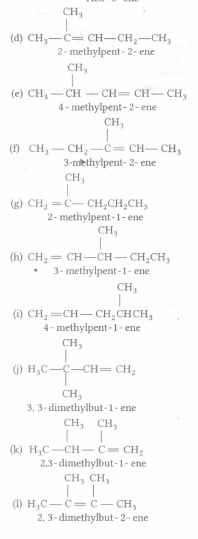
Write structures and IUPAC names of different structural isomers of alkenes coresponding to C6H12
33.
Explain the term aromaticity. What are the necessary conditions for any compound to show aromaticity?
34.
What were the weaknesses or limitations of Bohr's model of atoms? Briefly describe the quantum mechanical model of atom.
35.
Define atomic number, mass number and neutron. How are the three related to each other?
36.
Discuss the factors that influence the magnitude of ionization enthalpy. What are the general trends of variation of ionization enthalpy in the periodic table? Explain.
37.


38.
Observe the group shown in figure and answer the questions that follow based on the graph and related studied concepts.
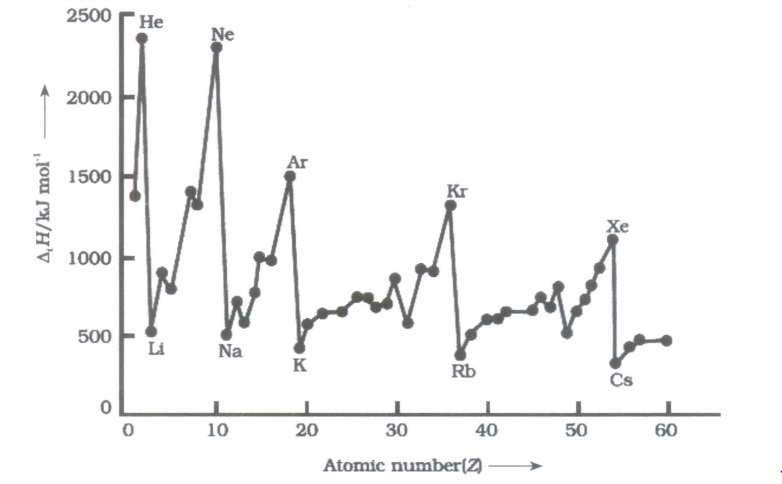
(a) Which group elements have lowest ionisation enthalpy and why?
(b) Which group element have highest ionisation enthalpy and why?
(c) Why is ionisation enthalpy of Be more than B?
(d) Why does 'N' have higher ionisation enthalpy than O?
1.
Second electron is to be removed from cation in which same number of protons attract less number of electrons more srongly, therefore, more energy is needed to remove second electron.
2.
Y(39) : 1s22s22p63s23p64s23d104p65s24d1
The element is Ytterium(39) It belongs to 5th period and 3rd group due to 3 valence electrons.
3.
Δv = Uncertainty in speed = 100 - 99.99 = 0.01 %
\(\Delta V=40 \mathrm{~m} \mathrm{~s}^{-1} \times \frac{0.01}{100}=40 \times 10^{-4}\)
= 4 x 10⁻³ m s-1
According to Heisen berg's Principle
\(\Delta x . \Delta V=\frac{h}{4 \pi m}\)
\(\Delta x=\frac{h}{4 \pi m \Delta v}\)
where Δx uncertainty in position.
'h' is planck's constant,
'm' is mass of electron,
π = 3.142
\(\Delta x=\frac{6.626 \times 10^{-34} \mathrm{kgm}^{2} \mathrm{~s}^{-1}}{4 \times 4 \times 10^{-3} \mathrm{~ms}^{-1} \times 9.11 \times 10^{-31} \mathrm{~kg} \times 3.142}\)
Δx = 1.447 x 10⁻² m
4.
The relative stability of various classes of carbonium ions may be explained by the number of no-bond resonance structures that can be written for them. Such structures are obtained by shifting the bonding electrons from an adjacent C-H bond to the electron deficient carbon so the positive charge originally on carbon is dispersed to the hydrogen. This manner of electron release by assuming no bond character in the adjacent C-H bond is called Hyperconjugation. Greater the hyperconjugation, greater will be the stability of alkenes.
5.
The decomposition of a compound by heat is called pyrolysis. This process when applied to alkanes is known as cracking.
6.
Mass percent of an element
= \( \frac{\text{ Mass of that element in the compund} \times 100 }{\text{ Molar mass of } Na_2SO_4}\)
= (2\(\times\)22.99) + 32.06 + (4\(\times\)16.00) = 142.04 g
Mass percent of Sodium
= \(\frac{45.98 \times 100}{142.04}\)
= 32.37
Mass percent of Sulphur
= \(\frac{32.06\times100}{142.04}\)
= 22.57
Mass percent of oxygen
= \(\frac{64\times100}{142.04} \)
= 45.06
7.
C < O < F is increasing order of electron gain enthalpy due to decrease in atomic size.
8.
Given results are tabulated as follows:
| Element | Percentage composition | Atomic mass | Relative number of moles | Simplest molar ratio | Simplest whole number molar ratio |
| Na | 43.4 | 23 | \(\frac{43.4}{23}=1.89 \) | \( \frac{1.89}{0.94}=3\) | 2 |
| C | 11.3 | 12 | \(\frac{11.3}{12}=0.94 \) | \(\frac{0.94}{94}=1\) | 1 |
| O | 45.3 | 16 | \(\frac{45.3}{16}=2.83 \) | \(\frac{2.83}{0.94}=3\) | 3 |
The empirical formula of the given compound is Na2CO3.
Now, Empirical formula mass of the compound = \(=(2 \times 23 \mathrm{u})+(1 \times 12 \mathrm{u})+(3 \times 16 \mathrm{u})=46 \mathrm{u}+12 \mathrm{u}+48 \mathrm{u}=106 \mathrm{u}\)
Then, \(n=\frac{\text { Molecular mass }}{\text { Empirical formula mass }}=\frac{106 \mathrm{u}}{106 \mathrm{u}}=1\)
Therefore, molecular formula of the given compound is given by, Molecular formula = 1 x Empirical formula = \(1 \times \mathrm{Na}_{2} \mathrm{CO}_{3}=\mathrm{Na}_{2} \mathrm{CO}_{3}\)
9.
The main points of difference between inductive and resonance effects are given below.
| Inductive Effect | Resonance Effect |
| It involves displacement of only σ-electrons and hence, occurs only in saturated compounds. |
It involves delocalisation of π or n (lone pairs) of electrons and hence occurs in unsaturated and conjugated systems |
| During inductive effect the electron pair is only slighty displaced towards the more electronegative atom and hence only partial positive and negative charges appear |
During resonance effect, the electron pair is completely transferred and hence full positive and negative charge appear. |
| Inductive effects are transmitted over short distance in saturated carbon chains and the magnitude of the effect decreses rapidly as the distance from the heteroatom increa |
The resonance effect are transmitted all along the length of the conjugated system without suffering much change in magnitude. e.g. |
| Inductive Effect | Resonance Effect |
| The effect almost becomes negligible beyond three carbon atoms from the heteroatom. \(\mathrm{C}-\mathrm{C}^{\delta \delta \delta+} \rightarrow{ }^{\delta \delta+} \rightarrow{\mathrm{C}}^{\delta+} \rightarrow \mathrm{Cl}\) |
C3, in crotonaldehyde is almost as positive as C1. \(\mathrm{CH}_{3}-\mathrm{CH}=\mathrm{CH}-\mathrm{CHO}\) \(\underset{4}{\mathrm{C}} \mathrm{H}_{3} \underset{3}{\mathrm{C}} \mathrm{H}=\mathrm{CH}{ }_{2}{\mathrm{C}}_{1}^{+} \mathrm{H}-\mathrm{O}\) \(\longleftrightarrow \mathrm{CH}_{3}-\mathrm{C}_{3}^{+} \mathrm{H}-\mathrm{CH}=\mathrm{CH}-\mathrm{O}^{-}\) |
10.
Electron gain enthalpy generally becomes more negative across a period as we move from left to right. Within a group, electron gain enthalpy becomes less negative down a group. However, adding an electron to the 2p-orbital leads to greater repulsion than adding an electron to the larger 3p-orbital. Hence the element with most negative electron gain enthalpy is chlorine; the one with the least negative electron gain enthalpy is phosphorus.
11.
(i) Wurtz reaction: Alkanes are produced by heating an alkyl halide with sodium metal in dry ether solution.
CH3Br + 2Na + BrCH3 \(\overset { dry\ ether }{ \longrightarrow } \) CH3CH3 + 2NaBr
Ethane
(ii) Hydrogenation: Alkenes react with hydrogen in presence of Ni or Pd catalyst to form saturated compounds.
CH2 = CH2 + H2 \(\overset { Ni }{ \underset { 373K }{ \longrightarrow } } \) CH3 - CH3
Ethane
12.
6.022 x 10²² molecules of oxygen
6.022 x 10²³ molecules of oxygen = 1 mol
6.022 x 10²² molecules of oxygen = 1 mol x \(\frac { 6.022\times { 10 }^{ 22 } }{ 6.022\times { 10 }^{ 23 } } \) = 0.1 mol
13.
392 g of sulphuric acid
Molar mass of H2SO4 = 2 x 1 + 32 + 4 x 16 = 98 g
98 g of sulphuric acid = 1 mol
392 g of sulphuric acid = 1 mol x\(\frac { 392 \ g }{ (98 \ g) } \) = 4 mol
14.
| Group 15 | Group 16 | |
| 2nd period | N | 0 |
| 3rd period | P | S |
ionization\(({ _{ 7 }N }={ 1s }^{ 2 },{ 2s }^{ 2 },{ 2p }^{ 3 }),\) enthalpy of nitrogen is greater than oxygen \(({ _{ 8 }O }={ 1s }^{ 2 },{ 2s }^{ 2 },{ 2p }^{ 4 }),\)due to extra stable half-filled 2p-orbitals. Similarly, ionization enthalpy of phosphorus is \(({ { _{ 15 }{ P } } }={ 1s }^{ 2 },{ 2s }^{ 2 },{ 2 }p^{ 6 },{ 3s }^{ 2 },{ 3p }^{ 3 })\) greater than sulfur on\(({ { _{ 16 }{ S } } }={ 1s }^{ 2 },{ 2s }^{ 2 },{ 2 }p^{ 6 },{ 3s }^{ 2 },{ 3p }^{ 4 })\) moving down the group, ionization enthalpy decreases with increasing atomic size. so, the increasing order of first ionization enthalpy is S.
15.
The uncertainty in the speed is 2%, i.e.,
\(45 \frac { 2 }{ 100 } =0.9m{ s }^{ -1 }\)
Using the equation Heisenberg's principle,
\(\triangle x=\frac { h }{ 4\pi m.\triangle v } =\frac { 6.6\times{ 10 }^{ -34 } Js }{ 4\times3.14\times40g \times{ 10 }^{ -3 } \ kg \ g^{-1}\times 0.9 m s^{-1} }\)
= 1.46×10⁻³³ m
This is nearly ~ 1018 times smaller than the diameter of a typical atomic nucleus. As mentioned earlier for large particles, the uncertainty principle sets no meaningful limit to the precision of measurements.
16.
(d)
Removal of electron from orbitals bearing lower n value is easier than from orbital having higher n value.
17.
(b)
Cu(II) oxide
18.
(a)
ethane < ethene < ethyne
19.
(a)
C3H6
20.
(c)
alkaline KMnO4
21.
(a)
3°>2°>1°
22.
(a)
ionisation energy
23.
(a)
3d54s2
24.
(a)
\(\lambda =\frac { h }{ mv } \)
25.
(b)
\(\left( { CH }_{ 3 } \right) _{ 3 }\overset { + }{ C } \)
26.
(c)
Sp2 - Sp3
27.
(d)
all of the above
28.
(b)
alkaline earth metals
29.
(a)
20.8 g
30.
(b)
\(\frac { 1 }{ 4 } \)mole
31.
(a)
6.02 x 10²³atoms of C
32.
\(\begin{array}{l} \text { (a) } \mathrm{CH}_{2}=\mathrm{CH}-\mathrm{CH}_{2} \mathrm{CH}_{2} \mathrm{CH}_{2} \mathrm{CH}_{3}\\ \quad \quad \quad \quad \text { Hex }-1 \text { - ene } \end{array}\)
\(\begin{array}{l} \text { (b) } \mathrm{CH}_{3}-\mathrm{CH}=\mathrm{CH}-\mathrm{CH}_{2} \mathrm{CH}_{2} \mathrm{CH}_{3}\\ \quad \quad \quad \quad \text { Hex }-2 \text { - ene } \end{array}\)
\(\begin{array}{l} \text { (c) } \mathrm{CH}_{3}-\mathrm{CH}_{2}-\mathrm{CH}=\mathrm{CH}-\mathrm{CH}_{2} \mathrm{CH}_{3}\\ \quad \quad \quad \quad \text { Hex - } 3 \text { - ene } \end{array}\)
33.
The aromatic compounds apparently contain alternate double and single bonds in a cyclic structure, and resemble benzene in chemical behaviour. They undergo substitution reactions rather addition reactions. This characteristic behaviour is called Aromatic character or Aromaticity.
Conditions for Aromaticity:
(i) An aromatic compound is cyclic and planar.
(ii) Each atom in an aromatic ring has a p-orbital. These p-orbitals must be parallel so that a continuous overlap is possible around a ring.
(iii) The cyclic \(\pi\)-molecular orbital formed by the overlap of p-orbitals must contain (4n + 2) \(\pi\) electrons, where (n = 0, 1, 2, 3, 4 etc.)
34.
Limitations of Bohr's model of an atom:
(i) It could not explain spectrum of multi-electron atoms.
(ii) It could not explain Zeeman and Stark effects.
(iii) It could not explain shape of molecules.
(iv) It was not in accordance with Heisenberg's uncertainty principle.
Quantum Mechanical Model: It was developed on the basis of Heisenberg's uncertainty principle and dual behaviour of matter. Main features of this model are given below :
(i) The energy of electrons in an atom is quantized i.e. can only have certain values.
(ii) The existence of quantized electronic energy levels is a direct result of the wave-like properties of electrons.
(iii) Both, the exact position and velocity of an electron in an atom cannot be determined simultaneously.
(iv) The orbitals are filled in increasing order of energy. All the information about the electron in an atom is stored in orbital wave function.\(\Psi \)
(v) From the value of\(\Psi \)2 at different points within atom, it is possible to predict the region around the nucleus where electron most probably will be found.
35.
Atomic Number (Z): The atomic number of an element is equal to the number of protons present inside the nucleus of its atoms. Since, an isolated atom has no net charge on it, in neutral atoms, the total number of electrons is equal to its atomic number.
Atomic number (Z) = Number of protons in the nucleus of an atom
= Number of electrons in the neutral atoms
Mass Number (A): The sum of the number of neutrons and protons in the nucleus of an atom is called its mass number. Mass number is denoted by A. Thus, for an atom, Mass number (A) = Number of protons (P) + Number of neutrons (n) A = P + n
Neutron: It is neutral particle. It is present in the nucleus of an atom. Expect hydrogen (which contains only one electron and one proton but no neutron), the atoms of all other elements including isotopes of hydrogen contain all the three fundamental particles called neutron, proton and electron.
The relation between mass number, Atomic no. and no. of neutrons is given by the equation:
A = Z+n I
Where A = Mass number
Z = Atomic number
n = Number of neutrons in the nucleus.
36.
Factors affecting Ionization enthalpy.
(i) Atomic size. With the increase in atomic size, the number of electron shells increases and thus the force of attraction between the electrons and the nucleus decreases. Therefore the ionization enthalpy decreases.
(ii) Nuclear charge. As the nuclear charge increases the attraction for the electron also increases that's why ionization enthalpy increases.
(iii) Screening or shielding effect. In a multi-electron atom, the electron present in the inner shells shield the electrons in the valence shell as a result these electrons experience less attraction from the nucleus. This leads to lesser ionization enthalpy.
Variation along a period. On moving from left to right in a period the nuclear charge increases and the atomic size decreases as a result ionization enthalpies are expected to increase.
Variation within a group. On moving down the group as the atomic size of the elements increases that's why ionization enthalpy decreases down the group
37.
38.
(a) Group 1 because they have largest atomic size.
(b) Group 18 because they have stable electronic configuration.
(c) Be(1s2 2s2). It is because 'Be' has completely filled s-orbital which is more stable therefore, needs higher energy to remove electrons than B(1s2 2s2 2p1).
(d) It is because 'N' has half filled orbital which is more stable and more energy is needed to remove electron in 'N' than O.

11th Standard CBSE Syllabus & Materials
11th Standard CBSE
CBSE 11th Business Studies Forms of Business Organisation Sample Question Papers Study Material - QB365 Set A
NEW11th Standard CBSE
CBSE 11th Business Studies Business, Trade and Commerce Sample Question Papers Study Material - QB365 Set A
NEW11th Standard CBSE
CBSE 11th Physics Waves Sample Question Papers Study Material - QB365 Set A
NEW11th Standard CBSE
CBSE 11th Physics Kinetic Theory Sample Question Papers Study Material - QB365 Set A



NCERT Books

Syllabus

Exam Pattern

Sample Question Papers

Previous year Question Papers

Important Notes

MCQ Practice test

NCERT Exemplers

Case study Questions

Image Based Questions

Passage based Questions

HOT Questions

Value Based Questions

Model Questions Papers
NCERT ( Book Back ) Questions

Assertion and Reason
Important Questions And Answers

CBSE 11th Standard CBSE Subjects
CBSE Standards







