
 100% FREE ACCESS
11th Standard Syllabus & Materials
11th Standard
TN 11th Tamil இயற்கை வேளாண்மை,சுற்றுச்சூழல் -செய்யுள் - மனோன்மணீயம் Important Questions And Answers Study Material - QB365 Set A
NEW11th Standard
TN 11th Tamil என்னுயிர் என்பேன் -துணைப்பாடம் - இசைத்தமிழர் இருவர் Important Questions And Answers Study Material - QB365 Set A
NEW11th Standard
TN 11th Tamil மொழி கலை -செய்யுள் - ஒவ்வொரு புல்லையும் Important Questions And Answers Study Material - QB365 Set A
NEW11th Standard
TN 11th Tamil பீடு பெற நில் - இலக்கணம் - பகுபத உறுப்புகள் Important Questions And Answers Study Material - QB365 Set A
NEW11th Standard
TN 11th Tamil பீடு பெற நில் - துணைப்பாடம் - வாடிவாசல் Important Questions And Answers Study Material - QB365 Set A
NEW11th Standard
TN 11th Tamil பீடு பெற நில் - செய்யுள் - குறுந்தொகை Important Questions And Answers Study Material - QB365 Set A

Published on: 01/10/2019
Chemical bonding
Download Tamil Nadu 11th Standard Chemistry question papers, model tests, one-mark questions, important questions, and public exam papers in PDF format. Free study materials and answer keys for TN State Board students.
Questions + Answers key
Take MCQ Chemistry Test
1.
Non- Zero dipole moment is shown by __________
CO2
p-dichlorobenzene
carbontetrachloride
water
2.
Xe F2 is isostructural with _____________
SbCl2
BaCl2
TeF2
ICI2-
3.
The correct order of O-O bond length in hydrogen peroxide, ozone and oxygen is _______
H2O2 > O3 >O2
O2 > O3 > H2O2
O2 > H2O2 > O3
O3 > O2 > H2O2
4.
Which one of the following is the likely bond angles of sulphur tetrafluoride molecule ?
120o,80o
109o,28
90o
89o,117o
5.
Which of the following is electron deficient ?
PH3
(CH3)2
BH3
NH3
6.
In which of the following Compounds does the central atom obey the octet rule ?
XeF4
AlCl3
SF6
SCl2
7.
What do you mean by metallic bond ?
8.
What are the number of bond pairs and lone pairs of electrons on N-atom in N\({ O }_{ 3}^{ - }\) ?
9.
Define bond energy.
10.
What is a pi bond ?
11.
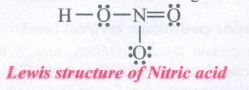
Explain the various steps to draw the lewis structure of Nitirc acid.
12.
13.
Explain resonance with reference to carbonate ion ?
14.
Explain Sp2 hybridisation in BF3.
15.
Bond angle in PH+4 is higher than in PH3. Why ?
16.
Define co-ordinate covalent bond.
17.
What is dipole moment ?
18.
Bent
19.
BF3
20.
C-N
21.
Gold
22.
CH4
23.
Bond order of O2, F2, N2 respectively are________
24.
Number of chlorine atoms which form equatorial bonds in PCI5 molecule are/is _________
25.
The number of lone pair of electrons on C-atom present in CO2 are _________
26.
The unit of dipole moment is________
27.
The complete transfer of one/or more valence electron from one atom to another leads to the formation of______
28.
(a) H2
(b) O2
(c) Cl2
(d) F2
29.
(a) NaCI
(b) CO2
(c) LiF
(d) MgO
1.
(d)
water
2.
(d)
ICI2-
3.
(b)
O2 > O3 > H2O2
4.
(d)
89o,117o
5.
(c)
BH3
6.
(d)
SCl2
7.
The forces that keep the atoms of the metal so closely in a metallic crystal constitute what is generally known as the metallic bond.
8.
No. of valence electrons in N-atom = 5 + 1 (negative charge) = 6
One O-atom forms a double bond.
Other two O-atoms shared with two electrons of N-atom.
\(\therefore\)No. of bond pairs = 4
No. of lone pairs = No. of valence electron - Bonding pairs
= 4 - 4 = 0
\(\therefore\) No. of lone pairs = 0
9.
The bond energy is defined as the minimum amount of energy required to break one mole of a particular bond in molecules in their gaseous state.
10.
When two atomic orbitals overlaps sideways, the resultant covalent bond is called a pi (\(\pi\)) bond.
11.
1. Skeletal structure
\(H\quad O\quad \underset { O }{ N } \quad O\)
2. Total number of valence electrons in HNO3
= [1 x 1 (hydrogen)] + [1 + 5 (nitrogen)] + [3 x 6 (oxygen)] = 1 + 5 + 18 = 24
3. Draw single bonds between atoms. Four bonds can be drawn as shown in the figure for HNO3 which account for eight electrons (4 bond pairs).
\(H-O-\underset { \overset { | }{ O } }{ N } -O\)
4. Distribute the remaining sixteen (24 - 8= 16) electrons as eight lone pairs starting from most electronegative atom, the oxygen. Six lone pairs are distributed to the two terminal oxygens (three each) to satisfy their octet and two pairs are distributed to the oxygen that is connected to hydrogen to satisfy its octet.
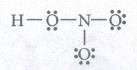
5. Verify wheather all the atoms have octet conguration. In the above distribution, the nitrogen has one pair short for octet. Therefore, move one of the lone pair from the terminal oxygen to form another bond with nitrogen. The Lewis structure of nitric acid is given as
12.
13.
'When we write Lewis structures for a molecule, more than one valid Lewis structures are possible in certain cases. For exampte let us consider the Lewis structure of carbbnate ion [CO3]2- . The skeletal structure of carbonate ion (The oxygen atoms are denoted as OA, OB & Oc
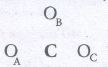
2. Total number of valence electrons = [1 x 4(carbon)] + [3 x 6 (oxygen)] + [2 (charge)] = 24 electrons.
3. Distribution of these valence electrons gives us the following structure.
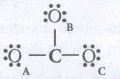
4. Complete the octet for carbon by moving a lone pair from one of the oxygens (OA) and write the charge of the ion (2-) on the upper right side.
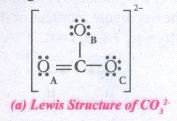
5. In this case, we can draw two additional Lewis structures by moving the lone pairs from the other two oxygens (OB & Oc) thus creating three similar structures as shown below in which the relative position of the atoms are same. They only differ in the position of bonding and lone pair of electrons. Such stnictures are called resonance structures (canonical structures) and this phenomenon is called resonance.
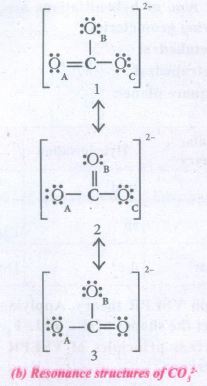
6. It is evident from the experimental results that all carbon-oxygen bonds in carbonate ion are equivalent. The actual structure of the molecules is said to be the resonance hybrid, an average of these three resonance forms. It is important to note that carbonate ion does not change from one structure to another and vice versa. It is not possible to picturise the resonance hybrid by drawing a single Lewis structure. However, the following structure gives a qualitative idea about the correct structure
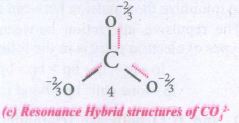
7. It is found that the energy of the resonance hybrid (structure 4) is lower than that of all possible canonical structures (Structure 1, 2 & 3). The difference in energy between structure 1 or 2 or 1 3, (most stable canonical structure) and structure 4 (resonance hybrid) is called resonance energy.
14.
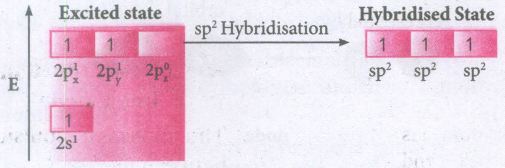
Sp2 hybridisation:
1. Consider boron trifluoride molecule. The valence shell electronic configuration of boron atom is [He] 2s2 2p1.
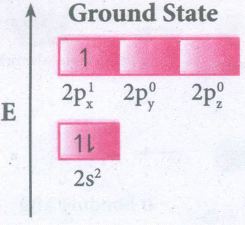
2. In the ground state boron has only one unpaired electron in the valence shell. In order-to form three covalent bonds with fluorine atoms, three unpaired electrons are required. To achieve this, one of the paired electrons in the 2s orbital is promoted to the 2py orbital in the excite state.
3. In boron, the s orbital and two p orbitals (Px and p ) in the valence shell hybridses, to generate three equivalent Sp2 orbitals as shown in the Figure. These three orbitals lie in the same xy plane and the angle between any two orbitals is equal to 120°
Overlap with 2pz orbitals of Dorine:
The three Sp2 hybridised orbitals of boron now overlap with the 2pz orbitals ofuorine (3 atoms). is overlap takes place along the axis as shown below
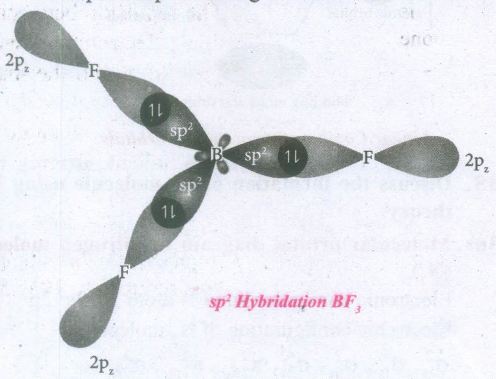
15.
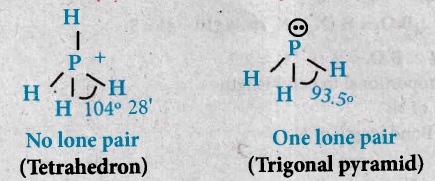
Due to the presence one lone p'air of elctrons on 'p' of PH3 the bond angle is less than 109o28' which is for a tetrahedron. The lone pair occupies more space.
16.
In certain bond formation, one of the combining atoms donates a pair of electrons (i.e.) two electrons which are necessary for the covalent bond formation, and these electrons are shared by both the combining atoms.
These type of bonds are called co-ordinate covalent bond or co-ordinate bond. The combining atom which donates the pair of electron is called a donor atom and the other atom an acceptor atom. This bond is denoted by an arrow starting from the donor atom pointing towards the acceptor atom.
17.
Dipole moment :
The polarity of a covalent bond can be measured in terms of dipole moment which is defined as \(\mu=q \times 2d\)
Where \(\mu\) is the dipole moment, q is the charge and 2d is the distance between the two charges.
Where p is the dipole moment, q is the charge and 2d is the distance between the two charges. The dipole moment is a vector and the direction of the dipole moment vector points from the negative charge to positive charge.
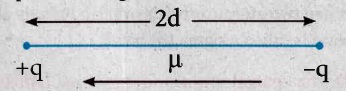
The unit for dipole moment is columb meter (C m). It is usually expressed in Debye unit (D). The conversion factor is 1 Debye = 3.336 x 10⁻³⁰ C m.
18.
O3
19.
120°
20.
1.43Å
21.
Metallic bond
22.
Covalent bond
23.
()
2,1,3
24.
()
.3
25.
()
4
26.
()
Coulomb-l m2
27.
()
Ionic bond
28.
O2 'It's bond order is 2 whereas in others bond order is 1.
29.
CO2, It contains covalent bond whereas others have ionic bond.

11th Standard Syllabus & Materials
11th Standard
TN 11th Tamil பீடு பெற நில் - செய்யுள் - காவடிச்சிந்து Important Questions And Answers Study Material - QB365 Set A
NEW11th Standard
TN 11th Tamil பீடு பெற நில் - உரைநடை - மலை இடப்பெயர்கள் : ஓர் ஆய்வு Important Questions And Answers Study Material - QB365 Set A
NEW11th Standard
TN 11th Tamil மாமழை போற்றுதும் - துணைப்பாடம் - யானை டாக்டர் Important Questions And Answers Study Material - QB365 Set A
NEW11th Standard
TN 11th Tamil மாமழை போற்றுதும் - செய்யுள் - ஐங்குறுநூறு Important Questions And Answers Study Material - QB365 Set A



Tamilnadu Stateboard 11th Standard Subjects

Maths

Commerce

Economics

Biology

Business Maths and Statistics

Accountancy

Computer Science

Physics
Chemistry
Maths
Biology
Economics
Physics
Chemistry

History
Business Maths and Statistics

Computer Science
Accountancy

Computer Applications
History
Computer Technology
Commerce
Computer Applications
Computer Technology

Tamil

English

French
Tamilnadu Stateboard Standards
