
 100% FREE ACCESS
11th Standard CBSE Syllabus & Materials
11th Standard CBSE
CBSE 11th Economics PART-A - Presentation of Data - New Sample Question Papers Study Material - QB365 Set A
NEW11th Standard CBSE
CBSE 11th Economics PART-A - Organisation of Data - New Sample Question Papers Study Material - QB365 Set A
NEW11th Standard CBSE
CBSE 11th Economics PART-A - Collection of Data - New Sample Question Papers Study Material - QB365 Set A
NEW11th Standard CBSE
CBSE 11th Economics PART-A - Introduction to Economics and Statistics - New Sample Question Papers Study Material - QB365 Set A
NEW11th Standard CBSE
CBSE 11th Business Studies International Trade Sample Question Papers Study Material - QB365 Set A
NEW11th Standard CBSE
CBSE 11th Business Studies Evolution and Fundamentals of Business Sample Question Papers Study Material - QB365 Set A

Published on: 30/07/2018
In this question paper, some of the important one mark, two and five marks questions from the chapter Chemical Bonding and Molecular Structure are covered.
Students, subscribe and get plenty of question paper with answer key. For subscription please click here.
Download CBSE Class 11th Standard CBSE Chemistry question papers, sample papers, important questions, and previous year solved papers in PDF format. Get free study materials, NCERT solutions, and exam preparation resources for Class 11th Standard CBSE Chemistry
Questions + Answers key
Take MCQ Chemistry Test
1.
Explain why PCl5 is trigonal bipyramidal,whereas IF 5 is square pyramidal?
2.
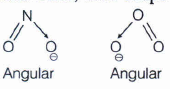
Which of the species have similar shape and why? \({ { NO }_{ 2 }^{ - } },{ { NO }_{ 2 }^{ + } },{ CO }_{ 2 },{ O }_{ 3 }\)
3.
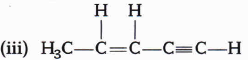
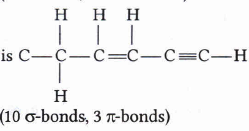
What is the total number of sigma and pi bond in the following molecules?
4.
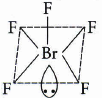
Explain the shape of BrF5
5.
Predict the geometry of XeF4 molecule.
6.
Why NF3 is pyramidal but BF3 is triangular planar?
7.
Explain why HF is less viscous than H2O
8.
Why is the energy of \({ \pi 2p }_{ x }\) and \({ { \pi 2p } }_{ y }\) molecular orbital lower than \({ \sigma 2p }_{ z }\) molecular orbital in \({ N }_{ 2 }\) molecule?
9.
Why axial bonds of PCI5 are longer than equatorial bonds?
10.
What is valence bond approach for the formation of covalent bond?
11.
What type of atomic orbitals can overlap to form molecular orbitals?
12.
Why AIF3 is a high melting solid whereas SiF4 is a gas?
13.
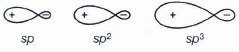
Draw the shape of the following hybrid orbitals sp, sp2 and sp3.
14.
Define electronegativity. How does it differ from electron gain enthalpy ?
15.
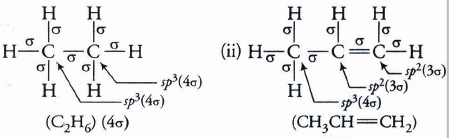
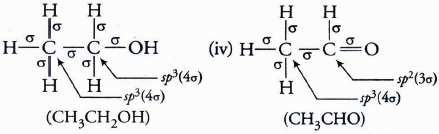
Which hybrid orbitals are used by carbon atoms in the following molecules?
(a) CH3–CH3;
(b) CH3–CH=CH2;
(c) CH3-CH2-OH;
(d) CH3-CHO
(e) CH3COOH
16.
Draw the structure of CuSO4.5H2O. Also, name the type of bond present in it.
17.
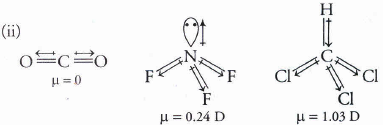
Represent diagrammatically the bond moments and the resultant dipole moment in CO2, NF and CHCL3.
18.
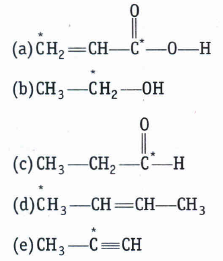
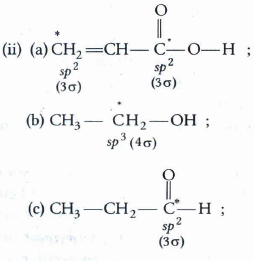
What is the type of hybridisation of carbon atoms marked with star?
1.
IF 5 The ground state and the excited state outer electronic configuration of iodine(Z = 53) are represented below
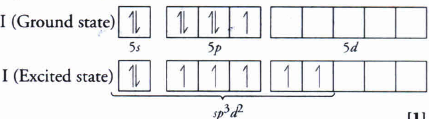
In IF 5 ,I is sp3 d2 hybridised therefore,shape of IF 5 is square pyramidal as it contains one lone pair of electrons

2.
\({ NO }_{ 2 }^{ + }\)and CO2 are sp hybridized, therefore, they have linear shape.
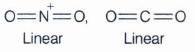
\({ { NO }_{ 2 }^{ - } }\) and O3 are sp2 hybridised.Both have lone pair of electrons but in former case it is not donated. Thus, their shape is angular.
3.
4.
The central atom Br has seven electrons in the valence shell. Five of these will form bonds with five fluorine atoms and the remaining two electrons are present as one lone pair. Hence, total pairs of electrons are six (5 bond pairs and 1 lone pair).
To minimize repulsion between lone pairs and bond pairs, the shape becomes square pyramidal.
5.
XeF4 = 4bp + 2lp (This is because Xe contains 8 valunce electrons) = square planar geometry.

6.
In NF3, N is surrounded by three F atoms and a lone pair thus, have lp-bp repulsion along with bp-bp repulsion.
Thus, its shape is pyramidal.
In BF3, B is surrounded by only three F atoms, i.e. have no lone pairs, so only repulsion present in it is bp - bp.
Thus, its shape is triangular planar.
7.
There is greater intermolecular hydrogen bonding in H2 O than that in HF as each H2 O molecule forms four H-bonds with water molecules,, whereas HF forms only H-bonds with other HF molecules. Greater the intermolecular H-bonding, greater is the viscosity. Hence, HF is less viscous than H2 O
8.
This is because of intermixing of 2s and 2pz orbitals because of their close proximity. Due to intermixing, \({ \sigma 2p }_{ z }\) molecular orbital becomes higher in energy than \({ \pi 2p }_{ x }\) and \({ { \pi 2p } }_{ y }\) molecular orbitals.
9.
This is due to greater repulsion on the axial bond pairs by the equatorial bond pairs of electrons.
10.
A covalent bond is formed by the overlap of half-filled atomic orbitals.
11.
Atomic orbitals with comparable energies and proper orientation overlap to form molecular orbitals
12.
AIF3 is an ionic compound whereas SiF4 is a non-polar covalent compound. Hence, interparticle forces in AIF3 are much stronger that's why it is a high melting solid.
13.
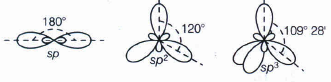
All the hybrid orbitals have same shape. However, their sizes are in the order : sp < sp2 < sp3
14.
Electronegativity of an element is the tendency of its atom to attract the shared pair of electrons towards itself in a covalent bond. Electron gain enthalpy of an element may be defined as the as the energy released when a neutral isolated gaseous atom accepts an extra electron to form the gaseous negative ion, i.e anion.
\(\underset { Neutral \ gaseous \ atom }{ X(g) } +{ e }^{ - }\longrightarrow \underset { Anion }{ { X }^{ - }(g) } ;\Delta H={ \Delta }_{ eg }H\)
Greater the amount of energy released in the above process, higher is the electron gain enthalpy of the element. Electronegativity differs from electron gain enthalpy because electronegativity is a property of an atom in the bonded state while electron gain enthalpy relates to atoms in their isolated gaseous states.
15.
16.
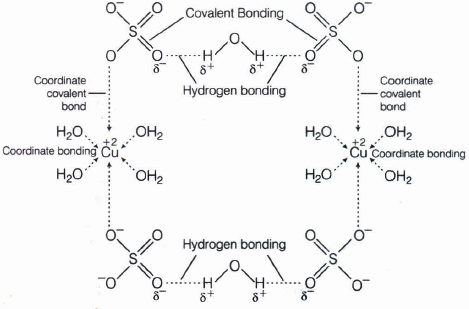
CuSO4.5H2O has ionic, covalent, coordinate and hydrogen bonds.
17.
18.

11th Standard CBSE Syllabus & Materials
11th Standard CBSE
CBSE 11th Business Studies Forms of Business Organisation Sample Question Papers Study Material - QB365 Set A
NEW11th Standard CBSE
CBSE 11th Business Studies Business, Trade and Commerce Sample Question Papers Study Material - QB365 Set A
NEW11th Standard CBSE
CBSE 11th Physics Waves Sample Question Papers Study Material - QB365 Set A
NEW11th Standard CBSE
CBSE 11th Physics Kinetic Theory Sample Question Papers Study Material - QB365 Set A



CBSE 11th Standard CBSE Subjects
CBSE Standards









