
 100% FREE ACCESS
11th Standard Syllabus & Materials
11th Standard
TN 11th Tamil இயற்கை வேளாண்மை,சுற்றுச்சூழல் -செய்யுள் - மனோன்மணீயம் Important Questions And Answers Study Material - QB365 Set A
NEW11th Standard
TN 11th Tamil என்னுயிர் என்பேன் -துணைப்பாடம் - இசைத்தமிழர் இருவர் Important Questions And Answers Study Material - QB365 Set A
NEW11th Standard
TN 11th Tamil மொழி கலை -செய்யுள் - ஒவ்வொரு புல்லையும் Important Questions And Answers Study Material - QB365 Set A
NEW11th Standard
TN 11th Tamil பீடு பெற நில் - இலக்கணம் - பகுபத உறுப்புகள் Important Questions And Answers Study Material - QB365 Set A
NEW11th Standard
TN 11th Tamil பீடு பெற நில் - துணைப்பாடம் - வாடிவாசல் Important Questions And Answers Study Material - QB365 Set A
NEW11th Standard
TN 11th Tamil பீடு பெற நில் - செய்யுள் - குறுந்தொகை Important Questions And Answers Study Material - QB365 Set A

Published on: 17/01/2020
Download Tamil Nadu 11th Standard Chemistry question papers, model tests, one-mark questions, important questions, and public exam papers in PDF format. Free study materials and answer keys for TN State Board students.
Questions + Answers key
Take MCQ Chemistry Test
1.
Which among these is not associated with aliphatic compounds?
They contain (4n+2)\(\pi\) electrons
They contain straight chain compounds
They contain branched chain compounds
They have appropriate number of H-atoms and functional groups.
2.
Which one of the following is correct order of the stability of carbanions ?
-C(CH3)3 > -CH(CH3)2 > -CH2-CH3 > -CH3
-CH3 > -CH2-CH3 > -CH(CH3)2> -(CH3)3
-CH(CH3)2>-H3 > -CH2-CH3 >-(CH3)3
-CH2-CH3>-CH(CH3)2>-CH3>-(CH3)3
3.
Statement I : In sulphur hexafluoride, the central atom has more than eight valence electrons.
Statement II : The central atom can accommodate additional electron pairs by using outer vacant d orbitals.
Statements I and II are correct and statement II is the correct explanation of statement I
Statements I and II are correct but statement II is not the correct explanation of statement I.
Statement I is correct but statement II is wrong.
Statement I is wrong but statement II is correct.
4.
In SN1, the rate of the reaction depends on the ______________.
nucleophile
medium
concentration of the substrate
none of the above
5.
Identify the wrong statement in the following __________.
The clean water would have a BOD value of more than 5 ppm
Greenhouse effect is also called as Global warming
Minute solid particles in air is known as particulate pollutants
Biosphere is the protective blanket of gases surrounding the earth
6.
The IUPAC name of the compound \({ CH }_{ 3 }-\underset { \overset { | }{ OH } }{ CH } -COOH\) is _____________
2 – Hydroxypropionic acid
2 – Hydroxy Propanoic acid
Propan – 2– ol –1 – oic acid
1 – Carboxyethanol
7.
At 100o C the vapour pressure of a solution containing 6.5g a solute in 100g water is 732mm. If Kb = 0.52, the boiling point of this solution will be __________
102oC
100oC
101oC
100.52oC
8.
The equilibrium constants of the following reactions are:
| N2 + 3H2 ⇌ 2NH3 : | K1 |
| N2 + O2 ⇌ 2NO : | K2 |
| H2 + ½O2 ⇌ H2O : | K3 |
The equilibrium constant (K) for the reaction ;
\({ 2NH }_{ 3 }+5/2{ O }_{ 2 }\overset { K }{ \rightleftharpoons } 2NO+{ 3H }_{ 2 }{ O },\) will be
\(K_2^3{K_3\over K_1}\)
\(K_1{K_3^3\over K_2}\)
\(K_2{K_3^3\over K_1}\)
\(K_2{K_3\over K_1}\)
9.
The number of molecules in 16g of methane is _________
3.023 x 10²³
6.023 x 10²³
16/6.023 x 1023
6.023/3 x 1023
10.
d-block elements form _____ compounds.
ionic
covalent
metallic
both (a) and (b)
11.
A gas such as carbon monoxide would be most likely to obey the ideal gas law at ___________
High temperature and high pressure
High temperature and low pressure
Low temperature and high pressure
Low temperature and high pressure
12.
Consider the following statements
1. Alkali metals are soft.
2. Alkali metals show high reactivity
3. I.E of alkali metal decreases down the group
Which of the following statement(s) given above is/ are correct?
1 & 3
only I
2 & 3
1, 2 & 3
13.
In an adiabatic expansion of an ideal gas ____________
w = -ΔU
w = ΔU + ΔH
ΔU = O
w = 0
14.
Water gas is _____.
H2O(g)
CO + H2O
CO + H2
CO + N2
15.
Splitting of spectral lines in an electric field is called _____________
Zeeman effect
Shielding effect
Compton effect
Stark effect
16.
An organic compound Ⓐ of molecular formula CH2O reacts with methyl magnesium iodide followed by acid hydrolysis to give Ⓑ of molecular formula C2H60. Ⓑ on reaction with PCIs gives ©. ©on reaction with alcoholic KOH gives Ⓓan alkene as the product. Identify Ⓐ, Ⓑ ©, Ⓓ and explain the reactions involved.
17.
What are the salient features of VB theory ?
18.
How is acid rain formed ? Explain its effect
19.
The ammonia evolved form 0.20 g of an organic compound by kjeldahl method neutralised 15ml of N/20 sulphare acid solution. Calculate the percentage of Nitrogen.
20.
The observed depression in freezing point of water for a particular solution is 0.093o C. Calculate the concentration of the solution in molality. Given that molal depression constant for water is 1.86 K Kg mol-1.
21.
List the characteristics of entropy:
22.
An organic compound was found to contain carbon = 40.65%, hydrogen = 8.55% and Nitrogen = 23.7%. Its vapour density was found to be 29.5.
What is the molecular formula of the compound?
23.
An element A belonging to group 2 and period 2 reacts with chlorine at an elevated temperature to give compound (B) compound B combines with LiAlH4 to form compound (C). Which is an hydride identify A, B, and C?
24.
Calculate the effective nuclear charge experienced by the 4s electron in potassium atom.
25.
An isotope of hydrogen (A) reacts with diatomic molecule of element which occupies group number 16 and period number 2 to give compound (B) is used as a moderator in nuclear reaction. (A) adds on to a compound ( C), which has the molecular formula C3H6 to give (D). Identify A, B, C and D.
26.
Describe the Aufbau principle
27.
List out the important features of quantum mechanical model of atom
28.
While writing the resonance structures, what are the rules to be followed ?
29.
Complete the following reactions.
Al4C3 + D2O ➝?
CaC2 + D2O ➝?
Mg3N2 + D2O ➝?
Ca3P2 + D2O ➝?
30.
A mixture of gases contains 4.76 mole of Ne, 0.74 mole of Ar and 2.5 mole of Xe. Calculate the partial pressure of gases, if the total pressure is 2 atm. at a fixed temperature. Solve this problem using Dalton's law.
31.
A piece of cut apple becomes brown. Why? Can you prevent it by a simple method
32.
In a constant volume calorimeter:3.5g of a gas with molecular weight 28 was burnt in excess oxygen at 298 K. The temperature of the calorimeter was found to increase from 298 K to 298.45 K due to the combustion process. Given that the calorimeter constant is 2.5 kJ K-1. Calculate the enthalpy of combustion of the gas in kJ mol-1
33.
Mention any two anomalous properties of second period elements.
34.
Represent the bond formation in [Fe(CN)6]4- and BF3-NH3
35.
Reagents and the conditions used in the reactions are given below. Complete the table by writing down the product and the name of the reaction.
| Reaction | Product | Name of the reaction |
|---|---|---|
| \({ CH }_{ 3 }{ CH }_{ 2 }OH+{ SOCl }_{ 2 }\overset { pyridine }{ \longrightarrow } ?\) | ------ | -------- |
| \({ CH }_{ 3 }{ CH }_{ 2 }Br+AgF\longrightarrow ?\) | ------- | -------- |
| \({ C }_{ 6 }{ H }_{ 5 }Cl+Na\overset { ether }{ \longrightarrow } ?\) | ------- | --------- |
36.
Give IUPAC names for the following compounds
CH3 – CH = CH – CH = CH – C ≡ C – CH3
37.
If there is no change in concentration, why is the equilibrium state considered dynamic?
38.
What is heat? What are its units?
39.
Calculate the equivalent mass of the following - Aluminium hydroxide
40.
Under what conditions, do real gases behave ideally?
41.
Why sodium hydroxide is much more water soluble than chloride ?
42.
Consider the following electronic arrangements for the d5 configuration.
(a)
| \(\upharpoonleft \downharpoonright \) | \(\upharpoonleft \downharpoonright \) | \(\upharpoonleft \) |
(b)
| \(\upharpoonleft \) | \(\upharpoonleft \) | \(\upharpoonleft \) | \(\upharpoonleft \downharpoonright \) |
(c)
| \(\upharpoonleft \) | \(\upharpoonleft \) | \(\upharpoonleft \) | \(\upharpoonleft \) | \(\upharpoonleft \) |
which of these represents the ground state
43.
Write balanced chemical equation for the following processes
Heating calcium in oxygen
1.
(a)
They contain (4n+2)\(\pi\) electrons
2.
(c)
-CH(CH3)2>-H3 > -CH2-CH3 >-(CH3)3
3.
(a)
Statements I and II are correct and statement II is the correct explanation of statement I
4.
(c)
concentration of the substrate
5.
(a)
The clean water would have a BOD value of more than 5 ppm
6.
(b)
2 – Hydroxy Propanoic acid
7.
(c)
101oC
8.
(c)
\(K_2{K_3^3\over K_1}\)
9.
(b)
6.023 x 10²³
10.
(d)
both (a) and (b)
11.
(b)
High temperature and low pressure
12.
(d)
1, 2 & 3
13.
(a)
w = -ΔU
14.
(c)
CO + H2
15.
(d)
Stark effect
16.
(i) Ⓐ of molecular formula CH2O is identified as HCHO, formaldehyde.
(ii) Formaldehyde reacts with CH3MgI followed by hydrolysis to give ethanol, CH3- CH2OH B as the product.
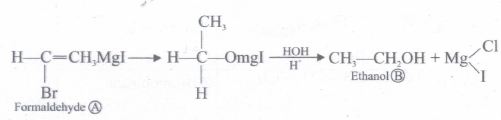
(iii) Ethanol Ⓑ, reacts with PCl5 to give C2H5CI, Ethyl chloride © as the product.

(iv) CH3-CH2CI © on reaction with alcoholic KOH undergoes dehydrohalogenation to give ethylene CH2 = CH2 © as the product.
\(CH_{ 3 }-{ CH }_{ 2 }Cl\overset { alcoholic }{ \underset { KOH }{ \longrightarrow } } \underset { Ethlene }{ { CH }_{ 2 }={ CH }_{ 2 }+HCl } \)
| A | HCHO | Forrnaldehyde |
| B | CH3 -CH2OH | Ethanol |
| C | CH3 -CH2CI | Ethyl chloride |
| D | CH2 -CH2 | Ethylene |
17.
(i) When half filled orbitals of two atoms overlap, a covalent bond will be formed between them.
(ii) The resultant overlapping orbital is occupied by the two electrons with opposite spins. For example, when H2 is formed, the two Is electrons of two hydrogen atoms get paired up and occupy the overlapped orbital.
(iii) The strength of a covalent bond depends upon the extent of overlap of atomic orbitals. Greater the overlap, larger is the energy released and stronger will be the bond formed.
(iv) Each atomic orbital has a specfic direction (except s-orbital which is spherical) and hence orbital overlap takes place in the direction that maximizes overlap.
18.
Rain water normally has a pH of 5.6 due to dissolution of atmospheric CO2 into it. Oxides of sulphur and nitrogen in the atmosphere may be absorbed by droplets of frater that make up clouds and get chemically converted into sulphuric acid and nitric acid respectively as a results of pH of rain water drops below the level 5.6, hence it is called acid rain. Acid rain is a by-product of a variety of sulphur and nitrogen oxides in the atmosphere. Burning of fossil fuels (coal and oil) in power stations, furnaces and petrol, diesel in motor engines produce sulphur dioxide and nitrogen oxides The main contributors of acid rain are SO2 and NO2.They are converted into sulphuric acid and nitric acid respectively by the reaction with oxygen and water.
2SO2 + O2 + 2H2O ⟶ 2H2SO4
4NO2 + O2 + 2H2O ⟶ 4HNO3
Harmful effects of acid rain
Some harmful effects are discussed below :
(i) Acid rain causes extensive damage to buildings and structural materials of marbles. This attack on marble is termed as Stone leprosy.
CaCO3 + H2SO4 ⟶ CaSO4 + H2O +CO2 ↑
(ii) Acid rain affects plants and animal life in aquatic ecosystem.
(iii) It is harmful for agriculture, trees and plants as it dissolves and removes the nutrients needed for their growth.
(iv) It corrodes water pipes resulting in the leaching of heavy metals such as iron, lead and copper into the drinking water which have toxic effects.
(v) It causes respiratory ailment in humans and animals.
19.
w = 0.2 g ,N = 1/20 N, v = 15 ml
\(\mathrm{V}=15 \mathrm{ml} \% \mathrm{~N}=\frac{1.4 \mathrm{NV}}{\mathrm{W}}=\frac{1.4 \times 1 / 20^{\times 15}}{0.2}=5.25 \%\)
20.
\(\Delta T_f=0.093^oC=0.093K\)
m = ?
Kf = 1.86K Kg mol-1
\(\Delta T_f=K_f.m\)
\(\therefore m={\Delta T_f\over K_f}\)
\(={0.093K\over 1.86\ K\ Kg\ mol^{-1}}\)
= 0.05 mol Kg-1
= 0.05 m.
21.
Characteristics of entropy:
(i) Entropy is a thermodynamic state function that is a measure of the randomness or disorderliness of the system.
(ii) In general, the entropy of gaseous system is greater than liquids and greater than solids. The symbol of entropy is S.
(iii) Entropy is defined as for a reversible change taking place at a constant temperature (T), the change in entropy (\(\Delta\)S) of the system is equal to heat energy absorbed or evolved (q) by the system divided by the constant temperature (T).
\(\Delta S_{sys}=\frac{q_{rev}}{T}\)
(iv) If heat is absorbed, then \(\Delta\)S is positive and there will be increase in entropy. If heat is evolved, \(\Delta\)S is negative and there is a decrease in entropy.
(v)The change in entropy of a process represented by \(\Delta\) S and is given by the equation.
\(\Delta S_{sys}=S_f-S_i\)
(vi) If Sf > Si, \(\Delta\)S is positive, the reaction is spontaneous and reversible.
If Sf < Si, \(\Delta\)S is negative, the reaction is non-spontaneous and irreversible.
(vii) Unit of entropy: SI unit of entropy is J K-1.
22.
| Elements | Percentage | Atomic mass | Relative No. of atoms | Simple ratio of atoms | Simplest whole number ratio |
|---|---|---|---|---|---|
| Carbon (C) | 40.65% | 12 | \({40.65\over 12}=3.3875\) | \({3.387\over1.693}=2.0\) | 2 |
| Hydrogen (H) | 8.55% | 1 | \({8.55\over1}=8.55\) | \({8.55\over1.693}=5.0\) | 5 |
| Nitrogen (N) | 23.7% | 14 | \({23.7\over 14}=1.693\) | \({1.693\over1.693}=1.0\) | 1 |
| Oxygen (O) | 27.1% | 16 | \({27.1\over16}=1.693\) | \({1.693\over1.693}=1.0\) | 1 |
Empirical formula = C2H5NO
Molecular mass = 2 x vapour density
= 2 x 29.5 = 59.0
Empirical formula mass of C2H5NO = 24 + 5 + 14 +16
= 59
n = \({Molecular \ mass \over Empirical \ formula \ mass }={59\over 59}=1\)
\(\therefore\) Molecular formula = (Empirical formula)n
= (C2H5NO)1
Molecular formula = C2H5NO
23.
(i) An element A belonging to II group and II period is beryllium (A)
(ii) Beryllium reacts with chlorine to form beryllium chloride (B)
Be +Cl2 \(\longrightarrow \) BeCl2
(B)
(iii) Beryllium chloride on treatment with LialH Forms beryllium hydride (c)
2BeCl2 + LiA1H4 \(\longrightarrow \) 2BeH2 + LiCl + AlCl3
(C)
| A | Be | Beryllium |
| B | Becl2 | Beryllium Chloride |
| C | BeH2 | Beryllium Hydride |
24.
The electronic configuration of K atom is
K19 = (1s2)(2s2p6)(3s23p6)4s1
Effective nuclear charge (Z*) = Z - S
Z* = 19 - [(0.85 \(\times\) No. of electrons in (n -1)th shell) + (1.00 total number of electrons in the inner shells)]
= 19-[0.85 \(\times\) (8) + (1.00 \(\times\) 10)]
Z* = 2.20
25.
The element which occupies group number (16) and period number (2) is oxygen. (B) is D2O which is used as a moderator in nuclear reactions.
So (A) must be deuterium, which is an isotope of hydrogen
\(2\underset { (A) }{ { D }_{ 2 } } +{ O }_{ 2 }\rightarrow 2\underset { (B) }{ { D }_{ 2 }O } \)
So (B) is D2O
(A) adds to (C) as follows :
\(3 \mathrm{D}_{2}+\mathrm{C}_{3} \mathrm{H}_{6} \rightarrow \mathrm{CH}_{3}-\mathrm{CH}-\mathrm{CH}_{2}\)
So (D) is 1,2 - dideutero propane.
| A | D2 | Deuterium |
| B | D2O | Heavy water or deuterium oxide |
| C | CH3-CH = CH2 | Propene |
| D | CH3 - CHD - CH2D | Propane deuteride |
26.
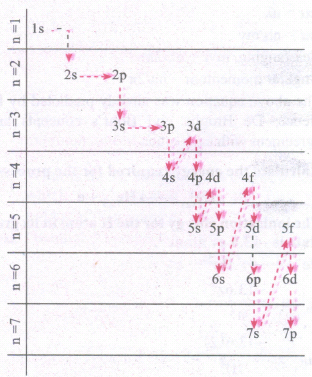
The word Aufbau in German means 'building up'. In the ground state of the atoms, the orbitals are filled in the order of their increasing energies. That is the electrons first occupy the lowest energy orbital available to them.
Once the lower energy orbitals are completely filled, then the electrons enter the next higher energy orbitals. The order of filling of various orbitals as per the Aufbau principle which is in accordance with (n + l) rule.
27.
(i) The energy of electrons in atoms is quantised
(ii) The existence of quantized electronic energy levels is a direct result of the wave like properties of electrons. The solutions of Schrodinger wave equation gives the allowed energy levels (orbits).
(iii) According to Heisenberg uncertainty principle, the exact position and momentum of an electron can not be determined with absolute accuracy. As a consequence, quantum mechanics introduced the concept of orbital. Orbital is a three dimensional space in which the probability of finding the electron is maximum.
(iv) The solution of Schrodinger wave equation for the allowed energies of an atom gives the wave function ψ,which represents an atomic orbital. The wave nature of electron present in an orbital can be well defined by the wave function ψ.
(v) The wave function ψ itself has no physical meaning.However, the probability of finding the electron in a small volume dxdydz around a point (x,y,z) is proportional to |ψ(x,y,x)|2 dxdydz |ψ(x,y,x)|2 is known as probability density and is always positive.
28.
(i) The arrangement of atoms must be identical or almost same in every resonance structure.
(ii) The energy content of all the canomical forms must be almost same.
(iii) Each canocial form must have the same number of unpaired electrons.
29.
Al4C3 + 12D2O ➝ 4AI(OD)3 + 3CD4
Aluminium Heavy Aluminium Deutero
carbide water deuteroxide Methane
CaC2 + D2O ➝ Ca(OD)2 + C2D2
Calcium Calcium Deutero
Carbide deuteroxide acetylene
Mg3N2 + 6D2O ➝ 3Mg(OD)2 + 2ND3
Magnesium Magnesium Deutero
Nitride deuteroxide ammonia
Ca3P2 + 6D2O ➝ 3Ca(OD)2 + 2PD3
Calcium Calcium Deutero
Phosphide deuteroxide Phosphine
30.
PNe = XNe PTotal
\(X_{Ne}=\frac{n_{Ne}}{n_{Ne}+n_{Ar}+n_{Xe}}\)
\(=\frac{4.76}{4.76+0.74+2.5}=0.595\)
\(X_{Ar}=\frac{n_{Ar}}{n_{Ne}+n_{Ar}+n_{Xe}}\)
\(=\frac{0.74}{4.76+0.74+2.5}=0.0093\)
\(X_{Xe}=\frac{n_{Xe}}{n_{Ne}+n_{Ar}+n_{Xe}}\)
\(=\frac{2.5}{4.76+0.74+2.5}=0.312\)
PNe = XNe PTotal = 0.595 x 2
= 1.19 atm.
PAr = XAr PTotal = 0.093 x 2
= 0.186 atm.
PXe = XXe PTotal = 0.312 x 2
= 0.624 atm.
31.
Apple turns brown when cut since the surface is exposed to air and undergoes oxidation. It can be prevented by dipping sliced apples in lemon juice. Lemon juice is an antioxidant which takes in all the available oxygen and prevents it from reaching the apple's tissues
32.
Ti = 298 K
Tf = 298.45 K
k = 2.5 kJK-1
m =3.5g
Mm = 28
heat evolved= kΔT
=k (Tf - Ti)
=2.5 KJ K-1 (298.45 - 298)K
=1.125kJ
ΔHc=\(\frac{1.125}{3.5}\times\)28KJmol-1
ΔHc = 9 kJ mol-1
33.
(i) Lithium and beryllium form more covalent compounds, unlike the alkali and alkali earth metals which predominantly form ionic compounds.
(ii) The elements of the second period have only four orbitals (2s & 2p) in the valence shell and have a maximum co-valence of 4, whereas the other members of the subsequent periods have more orbitals in their valence shell and shows higher valences. For example, boron forms BF4- and aluminium forms AIF63-.
34.
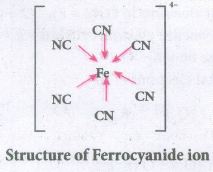
In ferrocynide ion [Fe(CN)6]4-, each cyanide ion (CN-) donates a pair of electrons to form a co-ordinate bond with iron (Fe2+) and these electrons are shared by Fe2+ and CN-.
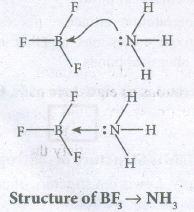
In certain cases, molecules having a lone pair of electrons such as ammonia donates its pair to an electron deficient molecules such as B3 to form a co-ordinate bond.
35.
| Reaction | Product | Name of the reaction |
|---|---|---|
| \({ CH }_{ 3 }{ CH }_{ 2 }OH+{ SOCl }_{ 2 }\overset { pyridine }{ \longrightarrow } ?\) | Chloro ethane CH3CH2Cl+SO2+HCl |
Darzens reactions |
| \({ CH }_{ 3 }{ CH }_{ 2 }Br+AgF\longrightarrow ?\) | Fluoro ethane CH3CH2F+AgBr |
Swarts reaction |
| \({ C }_{ 6 }{ H }_{ 5 }Cl+Na\overset { ether }{ \longrightarrow } ?\) | .Biphenyl C6H5-C6H5 |
Fittig |
36.

37.
This condition is not static and is dynamic, because both the forward and reverse reactions are still occurring with the same rate. No macroscopic change is observed.
38.
(i) Heat (q) is regarded as energy in transit across the boundary separating a system from its surroundings.
(ii) Heat changes result in temperature differences between system and surroundings.
(iii) Heat is a path function.
(iv) Units of heat: SI unit of heat is the joule (J).
39.
Molar Mass of Al(OH)3 = \(\begin{cases} atomic\ \ mass\ 'al'+3x\ atomic\ \ mass\ \ of \ 'O' \\ +3x\ atomic\ \ mass\ \ of\ \ 'h' \end{cases}\)
= 27 + 3\(\times\)16 + 3\(\times\)1 = 78
Acidity = 3
Equivalent mass of AL(OH)3 = \(\frac { Molar\quad mass }{ acidity } =\frac { 78 }{ 3 } =26geq^{ -1 }\)
40.
The real gases behave ideally at low pressure and at high temperature.
41.
The solubility product of NaCl is lower than that of NaOH. The more soluble a substance is, the higher the Ksp value it has In aqueous solution NaOH gives OH- ions. It can be solvated by establishing H-bonds with water molecules. So it is more water soluble.
42.
(i) ground state :
| \(\upharpoonleft \) | \(\upharpoonleft \) | \(\upharpoonleft \) | \(\upharpoonleft \) | \(\upharpoonleft \) |
This type of electronic configuration have ten possible arrangement (i.e. Half filled configuration is More).
43.
2Ca + O2 ⟶ 2CaO

11th Standard Syllabus & Materials
11th Standard
TN 11th Tamil பீடு பெற நில் - செய்யுள் - காவடிச்சிந்து Important Questions And Answers Study Material - QB365 Set A
NEW11th Standard
TN 11th Tamil பீடு பெற நில் - உரைநடை - மலை இடப்பெயர்கள் : ஓர் ஆய்வு Important Questions And Answers Study Material - QB365 Set A
NEW11th Standard
TN 11th Tamil மாமழை போற்றுதும் - துணைப்பாடம் - யானை டாக்டர் Important Questions And Answers Study Material - QB365 Set A
NEW11th Standard
TN 11th Tamil மாமழை போற்றுதும் - செய்யுள் - ஐங்குறுநூறு Important Questions And Answers Study Material - QB365 Set A



Tamilnadu Stateboard 11th Standard Subjects

Maths

Commerce

Economics

Biology

Business Maths and Statistics

Accountancy

Computer Science

Physics
Chemistry
Maths
Biology
Economics
Physics
Chemistry

History
Business Maths and Statistics

Computer Science
Accountancy

Computer Applications
History
Computer Technology
Commerce
Computer Applications
Computer Technology

Tamil

English

French
Tamilnadu Stateboard Standards
