
 100% FREE ACCESS
11th Standard Syllabus & Materials
11th Standard
TN 11th Tamil இயற்கை வேளாண்மை,சுற்றுச்சூழல் -செய்யுள் - மனோன்மணீயம் Important Questions And Answers Study Material - QB365 Set A
NEW11th Standard
TN 11th Tamil என்னுயிர் என்பேன் -துணைப்பாடம் - இசைத்தமிழர் இருவர் Important Questions And Answers Study Material - QB365 Set A
NEW11th Standard
TN 11th Tamil மொழி கலை -செய்யுள் - ஒவ்வொரு புல்லையும் Important Questions And Answers Study Material - QB365 Set A
NEW11th Standard
TN 11th Tamil பீடு பெற நில் - இலக்கணம் - பகுபத உறுப்புகள் Important Questions And Answers Study Material - QB365 Set A
NEW11th Standard
TN 11th Tamil பீடு பெற நில் - துணைப்பாடம் - வாடிவாசல் Important Questions And Answers Study Material - QB365 Set A
NEW11th Standard
TN 11th Tamil பீடு பெற நில் - செய்யுள் - குறுந்தொகை Important Questions And Answers Study Material - QB365 Set A

Published on: 13/09/2019
Download Tamil Nadu 11th Standard Chemistry question papers, model tests, one-mark questions, important questions, and public exam papers in PDF format. Free study materials and answer keys for TN State Board students.
Questions + Answers key
Take MCQ Chemistry Test
1.
The molar mass of Na2SO4 is ___________.
129
142
110
70
2.
The number of molecules in 16g of methane is _________
3.023 x 10²³
6.023 x 10²³
16/6.023 x 1023
6.023/3 x 1023
3.
How many moles of magnesium phosphate Mg3(PO4)2 Will Contain 0.25 moles of oxygen atoms?
0.02
3.125 x 10⁻²
1.25 x 10⁻²
2.5 x 10⁻²
4.
Calculate the percentage of N in ammonia molecule.
121.42%
28.35%
82.35%
28.53%
5.
The energy of electron in an atom is given by En =
\(\frac { 4{ \pi }^{ 2 }{ me }^{ 4 } }{ { n }^{ 2 }h^{ 2 } } \)
\(\frac { 2{ \pi }^{ 2 }{ me }^{ 4 } }{ { n }^{ 2 }h^{ 2 } } \)
\(\frac { 2{ \pi }^{ 2 }{ me }^{ 4 } }{ { n }^{ 2 }h^{ 2 } } \)
\(\frac { 2{ \pi }{ me }^{ 4 } }{ { n }^{ 2 }h^{ 2 } } \)
6.
Which is the lightest among the following?
An atom of hydrogen
An electron
A neutron
A proton
7.
Which one of the following is used as a standard for atomic mass?
6C12
7C12
6C13
6C14
8.
The mass of a gas that occupies a volume of 612.5 ml at room temperature and pressure (250 c and 1 atm pressure) is 1.1g. The molar mass of the gas is _______.
66.25 g mol-1
44 g mol-1
24.5 g mol-1
662.5 g mol-1
9.
7.5 g of a gas occupies a volume of 5.6 litres at 0° C and 1 atm pressure. The gas is ________.
NO
N2O
CO
CO2
10.
Which one of the following represents 180 g of water ?
5 Moles of water
90 moles of water
\(\frac { 6.022\times { 10 }^{ 23 } }{ 180 } \) molecules of water
6.022\(\times\)1024molecules of water
11.
The oxidation number of oxygen in O2 is__________
0
+1
+2
-2
12.
Hot concentrated sulphuric acid is a moderately strong oxidizing agent. Which of the following reactions does not show oxidising behaviour ?
Cu + 2H2 SO4 \(\longrightarrow \) CuSO4 +SO2 + 2H2O
C + 2H2 + SO4 \(\longrightarrow \) CO2 + 2SO2 + 2H2O
BaCl2 + H2SO4 \(\longrightarrow \) BaSO4 + 2HCl
None of the above
13.
1 g of an impure sample of magnesium carbonate (containing no thermally decomposable impurities) on complete thermal decomposition gave 0.44 g of carbon dioxide gas. The percentage of impurity in the sample is ______________.
0%
4.4%
16%
8.4%
14.
An element X has the following isotopic Composition 200X = 90%, 199X = 8% and 202X = 2%. The Weighted average atomic mass of the element X is closest to _________.
201 u
202 u
199 u
200 u
15.
What is milk of lime? How CO2 reacts with it?
16.
Discuss the biological importance of sodium and potassium.
17.
At room temperature, Hydrogen reacts very slowly. Explain
18.
What is the usual definition of entropy? What is the unit of entropy?
19.
Explain whether a gas approaches ideal behavior or deviates from ideal behaviour if
it is compressed to a smaller volume at constant temperature.
20.
What do you understand by the term oxidation number ?
21.
Assertion (A): In the reaction between potassium permanganate and potassium iodide, permanganate ions act as oxidising agent.
Reason (R): Oxidation state of manganese changes from +2 to +7 during the reaction.
Codes:
(a) Both A and R are true and R explains A
(b) Both A and R are true but R does not explain A
(c) A is true but R is false
(d) Both A and R are false
Both A and R are true and R explains A
Both A and R are true but R does not explain A
A is true but R is false
Both A and R are false
22.
Energy of an electron in hydrogen atom in ground state is -13.6 eV. What is the energy of the electron in the second excited state?
23.
0.456 g of a metal gives 0.606 g of its chloride. Calculate the equivalent mass of the metal.
24.
State the various statements of second law of thermodynamics.
25.
A sample of gas at 15°C at 1 atm. has a volume of 2.58 dm3. When the temperature is raised to 38°C at 1 atm does the volume of the gas increase? If so, calculate the final volume.
26.
Zn rod is immersed in CuSO4 solution. What will your observe after an hour? Explain your observation in terms of the redox reaction.
27.
Categorise the redox reactions that occur in our daily life
28.
Balance the following equations by oxidation number method.
P + HNO3 ⟶ HPO3 + NO + H2O
29.
Give the structural features of modern periodic law.
30.
A Compound on analysis gave Na = 14.31% S = 9.97% H = 6.22% and 0 = 69.5%.
Calculate the molecular formula of the compound if all the hydrogen in the compound is present in combination with oxygen as a water of crystallization. (molecular mass of the compound is 322).
31.
Calculate the empirical and molecular formula of a compound containing 76.6% carbon, 6.38 % hydrogen and rest oxygen its vapour density is 47.
32.
What is screening effect? Briefly give the basis for pauling's scale of electronegativity.
1.
(b)
142
2.
(b)
6.023 x 10²³
3.
(b)
3.125 x 10⁻²
4.
(c)
82.35%
5.
(c)
\(\frac { 2{ \pi }^{ 2 }{ me }^{ 4 } }{ { n }^{ 2 }h^{ 2 } } \)
6.
(b)
An electron
7.
(a)
6C12
8.
(b)
44 g mol-1
9.
(a)
NO
10.
(d)
6.022\(\times\)1024molecules of water
11.
(a)
0
12.
(c)
BaCl2 + H2SO4 \(\longrightarrow \) BaSO4 + 2HCl
13.
(c)
16%
14.
(d)
200 u
15.
The aqueous solution of calcium hydroxide is known as lime water and a suspension of slaked lime in water is known as milk of lime. When carbon dioxide is passed through lime water, it turns milky due to the formation of calcium carbonate.
\(Ca(OH)_2 + CO_2 ⟶ CaCO_3 + H_2O\)
16.
(i) Sodium and potassium ions maintain the ion balance and nerve impulse conduction.
(ii) Transport of sugar and amino acids into cells.
(iii) Potassium ions activate many enzymes, participate in the oxidation of glucose to produce ATP.
(iv) With sodium, potassium ion is responsible for the transmission of nerve signals.
(v) Sodium and potassium pump play an important role in transmitting nerve signals.
17.
In elementary state, Hydrogen exists as a diatomic molecule. The bond between two hydrogen atoms H-H is covalent. The bond dissociation energy is very high (435.9 Klmol-1 ). So bond cleavage is extremely difficult, so hydrogen is less reactive at room temperature.
18.
(i) Entropy is a measure of the molecular disorderliness (randomness) of a system. dS = dqrev/T
(ii) The entropy (S) is equal to heat energy exchanged (q) divided by the temperature (T) at which the exchange takes place. Therefore, The SI unit of entropy is JK-1
19.
The gas deviates from ideal gas behaviour and will be a real gas only. In the compressed state, the inter molecular forces will be very high as the molecules are very close.
20.
It is defined as the imaginary charge left on the atom when all other atoms of the compound have been removed in their usual oxidation states that are assigned according to set of rules.
21.
(c) A is true but R is false
22.
\(\mathrm{E}_{n}=\frac{-13.6}{\mathrm{n}^{2}} \mathrm{eV}\)
Second excited state
\(\therefore E_{3}=\frac{-13.6}{9} \mathrm{eV}\)
n = 3
E3 = -1.51 eV
23.
Mass of the metal = 0.456 g
Mass of the metal chloride = 0.606 g
0.456 g of the metal combines with 0.15 g of chlorine.
Mass of the metal that combines with 35.5 g of chlorine is \(\frac{0.456}{0.15}\) x 35.5
= 107.92 g eq-1.
24.
(i) Kelvin-Planck statement: It is impossible to construct a machine that absorbs heat from a hot source and converts it completely into work by a cyclic process without transferring a part of heat to a cold sink.
(ii) Clausius statement: It is impossible to transfer heat from a cold reservoir to a hot reservoir without doing some work.
(iii) Entropy statement: The entropy of an isolated system increases during a spontaneous process
25.
T1 = 15oC + 273 T2= 38 + 273
T1 = 288 K T2 = 311 K
V1 = 2.58 dm3 V2 = ?
(P = 1 atm constant)
\(\frac { { V }_{ 1 } }{ { T }_{ 1 } } =\frac { { V }_{ 2 } }{ { T }_{ 2 } } \)
\({ V }_{ 2 }=\left( \frac { { V }_{ 1 } }{ { T }_{ 1 } } \right) \times { T }_{ 2 }\)
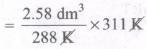
V2 = 2.78 dm3 i.e. volume increased from 2.58 dm3 to 2.78 dm3.
26.
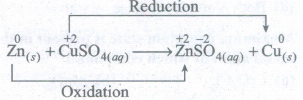
1. The blue colour of CuSO4 solution will get discharged and reddish brown copper metal will be deposited on Zn rod.
2. This is because blue colour Cu2+ (in CuSO4) gets reduced to Cu by accepting two electrons from Zn, which gets oxidised to colourless ZnSO4.
27.
1. Fading of the colour of the clothes
2. Burning of cooking gas, fuel, wood, etc.
3. Rusting of Iron
4. Extraction of Metals
28.
Step-1: To find atoms undergoing change in O.N
\(\overset { 0 }{ P } +\overset { +1\quad +5 }{ HNO_{ 3 } } \rightarrow \overset { +1+5-2 }{ HPO_{ 3 } } +\overset { +1-2 }{ NO } +\overset { +1-2 }{ { H }_{ 2 }O } \)
Step-2: To find total decrease and increase in O.N.
P ⟶ HPO3 (increase in O.N. of 5 units per atom)
HNO3 ⟶ NO (decrease in O.N. of3 units per atom)
Total decrease 5 x 3 = 15
Total increase 3 x 5 = 15
Step-3: To balance the total increase and decrease in the equation, by multiplying P by 3 and HNO3 by 5.
3P + 5HNO3 ⟶ HPO3 + NO + H2O
Step-4: To balance all atoms other than 'O' and 'H'
3P + 5HNO3 ⟶ 3HPO3 + 5NO + H2O
Step-5: To balance by oxygen atoms
Oxygen and hydrogen atoms balance by themselves.
Hence the balanced equation is 3P + 5HNO3 ⟶ 3HPO3 + 5 NO + H2O
29.
(i) According to the recommendation of IUPAC, the groups are numbered from 1 to 181A.
(ii) There are 18 vertical columns which constitute 18 groups or families.
(iii) There are 7 horizontal rows of the periodic table known as periods.
(iv) The first period contains two elements. One present in first group and the other in 18th group.
(v) Second and third periods contain 8 elements in each.
(vi) Fourth and fifth periods are completely filled as they contain 18 elements in each.
(vii) The sixth period contains 32 elements. The seventh is incomplete. Fourteen elements of both sixth and seventh periods are placed in separate panels at the bottom of the table.
(viii) This periodic table is important and useful because we can predict the properties of any element using periodic trend.
30.
| Element | % | Relative number of atoms | Simple Ratio |
| Na | 14.31 | \(\frac { 14.31 }{ 23 } =0.62\) | \(\frac { 0.62 }{ 0.31 } =2\) |
| S | 9.97 | \(\frac { 9.97 }{ 32 } =0.31\) | \(\frac { 0.31 }{ 0.31 } =1\) |
| H | 6.22 | \(\frac { 6.22 }{ 1 } =6.22\) | \(\frac { 6.22 }{ 0.31 } =20\) |
| O | 69.5 | \(\frac { 69.5 }{ 16 } =4.34\) | \(\frac { 4.34 }{ 0.31 } =14\) |
Empirical formula = Na2 SH20 O14
\(\left[ \begin{matrix} { Na }_{ 2 }{ SH }_{ 20 }{ O }_{ 14 } \\ =(2\times 23)+(1\times 32)+(20\times 1)+14(16) \\ =46+32+20+234 \\ =322 \end{matrix} \right] \)
n = \(\frac { molar\quad mass }{ caluclated\quad empirical\quad formula\quad mass } =\frac { 322 }{ 322 } =1\)
Molecular formula = Na2 SH20O14
Since all the hydrogen in the compound are present as water
\(\therefore \) The molecular formula is Na2 SO4 10H2O.
31.
| Element | Percentage | Atomic mass | Relative number of atoms | simple ratio | Whole no |
| C | 76.6 | 12 | \(\frac { 76.6 }{ 12 } =6.38\) | \(\frac { 6.38 }{ 1.06 } =6\) | 6 |
| H | 6.38 | 1 | \(\frac { 6.38 }{ 1 } =6.38\) | \(\frac { 6.38 }{ 1.06 } =6\) | 6 |
| 0 | 17.02 | 16 | \(\frac { 17.02 }{ 16 } =1.06\) | \(1.06\frac { 1.06 }{ 1.06 } =1\) | 1 |
Empirical Formula = C6 H6O
n = \(\frac { molar\ mass }{ calculated\ eprirical\ formula\ mass } \)
= \(\frac { 2\times \ vapour\ density }{ 94 } \frac { 2\times 47 }{ 94 } =1,\)
Molecular formula (C6H6O) x 1 = C6H6O.
32.
Screening effect: The repulsive force between the inner shell electrons and the valence electrons leads to a decrease in the electrostatic attractive forces acting on the valence electrons by the nucleus. Thus, the inner shell electrons act as a shield between the nucleus and the valence electrons. This effect is called shielding effect.
Pauling's scale: Pauling, he assigned arbitrary value of electronegativities for hydrogen and fluorine as 2.2 and 4.0 respectively. Based on this the electronegativity values for other elements can be calculated using the following expression.
\(({ X }_{ A }-{ X }_{ B })=0.182\sqrt { E_{ AB } } -({ E }_{ AA }*{ E }_{ BB })^{ 1/2 }\)
Where EAB' EAA and EBB are the bond dissociation energies of AB, A2 and B2 molecules respectively. The electronegativity of any given element is not a constant and its value depends on the element to which it is covalently bound. The electronegativity values play an important role in predicting the nature of the bond.

11th Standard Syllabus & Materials
11th Standard
TN 11th Tamil பீடு பெற நில் - செய்யுள் - காவடிச்சிந்து Important Questions And Answers Study Material - QB365 Set A
NEW11th Standard
TN 11th Tamil பீடு பெற நில் - உரைநடை - மலை இடப்பெயர்கள் : ஓர் ஆய்வு Important Questions And Answers Study Material - QB365 Set A
NEW11th Standard
TN 11th Tamil மாமழை போற்றுதும் - துணைப்பாடம் - யானை டாக்டர் Important Questions And Answers Study Material - QB365 Set A
NEW11th Standard
TN 11th Tamil மாமழை போற்றுதும் - செய்யுள் - ஐங்குறுநூறு Important Questions And Answers Study Material - QB365 Set A



Tamilnadu Stateboard 11th Standard Subjects

Maths

Commerce

Economics

Biology

Business Maths and Statistics

Accountancy

Computer Science

Physics
Chemistry
Maths
Biology
Economics
Physics
Chemistry

History
Business Maths and Statistics

Computer Science
Accountancy

Computer Applications
History
Computer Technology
Commerce
Computer Applications
Computer Technology

Tamil

English

French
Tamilnadu Stateboard Standards
