
 100% FREE ACCESS
11th Standard CBSE Syllabus & Materials
11th Standard CBSE
CBSE 11th Economics PART-A - Presentation of Data - New Sample Question Papers Study Material - QB365 Set A
NEW11th Standard CBSE
CBSE 11th Economics PART-A - Organisation of Data - New Sample Question Papers Study Material - QB365 Set A
NEW11th Standard CBSE
CBSE 11th Economics PART-A - Collection of Data - New Sample Question Papers Study Material - QB365 Set A
NEW11th Standard CBSE
CBSE 11th Economics PART-A - Introduction to Economics and Statistics - New Sample Question Papers Study Material - QB365 Set A
NEW11th Standard CBSE
CBSE 11th Business Studies International Trade Sample Question Papers Study Material - QB365 Set A
NEW11th Standard CBSE
CBSE 11th Business Studies Evolution and Fundamentals of Business Sample Question Papers Study Material - QB365 Set A

Published on: 29/11/2018
NCERT is an autonomous organization that sets the curriculum for the Central Board of Secondary Education, an education board adopted by various schools across the nation. The NCERT Solutions for Class 11 Chemistry includes answers to questions prescribed in textbooks adhering to school and exam syllabi. The NCERT Solutions for Class 11 Chemistry includes answers to questions ranging across various chapters such as the Structure of Atom, States of Matter, Thermodynamics, Equilibrium, Redox Reactions, Hydrogen, and others. Studying the NCERT Solutions for Class 11 Chemistry PDF assists students in acquiring a foundational knowledge for understanding different chemistry topics and solving various chemical equations.
CBSE Class 11 Chemistry always important to practice last year board exam question paper to practice for the upcoming board exams. Here the questions are covered from last 10 years which you should practice understanding the paper pattern and type of questions which have come in previous board exams for class 11. This will help you to get better marks in class 12 board exams. Practice getting better marks in board exams.
In this question paper, the questions are covered from the entire syllabus of 11th Chemistry. Questions are prepared as per NCERT guideline with the help of expert teachers.
Download CBSE Class 11th Standard CBSE Chemistry question papers, sample papers, important questions, and previous year solved papers in PDF format. Get free study materials, NCERT solutions, and exam preparation resources for Class 11th Standard CBSE Chemistry
Questions + Answers key
Take MCQ Chemistry Test
1.
What is the use of recycled waste?
2.
What is a spontaneous change? Give one example.
3.
Why do the C- C bonds rather than C - H bonds break during cracking of alkanes?
4.
Rotation around carbon-carbon single bond of ethane is not completely free. Justify the statement.
5.
In the estimation of sulphur by carius method 0.468 of an organic sulphur compound afforded 0.668 g of barium sulphate. Find the percentage of sulphur in the given compound.
6.
Explain why is there a phenomenal decrease in ionisation enthalpy from carbon to silicon?
7.
Justify that the following reaction are redox reaction
\(4BCl_{ 3 }(g)+3LiAl{ H }_{ 4 }(s)\longrightarrow 2{ B }_{ 2 }{ H }_{ 6 }(g)+3LiCl(s)+3AlC{ l }_{ 3 }(s)\)
8.
Write the number designation of a group that has 2 electrons beyond a noble gas configuration.
9.
What physical meaning is attributed to the square of the absolute value of wave function \(|\psi |^{ 2 }\)?
10.
How can you prove that red oxide of copper is not an element ?
11.
How many moles of atoms are present in 9.0 g of aluminum?
12.
Discuss the preparation of alkanes by Wurtz reaction. What is the limitation of the reaction?
13.
Apart from tetrahedral geometry, another possible geometry for CH4 is square planar with the four H atoms at the corners of the square and the C atom at its centre. Explain why CH4 is not square planar ?
14.
An alloy of iron (53.6%), nickel (45.8%) and manganese (0.6%) has a density of 8.17 g cm-3. Calculate the number of Ni atoms present in the alloy of dimensions 10.0 cm x 20.0 cm x 15.0 cm.
15.
Arrange the following set of compounds in order of their decreasing relative reactivity with an electrophile, E+.
(i) Chlorobenzene, 2, 4-dinitrochlorobenzene, p-nitrochlorobenzene
(ii) Toluene, \(p-{ H }_{ 3 }C-{ C }_{ 6 }{ H }_{ 4 }-{ NO }_{ 2 },\)
\(p-{ O }_{ 2 }N-{ C }_{ 6 }{ H }_{ 4 }-{ NO }_{ 2 }\)
Also explain ur answer.
16.
Complete the following chemical reactions and classify the above into (a) hydrolysis,(b) redox and (c) hydration reactions.
\(PbS(s)+{ 4 }H_{ 2 }{ O }_{ 2 }(aq)\rightarrow \)
17.
Discuss the shape of the following molecules using the VSEPR model: BeCl2, BCl3, SiCl4, AsF5, H2S, PH3
18.
Justify the given statement with suitable examples "the properties of the elements are a periodic function of their atomic number".
19.
A compound made up of two elements A and B has A = 70%, B = 30%. Their relative number of moles in the compound are 1.25 and 1.88. Calculate molecular formula of the compound, if its molecular mass is found to be 160.
20.
What are the harmful effects of photochemical smog and how can they be controlled?
21.
What are pesticides and herbicides? Explain giving examples.
22.
An alkane has a molecule mass of 72. Give all the possible structural isomers along with their IUPAC names.
23.
Consider structure I to VII and answer the following questions (i) and (ii).
I. \({ CH }_{ 3 }-{ CH }_{ 2 }-{ CH }_{ 2 }-{ CH }_{ 2 }-{ OH }\)
II.
\({ CH }_{ 3 }-{ CH }_{ 2 }-{ CH }-{ CH }_{ 3 }\\ \quad \quad \quad \quad \quad \quad \quad |\\ \quad \quad \quad \quad \quad \quad \quad { OH }\)
III.
\({ \quad \quad \quad \quad CH }_{ 3 }\\ \quad \quad \quad \quad |\\ { { CH }_{ 3 } }-{ C }-{ CH }_{ 3 }\\ \quad \quad \quad \quad |\\ \quad \quad \quad \quad { OH }\)
IV.
\({ CH }_{ 3 }-{ CH }-{ CH_{ 2 } }-{ OH }\\ \quad \quad \quad \quad |\\ \quad \quad \quad \quad { CH }_{ 3 }\)
V. \({ CH }_{ 2 }-{ CH }_{ 2 }-{ O }-{ CH }_{ 2 }-{ CH }_{ 3 }\)
VI.
\({ CH }_{ 2 }-{ O }-{ CH }_{ 2 }-{ CH }_{ 2 }-{ CH }_{ 3 }\)
VII.
\({ CH }_{ 3 }-{ O }-{ CH }-{ CH }_{ 3 }\\ \quad \quad \quad \quad \quad \quad |\\ \quad \quad \quad \quad \quad \quad { CH }_{ 3 }\)
Identify the pairs of compounds that represent chain isomerism.
24.
Why cannot sodium and potassium ne prepared by the electrolysis of their aqueous solutions ?
25.
Name a substance which can oxidise H2O2.
26.
List gases which are reponsible for green house effect.
1.
(i) Recycled waste can be used as fuel. It has high octane rating and can be used as green fuel.
(ii) Clothes can be made from recycled plastic waste.
(iii) It can be used to produce electricity.
2.
A process which can take place of its own or initiate under some condition.
For example: Common salt dissolves in water of its own.
3.
Since the bond dissociation energy of C - C bonds (348 KJ mol-1) is lower than bond dissociation energy of C -H bonds (414 KJ mol-1), therefore during cracking of alkanes, C - C bonds break more easily than C - H bonds.
4.
Rotation around C-C single bond is not completely free and it is restricted due to repulsions between the electron clouds of C-H bonds in the adjacent carbon atoms. Therefore, ethane exixts in infinate number of conformations. Out of these, two extreme conformations are staggered and eclipsed.
5.
Total mass of organic compound = 0.468 g [Given]
Mass of barium sulphate formed = 0.668 g [Given]
1 mol of BaSO4 = 233 g of BaSO4=32 g of sulphur
Thus, 0.668 g of BaSO4 contains \(= \frac{32×0.668}{233}\)g of sulphur = 0.0917 g of sulphur
Therefore, percentage of sulphur \(=\frac{0.0197}{0.468}\)×100=19.59%
Hence, the percentage of sulphur in the given compound is 19.59 %.
6.
As we move from carbon to silicon atomic size increases, i.e. the distance between the outermost electron and nucleus increases. Thus, this electron experience very small attraction from the nucleus and hence, easy to remove. Since, the size of Si-atom is larger, the outer electron experience lesser attraction and hence, its ionisation enthalpy (energy required to remove ab electron) is smaller.
7.
\(\overset { +3-1 }{ 4BCl_{ 3 } } (g)+\overset { +1+3-1 }{ 3LiAl{ H }_{ 4 } } (s)\longrightarrow \overset { -3+1 }{ 2{ B }_{ 2 }{ H }_{ 6 } } (g)+\overset { +1-1 }{ 3LiCl } (s)+3\overset { +3-1 }{ AlC{ l }_{ 3 } } (s)\)
Oxidation number of B decreases from +3(in BCl3) to -3(in B2H6) and oxidation number of H increases from -1(in LiAlH4) to +1 (in B2H6 ). This shows that BCl3 is reduced to B2H4 and LiAlH4 is oxidised. Hence, it is redox reaction.
8.
The number designation of a group that has 2 electrons beyond a noble gas configuration will be 2 which means it will belong to group 2 of the periodic table.
9.
|ψ|2 shows the probability of finding the electron at a point with coordinates (x, y, z).
10.
On heating red oxide of copper in the presence of hydrogen, its mass decreases and it forms shining metallic copper which is chemically different from the original compound.
Cu2O + H2 ⟶ 2Cu + H2O
11.
0.33 mol
12.
Wurtz synthesis: Higher alkanes are prepared by heating an alkyl halide (RX) with sodium metal in dry ether solution.
R - X + 2Na + XR \(\overset { ether }{ \longrightarrow } \) R - R + 2NaX
CH3Br + 2Na + BrCH3\(\longrightarrow \) CH3-CH3 + 2NaBr
Limitations: Use of two different alkyl halides in Wurtz reaction always leads to a mixture of alkanes. The separation of these alkanes is difficult because there is only a little difference in their boiling points. Thus only symmetrical alkanes can be prepared by this method.
13.
Electronic configuration of carbon atom: C: σ1s2 2s2 2p2.
In the excited state, the orbital picture of carbon can be represented as:
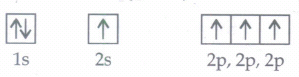
Hence, carbon atom undergoes sp3 hybridization in CH4 molecule and takes a tetrahedral shape.
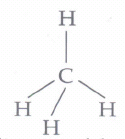
For a square planar shape, the hybridization of the central atom has to be dsp3. However, an atom of carbon does not have d-orbitals to undergo dsp3 hybridization. Hence, the structure of CH4 is tetrahedral.
14.
Calculation of mass of nickel (Ni) in the alloy.
Volume of the alloy = (10.0 cm) x (20.0 cm) x (15.0 cm) = 3000cm3
Mass of the alloy = Density x Volume
Mass of Ni in the alloy = (24510 g) x\(\frac { 45.8}{ 100 } \) = 11225.6 g
Calculation of number of nickel (Ni) atoms in the alloy
Gram atomic mas of Ni = 59 g
59 g of Ni have atoms = 6.022 x 10²³
11225.6 g of Ni have atoms = 6.022 x 10²³ x\(\frac { (11.225.6 g)}{ (59.0 g) } \)= 1.15 x1026atoms
15.
Presence of electron releasing group(or activating group) increases the electron density in benzene nucleus. Therefore, electrophile will attack
benzene nucleus easily. But, the presence of electron withdrawing group like -NO2 decrease the electron density in benzene ring. Therefore, electrophile will attack
benzene nucleus with difficulty. The order of reactivity towards electrophile, E+ in order of their decreasing relative reactivity is
(i) Chlorobenzene > p-nitrochlorobenzene > 2, 4- dinitrochlorobenzene
(ii) Toluene > \(p-{ CH }_{ 3 }-{ C }_{ 6 }{ H }_{ 4 }-{ NO }_{ 2 }>p-{ O }_{ 2 }N-{ C }_{ 6 }{ H }_{ 4 }-{ NO }_{ 2 }\)
16.
\(PbS(s)+{ 4 }H_{ 2 }{ O }_{ 2 }(aq)\rightarrow PbSO_{ 4 }(s)+{ 4H }_{ 2 }O(l)\) (redox reaction)
17.
According to VSEPR theory, the shape of a molecule depends upon the number shell electron pairs (bonded or non-bonded) around the central atom. Pairs of electrons in the valence shell repel each other. The order of their repulsion is as follows
Cl, The central atom Be has only 2 valence electron which are bonded to Cl, so there are only 2 bond pairs and no lone pairs. It is of the type AB2 and hence, the shape linear
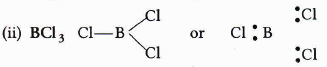
The central atom B has only 3 valence electron which are bonded with three CI atoms, so it contains only 3 bond pairs and no longer pair. It is of the type AB3 and hence, the shape is trigonal plannar
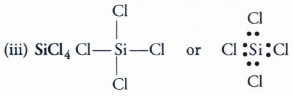
Similarly, the central atom Si has only 4 bond pairs and no longer pair. It is of the type AB4 and hence, the shape is tetrahedral
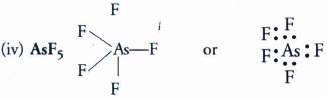
The central atom As has only 5 bond pairs and no lone pair. It is of the type AB5 and hence, the shape is trigonal bipyramidal
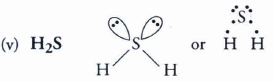
The central atom S has 6 valence electrons. Out of these only two are used in bond formation with two H-atoms while four(two pairs) remains as non-bonding electrons(i.e lone pairs)
So, it contains 2 bond pairs and 2 lone pairs. It is of the type AB2E2 and hence, the shape is bent V-shaped
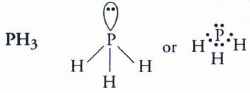
The central atom P has 5 valence electrons. Out of which three are utilised in bonding with H atoms and one pair remains as lone pair
So, it contains 3 bond pairs and one lone pair. It is of the type AB3 E and hence the shape is pyramidal.
18.
There are numerous physical properties of elements such as melting points, boiling points, heats of fusion and vaporisation, energy of atomisation, etc., which show periodic variations. The cause of periodicity in properties is the repetition of similar outer electronic configuration after certain regular intervals. e.g. all the elements of 1s group (alkali metals) have similar outer electronic configuration, i.e. ns1.
3Li = 1s2, 2s1
11Na = 1s2, 2s2, 2p6 , 3s1
19K = 1s2, 2s2, 2p6 , 3s2, 3p6, 4s1
Therefore, due to similar outermost shell electronic configuration all alkali metals have similar properties. e.g., sodium and potassium both are soft and reactive metals. They all form basic oxides and their basic character increases down the group. They all form unipositive ion by the loss of one electron. Similarly, all the elements of 17th group (halogens) have similar outermost shell electronic configuration, i.e. ns2 np5 and thus possess similar properties.
9F = 1s2, 2s1 , 2p5
17Cl = 1s2, 2s2, 2p6 , 3s2 , 3p5
35Br = 1s2, 2s2, 2p6 , 3s2, 3p6, 3d10, 4s2 , 4p5
19.
Calculation of molecular formula
Empirical formula mass =
\(2\times 56+3\times 16=160\)
\(n=\frac { molecular \ formula }{ empirical \ formula \ mass } =\frac { 160 }{ 160 } =1\)
\(\therefore Molecular\ formula={ A }_{ 2 }{ B }_{ 3 }\)
20.
Photochemical smog consists of O3 , NO, acrolein, formaldehyde and PAN. O3 and NO irritate the nose and throat and their high concentration causes a headache, chest pain, dryness of throat, cough, difficulty in breathing. Aldehydes and PAN cause irritation in eyes. PAN is highly toxic substance to plants and causes bronzing of tender leaves. Ozone also affects the rubber articles and causes cracking and ageing.
Control of Photochemical smog if primary precursors of photochemical smog such as hydrocarbons and NO2 are controlled, the secondary precursors such as O3 and PAN will automatically be reduced.
Certain Plants such as Pinus, Junioparus etc., can metabolise nitrogen oxide and can help in reducing photochemical smog.
21.
Pesticides These substance are used to kill or block the reproductive processes of pests. These are basically synthetic toxic chemicals with ecological repercussions. Their accumulation in higher animals causes serious metabolic and physiological disorders. DDt, aldrin, dieldrin, organophosphates and carbonates are some examples of pesticides.
Herbicides These are weed killers i.e. they kill unwanted herbs growing along with crops e.g. sodium chlorate (NaCIO3) and sodium arsenite (Na3AsO3). These are toxic to mammals. Some herbicides cause birth defects. Now a days triazines, better herbicides are used for the corn fields.
22.
The general formula of alkanes is CnH2n+2=12xn+1x(2n+2)=72 or 12n+2n+2=72 or n=5
Thus, the molecular formula of the alkane is C5H12. For structural isomers and their IUPAC names.
23.
I and III, I and IV, II and III and II and IV represent chain isomerism.
a) \({ CH }_{ 3 }CO{ CH }_{ 3 }\)
b) \(H-CH={ CH }_{ 2 }\).
24.
The electrode potential, i.e. reduction potential of Na (-2.71 V) or K (-2.92) is much lower than that of H2 O
(-0.83 V), therefore, upon electrolysis, water gets reduced in preference to Na+ or K+ ions. In other words, sodium and potassium cannot be obtained by electrolytic reduction of Na+ and K+ ions in aqueous solution.
25.
()
Acified KMnO4.
26.
()
Green house namely carbon dioxide,methane,nitrous oxide(N2,O),ozone and chlorofluorocarbons(CFS's) are reponsible for green house effect,i.e for maintaining temperature of the earth as these absorb the outgoing radiations from the earth's surface.

11th Standard CBSE Syllabus & Materials
11th Standard CBSE
CBSE 11th Business Studies Forms of Business Organisation Sample Question Papers Study Material - QB365 Set A
NEW11th Standard CBSE
CBSE 11th Business Studies Business, Trade and Commerce Sample Question Papers Study Material - QB365 Set A
NEW11th Standard CBSE
CBSE 11th Physics Waves Sample Question Papers Study Material - QB365 Set A
NEW11th Standard CBSE
CBSE 11th Physics Kinetic Theory Sample Question Papers Study Material - QB365 Set A



CBSE 11th Standard CBSE Subjects
CBSE Standards









