
 100% FREE ACCESS
11th Standard Syllabus & Materials
11th Standard
TN 11th Tamil இயற்கை வேளாண்மை,சுற்றுச்சூழல் -செய்யுள் - மனோன்மணீயம் Important Questions And Answers Study Material - QB365 Set A
NEW11th Standard
TN 11th Tamil என்னுயிர் என்பேன் -துணைப்பாடம் - இசைத்தமிழர் இருவர் Important Questions And Answers Study Material - QB365 Set A
NEW11th Standard
TN 11th Tamil மொழி கலை -செய்யுள் - ஒவ்வொரு புல்லையும் Important Questions And Answers Study Material - QB365 Set A
NEW11th Standard
TN 11th Tamil பீடு பெற நில் - இலக்கணம் - பகுபத உறுப்புகள் Important Questions And Answers Study Material - QB365 Set A
NEW11th Standard
TN 11th Tamil பீடு பெற நில் - துணைப்பாடம் - வாடிவாசல் Important Questions And Answers Study Material - QB365 Set A
NEW11th Standard
TN 11th Tamil பீடு பெற நில் - செய்யுள் - குறுந்தொகை Important Questions And Answers Study Material - QB365 Set A

Published on: 27/11/2019
Production Analysis
Download Tamil Nadu 11th Standard Economics question papers, model tests, one-mark questions, important questions, and public exam papers in PDF format. Free study materials and answer keys for TN State Board students.
Questions + Answers key
Take MCQ Economics Test
1.
___________ may be classified into five kinds
External Economies
Economies of scale
Internal Economies
Modern Economy
2.
_____________ is a free gift of nature.
Land
Organisation
Capital
All of these
3.
An Iso-quant curve is also known as
Inelastic Supply Curve
Inelastic Demand Curve
Equi-Marginal Utility
Equal Product Curve
4.
In a firm 5 units of factors produce 24 units of the product. When the number of factor increases by one, the production increases to 30 units. Calculate the Average Product.
30
6
5
24
5.
The functional relationship between "inputs" and "outputs" is called as
Consumption Function
Production Function
Savings Function
Investment Function
6.
What do you mean by law of supply?
7.
Economies are divided into how many types? What are they?
8.
What are the reasons for upward sloping supply curve?
9.
10.
11.
Bring out the differences between short run and long run production function.
12.
Explain the concept of division of labour.
13.
State the Cobb-Douglas production function.
14.
State and explain the elasticity of supply.
15.
What are the functions of Entrepreneur?
16.
Explain briefly the Iso-cost Line with the help of a diagram?
17.
Explain the types of elasticity supply with the help of diagram.
18.
19.
List out the properties of iso-quants with the help of diagrams.
1.
(c)
Internal Economies
2.
(a)
Land
3.
(d)
Equal Product Curve
4.
(c)
5
5.
(b)
Production Function
6.
(i) Law of supply is associated with production analysis.
(ii) It explains the positive (or) direct relationship between Price and quantity supplied.
7.
Economies are broadly divided into two types. They are,
(1) Internal Economies of scale
(2) External Economies of scale
8.
(i) Firms will supply less at lower prices and more at higher prices.
(ii) As price of the commodity increases, the amount supplied also increases.
(iii) So, supply curve has a positive slope from left to right.
9.
10.
11.
| Basis for comparison | Short - run production function | Long - run production function |
| Meaning | Short run production function alludes to the time period in which at least one factor of production is fixed | Long run production function connotes the time period in which all the factors of production are variable. |
| Law | Law of variable proportions | Law of returns to scale. |
| Scale of production | No change in scale of production. | change in scale of production |
| Factor - ratio | Changes | Does not change |
| Entry and exit | There are barriers to entry and the firms can shut down but cannot fully exit. | Firms are free to enter and exit |
12.
(i) Division of labour means dividing the process of production into distinct and several component process and assigning each component in the hands of a labour or a set of labourers, who are specialists in that particular process.
(ii) For Example: A tailor stitches maximum of four shirt a day in the case of garment exports firm, it may stitch more than 100 shirts a day
13.
(i) Charles Cobb and Paul Douglas have given a linear homogeneous production function.
(ii) A proportionate increase in the factors leads to a proportionate increase in output.
(iii) There is constant returns to scale with only labour and capital.
(iv) The elasticity of substitution between the factors is one.
Q = AL\(\alpha \)K\(\beta \)
Q = output; A = positive constant; K = Capital; L = Labour, \(\alpha \) + \(\beta \) = 1
14.
(i) Elasticity of supply is the degree of responsiveness of change in supply to change in price on the part of sellers.
(ii) There are 5 types of elasticity of supply:
1. Relatively elastic supply
2. Relatively inelastic supply
3. Unitary elastic supply
4. Perfectly elastic supply
5. Perfectly inelastic supply
(iii) The factors governing elasticity of supply are the nature of the commodity, cost of production, technical condition & time factor.
15.
Initiation: He considers the situation and availability of resources and plans the process of production.
Innovation: He introduces new methods in the production process.
Co-ordination: He uses a particular combination of the factors of production.
Control, direction & supervision: He directs the factors to get better results and supervises for the efficient functioning of all factors.
Risk taking, uncertainty bearing: Risk is insured, uncertainties cannot be insured.
16.
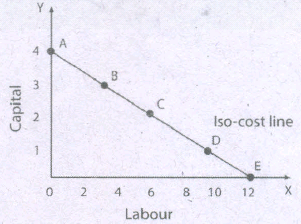
The Iso-cost line: The iso-cost line is an important component in analysing producer's behaviour. The iso-cost line represents different combinations of inputs which shows the same amount of cost. The iso-cost line gives information on factor prices and financial resources of the firm. It is otherwise called as "lso-price line" or "iso-income line" or "iso-expenditure line" or "total outlay curve".
Suppose that a producer has a total budget of H2O and for producing a certain level of output, he has to spend this amount on two factors Labour (L) and Capital (K). Prices of factors K is no and L is HO. Iso Cost Curve can be drawn by using the following hypothetical table.
| The Iso-Cost | |||
| Combination | Units of Capital Price = Rs 30 | Units of Labour Price = Rs 10 | Total Expenditure( in Rupees) |
| A | 4 | 0 | 120 |
| B | 3 | 3 | 120 |
| C | 2 | 6 | 120 |
| D | 1 | 9 | 120 |
| E | 0 | 12 | 120 |
As shown in Table, there are five combinations of capital and labour such as combination A represents 4 units of capital and zero units of labour and this combination costs Rs 120.
Similarly other combinations (B, C, D and E) cost same amount of rupees (Rs 120).
Symbolically,
4K + OL = Rs.120
3K + 3 = Rs.120
2K + 6L = Rs.120
lK + 9L = Rs.120, and
OK + 12L = Rs.120.
Thus, all the combinations A, B, C, D and E cost the same total expenditure.
From the figure it is shown that the costs to be incurred on capital and labour are represented by the triangle OAE. The line AE is called as Iso-cost line.
17.
There are five types of elasticity supply. There are,
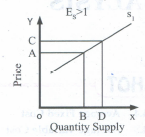
(1) Relative Elastic Supply: (ES> 1)
(i) The co-efficient of elastic supply is greater than 1 (ES> 1)
(ii) A unit change in the price causes more than one percent change in quantity supply of the commodity.
(2) Unitary Elastic Supply: (ES = 1)
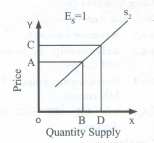
(i) The co-efficient of elastic supply is equal to one (ES = 1)
(ii) A unit change in the price causes an equal change in quantity supply is called elastic supply.
(3) Relatively Inelastic Supply: (ES < 1)
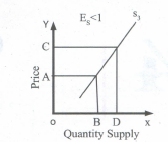
(i) The co-efficient of elasticity is less than one (ES < 1)
(ii) A unit change in the price causes and less than one percent change in the quantity supply.
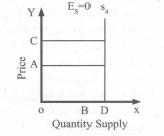
(4) Perfectly Inelastic Supply: (ES = 0) .
(i) The co-efficient of elasticity is equal to zero (ES = 0)
(ii) A unit change in the price causes no change in the quantity supply.
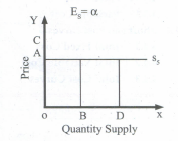
(5) Perfectly elastic supply: (ES = ∞)
(i) The co-efficient of elasticity of supply is infinity (ES = DC)
(ii) A unit change in the price causes an infinite change in the quantity supply.
18.
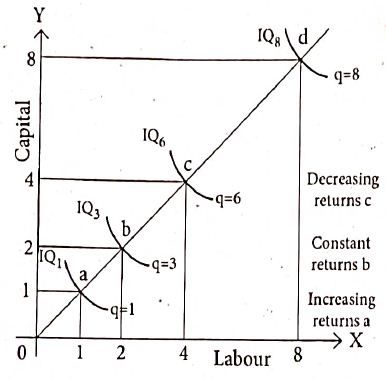
19.
Iso and quant are derived from the Greek language, meaning 'equal' and 'quantity'.
Definition:
Isoquant curve is a locus of points representing various combinations of two inputs capital and labour yielding the same output. It is also called equal product curve or product indifference curve.
Properties:
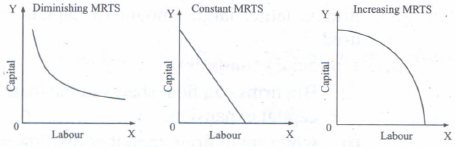
1. The isoquant curve has negative slope:
(i) Capital is being substituted by labour.
(ii) Isoquant has negative slope because of diminishing MRTS.
(iii) Constant MRTS (straight line) and increasing MRTS (concave) are also possible.
(iv) It depends on the nature of isoquant curve
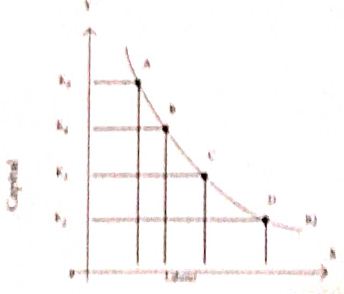
2. Isoquant curve is convex to origin:
The capital substituted per unit of labour goes on decreasing so the isoquant is convex to the origin.
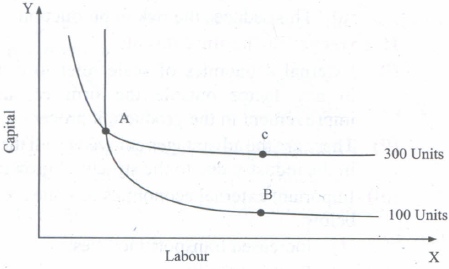
3. Isoquant curves cannot intersect each other:
Point A lies on IQ1 and IQ2, Point C lies on IQ2, showing higher output Point B
lies on IQ1, showing lower output. C = A, B = A But C > B.
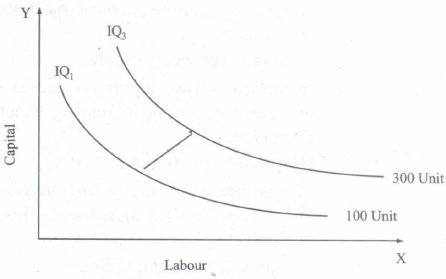
4. Upper isoquant curve represents a higher level of output:
Higher IQ2 shows higher output 200 units. Lower IQ1 shows lower output 100 units. IQ2 means the use of more factors than IQ1. Arrow shows increase in output with a right and upward shift of an isoquant curve.
5. Isoquant curve does not touch either x axis or y axis:
In IQ2 only capital is used and in IQ1 only labour is used.
.JPG)
Conclusion:
These are the properties of isoquant curves.

11th Standard Syllabus & Materials
11th Standard
TN 11th Tamil பீடு பெற நில் - செய்யுள் - காவடிச்சிந்து Important Questions And Answers Study Material - QB365 Set A
NEW11th Standard
TN 11th Tamil பீடு பெற நில் - உரைநடை - மலை இடப்பெயர்கள் : ஓர் ஆய்வு Important Questions And Answers Study Material - QB365 Set A
NEW11th Standard
TN 11th Tamil மாமழை போற்றுதும் - துணைப்பாடம் - யானை டாக்டர் Important Questions And Answers Study Material - QB365 Set A
NEW11th Standard
TN 11th Tamil மாமழை போற்றுதும் - செய்யுள் - ஐங்குறுநூறு Important Questions And Answers Study Material - QB365 Set A



Tamilnadu Stateboard 11th Standard Subjects

Maths

Commerce
Economics

Biology

Business Maths and Statistics

Accountancy

Computer Science

Physics

Chemistry
Maths
Biology
Economics
Physics
Chemistry

History
Business Maths and Statistics

Computer Science
Accountancy

Computer Applications
History
Computer Technology
Commerce
Computer Applications
Computer Technology

Tamil

English

French
Tamilnadu Stateboard Standards
