
 100% FREE ACCESS
11th Standard Syllabus & Materials
11th Standard
TN 11th Tamil இயற்கை வேளாண்மை,சுற்றுச்சூழல் -செய்யுள் - மனோன்மணீயம் Important Questions And Answers Study Material - QB365 Set A
NEW11th Standard
TN 11th Tamil என்னுயிர் என்பேன் -துணைப்பாடம் - இசைத்தமிழர் இருவர் Important Questions And Answers Study Material - QB365 Set A
NEW11th Standard
TN 11th Tamil மொழி கலை -செய்யுள் - ஒவ்வொரு புல்லையும் Important Questions And Answers Study Material - QB365 Set A
NEW11th Standard
TN 11th Tamil பீடு பெற நில் - இலக்கணம் - பகுபத உறுப்புகள் Important Questions And Answers Study Material - QB365 Set A
NEW11th Standard
TN 11th Tamil பீடு பெற நில் - துணைப்பாடம் - வாடிவாசல் Important Questions And Answers Study Material - QB365 Set A
NEW11th Standard
TN 11th Tamil பீடு பெற நில் - செய்யுள் - குறுந்தொகை Important Questions And Answers Study Material - QB365 Set A

Published on: 28/12/2018
+1 First Revision Test
Download Tamil Nadu 11th Standard Economics question papers, model tests, one-mark questions, important questions, and public exam papers in PDF format. Free study materials and answer keys for TN State Board students.
Questions + Answers key
Take MCQ Economics Test
1.
Most important form of selling cost is_____________.
Homogeneous product
Advertisement
Sales
Tax
2.
The Distribution of national income among the individuals
Personal
Functional
Both
Per capital Income
3.
___________________is the major home for textile manufacturing and export hup in India.
Karur
Tiruppur
Coimbatore
Dindigul
4.
__________ is the active factors of production.
Labour
Land
Capital
None
5.
During the periods of boom, the demand for all commodities tends to
Increase
Decrease
Equal
Constant
6.
Economics according to Robbins is ________.
Science of choice
Resource
Social Science
All the above
7.
Indian handicraft products could not compete with __ products.
Consumer products
Intermediate goods
Machine-made products
None of these
8.
Ordinal Utility can be measured by
Ranking
Numbering
Wording
None of these
9.
Agricultural sector exhibited features of ________ institution.
feudal
semi Feudal
technical
both (a) and (b)
10.
Identify the year in which National Rural Health Mission was launched.
2000
2005
2010
2015
11.
The father of Green Revolution in India was __________
M.S. Swaminathan
Gandhi
Visvesvaraya
N.R. Viswanathan
12.
Which Union Territory has the highest sex ratio?
Chandigarh
Pondicherry
Lakshadweep
Andaman Nicobar
13.
If x+y = 5 and x-y = 3 then, value of x
4
3
16
8
14.
Which of the following is a market structure where the Price is expected to be lower?
Perfect competition
Monopoly
Duopoly
Oligopoly
15.
In a firm 5 units of factors produce 24 units of the product. When the number of factor increases by one, the production increases to 30 units. Calculate the Average Product.
30
6
5
24
16.
Expansion of FDI____
Foreign Private Investment
Foreign Portfolio
Foreign Direct Investment
Forex Private Investment
17.
Find the odd one out:
"An inquiry into the Nature and the Causes of the Wealth of Nations"
"Principles of Economics"
"Nature and Significance of Economic science"
"Ceteris Paribus"
18.
According to the Loanable Funds Theory, supply of loanable funds is equal to
S + BC + DH + DI
I + DS + DH + BM
S + DS + BM + DI
S + BM + DH + DS
19.
Identify the formula of estimating average variable cost.
TC/Q
TVC/Q
TFC/Q
TAC/Q
20.
The position of Indian Economy among the other strongest economies in the world is ______
Fourth
Seventh
Fifth
Tenth
21.
Write a short note on industrial delicencing policy.
22.
What is total product?
23.
Write a note on the following concept.
i) N.N.M.
ii) IMR
iii) CMR
24.
Write the meaning of Gross National Happiness Index (GNHI).
25.
Who introduced imperfect competition?
26.
Find the average cost function where TC = 60 + 10x + 15x2.
27.
What are the Phases of colonial exploitation of India?
28.
Define Cottage Industry.
29.
Name any two types of utility.
30.
Define Revenue.
31.
The revenue function and demand function from marginal revenue function. Give the Reason.
32.
Explain the importance or the application of the Law of Diminishing Marginal Utility.
33.
Mention the features of a Developed economy.
34.
Examine the sources of Monopoly power.
35.
What is the importance of Jute Industry?
36.
State the reasons for nationalisation of commercial banks.
37.
What are the functions of Entrepreneur?
38.
39.
Explain different types of economic activities.
40.
Distinguish between fixed cost and variable cost.
41.
Explain the steps involved in making presentation using the software 'Microsoft Powerpoint'.
42.
Mention the water resources of Tamil Nadu.
43.
Explain the contribution of Amartya Kumar Sen towards the Economic development.
44.
What do you mean by stable equilibrium, particular equilibrium and general equilibrium? Explain.
45.
Bring out the relationship among TR, AR, MR curves and elasticity of demand.
46.
Profit is the reward for risk-taking and uncertainty-bearing.
47.
Explain relationship among total Average and Marginal Products.
48.
Elucidate the law of diminishing marginal utility with diagram.
49.
Explain about monetary and financial sector reforms.
50.
51.
Analyse the causes for Rural Indebtedness.
52.
Compare and contrast various definitions of Economics.
53.
Bring out the features of perfect competition.
1.
(b)
Advertisement
2.
(a)
Personal
3.
(a)
Karur
4.
(a)
Labour
5.
(a)
Increase
6.
(a)
Science of choice
7.
(c)
Machine-made products
8.
(a)
Ranking
9.
(d)
both (a) and (b)
10.
(b)
2005
11.
(a)
M.S. Swaminathan
12.
(b)
Pondicherry
13.
(a)
4
14.
(a)
Perfect competition
15.
(c)
5
16.
(c)
Foreign Direct Investment
17.
(d)
"Ceteris Paribus"
18.
(a)
S + BC + DH + DI
19.
(b)
TVC/Q
20.
(b)
Seventh
21.
Industrial delicensing policy: The most important objective of the new industrial policy of 1991 was the end of the industrial licensing or the license raj or red tapism. Under the industrial licensing policies, private sector firms had to secure licenses to start an industry.
22.
If refers to the total amount of commodity produced by the combination of all inputs in a given period of time. Summation of marginal product.
i.e., TP = \(\sum { MP } \), Where TP = Total product, MP = Marginal product.
23.
i) N.N.M: Neonatal Mortality - Death of kids. soon after delivery.
ii) IMR: Infant Mortality Rate - Death of children before completing one year after birth.
iii) CMR: Child Mortality Rate - Death of child before the age of file.
24.
The term "Gross National Happiness" was coined by the fourth King of Bhutan, Jigma Singye Wangchuck in 1972. It is an indicator of progress, which measures sustainable development, environmental conservation promotion of culture and good governance.
25.
The concept of imperfect competition was propounded in 1933 in England by Mrs. Joan Robinson (1903 - 1983) and in America by E.H. Chamberlin (1899 - 1967).
26.
\(\mathrm{AC}=\frac{\mathrm{TC}}{x}
\)
\(\mathrm{TC}=60+10 x+15 x^{2}
\)
\(\mathrm{AC}=\frac{60}{x}+10+15 x\)
27.
(i) Period of merchant capital
(ii) Period of industrial capital
(iii) Period of finance capital.
28.
Cottage industry are carried out by artisans in their own homes, these industries are traditional, with no or little power.
29.
(i) Form utility
(ii) Time utility
(iii) Place utility
(iv) Service utility
(v) Possession utility
(vi) Knowledge utility
30.
The amount of money that a producer receives in exchange for the sale of goods is revenue.
31.
If R is the total revenue function when the output is x, then marginal revenue.
\(MR=\frac { dR }{ dx } \) integrating with respect to 'x' we get.
Revenue Function: R = ഽ(MR) dx + k
where 'k' is the constant of integration which can be evaluated under given conditions when x = 0, total revenue R = 0.
Demand Functi.on: P = \(\frac { R }{ x } ,x\neq 0\).
32.
Importance or Application of the Law of DMU:
(1) The Law of DMU is one of the fundamental laws of consumption. It has applications in several fields of study.
(2) This law is the basis for other consumption laws such as Law of Demand, Elasticity of Demand, Consumer's Surplus and the Law of Substitution etc.
(3) The Finance Minister taxes a more-moneyed person more and a less-moneyed person less. When a person's income rises, the tax-rate rises because the MU of money to him falls with every rise in his income. Thus, the Law of DMU is the basis for progressive taxation.
(4) This law emphasises an equitable distribution of wealth. The MU of money to the more-moneyed is low. Hence, redistribution of income from rich to poor is justified.
(5) Adam Smith explains the famous "diamond-water paradox". Diamond is scarce, hence, its MU is high and its price is high, even though it is not very much needed. Water is abundant, hence, its MU is low and its price is low, even though it is very much essential.
33.
Features of a Developed Economy
(1) High National Income
(2) High Per Capita Income
(3) High Standard of Living
(4) Full Employment of Resources
(5) Dominance of Industrial Sector
(6) High Level of Technology
(7) High Industrialisation
(8) High Consumption Level
(9) High Level of Urbanisation
(10) Smooth Economic Growth
(11) Social Equity, Gender Equality and Low Levels of Poverty
(12) Political Stability and Good Governance
34.
(i) Natural Monopoly: A monopoly may arise on account of some natural causes. Some minerals are available only in certain regions. For example, South Africa has monopoly of diamonds and gold mines. Canada has monopoly of Nickel and Middle East has oil. This is natural monopoly.
(ii) State Monopoly: Government will have the sole right of producing certain goods and maintaining certain services. They are state monopolies. For example, public utilities like electricity and railways.
(iii) Legal Monopoly: A monopoly firm can get its monopoly power by getting patent rights, trade mark from the Government. This is called Legal Monopoly.
(iv) Technical: Monopoly power may be enjoyed due to technical reasons. A firm may have control over raw materials, technical knowledge, special know-how, scientific secrets and formula that enable a monopolist to produce a commodity. Example Coca-Cola.
35.
Jute Industry is an important industry for a country like India, Because not only it earn foreign exchange but also provides substantial employment opportunities in agriculture and Industrial sectors.
36.
(i) After Independence, the government adopted planned economic development.
(ii) The main objective of planning was social welfare.
(iii) Before Independence commercial banks were in the private sector.
(iv) These banks did not help the government to achieve the social objectives of planning.
(v) So the government nationalised 14 major commercial banks on 19th July 1969 and 6 more banks in 1980.
37.
Initiation: He considers the situation and availability of resources and plans the process of production.
Innovation: He introduces new methods in the production process.
Co-ordination: He uses a particular combination of the factors of production.
Control, direction & supervision: He directs the factors to get better results and supervises for the efficient functioning of all factors.
Risk taking, uncertainty bearing: Risk is insured, uncertainties cannot be insured.
38.
39.
Consumption: Human wants come under consumption.
Production: It deals with the transformation of inputs into output.
Exchange: It deals with trade and commerce.
Distribution: It deals with the reward to the factors of production.
40.
| S.No | Fixed cost | Variable cost |
| 1 | It does not change with the level of output | It changes with the level of output. |
| 2 | Short period concept | Short period and long period concept. |
| 3 | Related to fixed factors | Related to variable factors. |
| 4 | Firm continues production even when there is loss of fixed cost. | Firm produces only when variable cost is met. |
| 5 | (eg) watchman's wage, building rent. | (eg) wage of workers, power charges. |
| 6 | Also called supplementary cost or overhead cost | Also called prime cost, special cost or direct cost. |
41.
Microsoft Power Point :
It is a software used to perform computer-based presentation.
Steps involved in making presentation:
(i) Click Start Menu
(ii) Click Program
(iii) Select Microsoft Powerpoint - Click.
(iv) New PowerPoint file will open, and then type the title and subtitle if wanted.
(v) A new slide can be inserted by 'click' on icon 'new slide' or using short key 'Ctrl + M'
(vi) We can type the content, insert the table, pictures, movies, sounds, etc., with the content.
(vii) Tab 'Design' helps to design the slides (can select common design for all slides or separate slide for each slide)
(viii) Click icon slide show, one can run slide show either starting from the first slide or starting from the current slide.
The power point presentation (PPT) facilitates the key points to be kept in memory and understand the particular topic. Recently, the smart classroom teaching uses the PPT to deliver the information in an effective way to enhance the quality of teaching.
42.
Water Resources:
(i) Tamil Nadu is not endowed with rich natural resources compared "to other States".
(ii) It accounts for three per cent of water sources, four per cent of land area against six per cent of population.
(iii) North East monsoon is the major source of rainfall followed by South West monsoon.
(iv) There are 17 river basins in Tamil Nadu. The main rivers are Palar, Cheyyar, Ponnaiyar, Cauvery, Bhavani, Vaigai, Chittar, Tamiraparani, Vellar, Noyyal, Siruvani, Gundar, Vaipar, Valparai etc.
(v) Wells are the largest source of irrigation in Tamil Nadu (56%).
| Source of Irrigation | Numbers |
| Reservoirs Canals Tanks Tube Wells Open Wells |
81 2239 41262 3,20,707 14,92,359 |
43.
Contribution of Amartya Kumar Sen:
The Nobel citation refers to Sen's contributions to social choice theory, development economics, study on poverty and famines and concept of entitlements and capability development (1998).
(1) Poverty and Famines:
Sen's Poverty and Famines: An Essay on Entitlement and Deprivation" (1981) is both a theoretical and an applied work. In the book, several famines have been studied in the working of a general theoretical framework from an original angle. He examined various meanings of poverty and drew attention to the incidence of absolute and relative deprivation.
(2) Poverty and Inequality:
Sen has carried out massive work on poverty and inequality in India. Sen's major point has been that the distribution of income/ consumption among the persons below the poverty line is to be taken into account.
(3) The Concept of Capability:
The concept of capabilities developed by Sen has been cited as a better index of wellbeing than commodities or utilities. Capability, as defined by Sen, is the ability to transform Rawlsian primary goods to the achievement of well being.
(4) Entitlement:
Sen has included the concept of entitlement items like nutrition, food, medical and health care, employment, security of food supply in times of famine etc. He considered famine as arising out of the failure of establishing a system of entitlements.
(5) Choice of Technique:
Sen's 'Choice of Technique' was a research work where he argued that in a labour surplus economy, generation of employment cannot be increased at the initial stage by the adaptation of capital-intensive technique. Conclusively, Amartya Sen, more than just an economist, is an ethical philosopher. He is a lover of freedom and a humanist. He has focussed on the poor, viewing them not as objects of pity requiring charitable hand-outs, but as disempowered folk needing empowerment, education, health, nutrition, gender equality, safety net in times of distress; all are needed to empower people.
44.
(a) Stable Equilibrium
Prof. Stigler states that "equilibrium is a position from which there is no net tendency to move". Its absence is referred to as disequilibrium. Consumer's equilibrium occurs when he gets maximum satisfaction. The equilibrium of the producer occurs when he gets maximum profit. A resource is in equilibrium when it gets fully employed and gets its maximum payment. Thus, static equilibrium is based on given and constant prices, quantities, income, technology, population etc.
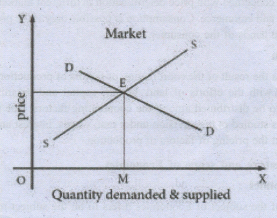
(b) Particular Equilibrium and General Equilibrium
An equilibrium, when it pertains to a single variable, may be called particular equilibrium. An equilibrium, on the other hand, when it relates to numerous variables or even the economy as a whole, may be called general equilibrium.
45.
Relationship among TR, AR, MR Curves:
When marginal revenue is positive, total revenue rises, when MR is zero, the total revenue becomes maximum. When marginal revenue becomes negative, total revenue starts falling. When AR and MR both are falling, then MR falls at a faster rate than AR.
TR, AR, MR and Elasticity of Demand:
The relationship among AR, MR and elasticity of demand (e) is stated as follows.
MR = AR (e-i/e)
The relationship between the AR curve and MR curve depends upon the elasticity of AR curve (AR = DD = Price).
a) When price elasticity of demand is greater than one, MR is positive and TR is increasing.
b) When price elasticity of demand is less than one, MR is negative and TR is decreasing.
c) When price elasticity of demand is equal to one, MR is equal to zero and TR is maximum and constant.
It is to be noted that, the output range of 1 to 5 units, the price elasticity of demand is greater than one according to total out by method. Hence TR is increasing and MR is positive.
TR, AR, MR & Elasticity
| Quantity (Q) |
Price (P) |
TR | AR | MR | Elasticity |
| 0 | 11 | 0 | 11 | - | e > 1 |
| 1 | 10 | 10 | 10 | 10 | |
| 2 | 9 | 18 | 9 | 8 | |
| 3 | 8 | 24 | 8 | 6 | |
| 4 | 7 | 28 | 7 | 4 | |
| 5 | 6 | 30 | 6 | 2 | |
| 6 | 5 | 30 | 5 | 0 | e = 1 |
| 7 | 4 | 28 | 4 | -2 | e > 1 |
| 8 | 3 | 24 | 3 | -4 | |
| 9 | 2 | 18 | 2 | -6 | |
| 10 | 1 | 10 | 1 | -8 | |
| 11 | 0 | 0 | 0 | -10 |
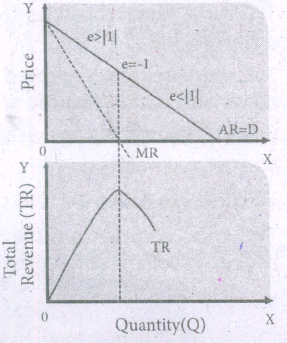
At the output range of 5 to 6 units, the price elasticity of demand is equal to one. Hence TR is maximum and MR equals to zero.
At the output range of 6 units to 10 units, the price elasticity of demand is less than unity. Hence TR is decreasing and MR is negative.
46.
a. Profits: Profits are the reward for organization or entrepreneurship. Risk-taking and uncertainty-bearing are the main functions of an entrepreneur. So we may consider profit as the reward for the above functions.
b. The Risk - bearing theory of profits: According to Prof.Hawley, profits are the reward for an entrepreneur for risk-taking. Risk-taking is an important function of an entrepreneur. Risk-taking and profit-making go together. The main criticism against this theory is that it does not make distinction between known risks and unknown risks Known risks (eg. theft, fire) can be insured against. We may say that profits are the reward for taking unknown risks. For there is a lot of uncertainty about such risks.
47.
| Stages | Total product | Marginal Product | Average Product |
| Stage I | Initially it Increases at an increasing rate and then increases at a decreasing rate | At the beginning it increases, then reaches a maximum urn and starts to decrease | At the first instant it increases, then attains maximum |
| Stage ll | It continues to increase at a diminishing rate and reaches maximum | It continuous to diminish and becomes equal to zero | It is equal to MP and then begins to diminish |
| Stage lll | It diminishes | It becomes negative | It continues to diminish but always greater than zero(Positive) |
48.
Introduction:
(i) H. H. Gossen first formulated this law.
(ii) So Jevons called it "Gossen's First law of consumption"
(iii) Marshall perfected it on the basis of cardinal analysis.
(iv) It is based on the satiable character of human wants.
Definition
Marshall states the law as "the additional benefit which a person derives from a given increase of his stock of a thing, diminishes with every increase in the stock that he already has".
Assumptions
(i) Utility can be measured - 1,2,3.
(ii) Marginal utility of money is constant.
(iii) The consumer is rational. He wants maximum satisfaction.
(iv) The units consumed must be reasonable in size.
(v) The commodity must be homogeneous.
(vi) The consumption must be continuous.
(vii) There is no change in taste, habit, preferences, fashion, income & character of the consumer.
Illustration:
(i) Suppose a consumer wants to consume 7 apples one after another.
(ii) The utility from the first apple is 20.
(iii) The utility from the 2nd apple is less than the first (15), the utility from the 3rd apple is less than the 2nd (10) and so on.
(iv) Finally the utility from the 5th apple becomes zero and the utility from the 6th apple is -5.
| Number of Apples | Total utility | Marginal Utility |
| 1 | 20 | 20 |
| 2 | 35 | 15(35 - 20) |
| 3 | 45 | 10(45 - 35) |
| 4 | 50 | 5 (50 - 45) |
| 5 | 50 | 0 (50 - 50) |
| 6 | 45 | -5 (45- 50) |
| 7 | 35 | -10 (35-45) |
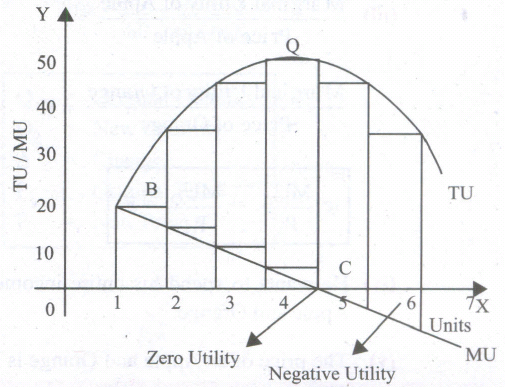
Explanation:
(i) TU goes on increasing but at a diminishing rate.
(ii) MU goes on diminishing
(iii) When MU is zero TU is maximum.
(iv) When MU becomes negative, TU diminishes.
Criticism:
(i) Utility is subjective so cannot be measured numerically.
(ii) The assumptions are unrealistic.
(iii) The law is not used for indivisible commodities.
Exceptions:
(i) Hobbies
(ii) Drunkards
(iii) Readings
(iv) Misers
(v) Music
(vi) Poetry
Importance:
(i) It is a fundamental law of consumption.
(ii) It is the basis for the law of demand, elasticity of demand, consumer's surplus.
(iii) Finance Minister uses it for progressive taxation.
(iv) Redistribution of income is justified.
(v) Adam Smith uses it for his "diamond water paradox".
Conclusion:
The law of diminishing marginal utility is of great use in our daily life.
49.
(i) Monetary reforms aimed at doing away with interest rate distortions and rationalizing the structure of lending rates.
(ii) The new policy tried in many ways to make the banking system more efficient.
(a) Reserve Requirements:
(i) In mid-1991, SLR and CRR were very high.
(ii) It was proposed to cut down the SLR from 38.5% to 25% within a time span of three years.
(b) Interest rate Liberalisation:
(i) Earlier, RBI controlled the rates payable on deposits of different maturities.
(ii) The rates which could be charged for bank loans which varied according to the sector, use and size of the loan.
(iii) Earlier, it was longer term deposits after the liberalisation it was progressively extended to deposits of shorter maturity.
(c) Greater Competition:
(i) Among public sector, private sector, and foreign banks and elimination of administrative constraints.
(ii) Banks were given freedom to relocate branches.
(iii) Bank branch licensing policy in order to rationalize the existing branch network.
(iv) Guidelines for opening new private sector bank.
(v) New accounting norms regarding classification of assets and provisions of bad debts were introduced for Narasimham Committee Report.
50.
The concept of economic planning in India was the limited natural resources are utilized skillfully so as to achieve the desired goals.
(i) First Five Year Plan (1951 - 1956) :
Agriculture development of the country.
(ii) Second Five Year Plan (1956 - 1961) :
Industrial Development of the country.
(iii) Third Five Year Plan (1961 - 1966) :
To make the economy independent and to reach self active position to take off.
(iv) Fourth Five Year Plan (1969 - 1974) :
The two main objectives of this plan growth with stability and progressive achievement of self reliance.
(v) Fifth Five year Plan (1974 - 1979) :
In this plan top priority was given to agriculture, next cement industry and mines.
(vi) Sixth Five Year Plan (1980 - 1985) :
Poverty eradication and technological self reliance was the main objective of this plan.
(vii) Seventh Five Year Plan (1986 - 1991) :
The establishment of the self sufficient economy opportunities for productive employment.
(viii) Eighth Five Year Plan (1992 - 1997) :
The top priority was given to development of human resources, employment, education and public health.
(ix) Ninth Five Year Plan (1997 - 2002) :
The main focus of this plan growth with justice and equity
(x) Tenth Five Year Plan (2002- 2007) :
To double the per capita income of India next 10 years.
(xi) Eleventh Five Year Plan (2007 - 2012) :
"Faster and more inclusive growth was the main aim of this plan"
(xii) Twelfth Five Year Plan (2012 - 2017) :
Its main aim is "Faster, more inclusive and sustainable growth".
51.
Introduction:
Rural indebtedness refers to the situation where the rural people are unable to repay the loan accumulated over a period.
Causes:
Poverty of farmers:
The vicious circle of poverty forces the farmers to borrow for consumption, cultivation and celebrations. Poverty, debt and high rates of interest hold the farmer in the grip of money lenders.
Failure of monsoon:
So it is difficult to identify good years to repay their debts.
Litigation:
(i) Due to land disputes, litigation in the court compels them to borrow heavily
(ii) Being uneducated and ignorant they are caught in the litigation process and lose their savings.
Money lenders-high interest rate:
The rate of interest charged by the local money lenders is very high and the compounding of interest leads to indebtedness of the farmer.
52.
| Wealth | Welfare | Scarcity | Growth |
| Adam Smith classical era. |
Alfred Marshall- neo classical era. |
Lionel Robbins new age. |
Paul Samuelson modern age. |
| An Inquiry into nature and causes of Wealth of Nations (1776). |
Principles of |
An Essay on the nature and Significance of Economic Science (1932). |
Economics studies how men and society choose with or without the use of money, to employ scarce productive resources which could have alternative uses, to produce various commodities over time and distribute them for consumption now and in the future among various people and groups of society. |
| Economics is the science of wealth. | Economics is a study of mankind in the ordinary business of life, it examines that part of individual and social action which is most closely connected with the attainment and with the use of material requisites of well being. It studies wealth and man. |
Economics is a science which studies human behaviour as a relationship between ends and scarce means which have alternative uses. |
Economics deals with how the society uses the limited resources for alternative uses. |
| Deals with only the goods which are scarce and have money value |
wealth and welfare of man is important. | Human behaviour regarding choice is important. |
It covers production, distribution and consumption. |
| Deals with consumption, production, exchange, distribution of wealth. |
Only material welfare is considered, differentiates between material and immaterial things. |
Economic problem arises because of scarcity of resources. |
Economics is a social science. |
| By introducing welfare, economics becomes inexact. |
Ethical aspects are not considered so Economics is exact |
||
| Welfare definition makes Economics classificatory. | Economics is a positive science. |
||
| Economics is a science of individual behaviour. |
|||
| Both material and immaterial activities are considered. |
53.
Large number of buyers and sellers:
(i) Since there are large number of buyers and sellers each individual buyer or seller buys or sells a very small quantity of the product found in the market.
(ii) So he has no power to fix the price of the product.
(iii) He is only a price taker.
Homogeneous product & uniform price:
(i) All the units of the product are perfectly substitutable - they are of the same size, shape, colour, quality.
(ii) So a uniform price prevails in the market.
Free entry and exit:
(i) In the short run, the very efficient producer can produce the product at a very low cost & earn super normal profit.
(ii) This attracts new firms to enter.
(iii) When there are more firms, supply increases, so price falls.
(iv) Inefficient producer faces loss & so quits the market.
Absence of transport cost:
The prevalence of the uniform price is also due to the absence of the transport cost.
Perfect knowledge of the market:
(i) All buyers and sellers have a thorough knowledge of the quality of the product, prevailing price.
No government intervention:
(i) No government regulation on supply of raw materials & in price determination.

11th Standard Syllabus & Materials
11th Standard
TN 11th Tamil பீடு பெற நில் - செய்யுள் - காவடிச்சிந்து Important Questions And Answers Study Material - QB365 Set A
NEW11th Standard
TN 11th Tamil பீடு பெற நில் - உரைநடை - மலை இடப்பெயர்கள் : ஓர் ஆய்வு Important Questions And Answers Study Material - QB365 Set A
NEW11th Standard
TN 11th Tamil மாமழை போற்றுதும் - துணைப்பாடம் - யானை டாக்டர் Important Questions And Answers Study Material - QB365 Set A
NEW11th Standard
TN 11th Tamil மாமழை போற்றுதும் - செய்யுள் - ஐங்குறுநூறு Important Questions And Answers Study Material - QB365 Set A



Tamilnadu Stateboard 11th Standard Subjects

Maths

Commerce
Economics

Biology

Business Maths and Statistics

Accountancy

Computer Science

Physics

Chemistry
Maths
Biology
Economics
Physics
Chemistry

History
Business Maths and Statistics

Computer Science
Accountancy

Computer Applications
History
Computer Technology
Commerce
Computer Applications
Computer Technology

Tamil

English

French
Tamilnadu Stateboard Standards
