
 100% FREE ACCESS
11th Standard CBSE Syllabus & Materials
11th Standard CBSE
CBSE 11th Economics PART-A - Presentation of Data - New Sample Question Papers Study Material - QB365 Set A
NEW11th Standard CBSE
CBSE 11th Economics PART-A - Organisation of Data - New Sample Question Papers Study Material - QB365 Set A
NEW11th Standard CBSE
CBSE 11th Economics PART-A - Collection of Data - New Sample Question Papers Study Material - QB365 Set A
NEW11th Standard CBSE
CBSE 11th Economics PART-A - Introduction to Economics and Statistics - New Sample Question Papers Study Material - QB365 Set A
NEW11th Standard CBSE
CBSE 11th Business Studies International Trade Sample Question Papers Study Material - QB365 Set A
NEW11th Standard CBSE
CBSE 11th Business Studies Evolution and Fundamentals of Business Sample Question Papers Study Material - QB365 Set A

Published on: 21/10/2025
Download CBSE Class 11th Standard CBSE Mathematics question papers, sample papers, important questions, and previous year solved papers in PDF format. Get free study materials, NCERT solutions, and exam preparation resources for Class 11th Standard CBSE Mathematics
Questions + Answers key
Take MCQ Mathematics Test
1.
Solve the following equations.21x2 - 28x + 10 = 0
2.
Find the sum of the an possible products of the first n natural numbers taken two by two.
3.
Show that the coefficient of the middle term in the expansion of (1 + x)2n is equal to the sum of the coefficients of two middle terms in the expansion of (1 + x)2n – 1.
4.
Solve the following system of inequalities and represent the solution graphically on number line.
3x - 7> 2(x - 6) and 6 - x > 11- 2x
5.
Represent the complex number z =1+ i\(\sqrt{3}\) in the polar form.
6.
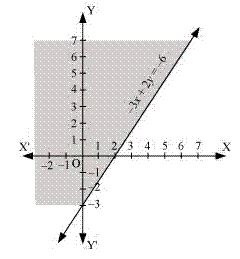
Solve the given inequality graphically in two-dimensional plane: –3x + 2y ≥ –6
7.
In how many ways can a cricket eleven be chosen out of a batch of 17 plays if
(i) there is no restriction on the selection
(i) a particular player is always chosen
(iii) a particular player is never chosen
8.
Find the three numbers in GP,whose sum is 52 and sum of whose product in pairs is 624.
9.
If the binomial expansion of \(\left( c+dy \right) ^{ -2 }\quad is\quad \frac { 1 }{ 4 } -3y+..\) then find the values of c and d.
10.
If \(\frac { (2n)! }{ 3!(2n-3)! } \) and \(\frac { n! }{ 2!(n-2)! } \) are in the ration 44:3, find n
11.
Which of the following is true?
1- i <1+ i
2i + 1>- 2i + 1 .
2i > 1
None of these
12.
\(\text { If } x=r \cos \theta, y=r \sin \theta \text { such that } x, y>0 \text { and }\)\(z=r(\cos \theta+i \sin \theta), \text { then }\)
\(\text { I. }|z|=r=\sqrt{x^{2}-y^{2}}\)
\(\text { II. }|z|=r=\sqrt{x^{2}+y^{2}}\)
\(\text { III. } \arg (z)=\theta\)
I and III are correct
II and III are correct
All are correct
None of these
13.
If the coefficients of 2nd, 3rd and the 4th terms in the expansion of (1+ x)n are in AP then value of n is _____.
2
7
11
14
14.
The remainder left out when 82n - (62)2n + 1is divided by 9, is _____.
0
2
7
8
15.
If there are 5 different objects A, B, C,D, E. The number of combinations of 3 different objects is ...A.... Here, A refers to _______.
9
12
11
10
16.
How many number lying between 999 and 10000 can be formed with the help of the digits 0,2, 3, 6, 7, 8, when the digits are not be repeated?
100
200
300
400
17.
The solution set of the inequality \(4 x+3<5 x+7 \forall x \in R \text { is }\) _______.
\((-4, \infty)\)
\([-4, \infty)\)
\((4, \infty)\)
\([4, \infty)\)
18.
Consider the inequality 40x + 20y \(\le\) 120, where x and yare whole numbers. Then, its solution set is _______.
(0, 0), (5, 5), (1, 1), (2, 2), (3, 0)
(0, 0), (0, 1), (0, 2), (0,3), (0, 4), (0, 5), (0, 6)
(1,0), (2, 0), (3, 0), (4, 0), (5, 0)
None of the above
19.
The sum of infinity of the G.P. a, ar, ar2, ar3, ...... \(\infty\) is ______.
\(\frac{a-1}{1-r}\)
\(\frac{a}{1-r}\)
\(\frac{2a}{1-r}\)
\(\frac{a}{1-r^2}\)
20.
If the first term of an AP. is 5 and common difference is - 3 then sum of its 60 terms is equal to ______.
-1050
-5010
3010
None of these
21.
If the sum of n terms of an AP. is 4n2 + 7n, then its nth term is ______.
8n -3
8n + 3
3n - 8
None of these
22.
Mr. Arvind Shukla a mathematics teacher of class XI. He writes a word INDEPENDENCE on the white board. He asks some questions which are based on the arrangements of the letters of the above word.
Then, answer the following questions.
(i) The number of permutations of n objects, where p objects are of the one kind, p2 are of second kind, ...pk are of kth kind and the rest, if any are of dfferent kind is
| (a) \(\frac{n !}{p_{1} ! p_{2} ! \ldots p_{k} !}\) | (b) \(\frac{n !}{p_{1} !+p_{2} !+\ldots+p_{k} !}\) | (c) \(\frac{n !}{p !}\) | (d) None of these |
(ii) Find the number of arrangements of the letters of the word starting with P.
| (a) 183600 | (b) 128600 | (c) 138600 | (d) 118600 |
(iii) Find the number of arrangements of the letter of word, when all the vowels always occur together.
| (a) 18600 | (b) 16800 | (c) 17600 | (d) 19600 |
(iv) Find the number of arrarngements of the letter of word, when all the vowels never occur together.
| (a) 1646400 | (b) 1545400 | (c) 144400 | (d) 156600 |
(v) Find the number of arrangements of the letter of word when wor begins with Iand ends in P
| (a) 16200 | (b) 12600 | (c) 14200 | (d) 15200 |
1.
\(\text { Ans. } x=\frac{2}{3}+i \frac{\sqrt{14}}{21}\)
2.
We know that,
\(\left(x_{1}+x_{2}+\ldots+x_{n}\right)^{2}=\left(x_{1}^{2}+x_{2}^{2}+\ldots+x_{n}^{2}\right)\)
+ 2(Sum of all possible products taken two at a time)
\(\text { or }\left(\sum_{i=1}^{n} x_{i}\right)^{2}=\left(\sum_{i=1}^{n} x_{i}^{2}\right)+2\left(\sum_{i=1, i<j}^{n} \sum_{j=1}^{n} x_{i} x_{j}\right) \)
\(\Rightarrow \sum_{i=1, i<j}^{n} \sum_{j=1}^{n} x_{i} x_{j}=\frac{1}{2}\left\{\left(\sum_{i=1}^{n} x_{i}\right)^{2}-\left(\sum_{j=1}^{n} x_{i}^{2}\right)\right\}\)
\(\therefore\) Required sum \(=\frac{1}{2}\left\{\left(\sum_{k=1}^{n} k\right)^{2}-\left(\sum_{k=1}^{n} k^{2}\right)\right\} \)
\(=\frac{1}{2}\left[\left\{\frac{n(n+1)}{2}\right\}^{2}-\frac{n(n+1)(2 n+1)}{6}\right] \)
\(=\frac{1}{2}\left[\frac{n(n+1)}{2}\left\{\frac{n(n+1)}{2}-\frac{2 n+1}{3}\right\}\right] \)
\(=\frac{n(n+1)}{4}\left\{\frac{3 n^{2}+3 n-4 n-2}{6}\right\}\)
\(=\frac{n(n+1)\left(3 n^{2}-n-2\right)}{24}=\frac{n(n+1)(n-1)(3 n+2)}{24}\)
3.
As 2n is even so the expansion (1 + x)2n has only one middle term which is
\(\left(\frac{2 n}{2}+1\right)^{\text {th }}\) i.e., (n + 1)th term.
The (n + 1)th term is 2nCnxn. The coefficient of xn is 2nCn
Similarly, (2n – 1) being odd, the other expansion has two middle terms
\(\left(\frac{2 n-1+1}{2}\right)^{\text {th }} \text { and }\left(\frac{2 n-1+1}{2}+1\right)^{\text {th }}\) i.e., nth and (n + 1)th terms. The coefficients of these terms are 2n – 1Cn – 1 and 2n – 1Cn, respectively.
Now \({ }^{2 n-1} \mathrm{C}_{n-1}+{ }^{2 n-1} \mathrm{C}_{n}={ }^{2 n} \mathrm{C}_{n}\) [ As \({ }^{n} \mathrm{C}_{r-1}+{ }^{n} \mathrm{C}_{r}={ }^{n+1} \mathrm{C}_{r}\)] as required.
4.
Ans. (5 ,\(\infty\))

5.
Let 1 = r cos \(\theta\), \(\sqrt{3}\) = r sin \(\theta\)
By squaring and adding, we get r2 (cos2\(\theta\)+ sin2\(\theta\)) = 4
i.e., r = \(\sqrt{4}\) = 2 (conventionally, r >0)
Therefore, cos \(\theta\) \(=\frac{1}{2}\), sin \(\theta\) \(=\frac{\sqrt{3}}{2}\), which gives \(\theta\) \(=\frac{\pi}{3}\)
Therefore, required polar form is \(z=2\left(\cos \frac{\pi}{3}+i \sin \frac{\pi}{3}\right)\)
The complex number z = 1+ i\(\sqrt{3}\) is represented.
6.
The graphical representation of – 3x + 2y = – 6 is given in the figure below.
This line divides the xy-plane in two half planes.
Select a point (not on the line), which lies in one of the half planes, to determine whether the point satisfies the given inequality or not.
We select the point as (0, 0).
It is observed that,
– 3(0) + 2(0) ≥ – 6 or 0 ≥ –6, which is true
Therefore, the lower half plane is not the solution region of the given inequality. Also, it is evident that any point on the line satisfies the given inequality.
Thus, the solution region of the given inequality is the half plane containing the point (0, 0) including the line.
The solution region is represented by the shaded region as follows.
7.
(i) Total number of ways of selecting 11players out of 17 is
\(^{17}C_{11}={17!\over 11!6!}={17\times16\times15\times14\times13\times12\times11!\over 11!\times6\times5\times4\times3\times2\times1}=12376\)
(ii) A particular player is always chosen means that 10 players are selected out of remaining 16 players is
\(^{16}C_{10}={16!\over 10!6!}={16\times15\times14\times13\times12\times11\times10!\over 10!\times6\times5\times4\times3\times2\times1}=8008\)
(iii)A particular player is never chosen means that 11 players are selected out of remaining 16 players is
\(^{16}C_{11}={16!\over 11!5!}={16\times15\times14\times13\times12\times11!\over 11!\times6\times5\times4\times3\times2\times1}=4368\)
8.
\(\frac { a }{ r } +a+ar=52\Rightarrow a\left( \frac { 1 }{ r } +1+r \right) =52\) ...(i)
and \(\frac { a }{ r } .a+a.ar+\frac { a }{ r } .ar\Rightarrow 624\Rightarrow { a }^{ 2 }\left( \frac { 1 }{ r } +r+1 \right) =624\) .(ii)
On dividing Eq.(ii) by Eq(i) we get a=12
On putting a=12 in Eq(i) we get
\(12\left( \frac { 1 }{ r } +r+1 \right) =52\Rightarrow r=\frac { 1 }{ 3 } \) or r=3
Ans.When \(r=\frac { 1 }{ 3 } \),then number are 36,12,44
When r=3, then numbers are 4, 12, 36.
9.
\(\left( c+dy \right) ^{ -2 }={ c }^{ -2 }(1+\frac { d }{ c } y)^{ -2 }\)
\(\therefore c^{ -2 }[1-2\times \frac { d }{ c } y+\frac { \left( -2 \right) \left( -2-1 \right) }{ 2! } \left( \frac { d }{ c } y \right) ^{ 2 }+...]=\frac { 1 }{ 4 } -3y+...\)
\(\Rightarrow { c }^{ -2 }-\frac { 2d }{ { c }^{ 3 } } y+...=\frac { 1 }{ 4 } -3y+...\)
\(On\quad comparing\quad first\quad term,{ c }^{ -2 }=\frac { 1 }{ 4 } \Rightarrow \frac { 1 }{ { c }^{ 2 } } =\frac { 1 }{ 4 } \Rightarrow c=2\)
\(On\quad comparing\quad second\quad term,\quad d=12\)
\( Ans.2,12\)
10.
n=6
11.
(d)
None of these
12.
(b)
II and III are correct
13.
(b)
7
14.
(b)
2
15.
(d)
10
16.
(c)
300
17.
(a)
\((-4, \infty)\)
18.
(b)
(0, 0), (0, 1), (0, 2), (0,3), (0, 4), (0, 5), (0, 6)
19.
(b)
\(\frac{a}{1-r}\)
20.
(b)
-5010
21.
(a)
8n -3
22.
(i) (a)
(ii) (c)
(iii) (b)
(iv) (a)
(v) (b)

11th Standard CBSE Syllabus & Materials
11th Standard CBSE
CBSE 11th Business Studies Forms of Business Organisation Sample Question Papers Study Material - QB365 Set A
NEW11th Standard CBSE
CBSE 11th Business Studies Business, Trade and Commerce Sample Question Papers Study Material - QB365 Set A
NEW11th Standard CBSE
CBSE 11th Physics Waves Sample Question Papers Study Material - QB365 Set A
NEW11th Standard CBSE
CBSE 11th Physics Kinetic Theory Sample Question Papers Study Material - QB365 Set A



NCERT Books

Syllabus

Exam Pattern

Sample Question Papers

Previous year Question Papers

Important Notes

MCQ Practice test

NCERT Exemplers

Case study Questions

Image Based Questions

Passage based Questions

HOT Questions

Value Based Questions

Model Questions Papers
NCERT ( Book Back ) Questions

Assertion and Reason
Important Questions And Answers

CBSE 11th Standard CBSE Subjects
CBSE Standards







