
 100% FREE ACCESS
11th Standard CBSE Syllabus & Materials
11th Standard CBSE
CBSE 11th Economics PART-A - Presentation of Data - New Sample Question Papers Study Material - QB365 Set A
NEW11th Standard CBSE
CBSE 11th Economics PART-A - Organisation of Data - New Sample Question Papers Study Material - QB365 Set A
NEW11th Standard CBSE
CBSE 11th Economics PART-A - Collection of Data - New Sample Question Papers Study Material - QB365 Set A
NEW11th Standard CBSE
CBSE 11th Economics PART-A - Introduction to Economics and Statistics - New Sample Question Papers Study Material - QB365 Set A
NEW11th Standard CBSE
CBSE 11th Business Studies International Trade Sample Question Papers Study Material - QB365 Set A
NEW11th Standard CBSE
CBSE 11th Business Studies Evolution and Fundamentals of Business Sample Question Papers Study Material - QB365 Set A

Published on: 21/10/2025
Download CBSE Class 11th Standard CBSE Mathematics question papers, sample papers, important questions, and previous year solved papers in PDF format. Get free study materials, NCERT solutions, and exam preparation resources for Class 11th Standard CBSE Mathematics
Questions + Answers key
Take MCQ Mathematics Test
1.
Express (-3i) (i)\(\left( -\frac { 1 }{ 4 } i \right) ^{ 3 }\) in the form a+ib
2.
Prove that cos 4x= 1-8 sin2 X cos 2 X.
3.
Show that \(\sqrt { 2+\sqrt { 2+\sqrt { 2+2cos8\theta =2cos\theta . } } } \)
4.
Express the following in radians.
40o 20'
5.
If A={a,b,c} and B= {r,s}, then find B x A
6.
Write the following as intervals.
{x : x \(\in\) R, -4 < x \(\le\) 6}
7.
A solution of 9% acid is to be diluted by adding 3% acid solution to it. The resulting mixture is to be more than 5% but less than 7% acid. If there is 460 liters of the 9% solution. How many liters of 3 % solution will have to be added?
8.
Find the conjugate and modulus of the complex number \(\frac { 2+3i }{ 3+2i } \)
9.
The Moon's distance from the Earth is 360000 km and its diameter subtend an angle of 31' at the eye of observer. Find the diameter of the Moon.
10.
If \(cos\left( \alpha +\beta \right) =\frac { 4 }{ 5 } ,\quad sin(\alpha -\beta )=\frac { 5 }{ 13 } \) and \(\alpha , \beta \) lie between 0 and \(\frac { \pi }{ 4 } \) then prove that \(tan 2\alpha =\frac { 56 }{ 33 } .\)
11.
Solve sin2x-sin4x+sin6x=0
12.
If A = {a,d}, B = {b,c,e} and C = {b,c,f}, then verify that \(A\times (B\cup C)=(A\times B)\cup (A\times C)\)
13.
If A and B are any two sets, then prove that (A\(\cap\)B)\(\cup\)(A - B)=A.
14.
Solve the following system of inequalities.
\(\frac{x}{2 x+1} \geq \frac{1}{4} \text { and } \frac{6 x}{4 x-1}<\frac{1}{2}\)
15.
If A = {4, 5, 7, 8, 10}. B = {4, 5, 9} and C = {1, 4, 6, 9}, then verify that
(i) (A \(\cap\) B) \(\cap\) C = A \(\cap\) (B \(\cap\) C)
(ii) A \(\cup\) (B \(\cap\) C) = (A \(\cup\) B) \(\cap\) (A \(\cup\) C)
(iii) A \(\cap\) (B \(\cup\) C) = (A \(\cap\) B) \(\cup\) (A \(\cap\) C)
16.
If a+ib =\(\frac { x+i }{ x-i } \) where x is real,prove that a2+b2=1 and \(\frac { b }{ a } =\frac { 2x }{ { x }^{ 2 }-1 } \)
17.
Let A = {1, 2, {3, 4}, 5}. Which of the following statements are incorrect and why?
(i) {3, 4} ⊂ A
(ii) {3, 4} ∈ A
(iii) {{3, 4}} ⊂ A
(iv) 1 ∈ A
(v) 1⊂ A
(vi) {1, 2, 5} ⊂ A
(vii) {1, 2, 5} ∈ A
(viii) {1, 2, 3} ⊂ A
(ix) ¢ ∈ A
(x) ¢⊂ A
(xi) {¢} ⊂ A.
18.
Prove that \(sin^{ 4 }\frac { \pi }{ 8 } +sin^{ 4 }\frac { 3\pi }{ 8 } +sin^{ 4 }\frac { 5\pi }{ 8 } +sin^{ 4 }\frac { 7\pi }{ 8 } =\frac { 3 }{ 2 } .\)
19.
\(\text { If } x=\sqrt{-16}, \text { then }\)_______.
x = 4i
x = 4
x = -4
All of these
20.
\(\text { If }|1-i|^{n}=2^{n}, \text { then } n \text { is equal to }\)_______.
1
0
-1
None of these
21.
If z is non-zero complex number and z = a + ib, then inverse of z is _______.
\(\frac{a}{a^{2}+b^{2}}+\frac{-b i}{a^{2}+b^{2}}\)
\(\frac{a}{a^{2}-b^{2}}+\frac{-b i}{a^{2}-b^{2}}\)
\(\frac{a}{a^{2}-b^{2}}+\frac{i b}{a^{2}-b^{2}}\)
\(\frac{-a}{a^{2}+b^{2}}+\frac{-b i}{a^{2}+b^{2}}\)
22.
Which of the following options define 'imaginary number'?
Square root of any number
Square root of positive number
Square root of negative number
Cube root of number
23.
The solution set of the inequality \(\frac{1}{2}\left(\frac{3 x}{5}+4\right) \geq \frac{1}{3}(x-6), \text { is }\) _______.
\((-\infty,-120)\)
\((-\infty, 120)\)
\((-\infty, 120]\)
\([-\infty, 120)\)
24.
In drilling world's deepest hole it was found that the temperature Tin degree celcius, x km below the earth's surface was given by T = 30 + 25 (x - 3),3 \(\le\) x \(\le\)15.At what depth will the temperature be between 155°C and 205°C?
10 to 12 km
8 to 10 km
8 to 10 km
15 to 18 km
25.
Ravi goes to market with Rs 200 to buy rice, which is available in packets of 1kg. The price of one packet of rice is Rs30. If x denotes the number of packets of rice which he buys, then the total amount spent by him is Rs 30x. The mathematical formulation of the given problem is _______.
30x > 200
30x < 200
30x \(\le\) 200
30x \(\ge\) 200
26.
If a function f satisfies f{f(x)} = x + 1 for all real values of x and if f(0) = \(\frac{1}{2}\) , then f(1) is equal to ______.
\(\frac{1}{2}\)
1
\(\frac{3}{2}\)
2
27.
The value of sin(45° + \(\theta\)) - cos(45° - \(\theta\)) is ______.
2cos\(\theta\)
2sin\(\theta\)
1
0
28.
If \(\tan \theta=\frac{1}{2} \text { and } \tan \phi=\frac{1}{3},\) then the value of \(\theta\) + \(\phi\) is ______.
\(\frac{\pi}{6}\)
\(\pi\)
0
\(\frac{\pi}{4}\)
29.
Let R be a relation in N defined by \(R=\left\{\left(1+x, 1+x^{2}\right): x \leq 5, x \in N\right\}\). Which of the following is false?
R = {(2, 2), (3, 5), (4, 10), (5, 17), (6, 25)}
Domain of R = {2, 3, 4, 5, 6}
Range of R = {2,5, 10, 17, 26}
None of the above
30.
The minute hand of a watch is 1.5 cm long. The distance travelled by the minute hand in 40 minutes is equal to ______.
3.28 cm
4.28 cm
5.28 cm
6.28 cm
31.
Radian measure of 40°20' is equal to ______.
\(\frac{120 \pi}{504}\) radian
\(\frac{121 \pi}{540}\) radian
\(\frac{121 \pi}{3}\) radian
None of these
32.
The relation on the set A = \(\{x:|x|<3, x \in Z\}\) is defined by R = \(\{(x, y): y=|x|, x \neq-1\}\). Then, the number of elements in the power set of R is ______.
32
16
8
64
33.
In a class of 35 students, 24 like to play cricket and 16 like to play football. Also each student likes to play at least one of the two games. How many students like to play both cricket and football is _____.
27
43
5
75
34.
If A = {x : x2 - 5x + 6 = 0); B = {2, 4}, C = {4, 5}, then \(A \times(B \cap C)\) is ______.
{(2, 4), (3, 4)}
{(4, 2), (4, 3)}
{(2, 4), (3,4), (4, 4)}
{(2, 2), (3,3), (4,4), (5, 5)}
35.
If b is not an element of A, then we write
(a) b \(\in\) A
(b) A \(\in\) b
(c) b \(\notin\) A
(d) A \(\notin\) b
36.
If the set A has m elements, B has n elements then the number of elements in A x B is ______.
m + n
m + n + 1
mn
n2
37.
If A = {x : x is a multiple of 3} and B = {x : x is a multiple of 5} then A - B is _____.
\(A\cap B\)
\(A-\bar B\)
\(\bar A\cap\bar B\)
\(\overline {A\cap B}\)
38.
For any two sets A and B, (A - B) \(\cup\) (B - A)=_____.
(A - B) \(\cup\) A
(B - A) \(\cup\) B
(A \(\cup\) B) - (A \(\cap\) B)
(A \(\cup\) B) \(\cap\) (A \(\cap\) B)
39.
The water acidity in a pool is considered normal, when the average pH reading of three daily measurements is between 7.2 and 7.8. The first two pH reading are 7.48 and 7.85, and pH reading of 3rd day is x.
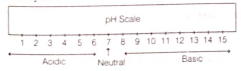
On the basis of above information, answer the following questions.
(i) The average pH of three days is
| (a) 5.11+x | (b) \(5.11+\frac{x}{3}\) | (c) 15.33+x | (d) None of these |
(ii) The system of linear inequality, which shows the given information is
| (a) \(7.2 \leq 5.11+\frac{x}{3} \leq 7.8\) | (b) \(7.2<5.11+\frac{x}{3} \leq 7.8\) | (c) \(7.2 \leq 5.11+\frac{x}{3}<7.8\) | (d) \(7.2<5.11+\frac{x}{3}<7.8\) |
(iii) The solution of linear inequality \(7.2 \leq 5.11+\frac{x}{3}\) is
| (a) x≥6.27 | (b) x>6.27 | (c) x≤6.27 | (d) x<6.27 |
(iv) The solution of linear inequality \(5.11+\frac{x}{3} \leq 78\) is
| (a) x≤8.07 | (b) x<8.07 | (c) x≥8.07 | (d) x>8.07 |
(v) The value of pH on third day is
| (a) [6.27,8.07] | (b) (627,8.07) | (c) (627,8.07] | (d) [6.27,8.07) |
40.
In the figure, it is given that ∠C = 90o, AD = DB, ED is perpendicular to AB, AB = 20 cm and AC = 12 cm.
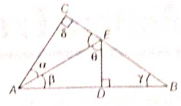
Based on the above information, answer the following questions.
(i) The value of \(\cos (\alpha+\theta)\) is
| (a) \(\frac{4}{5}\) | (b) \(\frac{3}{5}\) | (c) \(\frac{117}{125}\) | (d) \(\frac{44}{125}\) |
(ii) The value of \(\tan 2 \alpha\) is
| (a) \(\frac{3}{4}\) | (b) \(\frac{7}{24}\) | (c) \(\frac{336}{527}\) | (d) \(\frac{24}{25}\) |
(iii) Which of the following is true?
| (a) \(\gamma+\delta=0+\alpha\) | (b) \(\gamma+\delta>\theta+\alpha\) | (c) \(\gamma+\delta<0+\alpha\) | (d) \(\gamma+\delta<\alpha+\beta\) |
(iv) The value of \(\sin \left(\frac{\alpha+\theta+\gamma+\delta}{2}\right) \sin \left(\frac{\alpha+\theta-\gamma-\delta}{2}\right)\) is
| (a) \(\frac{4}{5}\) | (b) \(\frac{3}{5}\) | (c) \(\frac{117}{125}\) | (d) \(\frac{-119}{250}\) |
(v) The value of \(\tan \beta+\tan \theta\) is
| (a) \(\frac{16}{9}\) | (b) \(\frac{12}{25}\) | (c) \(\frac{25}{12}\) | (d) \(\frac{9}{16}\) |
41.
Hanuman Pareek and Pawan Saini are two students of class XI th in a school. The ages of both students is represented by f and g be real functions defined by \(f(x)=\sqrt{x+4}\) and \(g(x)=\sqrt{16-x^2}\). Then, answer the some questions which are based on above ages.
(i) Find the domain of sum of both ages, i.e. (f+g)
| (a) [-4,4] | (b) [-2,2] | (c) [-3,3] | (d) [-5,5] |
(ii) Find the product of both ages, i.e. (f g)
| (a) \( (x+2) \sqrt{4-x}\) | (b) \((x+4) \sqrt{4-x}\) | (c) \((x+4) \sqrt{x-2}\) | (d) \((x+3) \sqrt{x-2}\) |
(iii) Find the difference of both ages, i.e. (f-g)
| (a) \(\sqrt{x-4}-\sqrt{4-x^2}\) | (b) \(\sqrt{x+4}-\sqrt{4-x^2}\) | (c) \(\sqrt{x+4}-\sqrt{16-x^2}\) | (d) \(\sqrt{x+6}-\sqrt{x-6}\) |
(iv) Find the domain of \(\left(\frac{f}{g}\right)\).
| (a) (-4,4) | (b) (-2,2) | (c) (-3,3) | (d) (-5,5) |
(v) Find the \(\left(\frac{f}{g}\right)\)
| (a) \(\frac{1}{\sqrt{5+x}}\) | (b) \(\frac{1}{\sqrt{4+x}}\) | (c) \(\frac{1}{\sqrt{4-x}}\) | (d) \( \frac{1}{\sqrt{2+x}}\) |
1.
(-3i) (i)\(\left( -\frac { 1 }{ 4 } i \right) ^{ 3 }\)
= -3i2\(\times -\frac { 1 }{ 64 } { i }^{ 3 }=\frac { 3 }{ 64 } { i }^{ 5 }\)
= \(\frac { 3 }{ 64 } \)(i2)2.i=\(\frac { 3 }{ 64 } \)i= 0+ \(\frac { 3 }{ 64 } \)i
2.
LHS = cos 4x= 1-2sin2 2x [cos 2x=1-2sin2 x]
= 1-2 (sin 2x)2
= 1-2 (2sinx. cosx)2 [2sin 2x= 2sinx cosx]
= 1-8 sin2 x. cos2 x = RHS
3.
\(LHS=\sqrt { 2+\sqrt { 2+\sqrt { 2+2cos8\theta } } }\)
\(= \sqrt { 2+\sqrt { 2+\sqrt { 2(1+cos8\theta ) } } }\)
\(= \sqrt { 2+\sqrt { 2+\sqrt { 2(1+2cos^{ 2 }4\theta -1) } } } \)
\(= \sqrt { 2+\sqrt { 2+\sqrt { 4cos^{ 2 }4\theta } } } =\sqrt { 2+\sqrt { 2+2cos4\theta } } \)
\(= \sqrt { 2+\sqrt { 2(1+cos4\theta ) } } =\sqrt { 2+\sqrt { 2(1+2cos^{ 2 }2\theta -1) } } \)
\(= \sqrt { 2+\sqrt { 4cos^{ 2 }2\theta } } =\sqrt { 2+2cos2\theta } \)
\(= \sqrt { 2(1+cos2\theta } =\sqrt { 2(1+2cos^{ 2 }\theta -1) } \)
\(= \sqrt { 4cos^{ 2 }\theta } =\quad 2cos\theta \)
Hence Proved.
4.
Here, given degree measure have minutes.
Firstly, convert minutes into degree.
\(\because \) \(1'=\left( \frac { 1 }{ 60 } \right) ^{ o }\)
\(\therefore \) \(20'=\left( \frac { 20 }{ 60 } \right) ^{ o }=\left( \frac { 1 }{ 3 } \right) ^{ o }\)
Now, total degree to convert \(={ 40 }^{ o }+\frac { { 1 }^{ o } }{ 3 } \)
\(=\left( \frac { 120+1 }{ 3 } \right) =\left( \frac { 121 }{ 3 } \right) ^{ o }\)
\(\because \) Radian measure = \(\frac { \pi }{ 180 } \times \) Degree measure
\(\therefore \) Required radian measure \(=\frac { \pi }{ 180 } \times \frac { 121 }{ 3 } \)
\(=\frac { 121\pi }{ 540 } radian\)
5.
B x A = {(r,a),(r,b),(r,c),(s,a),(s,b),(s,c)}
6.
{x : x \(\in\) R, -4 < x \(\le\) 6} is the set that does not contain -4 but contain 6. So, it can be written as an interval whose first end is open and the last end is closed. So, the interval is (-4,6].
7.
More than 230 liters but less than 920 liters.
8.
\(z=\frac { 2+3i }{ 3+2i } x \frac { 3-2i }{ 3-2i } =\frac { 12+5i }{ 13 } \)
\(\overline { z } =\frac { 12 }{ 13 } -\frac { 5 }{ 13 } i\quad and\quad \left| z \right| =1\)
9.
\(\theta =31'=\left( \frac { 31 }{ 60 } \times \frac { \pi }{ 180 } \right) rad\quad and\quad r=360000km\)
\(\because \quad \theta =\frac { l }{ r } \therefore \frac { 31 }{ 60 } \times \frac { \pi }{ 180 } =\frac { 1 }{ 360000 } \)
Ans. 3247.62 km
10.
since, \(\alpha \),\(\beta \) lie between 0 and \(\frac { \pi }{ 4 } \)
\(\therefore -\frac { \pi }{ 4 } <\alpha -\beta \frac { \pi }{ 4 } and\quad 0<\alpha +\beta <\frac { \pi }{ 2 } \)
\(\Rightarrow cos\quad (\alpha -\beta )\quad and\quad sin\quad (\alpha +\beta )\quad are\quad positive.\)
\(Now,\quad sin\quad (\alpha +\beta )=\sqrt { 1-{ cos }^{ 2 }\left( \alpha +\beta \right) } =\frac { 3 }{ 5 } \)
\(and\quad \quad cos\quad (\alpha -\beta )=\sqrt { 1-{ sin }^{ 2 }\left( \alpha -\beta \right) } =\frac { 12 }{ 13 } \)
\(\therefore \quad tan\quad (\alpha +\beta )=\frac { sin\left( \alpha +\beta \right) }{ cos\left( \alpha +\beta \right) } =\frac { 3/5 }{ 4/5 } =\frac { 3 }{ 4 } \)
\(and\quad tan\quad (\alpha -\beta )=\frac { sin\quad \left( \alpha -\beta \right) }{ cos\quad \left( \alpha -\beta \right) } =\frac { 5/13 }{ 12/13 } =\frac { 5 }{ 12 }\)
\(now,\quad tan\quad 2\alpha =tan\quad [\left( \alpha +\beta \right) +\left( \alpha -\beta \right) ]\)
\(=\frac { tan\quad (\alpha +\beta )+tan\quad (\alpha -\beta ) }{ 1-tan\quad (\alpha +\beta )tan\left( \alpha -\beta \right) } =\frac { \frac { 3 }{ 4 } +\frac { 5 }{ 12 } }{ 1-\frac { 3 }{ 4 } \times \frac { 5 }{ 12 } } =\frac { 56 }{ 33 } \)
Hence proved.
11.
(sin2x + sin6x)- sin4x=0
\(\Rightarrow\) 2sin4xcos2x-sin4x=0
\(\Rightarrow\) sin4x=0 or cos2x=\(\frac { 1 }{ 2 } \)
Ans
\(x=\frac { n\pi }{ 4 } \quad or\quad n\pi \pm \frac { \pi }{ 6 } \)
12.
To determine \(A\times (B\cup C)\)
\(B\cup C\) = {b,c,e} \(\cup \) {b,c,f} = {b,c,e,f}
\(\therefore \)\(A\times (B\cup C)\) = {a,d} x {b,c,e,f}
={(a,b),(a,c),(a,e),(a,f),(d,b),(d,c)(d,e),(d,f)}........(i)
To determine \((A\times B)\cup (A\times C)\)
\(A\times B\)={a,d} x {b,c,e}
={(a,b),(a,c),(a,e),(d,b),(d,c),(d,e)}
\(A\times C\)={a,d} x {b,c,f}
={(a,b),(a,c),(a,f),(d,b),(d,c),(d,f)}
\(\therefore \)\((A\times B)\cup (A\times C)\) = {(a,b),(a,c),(a,e),(a,f),(d,b),(d,c),(d,e),(d,f)}......(ii)
From Eqs.(i) and (ii) we get
\(A\times (B\cup C)=(A\times B)\cup (A\times C)\)
13.
LHS=(A\(\cap\)B)\(\cup\)(A\(\cap\)B)' [\(\because\) A - B=A\(\cap\)B']
Let A\(\cap\)B=X, then
LHS=X\(\cup\)(A\(\cap\)B')
=(X\(\cup\)A)\(\cap\)(X\(\cup\)B') ..(i)
[\(\because\) \(\cup\) distribute over \(\cap\) ]
\(\because\) X = A\(\cap\)B
\(\therefore\) X\(\cup\)A=(A\(\cap\)B)\(\cup\)A=A [\(\because\) A\(\cap\)B\(\subseteq \)A]
and X\(\cup\)B'=(A\(\cap\)B)\(\cup\)B'
=(A\(\cup\)B')\(\cap\)(B\(\cup\)B') [\(\because\) \(\cup\) distribute over \(\cap\)]
=(A\(\cup\)B')\(\cap\)U [\(\because\) B\(\cup\)B'=U]
=A\(\cup\)B'
Now, substitutethe value of X\(\cup\)A, X\(\cup\)B' in Eq.(i), to get result
14.
Now, \(\frac{x}{2 x+1} \geq \frac{1}{4} \Rightarrow \frac{x}{2 x+1}-\frac{1}{4} \geq 0\)
\(\Rightarrow \frac{2 x-1}{4(2 x+1)} \geq 0, \text { here } 2 x+1 \neq 0, \text { i.e. } x \neq-\frac{1}{2} \)
\(\Rightarrow (2 x-1)(2 x+1) \geq 0\)
Case I When both are non-negative
\(2 x-1 \geq 0 \text { and } 2 x+1>0 \)
\(\Rightarrow x \geq \frac{1}{2} \text { and } x>-\frac{1}{2} \)
\(\therefore x \in\left[\frac{1}{2} \infty\right)\) ..(i)
Case II When both are non-positive
\((2 x-1) \leq 0 \text { and } 2 x+1<0 \)
\(\Rightarrow x \leq \frac{1}{2} \text { and } x<\frac{-1}{2} \)
\(\therefore x \in\left(-\infty,-\frac{1}{2}\right)\) .(ii)
From Eqs. (i) and (ii), we get
\(x \in\left(-\infty,-\frac{1}{2}\right) \cup\left[\frac{1}{2}, \infty\right) \) .(iii)
now,\(\frac{6 x}{4 x-1}<\frac{1}{2} \Rightarrow \frac{6 x}{4 x-1}-\frac{1}{2}<0\)
\(\Rightarrow \frac{8 x+1}{2(4 x-1)}<0 \)
\(\Rightarrow (8 x+1)(4 x-1)<0\)
We have, \((8 x+1)<0 \text { and }(4 x-1)>0 \)
or \((8 x+1)>0 \text { and }(4 x-1)<0\)
\(\Rightarrow \frac{-1}{8}<x<\frac{1}{4}\) ..(iv)
Now, for the solution set of given system of inequalities take common value of x from Eqs. (ill) and (iv), but there is no common value of x.
Ans. Solution set is a empty set.
15.
Given, A = {4, 5, 7, 8, 10}, B = {4, 5, 9} and C = {1, 4, 6, 9}
(i) Now, A \(\cap\) B = {4, 5, 7, 8, 10} \(\cap\) {4, 5, 9} = {4, 5}
\(\therefore\) LHS = (A \(\cap\) B) \(\cap\) C
= {4, 5} \(\cap\) {I, 4, 6, 9} = {4} ... (i)
Now, B \(\cap\) C = {4, 5, 9} \(\cap\) {I, 4, 6, 9} = {4, 9}
\(\therefore\) RHS = A \(\cap\) (B \(\cap\) C)
= {4, 5, 7, 8, 10} \(\cap\) {4, 9}= {4} ...(ii)
From Eqs. (i) and (ii), we get
LHS = RHS = {4}
Hence, (A \(\cap\) B) \(\cap\) C = A \(\cap\) (B \(\cap\) C)
(ii) Here, B \(\cap\) C = {4, 9}
\(\therefore\) LHS = A \(\cup\) (B \(\cap\) C)
= {4, 5, 7, 8, 10} \(\cup\) {4, 9}
\(\Rightarrow\) LHS = {4, 5, 7, 8, 9,10} ...(iii)
Now, A \(\cup\) B = {4, 5, 7, 8, 10} \(\cup\) {4, 5, 9}
= {4, 5, 7, 8, 9,10}
and A \(\cup\) C = {4, 5, 7, 8, 10} \(\cup\) {1, 4, 6, 9}
= {1,4, 5, 6, 7, 8, 9,10}
\(\therefore\) RHS = (A \(\cup\) B) \(\cap\) (A \(\cup\) C)
= {4, 5, 7, 8, 9,10} \(\cap\) {1, 4, 5, 6, 7, 8, 9,10}
= {4, 5, 7, 8, 9, 10} ...(iv)
From Eqs. (iii) and (iv), we get
LHS = RHS = {4, 5, 7, 8, 9,10}
Hence, A \(\cup\) (B \(\cap\) C) = (A \(\cup\) B) \(\cap\) (A \(\cup\) C)
(iii) Now, B \(\cup\) C = {4, 5, 9} \(\cup\) {I, 4, 6, 9}= {1, 4, 5, 6, 9}
\(\therefore\) LHS = A \(\cap\) (B \(\cup\) C)
= {4, 5, 7, 8, 10} \(\cap\) {1, 4, 5, 6, 9} = {4, 5} ... (v)
Now, A \(\cap\) B = {4, 5, 7, 8, 10} \(\cap\) {4, 5, 9}= {4, 5}
and A \(\cap\) C = {4, 5, 7, 8, 10} \(\cap\) {1, 4, 6, 9}= {4}
\(\therefore\) RHS = (A \(\cap\) B) \(\cup\) (A \(\cap\) C) = {4, 5} \(\cup\) {4}
= {4, 5} .....(vi)
From Eqs. (v) and (vi), we get
LHS = RHS = {4, 5}
Hence, A \(\cap\) (B \(\cup\) C) = (A \(\cap\) B) \(\cup\) (A \(\cap\) C)
16.
Here a+ib =\(\frac { x+i }{ x-i } =\frac { x+i }{ x-i } \times \frac { x+i }{ x+i } \)
= \(\frac { (x+i)^{ 2 } }{ x^{ 2 }-i^{ 2 } } =\frac { { x }^{ 2 }+2xi+{ i }^{ 2 } }{ { x }^{ 2 }+1 } \)
= \(\frac { x^{ 2 }-1 }{ x^{ 2 }+1 } +\frac { 2x }{ { x }^{ 2 }+1 } i\)
Comparing real and imaginary parts on both sides, we have
a=\(\frac { x^{ 2 }-1 }{ x^{ 2 }+1 } \)and b=\(\frac { 2x }{ { x }^{ 2 }+1 } \)
Now a2+b2= \(\left( \frac { x^{ 2 }-1 }{ x^{ 2 }+1 } \right) ^{ 2 }+\left( \frac { 2x }{ { x }^{ 2 }+1 } \right) ^{ 2 }\)
= \(\frac { (x^{ 2 }-1)^{ 2 }+{ 4x }^{ 2 } }{ ({ x }^{ 2 }+1)^{ 2 } } \)
= \(\frac { ({ x }^{ 2 }+1)^{ 2 } }{ ({ x }^{ 2 }+1)^{ 2 } } =1\)
Also \(\frac { b }{ a } =\frac { \frac { 2x }{ { x }^{ 2 }+1 } }{ \frac { { x }^{ 2 }-1 }{ { x }^{ 2 }+1 } } =\frac { 2x }{ { x }^{ 2 }-1 } \)
17.
(i) {3, 4} is a member of set A.
\(\therefore\) {3, 4} ∈ A
Hence {3, 4}⊂ A is incorrect.
(ii) {3, 4} is a member of set A.
\(\therefore\){3, 4} ∈ A is correct.
(iii) Here {3, 4} is a member of set A.
\(\therefore\) {{3,4}} is a set
\(\therefore\) {{3,4}} ⊂ A is correct.
(iv) 1 is a member of set A.
\(\therefore\) 1 ∈ A is correct.
(v) 1 is not a set, it is a member of set A.
\(\therefore\) 1⊂ A is incorrect.
(vi) 1, 2, 5 are members of set A.
\(\therefore\) {1, 2, 5} is a subset of set A.
\(\therefore\) {1, 2, 5} ⊂ A is correct.
(vii) 1, 2, 5 are members of set A.
\(\therefore\) {1, 2, 5} is a subset of set A.
\(\therefore\) {1, 2, 5} ∈ A is incorrect.
(viii) 3 is not a member of set A.
\(\therefore\) {1, 2, 3} is not a subset of set A.
\(\therefore\) {1, 2, 3} ⊂ A is incorrect.
(ix) ф is not a member of set A.
\(\therefore\) ф ∈ A is incorrect.
(x) Since ф is subset of every set,
\(\therefore\)ф ⊂ A is correct.
(xi)ф is not a member of set A.
\(\therefore\) {ф} ⊂ A is incorrect.
18.
\(\frac { 3 }{ 2 } \)
19.
(a)
x = 4i
20.
(b)
0
21.
(a)
\(\frac{a}{a^{2}+b^{2}}+\frac{-b i}{a^{2}+b^{2}}\)
22.
(c)
Square root of negative number
23.
(c)
\((-\infty, 120]\)
24.
(b)
8 to 10 km
25.
(b)
30x < 200
26.
(c)
\(\frac{3}{2}\)
27.
(d)
0
28.
(d)
\(\frac{\pi}{4}\)
29.
(a)
R = {(2, 2), (3, 5), (4, 10), (5, 17), (6, 25)}
30.
(d)
6.28 cm
31.
(b)
\(\frac{121 \pi}{540}\) radian
32.
(b)
16
33.
(c)
5
34.
(a)
{(2, 4), (3, 4)}
35.
(c)
(c) b \(\notin\) A
36.
(c)
mn
37.
(b)
\(A-\bar B\)
38.
(c)
(A \(\cup\) B) - (A \(\cap\) B)
39.
(i) (b)
(ii) (d)
(iii) (a)
(iv) (a)
(v) (b)
40.
Hint Given, AB = 20 cm, AC= 12 cm
\(\therefore B C =\sqrt{20^2-12^2}=16 \mathrm{cm} \)
\(\tan \gamma =\frac{A C}{B C}=\frac{12}{16}=\frac{3}{4}\)
\([\triangle D E A \cong \triangle D E B\) by SAS property]
\(\gamma =\beta \)
\(\cos \gamma =\frac{B D}{B E} \Rightarrow B E=\frac{10}{4 / 5}=\frac{25}{2} \)
\(\tan \gamma =\frac{D E}{B D} \Rightarrow D E=\frac{10}{4 / 3}=\frac{15}{2} \)
\(C E =B C-B E=16-\frac{25}{2}=\frac{7}{2} \)
\(\tan \alpha =\frac{C E}{A C}=\frac{7}{24}, \cos \alpha=\frac{24}{25}, \sin \alpha=\frac{7}{25} \)
\(\tan \theta =\tan \left(\frac{\pi}{2}-\beta\right)=\cot \beta=\cot \gamma=\frac{4}{3}, \)
\(\cos \theta =\frac{3}{5}, \sin \theta=\frac{4}{5}\)
(i) (d) Use formula cos (A+B)= cos A cos B-sin A sin B
(ii) (c) Use formula \(\tan 2 A=\frac{2 \tan A}{1-\tan ^2 A}\)
(iii) (c) Since, \( A E>C E \ \delta>\alpha \)
and \(A D>D E \beta<\theta \)
\( \gamma=\beta \quad \gamma<\theta\)
\( \therefore \gamma+\delta<\alpha+\theta\)
(iv) (d) Use formula
-2 sin A sin B=cos (A+B)-cos (A-B)
(v) (c)
41.
(i) (a)
(ii) (b)
(iii) (c)
(iv) (a)
(v) (c)

11th Standard CBSE Syllabus & Materials
11th Standard CBSE
CBSE 11th Business Studies Forms of Business Organisation Sample Question Papers Study Material - QB365 Set A
NEW11th Standard CBSE
CBSE 11th Business Studies Business, Trade and Commerce Sample Question Papers Study Material - QB365 Set A
NEW11th Standard CBSE
CBSE 11th Physics Waves Sample Question Papers Study Material - QB365 Set A
NEW11th Standard CBSE
CBSE 11th Physics Kinetic Theory Sample Question Papers Study Material - QB365 Set A



NCERT Books

Syllabus

Exam Pattern

Sample Question Papers

Previous year Question Papers

Important Notes

MCQ Practice test

NCERT Exemplers

Case study Questions

Image Based Questions

Passage based Questions

HOT Questions

Value Based Questions

Model Questions Papers
NCERT ( Book Back ) Questions

Assertion and Reason
Important Questions And Answers

CBSE 11th Standard CBSE Subjects
CBSE Standards







