
 100% FREE ACCESS
11th Standard CBSE Syllabus & Materials
11th Standard CBSE
CBSE 11th Economics PART-A - Presentation of Data - New Sample Question Papers Study Material - QB365 Set A
NEW11th Standard CBSE
CBSE 11th Economics PART-A - Organisation of Data - New Sample Question Papers Study Material - QB365 Set A
NEW11th Standard CBSE
CBSE 11th Economics PART-A - Collection of Data - New Sample Question Papers Study Material - QB365 Set A
NEW11th Standard CBSE
CBSE 11th Economics PART-A - Introduction to Economics and Statistics - New Sample Question Papers Study Material - QB365 Set A
NEW11th Standard CBSE
CBSE 11th Business Studies International Trade Sample Question Papers Study Material - QB365 Set A
NEW11th Standard CBSE
CBSE 11th Business Studies Evolution and Fundamentals of Business Sample Question Papers Study Material - QB365 Set A

Published on: 21/10/2025
Download CBSE Class 11th Standard CBSE Mathematics question papers, sample papers, important questions, and previous year solved papers in PDF format. Get free study materials, NCERT solutions, and exam preparation resources for Class 11th Standard CBSE Mathematics
Questions + Answers key
Take MCQ Mathematics Test
1.
The cable of a uniformly loaded suspension bridge hangs in the form of a parabola. The roadway which is horizontal and 100 m long is supported by vertical wires attached to the cable, the longest wire being 30 m and the shortest being 6 m. Find the length of a supporting wire attached to the roadway 18 m from the middle.
2.
An arch is in the form of a parabola with its vertical. The arch is 10 m high and 5 m wide at the base. How wide it is 2 m from the vertex of the parabola?
3.
An equilateral triangle is inscribed in the parabola \({ y }^{ 2 }=4ax\), where one vertex is at the vertex of the parabola. Find the length of the side of the triangle.
4.
If a parabolic reflector is 20 cm in diameter and 5 cm deep. Find the focus.
5.
A rod AB of length 15 cm rests in between two coordinate axes in such a way that the end point A lies on x-axis and end point B lies on y-axis. A point P(x, y) is taken on the rod in such a way that AP = 6 cm. Show that the locus of P is an ellipse.
6.
Find the coordinates of the foci and the vertices, the eccentricity,the length of the latus rectum of the hyperbolas
\((i) \frac{x^{2}}{9}-\frac{y^{2}}{16}=1,\)
\((ii) y^{2}-16 x^{2}=16\)
7.
Find the equation of the parabola that satisfies the given conditions:
Vertex (0, 0) passing through (5, 2) and symmetric with respect to y-axis.
8.
Find the coordinates of the focus, axis of the parabola, the equation of the directrix and the length of the latus rectum.
x2 = 6y
9.
Find the coordinates of the focus, axis of the parabola, the equation of the directrix and the length of the latus rectum.
y2=12x
10.
Find the centre and radius of the circles. x2+ y2-8x-10y-12=0
11.
A man running a racecourse notes that the sum of the distances from the two flag posts from him is always 10 m and the distance between the flag posts is 8 m. Find the equation of the posts traced by the man.
12.
Find the equation of the circle with radius 5 whose centre lies on x-axis and passes through the point (2,3).
13.
A rod of length 12cm moves with its ends always touching the coordinate axes. Determine the equation of the locus of a point P on the rod, which is 3 cm from the end in contact with the x-axis.
14.
Find the equation of the hyperbola satisfying the given conditions.
Foci (0, ± \(\sqrt10\) ),passing through (2, 3)
15.
The equation of the circle with centre (- 3, 2) and radius 4, is _______.
(x - 3)2 + (y - 2)2 = 16
(x + 3)2 + (y + 2)2 = 16
(x - 3)2 + (y + 2)2 = 16
(x + 3)2 + (y - 2)2 = 16
16.
Conic sections or more commonly conics are obtained by intersections of a ...A. .. with a double napped ...B.... Here, A and B respectively are_______.
line, right circular cone
cone, plane
line, cone
plane, right circular cone
17.
The latus rectum of the hyperbola \({ 16x }^{ 2 }-{ ay }^{ 2 }=144\quad is\) _______.
323
\(\frac { 15 }{ 4 } \)
\(\frac { 4 }{ 3 } \)
\(\frac { 3 }{ 4 } \)
18.
The difference between the lengths of the major axis and the latus rectum of an ellipse is ______.
\({ 2ae }^{ 2 }\)
\(ae\)
\(3ae\)
\(ae^{ 2 }\)
19.
The eccentricity of the ellipse \(\frac { { x }^{ 2 } }{ { a }^{ 2 } } +\frac { { y }^{ 2 } }{ { b }^{ 2 } } =1\) if its latus rectum is equal to one half of its minor axis is _______.
\(\frac { 1 }{ 2 } \)
\(\frac { \sqrt { 3 } }{ 2 } \)
\(\frac { 1 }{ \sqrt { 3 } } \)
None of these
20.
The locus of the points of trisection of the double ordinates of a parabola is a ______.
pair of lines
parabola
circles
none of these
1.
Here, wire are vertical.
Let equation of the parabola be in the form
\({ x }^{ 2 }=4ay\) ...(i)
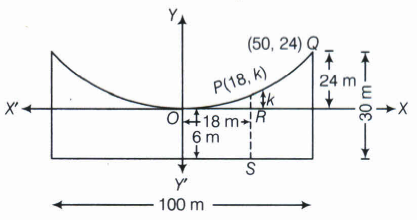
Focus is at the middle of the cable and shortest and longest vertical supports are 6 m and 30 m and roadway in 100 m long.
Clearly, the coordinates of Q(50, 24) will satisfy Eq.(i)
\(\therefore \quad (50)^{ 2 }=4a\times 24\Rightarrow 2500=96a\Rightarrow a=\frac { 2500 }{ 96 } \)
\(Hence,from\quad Eq.(i),\quad { x }^{ 2 }=4\times \frac { 2500 }{ 96 } y\Rightarrow { x }^{ 2 }=\frac { 2500 }{ 24 } y\)
Let PR=km
Then, point\ P(18,k) will satisfy the equation of parabola.
\(\therefore \quad From\quad Eq.(i),\quad (18)^{ 2 }=\frac { 2500 }{ 24 } \times k\)
\(\Rightarrow 324=\frac { 2500 }{ 24 } k\Rightarrow k=\frac { 324\times 24 }{ 2500 } =\frac { 324\times 6 }{ 625 } =\frac { 1944 }{ 625 } \)
\( \Rightarrow k=3.11\)
Therefore Required length= 6+k=6+3.11=9.11m(approx.)
2.
Here, axis is vertical, so let arch of parabola is in the form
\({ x }^{ 2 }=4ay\) ..(i)
\(\text {Given, OB=10m}\)
\(\text {and AC}=5m\Rightarrow AB=\frac { 5 }{ 2 } m\)
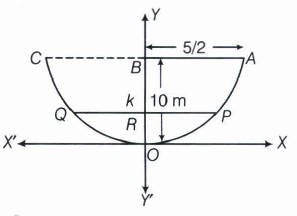
\(\text{Hence,coordinates of A}=\left( \frac { 5 }{ 2 } ,10 \right) \text{will satisfy Eq.(i)}\)
\( \left( \frac { 5 }{ 2 } \right) ^{ 2 }=4a\times 10\Rightarrow \frac { 25 }{ 4 } =40a\Rightarrow a=\frac { 5 }{ 32 } \)
From Eq.(i),
\( { x }^{ 2 }=4\times \frac { 5 }{ 32 } y\Rightarrow { x }^{ 2 }=\frac { 5 }{ 8 } y\)
Now,let OR=2 and
\( PQ=k\Rightarrow RP=\frac { k }{ 2 } \)
\(\therefore,P=\left( \frac { k }{ 2 } ,2 \right) \) will lie on parabola.
\(\therefore \left( \frac { k }{ 2 } \right) ^{ 2 }=\frac { 5 }{ 8 } \times 2\Rightarrow \frac { { k }^{ 2 } }{ 4 } =\frac { 5 }{ 4 } \Rightarrow k=\sqrt { 5 } =2.23m(approx.)\)
3.
First, we draw the parabola in the positive side of x-axis and inside that, draw an equilateral \(\triangle OAB.\)
\(\sin{ 30 }^{ \circ }=\frac { PB }{ OB } \Rightarrow \frac { 1 }{ 2 } =PB\Rightarrow PB=2\)
\(and \cos{ 30 }^{ \circ }=\frac { OP }{ OB } \Rightarrow \frac { \sqrt { 3 } }{ 2 } =OP\Rightarrow OP=\frac { \sqrt { 3 } }{ 2 } \)
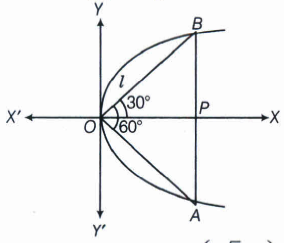
Coordinates of B=(OP, PB) = \(\left( \frac { \sqrt { 3 } }{ 2 } ,\frac { }{ 2 } \right) \)will satisfy
\({ y }^{ 2 }=4ax\) \(=8\sqrt { 3a } \)
Hence, the length of side of the triangle is \(=8\sqrt { 3a } \) .
4.
Let POQ be the parabolic reflector which is 20 cm in diameter and 5 cm deep.
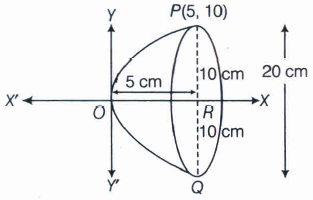
Then, PQ = 20 cm and OR = 5 cm, where R is the midpoint of PQ. We take OX as X-axis and OY as Y-axis. The equation of parabola may be taken as 4ax. Since, the point P(5, 10) lies on the parabola.
\({ 10 }^{ 2 }=4a(5)\Rightarrow a=5\)
Therefore, the coordinate of the focus are (a, o) i.e. (5, 0). Hence, the focus is the midpoint of the given diameter.
5.
Let AB be the rod making an angle \(\theta\) with
OX and P (x, y) the point on it
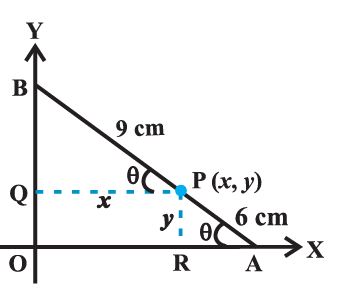
such that AP = 6 cm.
Since AB = 15 cm, we have
PB = 9 cm.
From P draw PQ and PR perpendiculars on y-axis and x-axis, respectively
\(\text { From } \Delta \mathrm{PBQ}, \cos \theta=\frac{x}{9} \)
\(\text { From } \Delta \mathrm{PRA}, \sin \theta=\frac{y}{6} \)
\(\text { Since } \quad \cos ^{2} \theta+\sin ^{2} \theta= 1 \)
\( \left(\frac{x}{9}\right)^{2}+\left(\frac{y}{6}\right)^{2}=1\)
\(\text { or } \ \frac{x^{2}}{81}+\frac{y^{2}}{36}=1\)
Thus the locus of P is an ellipse
6.
(i) Comparing the equation \(\frac{x^{2}}{9}-\frac{y^{2}}{16}=1,\) with the standard equation
\(\frac{x^{2}}{a^{2}}-\frac{y^{2}}{b^{2}}=1\)
Here, a = 3, b = 4 and c \(=\sqrt{a^{2}+b^{2}}=\sqrt{9+16}=5\)
Therefore, the coordinates of the foci are (± 5, 0) and that of vertices are (± 3, 0).Also, The eccentricity \(e=\frac{c}{a}=\frac{5}{3}\) The latus rectum \(=\frac{2 b^{2}}{a}=\frac{32}{3}\)
(ii) Dividing the equation by 16 on both sides, we have \(\frac{y^{2}}{16}-\frac{x^{2}}{1}=1\)
Comparing the equation with the standard equation \(\frac{y^{2}}{a^{2}}-\frac{x^{2}}{b^{2}}=1\) we find that a = 4, b = 1 and
\(c=\sqrt{a^{2}+b^{2}}=\sqrt{16+1}=\sqrt{17} \text { . }\)
Therefore, the coordinates of the foci are (0, ± \(\sqrt{17}\) ) and that of the vertices are (0, ± 4). Also The eccentricity \(e=\frac{c}{a}=\frac{\sqrt{17}}{4}\) The latus rectum \(=\frac{2 b^{2}}{a}=\frac{1}{2}\)
7.
The vertex of the parabola is at (0, 0) and it is symmetrical about the y-axis.
∴ axis of parabola is y-axis.
So the parabola is of the form x2 = 4ay.
Since the parabola passes through point (5,2)
∴ (5)2 = 4a x 2⇒ 25=8a ⇒ a=\(\frac { 25 }{ 8 } \)
The required equation of parabola is
x2=\(\frac { 4\times 25 }{ 8 } \)y
⇒ x2=\(\frac { 25 }{ 2 } \) y
⇒ 2x2=25y
8.
The given equation of parabola x2=6y
which is of the form x2=4ay
∴ 4a=6
⇒ a=\(\frac { 6 }{ 4 } \) ⇒ a=\(\frac { 3 }{ 2 } \)
∴ Coordinates of focus are \(\left( 0,\frac { 3 }{ 2 } \right) \)
Axis of parabola is x = 0
Equation of the directrix is
y=\(\frac { -3 }{ 2 } \) ⇒ 2y+3=0
Length of latus rectum =\(\frac { 4\times 3 }{ 2 } \)=6
9.
The given equation is y2 = 12x.
Here, the coefficient of x is positive. Hence, the parabola opens towards the right.
On comparing this equation with y2 = 4ax, we obtain
4a = 12 ⇒ a = 3
∴ Coordinates of the focus = (a, 0) = (3, 0)
Since the given equation involves y2, the axis of the parabola is the x-axis.
Equation of direcctrix, x = –a i.e., x = – 3 i.e., x + 3 = 0
Length of latus rectum = 4a = 4 × 3 = 12
10.
The given equation of circle is
x2 + y2 - 8x + 10y - 12 = 0
∴ (x2 - 8x) + (y2 + 10y) = 12
⇒ [x2 - 8x + (4)2] + [y2 + 10y + (5)2]
= 12 + (4)2 + (5)2
⇒ (x - 4)2 + (y + 5)2 = 12 + 16 + 25
⇒ (x - 4)2 + (y + 5)2 = 53
⇒ (x - 4)2 + (y + 5)2 =(\(\sqrt { 53 } \))2
Comparing it with (x - h)2 + (y - k)2 = r2, we have
h = 4, k = - 5 and r=\(\sqrt { 53 } \)
Thus co-ordinates of the centre is (4, -5) and radius is \(\sqrt { 53 } \) .
11.
Let A and B be the positions of the two flag posts and P(x, y) be the position of the man. Accordingly, PA + PB = 10.
We know that if a point moves in a plane in such a way that the sum of its distances from two fixed points is constant, then the path is an ellipse and this constant value is equal to the length of the major axis of the ellipse.
Therefore, the path described by the man is an ellipse where the length of the major axis is 10 m, while points A and B are the foci.
Taking the origin of the coordinate plane as the centre of the ellipse, while taking the major axis along the x-axis, the ellipse can be diagrammatically represented as
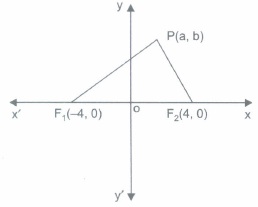
\(\text { The equation of the ellipse will be of the form } \frac{x^{2}}{a^{2}}+\frac{y^{2}}{b^{2}}=1 \text { , where } a \text { is the semi-major axis }\)
\(\text { Accordingly, } 2 a=10\)
\(a=5\)
\(\text { Distance between the foci }(2 c)=8\)
c = 4
\(\text { On using the relation } c=\sqrt{a^{2}-b^{2}} \text { , we obtain }\)
\(4=\sqrt{25-b^{2}} \)
\(\Rightarrow 16=25-b^{2} \)
\(\Rightarrow b^{2}=25-16=9 \)
\(\Rightarrow b=3\)
\(\text { Thus, the equation of the path traced by the man is } \frac{x^{2}}{25}+\frac{y^{2}}{9}=1 \text { . }\)
12.
Let the equation of the required circle be (x – h)2 + (y – k)2 = r2.
Since the radius of the circle is 5 and its centre lies on the x-axis, k = 0 and r = 5.
Now, the equation of the circle becomes (x – h)2 + y2 = 25.
It is given that the circle passes through point (2, 3).
\(\therefore(2-h)^{2}+3^{2}=25 \)
\(\Rightarrow(2-h)^{2}=25-9 \)
\(\Rightarrow(2-h)^{2}=16 \)
\(\Rightarrow 2-h=\pm \sqrt{16}=\pm 4 \)
\(\text { If } 2-h=4, \text { then } h=-2 . \)
\(\text { If } 2-h=-4, \text { then } h=6 .\)
Equation of required circle is
(x - 6)2 + (y - 0)2 = (5)2
⇒ x2 + 36 - 12x + y2 = 25
⇒ x2 + y2 - 12x + 11 = 0
When h=-2
Equation of required circle is
(x + 2)2 + (y - 0)2 = (5)2
⇒ x2 + 4 + 4x + y2 = 25
⇒ x2 + y2 + 4x - 21 = 0
13.
Let AB be a rod of length 12 cm and P(x, y) be any point on the rod such that PA = 3 cm and PB = 9 cm.
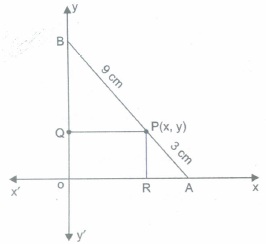
Let AR = a and BQ = b
Then ΔARP ~ ΔPQB
∴ \(\frac { AR }{ PQ } =\frac { AP }{ PB } \)
∴ \(\frac { a }{ x } =\frac { 3 }{ 9 } \) ⇒ 9a=3a ⇒ a=\(\frac { x }{ 3 } \)
and \(\frac { BQ }{ BP } =\frac { PR }{ PA } \)
∴ \(\frac { b }{ 9 } =\frac { y }{ 3 } \) ⇒ 3b=9y ⇒ b=3y
Now OR + AR = x + a = x+\(\frac { x }{ 3 } =\frac { 4x }{ 3 } \)
OB = OQ + BQ = y + b = y + 3y = 4y
In right angled ΔAOB
AB2= OA2+ OB2
∴ (12)2 = \(\left( \frac { 4x }{ 3 } \right) ^{ 2 }\)+(4y)2
⇒ 144=\(\frac { 16{ x }^{ 2 } }{ 9 } \)+16y2
⇒ \(\frac { 16{ x }^{ 2 } }{ 9\times 144 } +\frac { 16{ y }^{ 2 } }{ 144 } \) =1 ⇒ \(\frac { { x }^{ 2 } }{ 81 } +\frac { { y }^{ 2 } }{ 9 } \)=1
which is required locus of point P and which represents an ellipse.
14.
Here foci are (0, ±\(\sqrt10\)) which lie on y-axis.
So the equation of hyperbola in standard form is \(\frac { { y }^{ 2 } }{ { a }^{ 2 } } -\frac { { x }^{ 2 } }{ { b }^{ 2 } } \)=1
∴ foci (0, ± c) is (0, ± \(\sqrt10\)) a = \(\sqrt10\)
We know that c2 = a2 + b2
∴ (\(\sqrt10\))2 = a2 + b2 ⇒ b2 = 10 - a2
Since the hyperbola passes through (2, 3)
∴ \(\frac { 9 }{ a^{ 2 } } -\frac { 4 }{ { b }^{ 2 } } \)=1
⇒ \(\frac { 9 }{ a^{ 2 } } -\frac { 4 }{ 10-{ a }^{ 2 } } \)=1
⇒ \(\frac { 9(10-{ a }^{ 2 })-4{ a }^{ 2 }={ a }^{ 2 }(10-{ a }^{ 2 }) }{ { a }^{ 2 }(10-{ a }^{ 2 }) } \)
⇒ a4 - 23a2 + 90 = 0
⇒ a4 - 18a2 - 5a2 + 90 = 0
⇒ (a2 - 18) (a2 - 5) = 0
⇒ a2 = 18 or a2 = 5
When a2= 18 then b2= 10-18=-8 (which is not possible)
When a2 = 5 then b2 = 10 - 5 = 5
Thus required equation of hyperbola is
\(\frac { { y }^{ 2 } }{ 5 } -\frac { { x }^{ 2 } }{ 5 } \)=1
15.
(d)
(x + 3)2 + (y - 2)2 = 16
16.
(d)
plane, right circular cone
17.
(a)
323
18.
(a)
\({ 2ae }^{ 2 }\)
19.
(b)
\(\frac { \sqrt { 3 } }{ 2 } \)
20.
(b)
parabola

11th Standard CBSE Syllabus & Materials
11th Standard CBSE
CBSE 11th Business Studies Forms of Business Organisation Sample Question Papers Study Material - QB365 Set A
NEW11th Standard CBSE
CBSE 11th Business Studies Business, Trade and Commerce Sample Question Papers Study Material - QB365 Set A
NEW11th Standard CBSE
CBSE 11th Physics Waves Sample Question Papers Study Material - QB365 Set A
NEW11th Standard CBSE
CBSE 11th Physics Kinetic Theory Sample Question Papers Study Material - QB365 Set A



NCERT Books

Syllabus

Exam Pattern

Sample Question Papers

Previous year Question Papers

Important Notes

MCQ Practice test

NCERT Exemplers

Case study Questions

Image Based Questions

Passage based Questions

HOT Questions

Value Based Questions

Model Questions Papers
NCERT ( Book Back ) Questions

Assertion and Reason
Important Questions And Answers

CBSE 11th Standard CBSE Subjects
CBSE Standards







