
 100% FREE ACCESS
11th Standard CBSE Syllabus & Materials
11th Standard CBSE
CBSE 11th Economics PART-A - Presentation of Data - New Sample Question Papers Study Material - QB365 Set A
NEW11th Standard CBSE
CBSE 11th Economics PART-A - Organisation of Data - New Sample Question Papers Study Material - QB365 Set A
NEW11th Standard CBSE
CBSE 11th Economics PART-A - Collection of Data - New Sample Question Papers Study Material - QB365 Set A
NEW11th Standard CBSE
CBSE 11th Economics PART-A - Introduction to Economics and Statistics - New Sample Question Papers Study Material - QB365 Set A
NEW11th Standard CBSE
CBSE 11th Business Studies International Trade Sample Question Papers Study Material - QB365 Set A
NEW11th Standard CBSE
CBSE 11th Business Studies Evolution and Fundamentals of Business Sample Question Papers Study Material - QB365 Set A

Published on: 21/10/2025
Download CBSE Class 11th Standard CBSE Mathematics question papers, sample papers, important questions, and previous year solved papers in PDF format. Get free study materials, NCERT solutions, and exam preparation resources for Class 11th Standard CBSE Mathematics
Questions + Answers key
Take MCQ Mathematics Test
1.
Find the equation of the circle with centre (–3, 2) and radius 4.
2.
Find an equation of the circle with centre at (0,0) and radius r.
3.
Find the equation of circle passing through the points (4, 1) and (6, 5) and whose centre lies on the straight line 4x + y - 16 =0
4.
Find the equation of a circle with centre (2, 2) and passes through the point (4, 5).
5.
Does the point (4,5) lie inside, outside or on the circle x2 + y2 - 2x - 3 = 0?
6.
Find the centre and radius of the circles, 2x2+2y2-x=0
7.
Find the centre and radius of the circles. x2+ y2-8x-10y-12=0
8.
Find the centre and radius of the circles, x2 + y2 - 4x - 8y - 45 = 0
9.
Find the centre and radius of the circles.(x + 5)2 + (y - 3)2 = 36
10.
Find the equation of the circle with, centre (-a, -b) and radius \(\\ \sqrt { { a }^{ 2 }-{ b }^{ 2 } } \).
11.
Find the equation of the circle with, centre (1, 1) and radius \(\sqrt { 2 } \).
12.
Find the equation of the circle with, centre \(\left( \frac { 1 }{ 2 } ,\frac { 1 }{ 4 } \right) \) and radius \(\frac { 1 }{ 12 } \).
13.
Find the equation of the circle with, centre (-2,3) and radius 4.
14.
Find the equation of the circle with, centre (0,2) and radius 2.
15.
Find the centre and radius of the circle of the followings
(i) (x + 5)2 + (y - 3)2 = 36
(ii) x2 + y2 - 4x - 8y - 45 = 0
(iii) x2 + y2 - 6x + 4y -12 =0.
(iv) x2 + y2 + 8x + 10y - 8 = 0
(v) x2 + y2 - 2x + 4y = 8
(vi) x2 + y2 + 6x -10y + 16 =0
(vii) x2 + y2 + 8x -10y + 16 =0
(viii) x2 + y2 + 10x - 8Y - 36 = 0
(ix) 3x2 + 3y2 + 6x - 4y -1=0
16.
Does the point (–2.5, 3.5) lie inside, outside or on the circle x2 + y2 = 25?
17.
Does the point (- 1.5,2.5)lies inside or outside or on the circle x2 + y2 = 25?
18.
Find the equation of the circle which passes through the points (2,-2) and (3,4) and whose centre lies on the line x + y = 2
19.
Find the equation of the circle passing through (0, 0) and making intercepts a and b on the coordinate axes.
20.
Find the equation of the circle with radius 5 whose centre lies on x-axis and passes through the point (2,3).
21.
Find the equation of the circle passing through the points (2,3) and (-1, 1) and whose centre is on the line x - 3y - 11 =0.
22.
Find the equation of the circle passing through the points (4, 1) and (6, 5) and whose centre is on the line 4x +y = 16.
23.
If the equation of the circle with centre at (h, k) and radius r is x2 + y2 = r2. Then, hand k respectively are ______.
(1,1)
(-1,-1)
(0,0)
None of these
24.
A circle is the set of all points in a plane that are equidistant from a ...P... point in the ...Q.... Here, P and Q respectively are ______.
any, space
fixed, space
any, plane
fixed, plane
25.
Different kinds of conic sections are obtained depending on _______.
the position of the intersecting plane with respect to the cone
angle made by intersecting plane with the vertical axis of the cone
Both (a) and (b)
Neither (a) nor (b)
26.
Different kinds of conic sections are obtained depending on _______.
the position of the intersecting plane with respect to the cone
angle made by intersecting plane with the vertical axis of the cone
Both (a) and (b)
Neither (a) nor (b)
27.
The vertex separates the double napped right circular cone into ...M...parts called ...N....Here, M and N respectively stand for _______.
three, nappes
two, shapes
two, nappes
three, cones
28.
The vertex separates the double napped right circular cone into ...M...parts called ...N....Here, M and N respectively stand for _______.
three, nappes
two, shapes
two, nappes
three, cones
29.
The equation of the circle with centre (- 3, 2) and radius 4, is _______.
(x - 3)2 + (y - 2)2 = 16
(x + 3)2 + (y + 2)2 = 16
(x - 3)2 + (y + 2)2 = 16
(x + 3)2 + (y - 2)2 = 16
30.
The radius of the circle whose centre is (2, 3) and which passes through the point (5, 7), is _______.
5 units
4 units
3 units
1 unit
31.
The equation of the circle is simplest if the centre of the circle is at the _______.
X-axis
origin
Y-axis
None of these
32.
The curves circles, ellipses, parabolas and hyperbolas are known as _______.
conic sections
curve sections
line sections
plane sections
33.
The four distinct points (0,0), (2,0), (0,−2) and (k,−2) are concyclic if k is equal to ______.
-1
-2
2
0
34.
If the circle x2+y2+2ax+c = 0 and x2+y2+2by+c = 0 touch each other then ______.
\(\frac { 1 }{ { a }^{ 2 } } +\frac { 1 }{ { b }^{ 2 } } =\frac { 1 }{ c } \)
\(\frac { 1 }{ { a }^{ 2 } } +\frac { 1 }{ { b }^{ 2 } } =\frac { 1 }{ { c }^{ 2 } } \)
\(\frac { 1 }{ a } +\frac { 1 }{ b } =\frac { 1 }{ c } \)
None of these
35.
The circle x2+y2+2gx+2fy+c = 0 does not intersect x − axis if ______.
\(g^{ 2 }>c\)
\(g^{ 2 }
\(g^{ 2 }>2c\)
\(g^{ 2 }<2c\)
1.
Here h = –3, k = 2 and r = 4. Therefore, the equation of the required circle is (x + 3)2 + (y –2)2 = 16
2.
Here h = k = 0. Therefore, the equation of the circle is x2 + y2 = r2.
3.
\({ x }^{ 3 }+{ y }^{ 2 }-6x-8y+15=0\)
4.
The equation of circle is (x - h)2 + (y - k)2 = r2.. (i)
Since the circle passes through point (4,5) and co-ordinates of centre are (2, 2)
∴ radius of circle
=\(\sqrt { (4-2)^{ 2 }+(5-2)^{ 2 } } =\sqrt { 4+9 } =\sqrt { 13 } \)
Now the equation of required circle is
(x - 2)2 + (y - 2)2 = (\(\sqrt13\))2
⇒ x2+ 4 - 4x +y2 + 4 - 4y = 13
⇒ x2 + y2 - 4x - 4y - 5 =0.
5.
outside the circle
6.
The given equation of circle is
2x2 + 2y2 - x = 0
∴ x2+y2-\(\frac { x }{ 2 } \)=0
⇒ \(\left( { x }^{ 2 }-\frac { x }{ 2 } \right) +{ y }^{ 2 }\)=0
⇒ \(\left[ { x }^{ 2 }-\frac { x }{ 2 } +\left( \frac { 1 }{ 4 } \right) ^{ 2 } \right] +{ y }^{ 2 }=0+\left( \frac { 1 }{ 4 } \right) ^{ 2 }\)
⇒ \(\left( x-\frac { 1 }{ 4 } \right) ^{ 2 }+{ y }^{ 2 }=\left( \frac { 1 }{ 4 } \right) ^{ 2 }\)
Comparing it with (x - h)2 + (y - k)2 = r2, we have
h=\(\frac { 1 }{ 4 } \), k=0 and r=\(\frac { 1 }{ 4 } \)
Thus co-ordinates of the centre is \(\left( \frac { 1 }{ 4 } ,0 \right) \) and radius is \(\frac { 1 }{ 4 } \).
7.
The given equation of circle is
x2 + y2 - 8x + 10y - 12 = 0
∴ (x2 - 8x) + (y2 + 10y) = 12
⇒ [x2 - 8x + (4)2] + [y2 + 10y + (5)2]
= 12 + (4)2 + (5)2
⇒ (x - 4)2 + (y + 5)2 = 12 + 16 + 25
⇒ (x - 4)2 + (y + 5)2 = 53
⇒ (x - 4)2 + (y + 5)2 =(\(\sqrt { 53 } \))2
Comparing it with (x - h)2 + (y - k)2 = r2, we have
h = 4, k = - 5 and r=\(\sqrt { 53 } \)
Thus co-ordinates of the centre is (4, -5) and radius is \(\sqrt { 53 } \) .
8.
The given equation of circle is
x2 + y2 - 4x - 8y - 45 = 0
∴ (x2 - 4x) + (y2 - 8y) = 45
⇒ [x2 - 4x + (2)2] + [y2 - 8y + (4)2]
= 45 + (2)2 + (4)2
⇒ (x - 2)2 + (y - 4)2 = 45 + 4 + 16
⇒ (x - 2)2 + (y - 4)2 = 65
⇒ (x - 2)2 + (y - 4)2 = (\(\sqrt { 65 } \))2
Comparing it with (x- h)2 + (y - k)2 = r2, we have
h = 2, k = 4 and r = \(\sqrt { 65 } \)
Thus co-ordinates of the centre is (2, 4) and radius is \(\sqrt { 65 } \).
9.
The given equation of circle is
(x + 5)2 + (y - 3)2 = 36
⇒ (x + 5)2 + (y - 3)2 = (6)2
Comparing it with (x - h)2 + (y - k)2 = r2 we have
h = - 5, k = 3 and r = 6
Thus the coordinates of the centre is (-5, 3) and radius is 6
10.
Here h =-a, k =-b and r = \(\\ \sqrt { { a }^{ 2 }-{ b }^{ 2 } } \)
The equation of circle is
(x - h)2 + (y - k)2 = r2
∴ (x + a)2 + (y + b)2 = (\(\\ \sqrt { { a }^{ 2 }-{ b }^{ 2 } } \))2
⇒ x2 + a2 + 2ax + y2 + b2 + 2by = a2 - b2
⇒ x2 + y2 + 2ax + 2by + 2b2 = 0
which is required equation of circle.
11.
Here h = 1, k = 1 and r = \(\sqrt { 2 } \)
The equation of circle is
(x - h)2 + (y- k)2 = r2
(x - 1)2 + (y - 1)2 =(\(\sqrt { 2 } \))2
⇒ x2+1-2x+y2+1-2y=2
⇒ x2+y2-2x-2y=0
which is required equation of circle.
12.
Here h=\(\frac { 1 }{ 2 } \) , k=\(\frac { 1 }{ 4} \) and r=\(\frac { 1 }{ 12 } \)
The equation of circle is
(x - h)2 + (y - k)2 = r2
∴ \(\left( x-\frac { 1 }{ 2 } \right) ^{ 2 }+\left( y-\frac { 1 }{ 4 } \right) ^{ 2 }=\left( \frac { 1 }{ 12 } \right) ^{ 2 }\)
⇒ \({ x }^{ 2 }+\frac { 1 }{ 4 } -x+{ y }^{ 2 }+\frac { 1 }{ 16 } -\frac { 1 }{ 2 } y=\frac { 1 }{ 144 } \)
⇒ 144x2 + 36 - 144x + 144y2 + 9 - 72y = 1
⇒ 144x2 + 144y2 - 144x - 72y + 44 = 0
⇒ 4(36x2 + 36y2 - 36x - 18y + 11) = 0
⇒ 36x2 + 36y2 - 36x -18y + 11 = 0
which is required equation of circle.
13.
Here h = -2, k = 3 and r = 4
The equation of circle is
(x - h)2 + (y - k)2 = r2
∴ (x + 2)2 + (y - 3)2 = (4)2
⇒ x2 + 4 + 4x + y2 + 9 - 6y = 16
⇒ x2 + y2 + 4x - 6y - 3 = 0
which is required equation of circle.
14.
Here h = 0, k = 2 and r = 2
The equation of circle is
(x - h)2 + (y - k)2 = r2
∴ (x - 0)2 + (y - 2)2 = (2)2
x2 + y2 + 4 - 4y = 4
x2 + y2 - 4y = 0.
which is required equation of circle.
15.
(i) Given, (x + 5)2 +(y -3)2 = 36
On comparing the above equation with
(x-h)2 +(y - k)2 = r2, we get
h = - 5, k = 3 and r = 6
Centre (h,k)= (-5,3) and radius (r)= 6
(ii) Given x2 + y2 - 4x - 8y - 45 = 0
⇒⇒ (x2 - 4x)+(y2 - 8y) = 45
⇒⇒ (x2 - 4x + 4) + (y2 - 8y + 16) = 4 + 16 + 45
⇒(x−2)2+(y−4)2=\(( \sqrt{65} )^2\)
On compare the above equation with
(x - h)2 + (y - k)2 = r2, we get
h = 2, k = 4 and r = \( \sqrt{65} \)
∴Centre (h, k) ≡ (2,4) and radius =\( \sqrt{65} \)
(iii) Centre ≡ (3, - 2),radius = 5
(iv) (- 4, - 5), 7
(v) (1,- 2),\( \sqrt{13} \)
(vi) (- 3, 4),\( \sqrt{33} \)
(vii) (- 4, 5), 5
(viii) (- 5,4),\( \sqrt{77} \)
(ix) Centre ≡ (-1,2/3), radius = 4/3
16.
The equation of the given circle is x2 + y2 = 25.
x2 + y2 = 25
⇒ (x – 0)2 + (y – 0)2 = 52, which is of the form (x – h)2 + (y – k)2 = r2, where h = 0, k = 0, and r = 5.
∴ Centre = (0, 0) and radius = 5
Distance between point (–2.5, 3.5) and centre (0, 0)
\(=\sqrt{(-2.5-0)^{2}+(3.5-0)^{2}} \)
\(=\sqrt{6.25+12.25} \)
\(=\sqrt{18.5} \)
\(=4.3(\text { approx. })<5\)
Since the distance between point (–2.5, 3.5) and centre (0, 0) of the circle is less than the radius of the circle, point (–2.5, 3.5) lies inside the circle.
17.
Inside the circle.
18.
Let the equation of circle with centre 9h,k) and radius r be
(x- h)2 +(y - k)2= r2 ......(i)
Since, circle passes through the points (2,-2) and (3,4), so the points (2,-2) and (3,4) will lie on Eq.(i)
(2 - h)2+ (-2-k)2 = r2.....(ii)
and (3 - h)2+(4 - k)2 = r2...(iii)
Now, from Eqs (ii) and (iii), we get
(2-h)2+(-2-k)2=(3-h)2 +(4-k)2
2h + 12k = 17.....(iv)
Also, given that centre (h,k) lies on x+y =2.So, it will satisfy it
h +k = 2.....(v)
On solving Eqs.(iv) and (v) we get
h= 0.7,k = 13
Now,from Eq,(ii) we get
r2 = (2 - 0.7)2 + (2 - 13)2 = 1.69+10.89 = 12.58
Now, put the values of h,k and r in eq.(i), we get the answer
(x - 0.7)2+(y - 1.3)2=12.58
19.
Let the equation of the required circle be (x – h)2 + (y – k)2 = r2.
Since the circle passes through (0, 0),
(0 – h)2 + (0 – k)2 = r2
⇒ h2 + k2 = r2
The equation of the circle now becomes (x – h)2 + (y – k)2 = h2 + k2.
It is given that the circle makes intercepts a and b on the coordinate axes. This means that the circle passes through points (a, 0) and (0, b). Therefore,
(a – h)2 + (0 – k)2 = h2 + k2 … (1)
(0 – h)2 + (b – k)2 = h2 + k2 … (2)
From equation (1), we obtain
a2 – 2ah + h2 + k2 = h2 + k2
⇒ a2 – 2ah = 0
⇒ a(a – 2h) = 0
⇒ a = 0 or (a – 2h) = 0
\(\text { However, } a \neq 0 ; \text { hence, }(a-2 h)=0 \Rightarrow h=\frac{a}{2} \text { . }\)
\(\text { From equation (2), we abtain }\)
\(h^{2}+b^{2}-2 b k+k^{2}=h^{2}+k^{2}\)
\(\Rightarrow b^{2}-2 b k=0\)
\(\Rightarrow b(b-2 k)=0\)
\(\Rightarrow b=0 \text { or }(b-2 k)=0\)
\(\text { However, } b \neq 0 \text { ; hence, }(b-2 k)=0 \Rightarrow k=\frac{b}{2} \text { . }\)
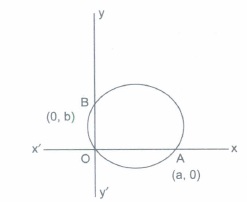
Thus, the equation of the required circle is
\(\left(x-\frac{a}{2}\right)^{2}+\left(y-\frac{b}{2}\right)^{2}=\left(\frac{a}{2}\right)^{2}+\left(\frac{b}{2}\right)^{2} \)
\(\Rightarrow\left(\frac{2 x-a}{2}\right)^{2}+\left(\frac{2 y-b}{2}\right)^{2}=\frac{a^{2}+b^{2}}{4} \)
\(\Rightarrow 4 x^{2}-4 a x+a^{2}+4 y^{2}-4 b y+b^{2}=a^{2}+b^{2} \)
\(\Rightarrow 4 x^{2}+4 y^{2}-4 a x-4 b y=0 \)
⇒ x2 + y2- ax - by = 0
which is required equation of circle.
20.
Let the equation of the required circle be (x – h)2 + (y – k)2 = r2.
Since the radius of the circle is 5 and its centre lies on the x-axis, k = 0 and r = 5.
Now, the equation of the circle becomes (x – h)2 + y2 = 25.
It is given that the circle passes through point (2, 3).
\(\therefore(2-h)^{2}+3^{2}=25 \)
\(\Rightarrow(2-h)^{2}=25-9 \)
\(\Rightarrow(2-h)^{2}=16 \)
\(\Rightarrow 2-h=\pm \sqrt{16}=\pm 4 \)
\(\text { If } 2-h=4, \text { then } h=-2 . \)
\(\text { If } 2-h=-4, \text { then } h=6 .\)
Equation of required circle is
(x - 6)2 + (y - 0)2 = (5)2
⇒ x2 + 36 - 12x + y2 = 25
⇒ x2 + y2 - 12x + 11 = 0
When h=-2
Equation of required circle is
(x + 2)2 + (y - 0)2 = (5)2
⇒ x2 + 4 + 4x + y2 = 25
⇒ x2 + y2 + 4x - 21 = 0
21.
The equation of the circle is
(x - h)2 + (y - k)2 = r2.....(i)
Since the circle passes through point (2, 3)
∴ (2 - h)2 + (3 - k)2 = r2
⇒ 4 + h2 - 4h + 9 + k2 - 6k = r2
⇒ h2 + k2 - 4h - 6k + 13 = r2 ...(ii)
Also the circle passes through point (-1, 1)
∴ (-1-h)2 + (1- k)2 = r2
⇒ 1 + h2 + 2h + 1 + k2 - 2k = r2
⇒ h2 + k2 + 2h - 2k + 2 = r2...(iii)
From (ii) and (iii), we have
h2 + k2 - 4h - 6k + 13 = h2 + k2 + 2h - 2k + 2
⇒ -6h-4k=-11
⇒ 6h + 4k = 11...(iv)
Since the centre (h, k) of the circle lies on the line x - 3y - 11 = 0
∴ h- 3k-11 = 0
⇒ h - 3k = 11...(v)
Solving (iv) and (v), we have
h=\(\frac { 7 }{ 2 } \) and k=\(\frac { -5 }{ 2 } \)
Putting these values of hand k in (ii), we have
\(\left( \frac { 7 }{ 2 } \right) ^{ 2 }+\left( \frac { -5 }{ 2 } \right) ^{ 2 }-\frac { 4\times 7 }{ 2 } -6\frac { -5 }{ 2 } \)=r2
⇒ \(\frac { 49 }{ 4 } +\frac { 25 }{ 4 } \)-14+15+13=r2
⇒ r2=\(\frac { 65 }{ 2 } \)
Thus equation of required circle is
\(\left( x-\frac { 7 }{ 2 } \right) ^{ 2 }+\left( y+\frac { 5 }{ 2 } \right) ^{ 2 }=\frac { 65 }{ 2 } \)
⇒ x2+\(\frac { 49 }{ 4 } \)-7x+y2+\(\frac { 25 }{ 4 } \)+5y=\(\frac { 65 }{ 2 } \)
⇒ 4x2 +49-28x+4y2 +25+20y= 130
⇒ 4x2 + 4y2 - 28x + 20y - 56 = 0
⇒ 4(x2 + y2 - 7x + 5y - 14) = 0
⇒ x2 + y2 - 7x + 5y - 14 =0.
22.
The equation of the circle is
(x - h)2 + (y - k)2 = r2... (i)
Since the circle passes through point (4, 1)
∴ (4 - h)2 + (1 - k)2 = r2
⇒ 16 + h2 - 8h + 1 + k2 - 2k = r2
⇒ h2 + k2 - 8h - 2k + 17 = r2...(ii)
Also the circle passes through point (6, 5)
∴ (6 - h)2 + (5 - k)2 = r2
⇒ 36 + h2 - 12h + 25 + k2 - 10k = r2
⇒ h2 + k2 - 12h - 10k + 61 = r2...(iii)
From (ii)and (iii), we have
h2+ k2-8h-2k+ 17=h2+ k2-12h-10k+61
⇒ 4h+ 8k= 44
⇒ h + 2k = 11....(iv)
Since the centre (h, k) of the circle lies on the line 4x + y = 16
∴ 4h + k = 16 ...(v)
Solving (iv) and (v), we have h = 3 and k = 4
Putting value of hand k in (ii), we have
(3)2 + (4)2 - 8 x 3 - 2 x 4 + 17 = r2
∴ r2=10
Thus equation of required circle is
⇒ (x - 3)2 + (y - 4)2 = 10
⇒ x2 + 9 - 6x + y2 + 16 - 8y = 10
⇒ x2 + y2 - 6x - 8y + 15 =0.
23.
(c)
(0,0)
24.
(d)
fixed, plane
25.
(c)
Both (a) and (b)
26.
(c)
Both (a) and (b)
27.
(c)
two, nappes
28.
(c)
two, nappes
29.
(d)
(x + 3)2 + (y - 2)2 = 16
30.
(a)
5 units
31.
(b)
origin
32.
(a)
conic sections
33.
(c)
2
34.
(a)
\(\frac { 1 }{ { a }^{ 2 } } +\frac { 1 }{ { b }^{ 2 } } =\frac { 1 }{ c } \)
35.
(a)
\(g^{ 2 }>c\)

11th Standard CBSE Syllabus & Materials
11th Standard CBSE
CBSE 11th Business Studies Forms of Business Organisation Sample Question Papers Study Material - QB365 Set A
NEW11th Standard CBSE
CBSE 11th Business Studies Business, Trade and Commerce Sample Question Papers Study Material - QB365 Set A
NEW11th Standard CBSE
CBSE 11th Physics Waves Sample Question Papers Study Material - QB365 Set A
NEW11th Standard CBSE
CBSE 11th Physics Kinetic Theory Sample Question Papers Study Material - QB365 Set A



NCERT Books

Syllabus

Exam Pattern

Sample Question Papers

Previous year Question Papers

Important Notes

MCQ Practice test

NCERT Exemplers

Case study Questions

Image Based Questions

Passage based Questions

HOT Questions

Value Based Questions

Model Questions Papers
NCERT ( Book Back ) Questions

Assertion and Reason
Important Questions And Answers

CBSE 11th Standard CBSE Subjects
CBSE Standards







