
 100% FREE ACCESS
11th Standard CBSE Syllabus & Materials
11th Standard CBSE
CBSE 11th Economics PART-A - Presentation of Data - New Sample Question Papers Study Material - QB365 Set A
NEW11th Standard CBSE
CBSE 11th Economics PART-A - Organisation of Data - New Sample Question Papers Study Material - QB365 Set A
NEW11th Standard CBSE
CBSE 11th Economics PART-A - Collection of Data - New Sample Question Papers Study Material - QB365 Set A
NEW11th Standard CBSE
CBSE 11th Economics PART-A - Introduction to Economics and Statistics - New Sample Question Papers Study Material - QB365 Set A
NEW11th Standard CBSE
CBSE 11th Business Studies International Trade Sample Question Papers Study Material - QB365 Set A
NEW11th Standard CBSE
CBSE 11th Business Studies Evolution and Fundamentals of Business Sample Question Papers Study Material - QB365 Set A

Published on: 21/10/2025
Download CBSE Class 11th Standard CBSE Mathematics question papers, sample papers, important questions, and previous year solved papers in PDF format. Get free study materials, NCERT solutions, and exam preparation resources for Class 11th Standard CBSE Mathematics
Questions + Answers key
Take MCQ Mathematics Test
1.
If Z \(\ne\) 0 is a complex number, then _______.
Re(z) = 0 \(\Rightarrow\) Im (Z2) = 0
Re(z2) = 0 \(\Rightarrow\)Im (Z2) = 0
Re(z) = 0 \(\Rightarrow\) Re(z2) = 0
None of the above
2.
If \(\sqrt{5} x^{2}+x+\sqrt{5}=0\) then which of the following is/are correct?
I. Discriminant, D = -19.
\(\text { II. } x=\frac{-1 \pm \sqrt{19} i}{2 \sqrt{5}} \text { . }\)
Only I is correct
Only II is correct
Both are correct
Both are incorrect
3.
The value of (z + 3) (\(\bar{z}\) + 3) is equivalent to _______.
\(|z+3|^{2}\)
\(|z-3|\)
\(z^{2}+3\)
None of these
4.
\(\text { If }|1-i|^{n}=2^{n}, \text { then } n \text { is equal to }\)_______.
1
0
-1
None of these
5.
If z is non-zero complex number and z = a + ib, then inverse of z is _______.
\(\frac{a}{a^{2}+b^{2}}+\frac{-b i}{a^{2}+b^{2}}\)
\(\frac{a}{a^{2}-b^{2}}+\frac{-b i}{a^{2}-b^{2}}\)
\(\frac{a}{a^{2}-b^{2}}+\frac{i b}{a^{2}-b^{2}}\)
\(\frac{-a}{a^{2}+b^{2}}+\frac{-b i}{a^{2}+b^{2}}\)
6.
If the origin is the centroid of a \(\Delta\)ABC having vertices A(a, 1, 3), B(-2, b, -5) and C(4, 7, c), then ______.
a = -2
b = 8
c = -2
None of these
7.
Which of the following statements is correct?
The coordinates of the origin 0 are (0, 0, 0)
The coordinates of any point on the X-axis will be as (0,y',z)
The coordinates of any point in the YZ-plane will be (x, 0, 0)
All of the above are correct
8.
The coordinates of the point R, which divides the segment joining P(x1,y1,z1) and Q(x2,y2,z2) internally in the ratio k : 1,are ______.
\(\left(\frac{k x_{2}-x_{1}}{1-k}, \frac{k y_{2}-y_{1}}{1-k}, \frac{k z_{2}-z_{1}}{1-k}\right) \)
\(\left(\frac{k x_{2}+x_{1}}{1+k}, \frac{k y_{2}+y_{1}}{1+k}, \frac{k z_{2}+z_{1}}{1+k}\right) \)
\(\left(\frac{k x_{2}+x_{1}}{1-k}, \frac{k y_{2}+y_{1}}{1-k}, \frac{k z_{2}+z_{1}}{1-k}\right)\)
None of the above
9.
Points P(2, 4, 6), Q(-2, -2, -2) and R(6, io, 14) are ______.
verticesof a triangle
collinear
non-collinear
Both(a)and (b)
10.
The three numbers representing the perpendicular distances of the point from three mutually perpendicular planes are called the ______.
coordinates of the point with respect to the two coordinate planes
coordinates of the origin with respect to the three coordinate planes
coordinates of the point with reference to the three coordinate planes
None of the above
11.
The last digit in 7300 is _____.
7
3
9
1
12.
The remainder left out when 82n - (62)2n + 1is divided by 9, is _____.
0
2
7
8
13.
If the term free from x in the expansion of \(\left(\sqrt{x}-\frac{k}{x^{2}}\right)^{15}\) is 455, then the values of k are _____.
1
2
3
-1
14.
If \(x \neq 0, \text { then }\left(x^{2}+\frac{3}{x}\right)\) is equal to _____.
\(x^{8}+12 x^{5}+\frac{108}{x}+\frac{81}{x^{4}} \)
\(x^{8}+12 x^{5}+54 x^{3}+\frac{180}{x}+\frac{81}{x^{3}} \)
\(x^{8}+12 x^{5}+54 x^{2}+\frac{108}{x}+\frac{81}{x^{4}}\)
None of the above
15.
The number of combinations of 4 different objects A, B, C,D taken 2 at a time is _____.
4
6
7
8
16.
The number of natural numbers smaller than 104, in the decimal notation of which all the digits are distinct is _____.
5274
5275
5276
5277
17.
The total number of 9-digits numbers which have all different digits is _______.
10!
9!
9 x 9!
10 x 10!
18.
Consider the following statements
Statement I \({ }^{n} P_{r}=\frac{n !}{(n-r) !}, 0 \leq r \leq n\)
Statement II \({ }^{n} P_{r}=n(n-1)(n-2) \ldots \ldots . .(n-r+1)\), \(0 \leq r \leq n\)
Which of the above statement (s) is/are true?
Only I
Only II
Both I and II
Neither I nor II
19.
A telegraph has 5 arms and each arm is capable of 4 distincts positions, including the position of rest. The total number of signals that can be made is ______.
1024
1023
1022
1021
20.
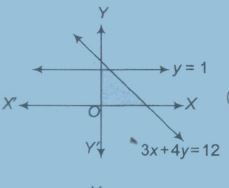
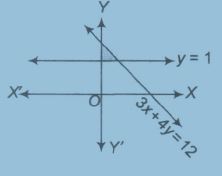
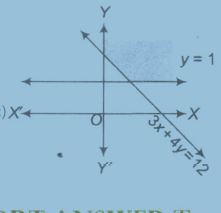
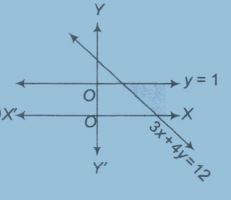
The graphical solution of the system of linear inequalities 3x + 4y \(\ge\) 12,y\(\ge\) 1,x \(\ge\) 0 is _______.
21.
The solution set of \(\frac{2 x-1}{3} \geq\left(\frac{3 x-2}{4}\right)-\left(\frac{2-x}{5}\right)\) is _______.
\((-\infty, 2)\)
\((-\infty, 2]\)
\(\left(-\infty,-\frac{1}{2}\right)\)
\(\left(-\infty,-\frac{1}{2}\right]\)
22.
Two real numbers or two algebraic expressions related by the symbol '<', '>', '\(\le\)' or '\(\ge\)'forms an _______.
equation
inequality
set
None of the above
23.
The all pairs of consecutive even positive integers, both of which are larger than 5, such that their sum is less than 23, are _______.
(2, 4), (5, 7) and (8, 10)
(3, 5), (6, 8) and (9, 11)
(6, 8), (8, 10) and (10, 12)
None of the above
24.
Which of the following solution set represent the following figure?
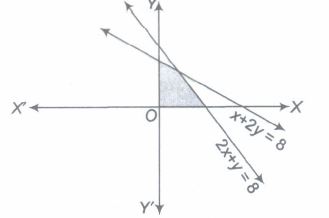
\(x+2 y \leq 8,2 x+y \leq 8, x \geq 0, y \geq 0 \)
\(x-2 y \leq 7, x+y \leq 8, x \geq 0, y \geq 0 \)
\(x+y<82 x+y<8, r>0 y>0\)
None of the above
25.
If \(\sqrt{3} \cos \theta+\sin \theta=\sqrt{2}, \text { then } \theta\) is equal to ______.
\(2 m \pi+\frac{5 \pi}{12}, m \in Z \)
\(2 m \pi-\frac{\pi}{12}, m \in Z\)
Both (a) and (b) are correct
Both (a) and (b) are incorrect
26.
The value of \(\cos \frac{2 \pi}{15} \cos \frac{4 \pi}{15} \cos \frac{8 \pi}{15} \cos \frac{16 \pi}{15} \mathrm{is}\) ______.
\(\frac{1}{4}\)
\(\frac{1}{8}\)
\(\frac{1}{12}\)
\(\frac{1}{16}\)
27.
The value of \(\cos \theta \cdot \cos \frac{\theta}{2}-\cos 3 \theta \cdot \cos \frac{9 \theta}{2}\) is equal to ______.
\(\sin 4 \theta \cdot \sin \frac{7 \theta}{2}\)
\(\sin 8 \theta\)
\(\sin 7 \theta+\sin 8 \theta\)
\(\sin 7 \theta.\sin 8 \theta\)
28.
The graph of the function, f(x) = \(\frac{1}{x^{2}}\) is ______.
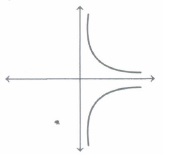
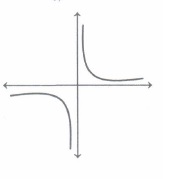
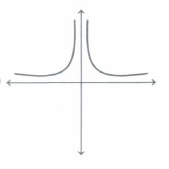
None of these
29.
The value of tan 3A - tan2A - tan A is ______.
tan3A tan2A tanA
- tan3A tan2A tanA
tan A tan2A - tan2A tan3A - tan3A tanA
None of the above
30.
Let R be a relation in N defined by \(R=\left\{\left(1+x, 1+x^{2}\right): x \leq 5, x \in N\right\}\). Which of the following is false?
R = {(2, 2), (3, 5), (4, 10), (5, 17), (6, 25)}
Domain of R = {2, 3, 4, 5, 6}
Range of R = {2,5, 10, 17, 26}
None of the above
31.
If A = {1, 2, 5, 6} and B = {1, 2, 3}, then what is (A x B) n (B x A) equal to ______.
{(1, 1), (2, 1), (6, 1), (3, 2)}
{(1, 1), (1,2), (2, 1), (2, 2)}
{(1, 1), (2, 2)}
{(1, 1), (1,2), (2, 5), (2, 6)}
32.
Each set Xr contains 5 elements and each set Yr contains 2 elements and \(\bigcup_{r=1}^{20} X_{r}=S=\bigcup_{r=1}^{n} Y_{r}\). If each element of S belongs to exactly 10 of the Xr's and to exactly 4 of the Yr's, then n is equal to _____.
10
20
100
50
33.
If A = {1,2, 3}, B = {3, 4}, C = {4, 5, 6}, then \((A \times B) \cap(B \times C)\) is equal to ______.
{(l,4)}
{(3,4)}
{(I, 4), (3, 4)}
None of these
34.
The set of negative real numbers is denoted by ...Y... Here, Y refers to _____.
\((-\infty, 0)\)
\([-\infty, 0]\)
\((-\infty, 0]\)
\([-\infty, 0)\)
35.
The set of real numbers {x: a < x < b} is called _____.
open interval
closed interval
semi-open interval
semi-closed interval
36.
If f(x) = log\({1+x\over 1-x}\) and g(x) = \({3x+x^3\over 1+3x^2}\) then f(g(x)) is equal to ______.
f(2x)
\([f(x)]^2\)
3f(x)
- f(3x)
37.
Let f(x) = Ix-1I then ______.
f(x2) = [f(x)]2
f(x +y) = f(x) f(y)
f(IxI) = I f(x) I
none of these
38.
If x = r sin\(\alpha\) cos \(\beta\), y = r sin\(\alpha\) sin \(\beta\)and z = r cos\(\alpha\), then X2 + y2 + Z2 is independent of ______.
\(\alpha , \beta\)
\(\gamma , \alpha\)
\(\gamma , \beta\)
none of these
39.
If A = {1, 2, 3, 4, 5, 6}then the number of proper sub-sets is _____.
64
36
26
63
40.
If A and B are two sets then A \(\cap\) (A \(\cap\) B') =_______.
A
B
A'\(\cap\)B'
ф
41.
If in the expansion of (1 +x)15, the coefficient of (2x + 3)th and (r - 1)th terms are equal then r is equal to _____.
9
5
8
none of the these
42.
The points (3, 3, 3), (0, 6, 3), (1, 7, 7) and (4, 4, 7) are vertices of ______.
a rectangle
a square
a parallelogram
a rhombus
1.
(a)
Re(z) = 0 \(\Rightarrow\) Im (Z2) = 0
2.
(c)
Both are correct
3.
(a)
\(|z+3|^{2}\)
4.
(b)
0
5.
(a)
\(\frac{a}{a^{2}+b^{2}}+\frac{-b i}{a^{2}+b^{2}}\)
6.
(a)
a = -2
7.
(a)
The coordinates of the origin 0 are (0, 0, 0)
8.
(b)
\(\left(\frac{k x_{2}+x_{1}}{1+k}, \frac{k y_{2}+y_{1}}{1+k}, \frac{k z_{2}+z_{1}}{1+k}\right) \)
9.
(b)
collinear
10.
(c)
coordinates of the point with reference to the three coordinate planes
11.
(d)
1
12.
(b)
2
13.
(d)
-1
14.
(c)
\(x^{8}+12 x^{5}+54 x^{2}+\frac{108}{x}+\frac{81}{x^{4}}\)
15.
(b)
6
16.
(a)
5274
17.
(c)
9 x 9!
18.
(c)
Both I and II
19.
(b)
1023
20.
(c)
21.
(b)
\((-\infty, 2]\)
22.
(a)
equation
23.
(c)
(6, 8), (8, 10) and (10, 12)
24.
(c)
\(x+y<82 x+y<8, r>0 y>0\)
25.
(c)
Both (a) and (b) are correct
26.
(d)
\(\frac{1}{16}\)
27.
(a)
\(\sin 4 \theta \cdot \sin \frac{7 \theta}{2}\)
28.
(c)
29.
(a)
tan3A tan2A tanA
30.
(a)
R = {(2, 2), (3, 5), (4, 10), (5, 17), (6, 25)}
31.
(b)
{(1, 1), (1,2), (2, 1), (2, 2)}
32.
(b)
20
33.
34.
(a)
\((-\infty, 0)\)
35.
(a)
open interval
36.
(c)
3f(x)
37.
(d)
none of these
38.
(a)
\(\alpha , \beta\)
39.
(d)
63
40.
(c)
A'\(\cap\)B'
41.
(b)
5
42.
(b)
a square

11th Standard CBSE Syllabus & Materials
11th Standard CBSE
CBSE 11th Business Studies Forms of Business Organisation Sample Question Papers Study Material - QB365 Set A
NEW11th Standard CBSE
CBSE 11th Business Studies Business, Trade and Commerce Sample Question Papers Study Material - QB365 Set A
NEW11th Standard CBSE
CBSE 11th Physics Waves Sample Question Papers Study Material - QB365 Set A
NEW11th Standard CBSE
CBSE 11th Physics Kinetic Theory Sample Question Papers Study Material - QB365 Set A



NCERT Books

Syllabus

Exam Pattern

Sample Question Papers

Previous year Question Papers

Important Notes

MCQ Practice test

NCERT Exemplers

Case study Questions

Image Based Questions

Passage based Questions

HOT Questions

Value Based Questions

Model Questions Papers
NCERT ( Book Back ) Questions

Assertion and Reason
Important Questions And Answers

CBSE 11th Standard CBSE Subjects
CBSE Standards







