
 100% FREE ACCESS
11th Standard CBSE Syllabus & Materials
11th Standard CBSE
CBSE 11th Economics PART-A - Presentation of Data - New Sample Question Papers Study Material - QB365 Set A
NEW11th Standard CBSE
CBSE 11th Economics PART-A - Organisation of Data - New Sample Question Papers Study Material - QB365 Set A
NEW11th Standard CBSE
CBSE 11th Economics PART-A - Collection of Data - New Sample Question Papers Study Material - QB365 Set A
NEW11th Standard CBSE
CBSE 11th Economics PART-A - Introduction to Economics and Statistics - New Sample Question Papers Study Material - QB365 Set A
NEW11th Standard CBSE
CBSE 11th Business Studies International Trade Sample Question Papers Study Material - QB365 Set A
NEW11th Standard CBSE
CBSE 11th Business Studies Evolution and Fundamentals of Business Sample Question Papers Study Material - QB365 Set A

Published on: 21/10/2025
Download CBSE Class 11th Standard CBSE Mathematics question papers, sample papers, important questions, and previous year solved papers in PDF format. Get free study materials, NCERT solutions, and exam preparation resources for Class 11th Standard CBSE Mathematics
Questions + Answers key
Take MCQ Mathematics Test
1.
Find the derivative of the following functions (it is to be understood that a, b, c, d, p, q, r and s are fixed non-zero constants and m and n are integers):
\(\frac{4x+5 sinx}{3x+7 cos x}\)
2.
Find the equation of the parabola that satisfies the given conditions:
Focus (0, -3); directrix y = 3
3.
Evaluate the following limit \(\lim_ { x\rightarrow 0 }{ lim } \frac { { sin }^{ 2 }2x }{ { sin }^{ 2 }4x } \)
4.
Find the octant in which the points (-3,4,2) and (-3,1,-4) lie.
5.
Find the equation of circle whose center is(1, 2) and touches X-axis
6.
Suppose \(f(x)=\left\{\begin{array}{l} a+b x, x<1 \\ 4, \quad x=1, \text { and if } \lim _{x \rightarrow 1} f(x)=f(1) \\ b-a x, x>1 \end{array}\right.\)then what are the possible values of a and b?
7.
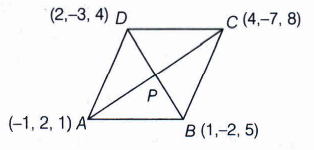
Verify that (-1, 2, 1), (1, -2, 5), (4, -7, 8) and (2, -3, 4) are the vertices of a parallelogram.
Tp prove a quadrilateral is a parallelogram, we have to prove that its diagonal bisect each other
8.
Find the area of the triangle formed by the lines joining the vertex of the 2y2+3y-4x-3=0
9.
Evaluate: \(\overset{Lt}{x\rightarrow 0}\frac{log(3+x)-log(3-x)}{x}\)
10.
Find the equation of the circle passing through (0, 0) and making intercepts a and b on the coordinate axes.
11.
Find a point in XY plane which is equidistant from three points (2, 0, 3), (0, 3, 2) and (0, 0, 1).
1.
f(x)=\(\frac{4x+5 sinx}{3x+7 cos x}\)
\(f^{'}(x)=\frac{d}{dx}[\frac{4x+5sinx}{3x+7 cos x}]\)
=\(\frac{(3x+7cos x)\frac{d}{dx}(4x+5sinx)-(4x+5sinx\frac{d}{dx}(3x+7 cos x)}{(3x+7cos x)^{2}}\)
=\(\frac{(4x+5 sinx)(3-7sinx)}{(3x+7 cosx)^{2}}\)
=\(\frac{12x+15x cosx+28 cos x+35 cos^{2}x-12x+28 x sinx-15 sinx+35 sin^{2}x}{(3x+7 cos)^{2}}\)
=\(\frac{15x cosx+28 cosx+28x sinx-15 sinx+35(cos^{2}x+sin^{2}x)}{(3x+7 cos x)^{2}}\)
=\(\frac{28x sinx-15 sin x+35}{(3x+7 cos x)^{2}}\)
2.
Focus = (0, –3); directrix y = 3
Since the focus lies on the y-axis, the y-axis is the axis of the parabola.
Therefore, the equation of the parabola is either of the form x2 = 4ay or x2 = – 4ay.
It is also seen that the directrix, y = 3 is above the x-axis, while the focus (0, –3) is below the x-axis. Hence, the parabola is of the form x2 = –4ay.
Here, a = 3
Thus, the equation of the parabola is x2 = –12y.
3.
\(\lim_ { x\rightarrow 0 }{ lim } \frac { { sin }^{ 2 }2x }{ { \left[ sin\quad 2(2x) \right] }^{ 2 } } \)
\(=\lim_ { x\rightarrow 0 }{ lim } \frac { { sin }^{ 2 }2x }{ { \left( 2sin\quad 2x\quad cos\quad 2x \right) }^{ 2 } } \)
\(=\lim_ { x\rightarrow 0 }{ lim } \frac { { sin }^{ 2 }2x }{ { 4sin }^{ 2 }2x\quad { cos }^{ 2 }2x } =\lim_ { x\rightarrow 0 }{ lim } \frac { 1 }{ 4{ cos }^{ 2 }2x } \)
Ans:1
4.
The point (-3,4,2) lies in II octant and the point (-3,1,4) lies in VI octant.
5.
Given, centre (h, k) = (1, 2)
and circle touches on X-axis.
\(\therefore\) Radius (r) = y-coordinate of centre = 2
So, equation of circle is
\((x-1)^{2}+(y-2)^{2}=2^{2} \quad\left[\because(x-h)^{2}+(y-k)^{2}=r^{2}\right] \)
\(\Rightarrow x^{2}-2 x+1+y^{2}-4 y+4=4 \)
\(\left[\because(a-b)^{2}=a^{2}+b^{2}-2 a b\right] \)
\(\Rightarrow x^{2}+y^{2}-2 x-4 y+1=0\)
which is the required equation of circle.
6.
\(LHL=\lim _{ x\rightarrow { 1 }^{ - } }{ a+bx)= } \lim _{ h\rightarrow { 0 } }{ [a+b(1-h)]=a+b } \)
\(RHL=\lim _{ x\rightarrow { 1 }^{ + } }{ (b-ax) } =\lim _{ h\rightarrow { 0 } }{ [b-a(1+h)]=b-a } \)
\(\because LHL=RHL=f\left( 1 \right) \Rightarrow A+B=B-A=4\)
Ans. A = 0, B = 4
7.
Let A(-1, 2, 1), B(1, -2, 5), C(4, -7, 8) and D(2, -3, 4) be the vertices of a quadrilateral ABCD.
\(Then\quad the\quad mid\quad point\quad AC\)
\(=\left( \frac { -1+4 }{ 2 } ,\frac { 2-7 }{ 2 } ,\frac { 1+8 }{ 2 } \right) =\left( \frac { -3 }{ 2 } ,\frac { -5 }{ 2 } ,\frac { 9 }{ 2 } \right) \)
\(\left[ \because coordinates\quad of\quad mid-point=\left( \frac { { x }_{ 1 }+{ x }_{ 2 } }{ 2 } ,\frac { { { y }_{ 1 }+ }{ y }_{ 2 } }{ 2 } ,\frac { { z }_{ 1 }+{ z }_{ 2 } }{ 2 } \right) \right] \)
\(and\quad mid\quad point\quad BD=\left( \frac { 1+2 }{ 2 } ,\frac { -2-3 }{ 2 } ,\frac { 5+4 }{ 2 } \right)\)
\(=\left( \frac { 3 }{ 2 } ,\frac { -5 }{ 2 } ,\frac { 9 }{ 2 } \right) \)
Here, mid-point of both the diagonals are same i.e they bisect each other. Hence ABCD is a parallelogram
8.
Given equation of parabola is 2y2+3y-4x-3=0
\(2\left[ y^{ 2 }+2.y.\frac { 3 }{ 4 } +\left( \frac { 3 }{ 4 } \right) ^{ 2 }-\left( \frac { 3 }{ 4 } \right) ^{ 2 } \right] =4x+3\)
\(\Rightarrow 2\left( y+\frac { 3 }{ 4 } \right) =4x+3+\frac { 9 }{ 8 } \)
\(\Rightarrow \left( y+\frac { 3 }{ 4 } \right) ^{ 2 }=2\left( x+\frac { 33 }{ 32 } \right) \)
\(This\quad is\quad of\quad the\quad form\quad Y^{ 2 }=\quad 4aX,\quad Where\quad Y=\quad y+\frac { 3 }{ 4 } ,X=x+\frac { 33 }{ 32 } \)
Ans \(\left( \frac { -33 }{ 32 } ,\frac { -3 }{ 4 } \right) \left( \frac { -17 }{ 32 } ,\frac { -3 }{ 4 } \right) ,x=\frac { -49 }{ 32 } ,2\)
9.
\(\overset{Lt}{x\rightarrow 0}\frac{log(3+x)-log(3-x)}{x}\)=\(\overset{Lt}{x\rightarrow 0}\frac{log[3(1+\frac{x}{3})]-log[3(1-\frac{x}{3})]}{x}\)
⇒ \(\overset{Lt}{x\rightarrow 0}\frac{log3+log(1+\frac{x}{3}-log 3-log(1-\frac{x}{3})}{x} \Rightarrow \overset{Lt}{x\rightarrow 0}\frac{log(1+\frac{x}{3})}{x}-\frac{log(1-\frac{x}{3})}{x}\)
⇒ \(\overset{Lt}{x\rightarrow 0} \frac{log(1+\frac{x}{3})}{3\times \frac{x}{3}}-\frac{log(1-\frac{x}{3})}{\frac{-x}{3}\times -3} \Rightarrow \overset{Lt}{\frac{-x}{3}\times -3} \Rightarrow \overset{Lt}{\frac{x}{3}\rightarrow 0} \frac{1}{3}[\frac{log(1+\frac{x}{3})}{\frac{x}{3}}]+\overset{Lt}{-\frac{x}{3}\rightarrow 0}\frac{1}{3}[\frac{log(1-\frac{x}{3})}{-\frac{x}{3}}]\)
\(\Rightarrow \frac{1}{3}\times 1+\frac{1}{3}\times 1 \Rightarrow\frac{1}{3}+\frac{1}{3}\Rightarrow \frac{2}{3}\)
Hence \(\overset{Lt}{x\rightarrow 0}\frac{log(3+x)-log(3-x)}{x}=\frac{2}{3}\)
10.
Let the equation of the required circle be (x – h)2 + (y – k)2 = r2.
Since the circle passes through (0, 0),
(0 – h)2 + (0 – k)2 = r2
⇒ h2 + k2 = r2
The equation of the circle now becomes (x – h)2 + (y – k)2 = h2 + k2.
It is given that the circle makes intercepts a and b on the coordinate axes. This means that the circle passes through points (a, 0) and (0, b). Therefore,
(a – h)2 + (0 – k)2 = h2 + k2 … (1)
(0 – h)2 + (b – k)2 = h2 + k2 … (2)
From equation (1), we obtain
a2 – 2ah + h2 + k2 = h2 + k2
⇒ a2 – 2ah = 0
⇒ a(a – 2h) = 0
⇒ a = 0 or (a – 2h) = 0
\(\text { However, } a \neq 0 ; \text { hence, }(a-2 h)=0 \Rightarrow h=\frac{a}{2} \text { . }\)
\(\text { From equation (2), we abtain }\)
\(h^{2}+b^{2}-2 b k+k^{2}=h^{2}+k^{2}\)
\(\Rightarrow b^{2}-2 b k=0\)
\(\Rightarrow b(b-2 k)=0\)
\(\Rightarrow b=0 \text { or }(b-2 k)=0\)
\(\text { However, } b \neq 0 \text { ; hence, }(b-2 k)=0 \Rightarrow k=\frac{b}{2} \text { . }\)
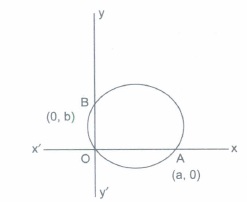
Thus, the equation of the required circle is
\(\left(x-\frac{a}{2}\right)^{2}+\left(y-\frac{b}{2}\right)^{2}=\left(\frac{a}{2}\right)^{2}+\left(\frac{b}{2}\right)^{2} \)
\(\Rightarrow\left(\frac{2 x-a}{2}\right)^{2}+\left(\frac{2 y-b}{2}\right)^{2}=\frac{a^{2}+b^{2}}{4} \)
\(\Rightarrow 4 x^{2}-4 a x+a^{2}+4 y^{2}-4 b y+b^{2}=a^{2}+b^{2} \)
\(\Rightarrow 4 x^{2}+4 y^{2}-4 a x-4 b y=0 \)
⇒ x2 + y2- ax - by = 0
which is required equation of circle.
11.
Let A(2, 0, 3), B(O, 3, 2) and C(O, 0,1) be given points.
Let P(x, y, 0) be any point in XY plane such that PA = PB = PC.
Now PA = PB => PA2 = PB2
\(\therefore \) (x - 2)2 + (y - 0)2 + (- 3)2
= (x - 0)2 + (y - 3)2 + (- 2)2
=> x2+4-4x+y2+9
=x2+y2+9-6y+4
=> 4x - 6y = 0 => 2x - 3y = 0 ....(i)
Also PB = PC => PB2 = PC2
(x - 0)2 + (y - 3)2 + (0 - 2)2 = (x - 0)2 + (y - 3)2 + (0 - 2)2
\(\therefore \)(x - 0)2 + (y - 3)2 + (0 - 2)2 = (x - 0)2 + (y - 3)2 + (0 - 1)2
=> x2+ y2 + 9 - 6y + 4
=x2+y2+1
=> 6y = 12 => y = 2
Putting value of y in (i), we have
2x-3x2=0 => x=3
Thus co-ordinates ofrequired point are (3, 2, 0).

11th Standard CBSE Syllabus & Materials
11th Standard CBSE
CBSE 11th Business Studies Forms of Business Organisation Sample Question Papers Study Material - QB365 Set A
NEW11th Standard CBSE
CBSE 11th Business Studies Business, Trade and Commerce Sample Question Papers Study Material - QB365 Set A
NEW11th Standard CBSE
CBSE 11th Physics Waves Sample Question Papers Study Material - QB365 Set A
NEW11th Standard CBSE
CBSE 11th Physics Kinetic Theory Sample Question Papers Study Material - QB365 Set A



NCERT Books

Syllabus

Exam Pattern

Sample Question Papers

Previous year Question Papers

Important Notes

MCQ Practice test

NCERT Exemplers

Case study Questions

Image Based Questions

Passage based Questions

HOT Questions

Value Based Questions

Model Questions Papers
NCERT ( Book Back ) Questions

Assertion and Reason
Important Questions And Answers

CBSE 11th Standard CBSE Subjects
CBSE Standards







