
 100% FREE ACCESS
11th Standard CBSE Syllabus & Materials
11th Standard CBSE
CBSE 11th Economics PART-A - Presentation of Data - New Sample Question Papers Study Material - QB365 Set A
NEW11th Standard CBSE
CBSE 11th Economics PART-A - Organisation of Data - New Sample Question Papers Study Material - QB365 Set A
NEW11th Standard CBSE
CBSE 11th Economics PART-A - Collection of Data - New Sample Question Papers Study Material - QB365 Set A
NEW11th Standard CBSE
CBSE 11th Economics PART-A - Introduction to Economics and Statistics - New Sample Question Papers Study Material - QB365 Set A
NEW11th Standard CBSE
CBSE 11th Business Studies International Trade Sample Question Papers Study Material - QB365 Set A
NEW11th Standard CBSE
CBSE 11th Business Studies Evolution and Fundamentals of Business Sample Question Papers Study Material - QB365 Set A

Published on: 21/10/2025
Download CBSE Class 11th Standard CBSE Mathematics question papers, sample papers, important questions, and previous year solved papers in PDF format. Get free study materials, NCERT solutions, and exam preparation resources for Class 11th Standard CBSE Mathematics
Questions + Answers key
Take MCQ Mathematics Test
1.
Using the distance formula show that the points A(3,-2), B(5,2) and C(8,8) are collinear.
2.
Find the conjugate of the complex number \(\frac { 1-i }{ 1+i }\)
3.
\(Find \sin\theta \ and\ tan\ \theta ,\ if\ cos\theta =-\frac { 3 }{ 5 } and\ \theta \text { lies in the thrd quadrant}\)
4.
Prove that \(cos\left( \frac { 3\pi }{ 4 } +x \right) -cos\left( \frac { 3\pi }{ 4 } -x \right) =-\sqrt { 2 } sinx.\)
5.
Let f(x)=x2 and g(x)=2x+1 be two real functions.Find (f + g) (x), (f –g) (x), (fg) (x),\(\left(\frac{f}{g}\right)(x)\)
6.
Let n(U) = 700, n(A) = 200, n(B) = 300 and \(n(A\cap B)\) = 100 .Find \(n({ A }^{ ' }\cap { B }^{ ' })\).
7.
Find the derivative of \(\frac { a+b\sin\ x }{ c+d \cos\ x } \) (it is to be understood that a, b, c, d, p, q, rand s are fixed non-zero constants and m and n are integers)
8.
In how many ways can the letters of the word PERMUTATIONS be arranged if the
(i) words start with P and end with S
(ii) vowels are all together
(iii) there are always 4 letters between P and S?
9.
Find the sum to n terms of the series \(\frac{1}{1\times 2}+\frac{1}{2\times 3}+\frac{1}{3\times 4}+....\)
10.
Find the mean deviation about the mean for the data
| Income per day | 0-100 | 100-200 | 200-300 | 300-400 | 400-500 | 500-600 | 600-700 | 700-800 |
| Number of persons | 4 | 8 | 9 | 10 | 7 | 5 | 4 | 3 |
11.
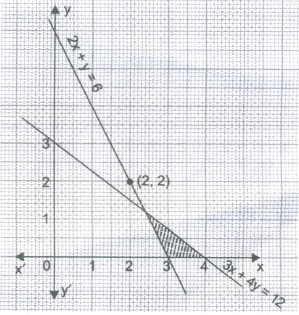
Solve the inequalities graphically: 2x +y \(\ge\) 6, 3x +4y \(\le\)12
12.
Prove by the principle of mathematical induction that for all n∊N \(\frac { 1 }{ 1.2 } +\frac { 1 }{ 2.3 } +\frac { 1 }{ 3.4 } +...+\frac { 1 }{ n(n+1) } =\frac { n }{ (n+1) } \)
13.
Let R be a relation from a set A to B, then ______.
R=A\(\cup\)B
R =A\(\cap\)B
R\(\subset\)A x B
R \(\subset\) B x A
14.
If 4 sin2\(\theta=1\) then the values of \(\theta\) are ______.
\(2n\pi\pm{\pi\over3},n\in Z\)
\(n\pi\pm{\pi\over3},n\in Z\)
\(n\pi\pm{\pi\over6},n\in Z\)
\(2n\pi\pm{\pi\over6},n\in Z\)
15.
If A and B are two sets then A \(\cap\) (A \(\cap\) B') =_______.
A
B
A'\(\cap\)B'
ф
16.
The number of subsets of a set containing n elements is _____.
2n - 2
n2
2n
n
17.
The sum of infinity of the G.P. a, ar, ar2, ar3, ...... \(\infty\) is ______.
\(\frac{a-1}{1-r}\)
\(\frac{a}{1-r}\)
\(\frac{2a}{1-r}\)
\(\frac{a}{1-r^2}\)
18.
\(\overset{lim}{x\rightarrow \frac{\pi}{2}} \) (sec x-tan x) is equal to ______.
0
1
2
3
19.
\(\overset{lim}{x\rightarrow 0} \frac{\sqrt{1+x}-1}{x}\) is equal to _____.
3
0
\(\frac{1}{2}\)
1
20.
\(\overset{lim}{x\rightarrow 0} \frac{sin2x}{x}\) is _______.
3
\(\frac{1}{3}\)
2
\(\frac{1}{2}\)
21.
The eccentricity of the ellipse \(\frac { { x }^{ 2 } }{ { a }^{ 2 } } +\frac { { y }^{ 2 } }{ { b }^{ 2 } } =1\) if its latus rectum is equal to one half of its minor axis is _______.
\(\frac { 1 }{ 2 } \)
\(\frac { \sqrt { 3 } }{ 2 } \)
\(\frac { 1 }{ \sqrt { 3 } } \)
None of these
22.
The total number of terms in the expansion of (x + a)80 + (x - a)80 is _____.
41
31
51
161
23.
The middle term in the expansion of \(\left( \frac { { 2x }^{ 2 } }{ 3 } +\frac { 3 }{ { 2x }^{ 2 } } \right) ^{ 10 }\)is _____.
240
280
262
252
24.
If 40Cr+2 = 40Cr-2 then r is equal to ______.
20
18
14
28
25.
The number of ways to arrange the letters of the word HAPPY are ______.
120
90
40
60
26.
The ratio in which the line joining (4, -3, 2) and (6, -5, -1) is divided by YZ-plane is _______.
2 : 3
2 : -3
-2 : 3
none of these
27.
If p be the length of the perpendicular from the origin to the line \({x\over a}+{y\over b}=1\) then ______.
\({1\over p^2}=a^2 + b^2\)
\({1\over p^2}={1\over a^2} +{1\over b^2}\)
p2 = a2 + b2
none of these
28.
The area of a triangle whose vertices are (3, -2), (5, 6) and (-2, -5) is ______.
15 sq. units
16 sq. units
17 sq. units
18 sq. units
29.
In a G.P. if the (m + n)th terms is p and (m - n)th terms is q then its mth terms is ______.
-1
pq
\(\sqrt { pq } \)
\(\frac { 1 }{ 2 } \left( p+q \right) \)
30.
If the sum of n terms of an AP. is 4n2 + 7n, then its nth term is ______.
8n -3
8n + 3
3n - 8
None of these
31.
Standard deviation of a data is given by ______.
\(σ=\sqrt{{1\over N}\sum fd^2-\left({1\over N}\sum fd\right)^2}\)
\(σ=\sqrt{\left({1\over N}\sum fd\right)^2-{1\over N}\sum fd^2}\)
\(σ=\sqrt{{1\over N}\sum fd^2-{1\over N}\sum fd^2}\)
None of these
32.
Prove that : sin x + sin 3x + sin 5x + sin 7x = 4 cos x cos2x sin 4x
33.
Prove the following:
\({cos \ 4x +cos \ 3x +cos \ 2x\over sin \ 4x+sin 3\ x+sin \ 2x}=\cot 3x \)
1.
Show that AB + BC = AC
2.
\(z=\frac { 1-i }{ 1+i } x \frac { 1-i }{ 1-i } =\frac { 1-1-2i }{ 1+1 } =-i\) = i
3.
\(\sin\theta =\frac { -4 }{ 5 } \ and\ \tan \theta =\frac { 3 }{ 4 } \)
4.
\(cos\left( \frac { 3\pi }{ 4 } +x \right) -cos\left( \frac { 3\pi }{ 4 } -x \right)\)
\(=\left( -\frac { 1 }{ \sqrt { 2 } } cos\quad x\quad -\quad \frac { 1 }{ \sqrt { 2 } } sin\quad x \right) -\left( -\frac { 1 }{ \sqrt { 2 } } cos\quad x\quad +\quad \frac { 1 }{ \sqrt { 2 } } sin\quad x \right) \)
\(=-\sqrt { 2 } sinx.\)
5.
We have,
\((f+g)(x)=x^{2}+2 x+1,(f-g)(x)=x^{2}-2 x-1\)
\((\text { fg })(x)=x^{2}(2 x+1)=2 x^{3}+x^{2},\left(\frac{f}{g}\right)(x)=\frac{x^{2}}{2 x+1}, x \neq-\frac{1}{2} \)
6.
\(n({ A }^{ ' }\cap { B }^{ ' })=n(U)-n(A\cup B)\)
Ans.300
7.
Here f(x)=\(\frac { a+b\quad sin\quad x }{ c+d\quad cos\quad x } \)
\(\therefore f'(x)=\frac { d }{ dx } \left[ \frac { a+b\quad sin\quad x }{ c+d\quad cos\quad x } \right] \)
= \(\frac { (c+dcosx)\frac { d }{ dx } (a+b\quad sinx)-(a+b\quad sinx)\frac { d }{ dx } (c+d\quad cosx) }{ c+d\quad cosx^{ 2 } } \)
\(=\frac { (a-b\quad sinx)(-d\quad sinx) }{ (c+d\quad cosx)^{ 2 } } \)
\(=\frac { bc\quad cosx+bd\quad cos^{ 2 }x+\quad ad\quad sinx+bd\quad sin^{ 2 }x }{ (c+d\quad cosx)^{ 2 } } \)
\(=\frac { bc\quad cosx+bd\quad sinx+\quad bd(cos^{ 2 }x+sin^{ 2 }x) }{ (c+d\quad cosx)^{ 2 } } \)
\(=\frac { bd(cos^{ 2 }x+sin^{ 2 }x) }{ (c+d\quad cosx)^{ 2 } } \)
\(=\frac { bc\quad cosx+ad\quad sinx+bd }{ (c+d\quad cosx)^{ 2 } } \)
8.
Total letters in the word PERMUTATIONS = 12.
Here T = 2.
(i) Now first letter is P and last letter is S, which are fixed.
So the remaining 10 letters are to be arranged between P and S
∴ Number of permutations = \(10!\over 2!\)
\(={10\times9\times8\times7\times6\times5\times4\times3\times2!\over 2!}\)
=1814400
(ii) There are 5 vowels in the word PERMUTATIONS. All vowels can be put together.
∴ Number of permutations of all vowels together = 5p5
\(={5!\over 0!}=5 \times 4 \times 3 \times 2 \times 1 = 120\)
Now consider the 5vowels together as one letter. Sothe number of letters in the word when all vowels are together = 8.
∴ Number of permutations \(={8!\over 2!}\)
\(={8\times7\times6\times5\times4\times3\times2!\over 2!}\)
=20160
Hence the total number of permutations
= 120 x 20160 = 2419200
(iii) Here P and S are on 1st and 6th places
P and S are on 2nd and 7th places
P and S are on 3rd and 8th places P and S are on 4th and 9th places
P and S are on 5th and 10th places P and S are on 6th and 11th places
P and S are on 7th and 12th places
Now we see that P and S can be put in 7 ways and also P and S can interchange their positions.
∴ Number of permutations = 2 x 7 = 14
Now the remaining 10 places can be filled with remaining 10 letters.
∴ Number of permutations = \(10!\over 2!\)
\(={10\times9\times8\times7\times6\times5\times4\times3\times2!\over 2!}\)
=1814400
Thus total number of permutations = 14 x 1814400= 25401600
9.
The given series is
\(\frac{1}{1\times 2}+\frac{1}{2\times 3}+\frac{1}{3\times 4}+....\)
Let 'an' be nth term of the given series and 'Sn' be the sum of nth terms of the given series.
\(\therefore a_n=\frac{1}{(n^{th}\quad term\quad of\quad 1,2,3...)(n^{th}\quad term\quad of 2,3,4...)}\)
= \(\frac{1}{[1+(n+1)\times 1][2+(n-1)\times 1]}\)
= \(\frac{1}{n(n+1)}=\frac{1}{n}+(\frac{-1}{n+1})\) [By partial fraction]
Putting n = 1, 2, 3, ....n, we have
\(a_1=\frac{1}{1}-\frac{1}{2};\)
\(a_2=\frac{1}{2}-\frac{1}{3};\)
\(a_3=\frac{1}{3}-\frac{1}{4}.....\)
\(a_n=\frac{1}{n}-\frac{1}{n+1}....\)
Adding vertically, we have:
Sn = a1 + a2 + a3 + .... + an
= \(\frac{1}{1}-\frac{1}{n+1}=\frac{n+1-1}{n+1}=\frac{n}{n+1}\)
\(\therefore\) Sn = \(\frac{n}{n+1}\)
10.
| Income per day | Mid values xi | fi | fixi | |xi-358| | fi|xi-358| |
| 0-100 | 50 | 4 | 200 | 308 | 1232 |
| 100-200 | 150 | 8 | 1200 | 208 | 1664 |
| 200-300 | 250 | 9 | 2250 | 108 | 972 |
| 300-400 | 350 | 10 | 3500 | 8 | 80 |
| 400-500 | 450 | 7 | 3150 | 92 | 644 |
| 500-600 | 550 | 5 | 2750 | 192 | 960 |
| 600-700 | 650 | 4 | 2600 | 292 | 1168 |
| 700-800 | 750 | 3 | 250 | 392 | 1176 |
| 50 | 17900 | 7896 |
Mean\(\overline { x } =\frac { 1 }{ N } \sum { { f }_{ i }{ x }_{ i } } =\frac { 1 }{ 50 } \times 17900=358\)
Mean deviation about mean\(=\frac { 1 }{ N } \sum _{ i=1 }^{ n }{ { f }_{ i }\left| { x }_{ i }-\overline { x } \right| } \)
\(=\frac{1}{50}\times7896 = 157.92\)
11.
2x + y≥ 6 … (1)
3x + 4y ≤ 12 … (2)
The graph of the lines, 2x + y= 6 and 3x + 4y = 12, are drawn in the figure below.
Inequality (1) represents the region above the line, 2x + y= 6 (including the line 2x + y= 6), and inequality (2) represents the region below the line, 3x + 4y =12 (including the line 3x + 4y =12).
Hence, the solution of the given system of linear inequalities is represented by the common shaded region including the points on the respective lines as follows.
12.
Let \(\frac { 1 }{ 1.2 } +\frac { 1 }{ 2.3 } +\frac { 1 }{ 3.4 } +...+\frac { 1 }{ n(n+1) } =\frac { n }{ (n+1) } \)
For n =1
P(1) = \(\frac { 1 }{ 1(1+1) } =\frac { 1 }{ 1+1 } \Rightarrow \frac { 1 }{ 2 } =\frac { 1 }{ 2 } \)
∴ P(1) is true
Let P(n) be true for n = k
∴ P(k) = \(\frac { 1 }{ 1.2 } +\frac { 1 }{ 2.3 } +\frac { 1 }{ 3.4 } +...+\frac { 1 }{ k(k+1) } =\frac { k }{ (k+1) } \) ...(i)
For n = k+1
∴ P(k+1)= \(\frac { 1 }{ 1.2 } +\frac { 1 }{ 2.3 } +\frac { 1 }{ 3.4 } +...+\frac { 1 }{ k(k+1) } +\frac { 1 }{ (k+1)(k+2) } =\frac { k+1 }{ k+2 } \)
= \(\frac { k }{ k+1 } +\frac { 1 }{ (k+1)(k+2) } =\frac { k(k+2)+1 }{ (k+1)(k+2) } =\frac { { k }^{ 2 }+2k+1 }{ (k+1)(k+2) } \) [Using (i)]
= \(\frac { (k+1)^{ 2 } }{ (k+1)(k+2) } =\frac { k+1 }{ k+2 } \)= P(k+1) is true
Thus P(k) is true ⇒ P(k + 1) is true
Hence by principle of mathematical induction, P(n) is true for all n∊N.
13.
(c)
R\(\subset\)A x B
14.
(c)
\(n\pi\pm{\pi\over6},n\in Z\)
15.
(c)
A'\(\cap\)B'
16.
(c)
2n
17.
(b)
\(\frac{a}{1-r}\)
18.
(a)
0
19.
(c)
\(\frac{1}{2}\)
20.
(c)
2
21.
(b)
\(\frac { \sqrt { 3 } }{ 2 } \)
22.
(a)
41
23.
(d)
252
24.
(a)
20
25.
(d)
60
26.
(c)
-2 : 3
27.
(b)
\({1\over p^2}={1\over a^2} +{1\over b^2}\)
28.
(c)
17 sq. units
29.
(c)
\(\sqrt { pq } \)
30.
(a)
8n -3
31.
32.
We have
L.H.S.= sin x + sin 3x + sin 5x + sin 7x
= (sin 7x + sin x) + (sin 5x + sin 3x)
\(=[2sin({7x+x\over2})cos({7x-x\over2})]+[2sin({5x+3x\over2})cos({5x-3x\over2})]\)
= 2 sin 4x cos 3x + 2 sin 4x cos x
\([\because \ sinC+sin D=2sin{C+D\over2}.cos{C-D\over2}]\)
= 2 sin 4x [cos 3x + cos x]
= 2 sin 4x\([2cos({3x+x\over2})cos({3x-x\over2})]\)
\([\because \ cos C+cosD=2cos {{C+D\over2}.cos{C-D\over2}}]\)
= 2 sin 4x [2 cos 2x cos x]
= 4 cos x cos 2x sin 4x = R.H.S.
33.
We have
L.H.S. = \({cos \ 4x +cos \ 3x +cos \ 2x\over sin \ 4x+sin 3\ x+sin \ 2x}\)
\(={(cos \ 4x +cos \ 2x )+cos \ 2x\over (sin \ 4x+sin 2\ x)+sin \ 2x}\)
\(={2cos{4x+2x\over2}cos{4x-2x\over2}+cos3x\over 2sin{4x+2x\over2}cos{4x-2x\over2}+sin3x}\)
\(\left[\begin{array}{l} \because \sin \mathrm{C}+\sin \mathrm{D}=2 \sin \left(\frac{\mathrm{C}+\mathrm{D}}{2}\right) \cos \left(\frac{\mathrm{C}-\mathbf{D}}{2}\right) \\ \cos \mathrm{C}+\cos \mathrm{D}=2 \cos \left(\frac{\mathrm{C}+\mathrm{D}}{2}\right) \cos \left(\frac{\mathrm{C}-\mathrm{D}}{2}\right) \end{array}\right]\)
\(={2cos \ 3x \cos \ x + cos \ 3x\over 2sin \ 3x \cos x+ sin \ 3x}\)
\(={cos \ 3x (2 \cos \ x + 1)\over sin \ 3x(2 \cos x+ 1)}={cos \ 3x\over sin \ 3x}\)
= cot 3x = R.H.S.

11th Standard CBSE Syllabus & Materials
11th Standard CBSE
CBSE 11th Business Studies Forms of Business Organisation Sample Question Papers Study Material - QB365 Set A
NEW11th Standard CBSE
CBSE 11th Business Studies Business, Trade and Commerce Sample Question Papers Study Material - QB365 Set A
NEW11th Standard CBSE
CBSE 11th Physics Waves Sample Question Papers Study Material - QB365 Set A
NEW11th Standard CBSE
CBSE 11th Physics Kinetic Theory Sample Question Papers Study Material - QB365 Set A



NCERT Books

Syllabus

Exam Pattern

Sample Question Papers

Previous year Question Papers

Important Notes

MCQ Practice test

NCERT Exemplers

Case study Questions

Image Based Questions

Passage based Questions

HOT Questions

Value Based Questions

Model Questions Papers
NCERT ( Book Back ) Questions

Assertion and Reason
Important Questions And Answers

CBSE 11th Standard CBSE Subjects
CBSE Standards







