
 100% FREE ACCESS
11th Standard CBSE Syllabus & Materials
11th Standard CBSE
CBSE 11th Economics PART-A - Presentation of Data - New Sample Question Papers Study Material - QB365 Set A
NEW11th Standard CBSE
CBSE 11th Economics PART-A - Organisation of Data - New Sample Question Papers Study Material - QB365 Set A
NEW11th Standard CBSE
CBSE 11th Economics PART-A - Collection of Data - New Sample Question Papers Study Material - QB365 Set A
NEW11th Standard CBSE
CBSE 11th Economics PART-A - Introduction to Economics and Statistics - New Sample Question Papers Study Material - QB365 Set A
NEW11th Standard CBSE
CBSE 11th Business Studies International Trade Sample Question Papers Study Material - QB365 Set A
NEW11th Standard CBSE
CBSE 11th Business Studies Evolution and Fundamentals of Business Sample Question Papers Study Material - QB365 Set A

Published on: 21/10/2025
Download CBSE Class 11th Standard CBSE Mathematics question papers, sample papers, important questions, and previous year solved papers in PDF format. Get free study materials, NCERT solutions, and exam preparation resources for Class 11th Standard CBSE Mathematics
Questions + Answers key
Take MCQ Mathematics Test
1.
Solve the inequalities in graphically 5(2x-7) -3 (2x + 3) \(\le\)0, 2x +19 \(\le\) 6x +47
2.
A man wants to cut three lengths from a single piece of board of length 91 cm, the second length is to be 3 cm longer than the shortest and third length is to be twice as long as the shortest. What are the possible lengths for the shortest board, if third piece is to be at least 5cm longer than the second?
[Hint: If x is the length of the shortest board, then x , (x + 3) and 2x are the lengths of the second and third piece, respectively. Thus, x + (x + 3) + 2x ≤ 91 and 2x ≥ (x + 3) + 5].
3.
A solution is to be kept between 680 F and 770F. What is the range of temperature in degree Celsius (C), if the Celsius/Fahrenheit (F) conversion formula is given by F=\(\frac { 9 }{ 5 } C+32?\)
4.
Find all pairs of consecutive odd natural numbers, both of which are larger than 10, such that their sum is less than 40.
5.
Find all the pairs of consecutive positive integers, both of which are larger than 8 such that their sum is less than 28.
6.
Solve for \(x,\frac { 4 }{ x+1 } \le 3\le \frac { 6 }{ x+1' } x>0\)
7.
How many litres of water will have to be added to 1125 litres of the 45% solution of acid so that the resulting mixture will contain more than 25% but less than 30% acid content?
8.
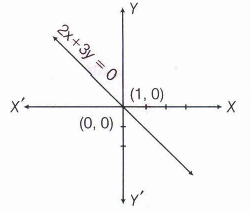
Solve the inequality 2x + 3y>0 graphically.
9.
Solve \(1\le |x-2|\le 3\).
10.
A manufacturer has 600 litres of a 12% solution of acid. How many litres of a 30% acid solution must be added to it so that acid content in the resulting mixture will be more than 15% but less than 18%?
11.
Solve 7x + 3 < 5x + 9. Show the graph of the solutions on number line.
12.
Solve 30 x < 200 when
(i) x is a natural number,
(ii) x is an integer.
13.
Solve the inequalities: 6\(\le\)-3 (2x-4)<12
14.
Solve 5x - 3 < 3x + 1 when
(i) x is an integer,
(ii) x is a real number
15.
Find all pairs of consecutive odd positive integers both of which are smaller than 10 such that their sum is more than 11.
16.
The graphical solution of 3x - 6 \(\ge\) 0 is _______.
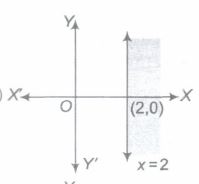
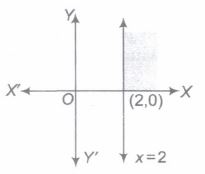
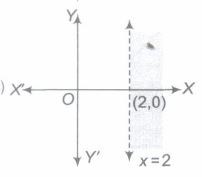
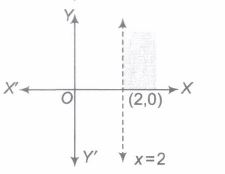
17.
Which of the following is/are true?
A vertical line will divide the plane in left and right half planes
A non-vertical line will divide the plane into left and right half planes
Both (a) and (b)
None of the above
18.
Which of the following represent the solution set in the following figure?
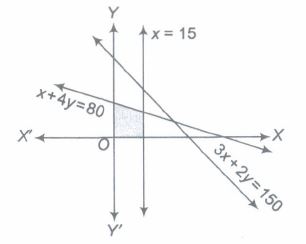
\(3 x+2 y \geq 150, x+4 y \leq 80, x \leq 15, x, y \geq 0 \)
\(3 x+2 y \leq 150, x+4 y \geq 80, x \geq 15, x, y \geq 0 \)
\(3 x+2 y \leq 150, x+4 y \leq 80, x \leq 15, x, y \geq 0\)
None of the above
19.
The solution set of the inequalities 2x + y \(\ge\) 4,x + y \(\le\) 3, 2x - 3y \(\le\) 6 is _______.
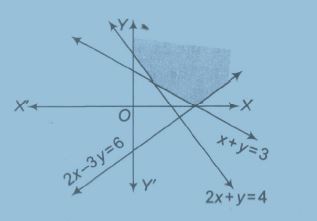
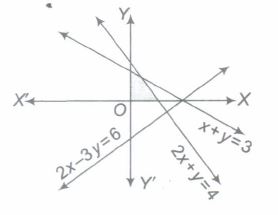
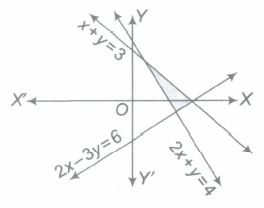
None of the above
20.
If a young man rides his motorcycle at 25 krn/h, he has to spend Rs 2 per km in petrol, and if he rides it at 40 krn/h, the petrol cost rises to Rs 5 per km. He has Rs 100 to spend on petrol and wishes to find the maximum distance, he can travel within one hour. If x and y denote the distance travelled by him (in krn) at 25 km/h and 40 krn/h, respectively. Then, inequations are _______.
\(2 x+5 y \leq 100, \frac{x}{25}+\frac{y}{40} \geq 1, x \geq 0, y \geq 0 \)
\(2 x+5 y \geq 100, \frac{x}{25}+\frac{y}{40} \geq 1, x \geq 0, y \geq 0\)
\(2 x+5 y \leq 100, \frac{x}{25}+\frac{y}{40} \leq 1, x \geq 0, y \geq 0 \)
\(2 x+5 y \leq 100,25 x+40 y \leq 1, x \geq 0, y \geq 0\)
1.
We have 5(2x-7) -3 (2x + 3) \(\le\)0 and 2x +19 \(\le\) 6x +47
From inequality (i),we get
5(2x-7) -3 (2x + 3) \(\le\)0
\(\Rightarrow\) 10x - 35 - 6x - 9 \(\le\) 0 and -4x \(\le\) 28
\(\Rightarrow\) -4x -44 \(\le\) 0 and x \(\ge\) -7 [adding 44 on both sides]
\(\Rightarrow\) 4x\(\le\)44 and x \(\ge\) -7
\(\Rightarrow\) x\(\le\)11 and x\(\ge\) -7 [dividing both sides by 4]
\(\therefore\) The solution set is (- \(\infty\), 11].
From inequality (ii), we get
\(2 x+19 \leq 6 x+47\)
\(\Rightarrow \quad 2 x+19-2 x \leq 6 x+47-2 x\) [subtracting 2x from both sides
\(\Rightarrow 19 \leq 4 x+47 \)
\(\Rightarrow 19-47 \leq 4 x+47-47\) [subtracting 47 from both sides]
\(\Rightarrow \quad-28 \leq 4 x \text { or } 4 x \geq-28\)
\(\Rightarrow \frac{4 x}{4} \geq \frac{-28}{4}\) [dividing both sides by 4]
\(\Rightarrow x \geq-7\)
\(\therefore \text { The solution set is }[-7, \infty) \text { . }\)
Now, let us draw the graphs of the solutions of both inequalities on number line.

It can be seen that the values of x, which are common to both are lying in the interval [-7,11].
Hence, the solution set of given system of inequations is [- 7, 11] and this can be represented graphically on the number line as

2.
Let the length of the shortest piece be x cm, so that the lengths of second and third piece are(x+3) cm and 2x cm respectively.Then x+ (x+3)+2x \(\le \) 91
and 2x\(\ge \)(x+3)+5
From inequality (i), we get
\(4x+3\le 91\)
\( \Rightarrow 4x+3-3\le 91-3[subtarcting\quad 3\quad from\quad both\quad sides]\)
\(\Rightarrow 4x\le 88[dividing\quad both\quad sides\quad by\quad 4\)
\( \Rightarrow \frac { 4x }{ 4 } \le \frac { 88 }{ 4 } \)
\(\Rightarrow x\leq 22\)
From inequality (ii), we get
\(2x\ge x+8\)
\( \Rightarrow 2x-x\ge x+8-x[subtracting\quad x\quad from\quad both\quad sides]\)
\( \Rightarrow x\ge 8\)
From inequality (iii) and (iv), we get
\(8\le x\le 22\)
Hence, the shortest piece must be atleast 8 cm long but not more than 22cm long
3.
Since the solution is to be kept between 68°F and 77°F, 68 < F < 77
\(\text { Putting } \mathrm{F}=\frac{9}{5} \mathrm{C}+32 \text { , we abtain }\)
\(68<\frac{9}{5} \mathrm{C}+32<77\)
\(\Rightarrow 68-32<\frac{9}{5} \mathrm{C}<77-32\)
\(\Rightarrow 36<\frac{9}{5} \mathrm{C}<45\)
\(\Rightarrow 36 \times \frac{5}{9}<\mathrm{C}<45 \times \frac{5}{9}\)
\(\Rightarrow 20<\mathrm{C}<25\)
Thus,the required range of temperature in degree celsius is between 20° and 25°
4.
Let x be the smaller of the two consecutive odd natural number, so that the other one is x +2. Then, we should have
x > 10 ... (1)
and x + ( x + 2) < 40 ... (2)
Solving (2), we get
2x + 2 < 40
i.e., x < 19 ... (3)
From (1) and (3), we get
10 < x < 19
Since x is an odd number, x can take the values 11, 13, 15, and 17. So, the required possible pairs will be
(11, 13), (13, 15), (15, 17), (17, 19)
5.
(10, 12), (12, 14)
6.
We have, \(\frac { 4 }{ x+1 } \le 3\le \frac { 6 }{ x+1 } \)
\(\Longrightarrow \)\(4\le 3\left( x+1 \right) \le 6\quad \left[ \because x+1\neq 0\Longrightarrow x\neq -1 \right] \)
\(\Longrightarrow \)\(\frac { 4 }{ 3 } \le x+1\le 2\)
\(\Longrightarrow \)\(\frac { 4 }{ 3 } -1\le x\le 2-1\Longrightarrow \frac { 1 }{ 3 } \le x\le 1\)
Ans. \(\left[ \frac { 1 }{ 3 } ,1 \right] \)
7.
Let x litres ofwater be added to 1125 litres of 45% acid solution.
Then total quantity of mixture = (1125 + x) litres
\(\frac { 45 }{ 100 } \times 1125+0\times \frac { x }{ 100 } >\frac { 25 }{ 100 } \times \left( 1125+x \right) \) and \(\frac { 45 }{ 100 } \times 1125+0\times \frac { x }{ 100 } <\frac { 30 }{ 100 } \times \left( 1125+x \right) \)
Combining the above inequations, we get
\(\frac { 25 }{ 100 } \times 100\le \frac { 2025\times 100 }{ 4(1125+x) } \le \frac { 30 }{ 100 } \times 100\)
\(\Rightarrow\) \(25\le \frac { 50625 }{ 1125+x } \le 30\)
\(\Rightarrow\) \(25\le \frac { 50625 }{ 1125+x } \) and \(\frac { 50625 }{ 1125+x } \le 30\)
\(\Rightarrow\) 28125 + 25x \(\le\) 50625 and 50625 \(\le\)33750 + 30x
\(\Rightarrow\) 25x \(\le\) 22500 and 30x \(\ge\) 1687.5
\(\Rightarrow\) x \(\le\) 900 and x \(\ge\) 562.5
\(\Rightarrow\) 562.5 \(\le\) x \(\le\) 900
8.
At point (1, 0), given inequality 2(1) +3(0)>0 \(\Rightarrow\)2>0.which in true. So, shading is towards at that point
9.
Write the given inequalities as \(|x-2|\ge 1\) and \(|x-2|\le 3\) Solve each inequality separately and then take the intersection of their solution sets
Ans. [-1, 1] \(\cup \) [3, 5]
10.
Let x litres of 30% acid solution is required to be added. Then
Total mixture = (x + 600) litres
Therefore 30% x + 12% of 600 > 15% of (x + 600)
and 30% x + 12% of 600 < 18% of (x + 600)
or \(\frac{30 x}{100}+\frac{12}{100}(600)>\frac{15}{100}(x+600) \)
and \(\frac{30 x}{100}+\frac{12}{100}(600)<\frac{18}{100}(x+600)\)
or 30x + 7200 > 15x + 9000
and 30x + 7200 < 18x + 10800
or 15x > 1800 and 12x < 3600
or x > 120 and x < 300,
i.e. 120 < x < 300
Thus, the number of litres of the 30% solution of acid will have to be more than 120 litres but less than 300 litres.
11.
We have 7x + 3 < 5x + 9 or
2x < 6 or x < 3
The graphical representation of the solutions are

12.
We are given 30 x < 200
or \(\frac{30 x}{30}<\frac{200}{30}\) (Rule 2), i.e., x < 20 / 3.
(i) When x is a natural number, in this case the following values of x make the statement true.
1, 2, 3, 4, 5, 6.
The solution set of the inequality is {1,2,3,4,5,6}.
(ii) When x is an integer, the solutions of the given inequality are..., – 3, –2, –1, 0, 1, 2, 3, 4, 5, 6
The solution set of the inequality is {...,–3, –2,–1, 0, 1, 2, 3, 4, 5, 6}.
13.
We have 6 \(\le\) -3 (2x-4) <12
-2 \(\ge\) (2x -4) > -4 \(\Rightarrow\) 2 \(\ge\) 2x >0
1\(\ge\)c > 0 \(\Rightarrow\) 0 < x \(\le\) 1
14.
We have, 5x –3 < 3x + 1
or 5x –3 + 3 < 3x +1 +3 (Rule 1)
or 5x < 3x +4
or 5x – 3x < 3x + 4 – 3x (Rule 1)
or 2x < 4 or x < 2 (Rule 2)
(i) When x is an integer, the solutions of the given inequality are ..., – 4, – 3, – 2, – 1, 0, 1
(ii) When x is a real number, the solutions of the inequality are given by x < 2, i.e., all real numbers x which are less than 2. Therefore, the solution set of the inequality is x ∈ (– ∞, 2).
We have considered solutions of inequalities in the set of natural numbers, set of integers and in the set of real numbers. Henceforth, unless stated otherwise, we shall solve the inequalities in this Chapter in the set of real numbers.
15.
Let x and x + 2 be two consecutive odd positive integers
Then x + 2 < 10 and x + x 2 > 11
\(\Rightarrow\) x < 8 and 2x + 2 > 11
\(\Rightarrow\) x < 8 and 2x > -2 + 11
\(\Rightarrow\) x < 8 and 2x > 9
\(\Rightarrow\) x < 8 and x >\(\frac { 9 }{ 2 } \)
\(\Rightarrow\)\(\frac { 9 }{ 2 } \) \(\Rightarrow\)
Thus required pairs of odd positive integers are (5, 7) and (7, 9).
16.
(a)
17.
(a)
A vertical line will divide the plane in left and right half planes
18.
(c)
\(3 x+2 y \leq 150, x+4 y \leq 80, x \leq 15, x, y \geq 0\)
19.
(c)
20.
(c)
\(2 x+5 y \leq 100, \frac{x}{25}+\frac{y}{40} \leq 1, x \geq 0, y \geq 0 \)

11th Standard CBSE Syllabus & Materials
11th Standard CBSE
CBSE 11th Business Studies Forms of Business Organisation Sample Question Papers Study Material - QB365 Set A
NEW11th Standard CBSE
CBSE 11th Business Studies Business, Trade and Commerce Sample Question Papers Study Material - QB365 Set A
NEW11th Standard CBSE
CBSE 11th Physics Waves Sample Question Papers Study Material - QB365 Set A
NEW11th Standard CBSE
CBSE 11th Physics Kinetic Theory Sample Question Papers Study Material - QB365 Set A



NCERT Books

Syllabus

Exam Pattern

Sample Question Papers

Previous year Question Papers

Important Notes

MCQ Practice test

NCERT Exemplers

Case study Questions

Image Based Questions

Passage based Questions

HOT Questions

Value Based Questions

Model Questions Papers
NCERT ( Book Back ) Questions

Assertion and Reason
Important Questions And Answers

CBSE 11th Standard CBSE Subjects
CBSE Standards







