
 100% FREE ACCESS
11th Standard CBSE Syllabus & Materials
11th Standard CBSE
CBSE 11th Economics PART-A - Presentation of Data - New Sample Question Papers Study Material - QB365 Set A
NEW11th Standard CBSE
CBSE 11th Economics PART-A - Organisation of Data - New Sample Question Papers Study Material - QB365 Set A
NEW11th Standard CBSE
CBSE 11th Economics PART-A - Collection of Data - New Sample Question Papers Study Material - QB365 Set A
NEW11th Standard CBSE
CBSE 11th Economics PART-A - Introduction to Economics and Statistics - New Sample Question Papers Study Material - QB365 Set A
NEW11th Standard CBSE
CBSE 11th Business Studies International Trade Sample Question Papers Study Material - QB365 Set A
NEW11th Standard CBSE
CBSE 11th Business Studies Evolution and Fundamentals of Business Sample Question Papers Study Material - QB365 Set A

Published on: 21/10/2025
Download CBSE Class 11th Standard CBSE Mathematics question papers, sample papers, important questions, and previous year solved papers in PDF format. Get free study materials, NCERT solutions, and exam preparation resources for Class 11th Standard CBSE Mathematics
Questions + Answers key
Take MCQ Mathematics Test
1.
Solve the inequalities : \(x+\frac { x }{ 2 } +\frac { x }{ 3 } <11\)
2.
If nC9 = nC8 , find nC17.
3.
Find the conjugate of (6 + 5i )2
4.
Prove the following identities.
\((1+cot\theta -cosec\theta )(1+tan\theta +sec\theta )=2\)
5.
If \(f(x)=\frac { x+1 }{ x-1 } \), then find \(f({ x }^{ 2 })\) and \([f(x)]^{ 2 }\) .
6.
Express R = \(\left\{ \left( a,b \right) :2a+b=5;a,b\in w \right\} \) as the set of ordered pairs (in roster form).
7.
If A={1,2,3,4,5}, B={1,3,5,8}, C={2,5,7,8}, verify that A-(B\(\cup \)C)=(A-B)\(\cap \)(A-C).
8.
Solve the following system of inequalities and represent the solution graphically on number line.
3x - 7> 2(x - 6) and 6 - x > 11- 2x
9.
If \(\sin x=\frac{3}{5}, \cos y=-\frac{12}{13}\) where x and y both lie in second quadrant,find the value of sin (x + y).
10.
From a group of 15 cricket players, a team of 11 players in to be chosen . In how many ways can this be done?
11.
Find all pairs of consecutive odd natural numbers, both of which are larger than 10, such that their sum is less than 40.
12.
Find the conjugate and modulus of the complex number \(\frac { 2+3i }{ 3+2i } \)
13.
In a circle of diameter 44 cm, the length of chord is 22 cm. Find the length of minor arc of the chord.
14.
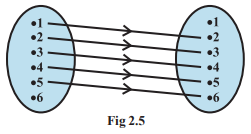
Let A = {1, 2, 3, 4, 5, 6}. Define a relation R from A to A by R = {(x, y) : y = x + 1 }
(i) Depict this relation using an arrow diagram.
(ii) Write down the domain, codomain and range of R.
15.
Write the following as intervals and also represent on the number line
\(\{ x:x\in R,5\le x\le 6\} \)
16.
If U = {1, 2, 3, 4, 5, 6, 7, 8}, A={1, 2, 3, 4}, B = {3, 4, 6} and C = {5, 6, 7, 8}, then verify that (A\(\cap\)B)' = A' \(\cup\) B'.
17.
Find the union of each of the following pairs of sets :
(i) X = {1, 3, 5} Y = {1, 2, 3}
(ii) A = [ a, e, i, o, u} B = {a, b, c}
(iii) A = {x : x is a natural number and multiple of 3} B = {x : x is a natural number less than 6}
(iv) A = {x : x is a natural number and 1 < x \(\leq\) 6 } B = {x : x is a natural number and 6 < x < 10 }
(v) A = {1, 2, 3}, B = \(\phi\)
18.
Find the values of x and y if (x+iy) (4+5i) =6-2i.
19.
Find the values of other five trigonometric functions tan x =\(-\frac{5}{12}\) ,x lies in second quadrant.
20.
Three balls are drawn from a bag containing 5 red 4 White and 3 black balls , find the number of ways in which this can be done , if alteast 2 balls are red.
21.
Solve the inequality \(\frac { 2x+5 }{ x-1 } >5\)
22.
Find the domain and range of the function \(f(x)=\frac { { x }^{ 2 }-9 }{ x-3 } \)
23.
A polynomial equation has _______.
atleast two roots
atleast one root
atmost three roots
atmost two roots
24.
\(\text { If } z_{1}=6+3 i \text { and } z_{2}=2-i, \text { then } \frac{z_{1}}{z_{2}} \text { is equal to }\) _______.
\(\frac{1}{5}(9+12 i)\)
\(9+12 i\)
\(3+2 i\)
\(\frac{1}{5}(12+9 i)\)
25.
If x, y\(\in\) R, then x + iy is a non-real complex number, if _______.
x = 0
y = 0
x \(\ne\) 0
y \(\ne\) 0
26.
Which of the following options define 'imaginary number'?
Square root of any number
Square root of positive number
Square root of negative number
Cube root of number
27.
The number of ways in which 2 black and 3 red balls can be selected from a bag containing 5 black and 6 red balls is _______.
170
190
180
200
28.
If \(\frac{1}{9 !}+\frac{1}{10 !}=\frac{x}{11 !}\) then x is equal to _______.
100
110
99
121
29.
A solution is to be kept between 68°F and 77°F. The range in temperature in degree Celsius (C), if the Celsius/Fahrenheit (F) conversion formula is given by \(F=\frac{9}{5} C+32\) is _______.
between 20°C and 22°C
between 20°C and 25°C
between 36°C and 45°C
between 4°C and 5°C
30.
The solution set of the inequality 4x + 3 < 6x + 7 is _______.
\([-2, \infty)\)
\((-\infty,-2)\)
\((-2, \infty)\)
None of these
31.
Which of the following is/are true?
A vertical line will divide the plane in left and right half planes
A non-vertical line will divide the plane into left and right half planes
Both (a) and (b)
None of the above
32.
If \(\tan \theta=\frac{1}{2} \text { and } \tan \phi=\frac{1}{3},\) then the value of \(\theta\) + \(\phi\) is ______.
\(\frac{\pi}{6}\)
\(\pi\)
0
\(\frac{\pi}{4}\)
33.
In a circle of radius r, an arc of length r will subtend an angle of ______.
r radian
l radian
\(\pi\) radian
2\(\pi\) radian
34.
Two finite sets A and B have m and n elements respectively. If the total number of relation from A to B is 64, then the possible values of m and n can be ______.
1 and 5
2 and 4
2 and 3
1 and 4
35.
Let A and B be two sets such that n (A) = 0.16, n(B) = 0.14 and n(A \(\cup\) B) = 0.25. Then, n(A \(\cap\) B) is equal to_____.
0.3
0.5
0.05
None of these
36.
Let A = {I, 2, 3, 4, 5, 6,7,8,9, 10} and B = {2, 3, 5, 7}. Then, which of following is true?
A \(\cap\) B = A
A \(\cap\) B = B
A \(\cap\) B \(\not \subset\).B
None of these
37.
If A = {x : x2 - 5x + 6 = 0); B = {2, 4}, C = {4, 5}, then \(A \times(B \cap C)\) is ______.
{(2, 4), (3, 4)}
{(4, 2), (4, 3)}
{(2, 4), (3,4), (4, 4)}
{(2, 2), (3,3), (4,4), (5, 5)}
38.
Let R be a relation from a set A to B, then ______.
R=A\(\cup\)B
R =A\(\cap\)B
R\(\subset\)A x B
R \(\subset\) B x A
39.
For any two sets A and B, \(A\cap(A\cup B)=\)_____.
B
A
ф
none of these
40.
In a ΔABC, if the sides are 7cm, 4\(\sqrt { 3 } \) cm and .\(\sqrt { 13 } \) cm, then the smallest angle is ______.
45o
60o
30o
90o
41.
6C1 + 6C2+6C3+6C4+6C5+6C6 is equal to ______.
63
43
83
none of these
42.
If 40Cr+2 = 40Cr-2 then r is equal to ______.
20
18
14
28
43.
Consider z=a+i b and \(\bar{z}\)=a-i b, where a and b are real numbers are conjugate of each other.
Based on the above information, answer the following questions.
(i) If the complex numbers \(-3+i\left(x^2 y\right)\) and \(x^2+y+4 i\), where x and y are real, are conjugate to each other, then the number of ordered pairs (x, y) is
| (a) 1 | (b) 2 | (c) 3 | (d) 4 |
(ii) The conjugate of \((6+5 i)^2\) is
| (a) \(11-60 \mathrm{i}\) | (b) \(11+60 i\) | (c) \(-11-60 i\) | (d) \(-11+60i\) |
(iii) Let \(z=x^2-7 x-9 y i\) such that \(\bar{z}=y^2 i+20 i-12\), then the number of ordered pairs (x, y) is
| (a) 1 | (b) 2 | (c) 3 | (d) 4 |
(iv) If \(z_1=3+2 i\) and \(z_2=2-i\), then \(\overline{z_1+z_2}\) is equal to
| (a) \(\overline{z_1} \overline{z_2}\) | (b) \(\frac{z_1}{z_2}\) | (c) \(\overline{z_1} z_2\) | (d) \(\overline{z_1}+\overline{z_2}\) |
(v) The number of real values of x such that \(\sin x+i \cos 2 x\) and \(\cos x-i \sin 2 x\) are conjugate to each other is
| (a) 0 | (b) 3 | (c) 1 | (d) 2 |
44.
Consider thc information given below Let P (a, b) be any point on the unit circle given below, which has its centre at origin O. It is given that ∠AOP = x radian.
Now, answer the questions based on the figure given below.
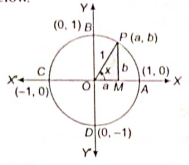
(i) If \(a = \frac{ \sqrt{3}}{2}\) and \(b = \frac{-1}{2}\) then the value of x in radian is
| (a) \(\frac{\pi}{6}\) | (b) \(\frac{7\pi}{6}\) | (c) \(\frac{5\pi}{6}\) | (d) \(\frac{11\pi}{6}\) |
(ii) If x = 75o, then the value of tan x is equal to
| (a) \(2 + \sqrt3\) | (b) \(2-\sqrt3\) | (c) \(\sqrt3 + 3\) | (d) \(\sqrt2 + 1\) |
(iii) If x = 25°, then the value of x in radian is
| (a) \(\frac{5\pi}{18}\) | (b) \(\frac{\pi}{18}\) | (c) \(\frac{5\pi}{36}\) | (d) \(\frac{\pi}{36}\) |
(iv) Which of the following is incorrect?
| (a) sin x is positive for 0 < x < π |
| (b) sin x isnegative for π < x < 2π |
| (c) cos x is positive for 0 < x < π/2 and 3π/2 < x < 2π |
| (d) cos x is positive for π/2 < x < 3π/2 |
45.
Mr. Abhishek Dubey a Mathematics class XIth teacher of write a problem on black board totest the Function". preparation about the topic 'Relation and The problem is describe as following:
"Let A be a relation be set of on first A ten natural numbers and let R defined by
\((x, y) \in R \Leftrightarrow x+2 y=14\)
i.e., \(R=\{(x, y): x \in A, y \in A\) and x+2 y=14} ".
Then, answer the following questions which are based on above problem.
(i) Find the relation (R)
| (a) {(2, 4), (4, 3), (6, 2), (8, 1)} | (b) {(2, 6), (4, 5), (6, 4), (8, 3)} | (c) {(4, 2), (3, 4), (2, 6), (1, 8)} | (d) None of the above |
(ii) Find the R-1.
| (a) {(4, 2), (3, 4), (2, 6), (1, 8)} | (b) {(6, 2), (5, 4), (4, 6), (3, 8)} | (c) {(2, 4),(4, 3), (6, 2), (8, 1)} | (d) {(2,6), (4, 5), (6, 4), (8, 3)} |
(iii) Find Dom(R)
| (a) {2, 4, 6, 8} | (b) {3, 5, 6, 8} | (c) {4, 3, 2, 1} | (d) {4, 5, 6, 8) |
(iv) Find Range (R).
| (a) {6, 5, 4, 3) | (b) {6, 3, 8, 7} | (c) {2, 4, 8, 10} | (d) {5, 3, 1, 9} |
(v) Find Dom (R-1)
| (a) {4, 3, 2, 1} | (b) {4, 5, 6, 8} | (c) {2, 4, 6, 8} | (d) {3, 5, 6, 8} |
1.
Here \(x+\frac { x }{ 2 } +\frac { x }{ 3 } <11\)
\(\Rightarrow\) \(\frac { 6x+3x+2x }{ 6 } <11\) \(\Rightarrow\) \(\frac { 11x }{ 6 } <11\)
Multiplying both sides by 6, we have 11x < 66
Dividing both sides by 11, we have x < 6
Thus the solution is (-\(\infty\), 6)
2.
We have,\({ }^{n} \mathrm{C}_{9}={ }^{n} \mathrm{C}_{8}\)
i.e., \(\frac{n !}{9 !(n-9) !}=\frac{n !}{(n-8) ! 8 !}\) or \(\frac{1}{9}=\frac{1}{n-8} \text { or } n-8=9 \text { or } n=17\)
\(\text{Therefore} { }^{n} \mathrm{C}_{17}={ }^{17} \mathrm{C}_{17}\) = 1.
3.
z = (6 + 5i )2 = 36 - 25 + 60i = 11 + 60i
= 11 - 60i
4.
LHS= \((1+cot\theta -cosec\theta )(1+tan\theta +sec\theta )\)
\(=(1+\frac { cos\theta }{ sin\theta } -\frac { 1 }{ sin\theta } )(1+\frac { sin\theta }{ cos\theta } +\frac { 1 }{ cos\theta } )\)
\(=(\frac { sin\theta +cos\theta -1 }{ sin\theta } )(\frac { sin\theta +cos\theta +1 }{ cos\theta } )\)
\(=\frac { (sin\theta +cos\theta )^{ 2 }-1 }{ sin\theta cos\theta } \)
\(=\frac { { sin }^{ 2 }\theta +{ cos }^{ 2 }\theta +2sin\theta cos\theta -1 }{ sin\theta cos\theta } =\frac { 1+2sin\theta cos\theta -1 }{ sin\theta cos\theta } d \quad [\because sin^{ 2 }\theta +{ cos }^{ 2 }\theta =1]\)
\(=\frac { 2sin\theta cos\theta }{ sin\theta cos\theta } =2=RHS\)
Hence Proved.
5.
\(f(x)=\frac { { x }^{ 2 }+1 }{ { x }^{ 2 }-1 } ,(f(x))^{ 2 }=(\frac { x+1 }{ x-1 } )^{ 2 }\)
6.
Given, R = \(\left\{ \left( a,b \right) :2a+b=5;a,b\in w \right\} \)
Here, W represent set of whole numbers.
When a = 0, b = 5
When a = 1, b = 3
When a = 2 b = 1
For a \(\ge \)3, the value of b given by the above relation are not whole numbers.
\(\therefore \) R = {(0,5),(1,3),(2,1)}
7.
B\(\cup \)C={1,2,3,5,7,8}
\(\therefore \)A-(B\(\cup \)C)-{4}
and (A-B)\(\cup \)(A-C)={2,4}\(\cup \){1,3,4}={4}
8.
Ans. (5 ,\(\infty\))

9.
We know that
sin (x + y) = sin x cos y + cos x sin y ... (1)
Now \(\cos ^{2} x=1-\sin ^{2} x=1-\frac{9}{25}=\frac{16}{25}\)
Therefore \(\cos x=\pm \frac{4}{5}\)
Since x lies in second quadrant, cos x is negative.
Hence \(\cos x=- \frac{4}{5}\)
Now sin2y = 1 – cos2y = 1 \(-\frac{144}{169}=\frac{25}{169}\)
i.e. \(\sin y=\pm \frac{5}{13}\)
Since y lies in second quadrant, hence sin y is positive. Therefore,\(\sin y= \frac{5}{13}\) Substituting the values of sin x, sin y, cos x and cos y in (1), we get
\(\sin (x+y)=\frac{3}{5} \times\left(-\frac{12}{13}\right)+\left(-\frac{4}{5}\right) \times \frac{5}{13}=-\frac{36}{65}-\frac{20}{65}=-\frac{56}{65}\)
10.
Required number of ways = 15C11
11.
Let x be the smaller of the two consecutive odd natural number, so that the other one is x +2. Then, we should have
x > 10 ... (1)
and x + ( x + 2) < 40 ... (2)
Solving (2), we get
2x + 2 < 40
i.e., x < 19 ... (3)
From (1) and (3), we get
10 < x < 19
Since x is an odd number, x can take the values 11, 13, 15, and 17. So, the required possible pairs will be
(11, 13), (13, 15), (15, 17), (17, 19)
12.
\(z=\frac { 2+3i }{ 3+2i } x \frac { 3-2i }{ 3-2i } =\frac { 12+5i }{ 13 } \)
\(\overline { z } =\frac { 12 }{ 13 } -\frac { 5 }{ 13 } i\quad and\quad \left| z \right| =1\)
13.
Given, diameter = 44 cm
\(\therefore \) Radius, r = \(\frac { 44 }{ 2 } \) = 22 cm
Let chord AB = 22 cm
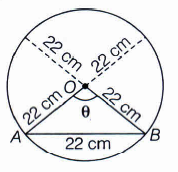
Since OA = OB = AB = 22 cm
\(\therefore \) \(\Delta \)OAB is equilateral
\(\Rightarrow \theta =\angle AOB=60^{ 0 }\)
Now, we convert 60o into radian measure.
\(\therefore 60^{ 0 }=\left( 60\times \frac { \pi }{ 180 } \right) rad\)
\(\left[ \because radian\quad measure=\frac { \pi }{ 180 } \times degree\quad measure \right] \)
\(\Rightarrow 60^{ 0 }=\frac { \pi }{ 3 } radian\)
\(\therefore Length\quad of\quad minor\quad arc\quad AB=r\theta \left[ \because \theta =\frac { arc\quad length(l) }{ radius\quad (r) } \therefore arc\quad length=r\theta \right] \)
\(=22\times \frac { \pi }{ 3 } =\frac { 22 }{ 3 } \times \frac { 22 }{ 7 } \quad \quad \left[ \because \pi =\frac { 22 }{ 7 } \right] \)
\(=\frac { 484 }{ 21 } cm\)
14.
(i) By the definition of the relation, R = {(1,2), (2,3), (3,4), (4,5), (5,6)}.
(ii) We can see that the domain ={1, 2, 3, 4, 5,} Similarly, the range = {2, 3, 4, 5, 6} and the codomain = {1, 2, 3, 4, 5, 6}.
15.
\(\{ x:x\epsilon R,5\le x\le 6\} \) is the set which contains 5 and 6 both. So, it is equivalent to a closed interval i.e[5,6].
On the real line, [5,6] can be graphed as shown in the figure given below.
-S.png)
The dark portion on the number line represent [5,6]
16.
A\(\cap\)B = {3, 4}
(A\(\cap\)B)' = {5,6,7,8} and B' = {1, 2,5, 7, 8}
A' \(\cup\) B' = {1, 2, 5, 6, 7, 8}
Clearly, (A\(\cap\)B)' = A' \(\cup\) B'.
17.
(i) X = {1, 3, 5} Y = {1, 2, 3}
X = {1, 3, 5} Y = {1, 2, 3}
X∪ Y= {1, 2, 3, 5}
(ii) A = [ a, e, i, o, u} B = {a, b, c}
A = {a, e, i, o, u} B = {a, b, c}
A∪ B = {a, b, c, e, i, o, u}
(iii) A = {x : x is a natural number and multiple of 3} B = {x : x is a natural number less than 6}
A = {x: x is a natural number and multiple of 3} = {3, 6, 9 …}
As B = {x: x is a natural number less than 6} = {1, 2, 3, 4, 5, 6}
A ∪ B = {1, 2, 4, 5, 3, 6, 9, 12 …}
∴ A ∪ B = {x: x = 1, 2, 4, 5 or a multiple of 3}
(iv) A = {x : x is a natural number and 1 < x \(\leq\) 6 } B = {x : x is a natural number and 6 < x < 10 }
A = {x : x is a natural number and 1 < x ≤ 6} = {2, 3, 4, 5, 6}
B = {x : x is a natural number and 6 < x < 10} = {7, 8, 9}
A∪ B = {2, 3, 4, 5, 6, 7, 8, 9}
∴ A∪ B = {x: x ∈ N and 1 < x < 10}
(v) A = {1, 2, 3}, B = \(\phi\)
A = {1, 2, 3}, B = Φ A∪ B = {1, 2, 3}
18.
(x + iy)(4 + 5i) = 6-2i
⇒ 4x + 5xi + 4yi + 5yi2 = 6-2i
⇒ (4x - 5y) + (5x + 4y)i = 6-2i
Comparing real and imaginary parts on both sides,we have
4x - 5y = 6 and 5x + 4y = -2
Solving these two equations for x and y, we get
x=\(\frac { 14 }{ 41 } \) and y=\(-\frac { 38 }{ 41 } \)
19.
Here tan x =\(-{5\over12}\)
cot x=\({1\over tan \ x}={-12\over 5}\)
Now sec2x = 1 + tan 2x
\(\Rightarrow sec^2 x=1+({-5\over 12})^2\)
\(\Rightarrow sec \ x={169\over 144}\)
\(\Rightarrow sec x=\pm{13\over 12}\)
But x lies in second quadrant.
\(\therefore \ sec \ x={-13\over 12}\)
\(cos \ x={1\over sec \ x}={-12\over 13}\)
Also sin2 x + cos2 x = 1
\(\Rightarrow sin^2 x+({-12\over 13})^2=1\)
\(\Rightarrow sin ^2=1-{144\over 169}\)
\(\Rightarrow sin ^2 \ x ={25\over 169}\)
\(\Rightarrow sin \ x=\pm{5\over13}\)
But x lies in second quadrant.
\(\therefore sin x={5\over13}\)
\(cosec \ x={1\over sin \ x}={13\over 5}\)
20.
Required number of ways= 5C2 X 7C1 + 5C3
21.
\(\left( 1,\frac { 10 }{ 3 } \right) \)
22.
Domain = R-{3} Range = R - {6}
23.
(b)
atleast one root
24.
(a)
\(\frac{1}{5}(9+12 i)\)
25.
(d)
y \(\ne\) 0
26.
(c)
Square root of negative number
27.
(d)
200
28.
(d)
121
29.
(b)
between 20°C and 25°C
30.
(c)
\((-2, \infty)\)
31.
(a)
A vertical line will divide the plane in left and right half planes
32.
(d)
\(\frac{\pi}{4}\)
33.
(b)
l radian
34.
(c)
2 and 3
35.
(c)
0.05
36.
(b)
A \(\cap\) B = B
37.
(a)
{(2, 4), (3, 4)}
38.
(c)
R\(\subset\)A x B
39.
(b)
A
40.
(c)
30o
41.
(a)
63
42.
(a)
20
43.
(i) (b)
(ii) (a)
(iii) (d)
(iv) (d)
(v) (a)
44.
(i) (d) Hint \(a=\sqrt{3}\) and b=-2
\(\therefore x\) lies in 4 th quadrant.
\( \cot x=\frac{a}{b}=-\sqrt{3}=\cot \left(2 \pi-\frac{\pi}{6}\right) \)
\( \cot x=\cot \frac{11 \pi}{6} \Rightarrow x=\frac{11 \pi}{6}\)
(ii) (a) Hint \(\tan 75^{\circ} =\tan \left(45^{\circ}+30^{\circ}\right)=\frac{\tan 45^{\circ}+\tan 30^{\circ}}{1-\tan 45^{\circ} \tan 30^{\circ}} \)
\(=\frac{1+\frac{1}{\sqrt{3}}}{1-\frac{1}{\sqrt{3}}}=\frac{\sqrt{3}+1}{\sqrt{3}-1}=2+\sqrt{3}\)
(iii) (c) Hint \(x=25^{\circ}\)
\(25^{\circ}=\left(25 \times \frac{\pi}{180^{\circ}}\right) \text { radian }=\frac{5 \pi}{36}\)
(iv) (d) Hint cos x is negative in \(x \in\left(\frac{\pi}{2}, \frac{3 \pi}{2}\right)\).
45.
(i) b
(ii) b
(iii) (a)
(iv) (a)
(v) (c)

11th Standard CBSE Syllabus & Materials
11th Standard CBSE
CBSE 11th Business Studies Forms of Business Organisation Sample Question Papers Study Material - QB365 Set A
NEW11th Standard CBSE
CBSE 11th Business Studies Business, Trade and Commerce Sample Question Papers Study Material - QB365 Set A
NEW11th Standard CBSE
CBSE 11th Physics Waves Sample Question Papers Study Material - QB365 Set A
NEW11th Standard CBSE
CBSE 11th Physics Kinetic Theory Sample Question Papers Study Material - QB365 Set A



NCERT Books

Syllabus

Exam Pattern

Sample Question Papers

Previous year Question Papers

Important Notes

MCQ Practice test

NCERT Exemplers

Case study Questions

Image Based Questions

Passage based Questions

HOT Questions

Value Based Questions

Model Questions Papers
NCERT ( Book Back ) Questions

Assertion and Reason
Important Questions And Answers

CBSE 11th Standard CBSE Subjects
CBSE Standards







